Now Available: 'Rhombus' On Smoke Sessions Records By Today's Leading Jazz Organ Trio: Larry Goldings, Peter Bernstein And Bill Stewart

Courtesy Kevin Scanlon

It’s a killer album, with the band displaying different facets of what an organ trio can do.
—The Big Takeover
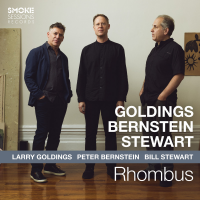
Organist Larry Goldings, Guitarist Peter Bernstein, and Drummer Bill Stewart Reconvene Their Celebrated Trio for Rhombus, out August 7, 2026 (Smoke Sessions Records)
Marking 35 years of History with Distinctive Music by Keith Jarrett, Wayne Shorter, Abdullah Ibrahim, Monk, and Irving Berlin, along with memorable originals
Album Release Shows at Smoke Jazz Club in New York City, August 19-23, 2026
When they first took the stage at Augie’s Jazz Bar, organist Larry Goldings, guitarist Peter Bernstein, and drummer Bill Stewart would never have imagined that more than 35 years later they’d not only still be working together, but that they would be considered by many to be the gold standard for the modern jazz organ trio. That ascension hasn’t stopped the trio from searching for ways to delve deeper or to explore new terrain. Their remarkable new album, Rhombus, finds Goldings, Bernstein, and Stewart drawing inspiration from some of the most revered composers in jazz history, artists – many of them pianists—whose music may not seem a natural fit for the organ trio. While the trio’s sound flows outwards from the great tradition of organ trio jazz, this repertoire is brilliantly curated to lead them into the unexpected, ideal territory for their perceptive explorations.
Rhombus, out August 7, 2026, from Smoke Sessions Records, includes pieces from such monumental composers as Keith Jarrett, Randy Weston, Abdullah Ibrahim, Wayne Shorter, Thelonious Monk, and Irving Berlin. These are all groundbreaking musical thinkers whose profound works speak directly and succinctly through beautiful melodies, built on a foundation of immense depth and mystery. The trio responds beautifully and searchingly to that mystery, but their deepest inspiration likely comes not from the material they play but from their ever-evolving friendships, experiences, and camaraderie.
As Bernstein describes, “When you play with each other for over 35 years, it becomes the bar that everything else is measured against. That level of familiarity is nice in that it feels comfortable, yet at the same time, I have to try to reach for something different because these cats have heard all my licks. Being comfortable, you’re prepared to take more chances, which is what improvisational music is all about."
“We’re still discovering new freedoms through playing with each other, having grown as musicians and as people,” Goldings adds. “We’re all very eclectic in our musical tastes, and the continuing challenge is to figure out how to make these disparate compositions sound like us.”
Many of their choices reflect not only long-cherished and intensely studied favorites, but facets of that shared history. Jarrett, for instance, whose “Everything That Lives Laments” opens the album in a surprisingly enigmatic mood, taught Goldings and Bernstein a few key early lessons at his home. Randy Weston’s “Hi-Fly” was a touchstone of the trio’s sets of Augie’s, but hadn’t been revisited in many years. Even a familiar standard such as Berlin’s “They Say It’s Wonderful” harkens back to Goldings and Bernstein’s pre-internet student days, when they frequented the Lincoln Center library to hunt for more obscure tunes by composers they admired. Abdullah Ibrahim’s “Mamma” indirectly links the trio to the church roots of the organ via that tradition’s indelible influence on the South African composer. Shorter’s “Penelope” offers a chance to luxuriate in lush, fascinating harmony.
Bernstein’s “Dissipation Blues” is a rollicking blues that winks at the classic “Hesitation Blues” while wincing at the dissipating freedoms and mores in today’s political climate. Goldings’s title track breaks the unwritten rule of jazz that trio albums are required to use some form of wordplay on the number three in their titles. Perhaps the fourth side of the “Rhombus” is the longevity that means so much to the trio’s sound, though the composer insists that he was attracted by nothing more than the sound of the word and its apt suggestion of geometrical form.
Concluding the album with a rousing rendition of Monk’s “In Walked Bud” acknowledges the impact of the bebop legacy, the tail end of which the bandmates encountered upon their arrival in New York City. “The great players that were two and three generations older than us were still around playing,” Goldings recalls. “As a young musician playing under an older person, we were all thrown into situations where you expected to know a wealth of tunes. The advantage of that is you internalize these great works and that will inevitably improve your ability to improvise. You can draw on the beautiful logic behind those great melodies and chord progressions to come up with your own ideas.”
Goldings, Bernstein and Stewart have never been a group interested in radical reinvention, which can make it somewhat easy to overlook just how breathtakingly expressive and inventive their playing can be. They intently carry forward the tradition, but their interpretation of that idea demands a willingness to reach deep inside to forge a connection between the soul and the listener. Goldings continues, “The older generation of players had a vulnerability to say, ‘Here's the song, here's my sound, here's the depth of what I'm feeling.’ I think that all three of us still respond to that more than anything else. That’s powerful enough.”
All of that is simply an environment in which Goldings, Bernstein, and Stewart can converse and investigate together. Ultimately, the attraction of this trio has little to do with repertoire, innovation, or reinvention – it’s about camaraderie, the way that their experiences together and apart are revealed in subtle new shadings, stunning dynamics, striking vulnerability and expression, joyous humor, and penetrating conversation. Their chemistry on Rhombus is breathtaking, but they’ve already evolved further from here. “We could record next week or the week after that, and the music will be different each time,” Stewart says. “But it's always exciting for me. I trust that whatever happens, we're going to get into something different.”
Rhombus was produced by Paul Stache and recorded on October 20, 2025, at Second Take Sound in New York City. Available in spatial audio on limited edition LP, CD and audiophile HD formats.
Marking 35 years of History with Distinctive Music by Keith Jarrett, Wayne Shorter, Abdullah Ibrahim, Monk, and Irving Berlin, along with memorable originals
Album Release Shows at Smoke Jazz Club in New York City, August 19-23, 2026
When they first took the stage at Augie’s Jazz Bar, organist Larry Goldings, guitarist Peter Bernstein, and drummer Bill Stewart would never have imagined that more than 35 years later they’d not only still be working together, but that they would be considered by many to be the gold standard for the modern jazz organ trio. That ascension hasn’t stopped the trio from searching for ways to delve deeper or to explore new terrain. Their remarkable new album, Rhombus, finds Goldings, Bernstein, and Stewart drawing inspiration from some of the most revered composers in jazz history, artists – many of them pianists—whose music may not seem a natural fit for the organ trio. While the trio’s sound flows outwards from the great tradition of organ trio jazz, this repertoire is brilliantly curated to lead them into the unexpected, ideal territory for their perceptive explorations.
Rhombus, out August 7, 2026, from Smoke Sessions Records, includes pieces from such monumental composers as Keith Jarrett, Randy Weston, Abdullah Ibrahim, Wayne Shorter, Thelonious Monk, and Irving Berlin. These are all groundbreaking musical thinkers whose profound works speak directly and succinctly through beautiful melodies, built on a foundation of immense depth and mystery. The trio responds beautifully and searchingly to that mystery, but their deepest inspiration likely comes not from the material they play but from their ever-evolving friendships, experiences, and camaraderie.
As Bernstein describes, “When you play with each other for over 35 years, it becomes the bar that everything else is measured against. That level of familiarity is nice in that it feels comfortable, yet at the same time, I have to try to reach for something different because these cats have heard all my licks. Being comfortable, you’re prepared to take more chances, which is what improvisational music is all about."
“We’re still discovering new freedoms through playing with each other, having grown as musicians and as people,” Goldings adds. “We’re all very eclectic in our musical tastes, and the continuing challenge is to figure out how to make these disparate compositions sound like us.”
Many of their choices reflect not only long-cherished and intensely studied favorites, but facets of that shared history. Jarrett, for instance, whose “Everything That Lives Laments” opens the album in a surprisingly enigmatic mood, taught Goldings and Bernstein a few key early lessons at his home. Randy Weston’s “Hi-Fly” was a touchstone of the trio’s sets of Augie’s, but hadn’t been revisited in many years. Even a familiar standard such as Berlin’s “They Say It’s Wonderful” harkens back to Goldings and Bernstein’s pre-internet student days, when they frequented the Lincoln Center library to hunt for more obscure tunes by composers they admired. Abdullah Ibrahim’s “Mamma” indirectly links the trio to the church roots of the organ via that tradition’s indelible influence on the South African composer. Shorter’s “Penelope” offers a chance to luxuriate in lush, fascinating harmony.
Bernstein’s “Dissipation Blues” is a rollicking blues that winks at the classic “Hesitation Blues” while wincing at the dissipating freedoms and mores in today’s political climate. Goldings’s title track breaks the unwritten rule of jazz that trio albums are required to use some form of wordplay on the number three in their titles. Perhaps the fourth side of the “Rhombus” is the longevity that means so much to the trio’s sound, though the composer insists that he was attracted by nothing more than the sound of the word and its apt suggestion of geometrical form.
Concluding the album with a rousing rendition of Monk’s “In Walked Bud” acknowledges the impact of the bebop legacy, the tail end of which the bandmates encountered upon their arrival in New York City. “The great players that were two and three generations older than us were still around playing,” Goldings recalls. “As a young musician playing under an older person, we were all thrown into situations where you expected to know a wealth of tunes. The advantage of that is you internalize these great works and that will inevitably improve your ability to improvise. You can draw on the beautiful logic behind those great melodies and chord progressions to come up with your own ideas.”
Goldings, Bernstein and Stewart have never been a group interested in radical reinvention, which can make it somewhat easy to overlook just how breathtakingly expressive and inventive their playing can be. They intently carry forward the tradition, but their interpretation of that idea demands a willingness to reach deep inside to forge a connection between the soul and the listener. Goldings continues, “The older generation of players had a vulnerability to say, ‘Here's the song, here's my sound, here's the depth of what I'm feeling.’ I think that all three of us still respond to that more than anything else. That’s powerful enough.”
All of that is simply an environment in which Goldings, Bernstein, and Stewart can converse and investigate together. Ultimately, the attraction of this trio has little to do with repertoire, innovation, or reinvention – it’s about camaraderie, the way that their experiences together and apart are revealed in subtle new shadings, stunning dynamics, striking vulnerability and expression, joyous humor, and penetrating conversation. Their chemistry on Rhombus is breathtaking, but they’ve already evolved further from here. “We could record next week or the week after that, and the music will be different each time,” Stewart says. “But it's always exciting for me. I trust that whatever happens, we're going to get into something different.”
Rhombus was produced by Paul Stache and recorded on October 20, 2025, at Second Take Sound in New York City. Available in spatial audio on limited edition LP, CD and audiophile HD formats.
For more information contact AMT Public Relations.
Track Listing
Everthing That Lives Laments; Hi-Fly; Rhombus; Mamma; They Say It's Wonderful; Dissipation Blues; Penelope; In Walked Bud.
Personnel


Album information
Title: Rhombus | Year Released: 2026 | Record Label: Smoke Sessions Records
About Larry Goldings
Tags
Recording
AMT Public Relations
April Thibeault
United States
New York
New York City
Larry Goldings
Peter Bernstein
Bill Stewart
Rhombus
Larry Goldings Concerts
Oct
24
Sat