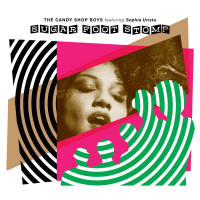
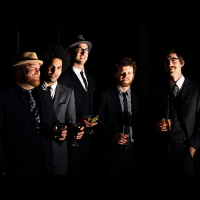
For roughly eight years, New York’s burlesque world danced to The Candy Shop Boys. From 2009 to about 2017 the quintet played over 150 shows a year in the city’s supper clubs and late rooms, and over two January nights in 2013 they went into Tedesco Studios and recorded the songbook those rooms were built on. Twelve tracks came out on a limited CD. The full sessions, twenty-one tracks and seventy-three minutes, sat on a hard drive for thirteen years. On October 30, 2026, BYNK Records releases them complete as Sugarfoot Stomp (BYNK006), the band’s debut album under its own name, newly remixed and remastered, with vocalist Sophia Urista out front.
The record might have stayed where it was. “The band stopped playing together around 2017, and as we all went on to new things, we kept asking each other about this album,” says tenor saxophonist Matt Parker, the founder of BYNK Records. “When I went back through the sessions, I could hear how locked in we were. That connection was real, and we all wanted people to hear it.”
The title track, “Sugar Foot Stomp,” was first known as “Dippermouth Blues” in King Oliver’s Creole Jazz Band in 1923. When Fletcher Henderson made it a national hit in 1925, the song was renamed; a “sugar foot” was a flattering name for a dancer. A song titled for dancers is the perfect opener for this band, because The Candy Shop Boys worked so closely with dancers. Performers chose their songs each night, but always from the band’s list. “We all brought material to the band, and the dancers all chose from that songbook,” Parker says. “Jesse Elder did most of the arrangements. He was spectacular at capturing our sound.”
What the record holds is a century of songs that said what couldn’t be said: viper songs, Cotton Club material, dealer songs and double entendre, sitting next to The Doors, The Beatles, and Prince played in the same spirit. Dr. Reggie Quinerly’s liner notes trace that lineage, what he calls “the duality and coded subtlety of language,” from the radio age to the present. “Kicking the Gong Around” (Harold Arlen and Ted Koehler) is most famous as Cab Calloway’s 1931 Cotton Club showpiece, in which the title means smoking opium. “When I Get Low I Get High,” written by Marion Sunshine and recorded by Ella Fitzgerald with Chick Webb in 1936, is the rare viper song that barely bothers with code. “The Candy Man,” written by trumpeter Herb Morand and cut by Rosetta Howard with the Harlem Hamfats in 1938, is dealer and double entendre in one, and emphatically not the Willy Wonka song. “Come Together” is the song Urista would later sing to turn the chairs on NBC’s The Voice. And “Isfahan,” the Duke Ellington and Billy Strayhorn ballad, is the album’s still center: a quartet performance, no violin or vocals, recorded last.
Read more
Parker’s own favorite is older still. “Black & Tan Fantasy was one of my favorite songs to perform,” he says of the Ellington and Bubber Miley elegy for the integrated clubs, which ends, as it always has, on Chopin’s funeral march. “I always felt like the band brought a very powerful dynamic, and then Scott and I would ride over the top of this kind of hurricane of sound that the rhythm section would create.”
Out front on ten of the twenty-one tracks is Sophia Urista. “Sophia would grab an audience immediately and not let them go until she was ready to walk off the stage,” Parker says. “We played with her for years before The Voice, and we all could see how far she would go. She’s a one in a million performer.” Detroit-born and Brooklyn-bred, Urista has been the MC at The Box, Sleep No More, and Duane Park, starred as Dusty Moonboots in the Las Vegas hit Opium, and fronted the rock band Brass Against, opening for Tool.
Around her is a band of players who went on to be known well beyond the burlesque circuit. Violinist Scott Tixier came up in the Paris jazz scene, mentored by Jean-Luc Ponty, before spending more than a decade in New York. He holds six Grammy certificates, with credits from Stevie Wonder and Elton John to Beyoncé and Hans Zimmer, and he played and composed on the John Wick soundtrack. He was a featured soloist in Jon Batiste’s American Symphony at Carnegie Hall, documented in the Netflix film, and his concert piece Ressemblance was premiered by Hilary Hahn at Wigmore Hall. His solo album Bonfire, fully improvised in a single take, came out in 2025, and he is now an associate professor at the University of North Texas, where he founded the Jazz Strings Program.
Pianist Jesse Elder wrote most of The Candy Shop Boys’ arrangements. A four-time winner of ASCAP’s Young Jazz Composer competition who studied at Interlochen, Oberlin, and The New School, he spent eight years as the full-time music director of Postmodern Jukebox, touring the world. When the pandemic took away their work in 2020, he and his wife, violinist Blanca Cecilia González, a Juilliard graduate, began playing in the parks near their home in Forest Hills, Queens. That became Musiquita, a family music duo performing in Spanish and English, which now partners with Caramoor, Wolf Trap, Greenwich House Music School, PJ Library, and many others.
Bassist Kenball Zwerin, a San Francisco native, studied in Havana with Lázaro Machado of the Cachao family. Living in New York City, he became a staple of the Lower East Side avant-garde performing arts scene. He later served as a public defender in Brooklyn and now practices criminal defense law in his hometown.
Drummer Arthur Vint came to New York from Tucson in 2007 and has since appeared on more than forty albums, playing with Postmodern Jukebox and Vince Giordano & The Nighthawks, and on screen in Boardwalk Empire and The Knick. He spent a decade working at the Village Vanguard, and in 2022 he opened his own club, the Century Room, inside Tucson’s historic Hotel Congress, where he presents more than 500 bands a year; he also teaches at the University of Arizona. In 2024 he founded Desert Spoon Records to release Copper State, an album he recorded in 2019 and shelved through the pandemic.
Tenor saxophonist Matt Parker grew up in Fort Lauderdale, Florida, where he made his club debut as a teenager with saxophonist Jimmy Cavallo, and came to New York in 1999 to study at The New School. He toured with Maynard Ferguson’s Big Bop Nouveau Band and later with Hess Is More and Postmodern Jukebox, and has worked across New York’s dance and theater worlds with Dorrance Dance, Murray Hill, and Bridget Everett. DownBeat called his debut, Worlds Put Together (2013), “restlessly inventive”; his most recent album is 432 Hz Piano and Winds I (2026). A D’Addario Woodwinds artist, he founded BYNK Records, based in Connecticut.
The band began in 2009 as Melody Sweets and The Candy Shop Boys, billed in those years as “The Best Little Big Band in the Biz.” They recorded with Sweets in October 2011 and performed at the 2011 Burlesque Hall of Fame Weekender in Las Vegas. When Sweets left to originate the Green Fairy in Absinthe at Caesars Palace, the band proved lucky in singers all over again: Aaron Marcellus, Michael Cunio, and Urista all arrived around the same time. “We were part of New York’s burlesque community from 2009 to about 2017,” Parker says. “Duane Park was home base, we held a weekly gig at the Rum House in Times Square for about eight years, and we played the Slipper Room, the Manderley Bar at Sleep No More, the Derby, the New York and Coney Island Burlesque Festivals. We’d play over 150 shows a year.” And the band spent many of those nights behind one performer in particular: “We did countless shows backing up Murray Hill, Mr. Show Business himself. He’s unbelievably quick, and we were able to fly behind him and stop on a dime as a band. That was a huge part of what the band was.”
In 2014 the band was heard and seen in the film John Wick, and their “Evil Man Blues” landed on the Official Motion Picture Soundtrack. With Urista, the band toured nationally for Dos Equis’ Bazaar Noir. Audiences have been searching for the band ever since, 46,200 Shazams and counting, and until now there has been almost nothing to find.
Thirteen years on, what Parker remembers alongside the music is the hang. “Between sets we’d play cards every night, or dominoes. Lots of different people would win. Honestly, I miss that as much as the gigs.”
Show less