Home » Jazz Articles » Extended Analysis » Spike Orchestra: Spike Orchestra: Ghetto
Spike Orchestra: Spike Orchestra: Ghetto

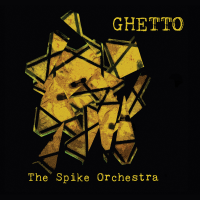
In this climate the Spike Orchestra, a flexible collective organised around the duo of Sam Eastmond and Nikki Franklin, are a breath of fresh air. They feature a rotating cast of musicians that can expand to up to twenty others where the piece demands. For this entirely self-financed and publicised work, the subject matter of the 1943 Warsaw Ghetto uprising is unusual, weighty and about as far from 'I Got Rhythm' as it is possible to get. Any initial concern that this might prove hard work or difficult listening however evaporates under the emotional pull of the music—Eastmond has been led to believe that he had family inside the Ghetto and it shows. First impressions are driven by the effectiveness of the switching between formats from the widescreen orchestral set pieces to the six piece 'Spiketet' or the more intimate duo pieces featuring Eastmond and Franklin. It feels as if the Orchestra is taking you on a fast cut ride through archive footage, zooming in and highlighting incidents or individual stories along the way, emphasising the indefatigable human spirit of those trapped and, by implication, the loss to the world through their premature passing.
The orchestral pieces have echoes of many influences, Ellington, Gil Evans, Gershwin perhaps, but it is the blend with other musics such as the incorporation of Klezmer into "Construction" that lifts this into something different and unique. Both these and the duo pieces blend Franklin's vocal exclamations and punctuations with Eastmond's trumpet into an effect that is always emotional, moving, if nigh on impossible to analyse. Maybe that is the point—these days we can all read of the horrors of the 1943 Uprising at the click of a mouse, but only music and music of this quality to boot, can make us feel more than words or bland facts. So I could tell you that average daily food rations in 1941 for Jews in Warsaw were just 184 calories, compared to 699 calories for gentile Poles and 2,613 calories for Germans—but you will better understand the implications by listening to Franklin and Eastmond on the duo piece "Starvation."
Within the orchestral pieces the use of unusual instruments such as the accordion and bass clarinet give a different feel to the music "Underground," for example, develops from an invigorating conversation between the brass into a tense stepping rhythm, that sounds like a damped guitar. This use of rhythm is important too in "Trains," the understated guitar and accordion combination under Nick Blake's excellent sax solo being particularly effective. Mention must also be made of Sam Leak's evocative keyboard solo on the concluding piece "Uprising"—the Rhodes sound perfectly judged between distortion and the interaction with the brass stabs that punctuate it.
Perhaps the nearest parallel in recent times has been Darcey James Argue's Brooklyn Babylon, that shares a breadth of vision and desire not to settle for the commonplace more than any tangible musical similarities. With major label assistance this album would be a significant achievement for the Spike Orchestra, on an indie in these timorous times it is a remarkable single minded triumph. In short Ghetto is an extraordinary hidden jewel and as such is highly recommended.
Track Listing
Life Before; Construction; Life After; Child Smugglers; Underground; Life Inside; Starvation; Trains; Pesach 1943; Uprising.
Personnel
Spike Orchestra
band / ensemble / orchestraSam Eastmond: trumpet; Nikki Franklin: voice; Dan Oates: violin; Mike Guy: accordion; Mat Heighway: double bass; Pete Cater: drums; Mike Wilkins: alto sax,clarinet; Claude Werner: alto sax, flute; Nick Blake: tenor & soprano sax; Jon Gillies: tenor sax; Erica Clarke: baritone sax, bass clarinet; Karen Straw: trumpet; Paul Gardner: trumpet; Chris Caulfield: trumpet; Joe Rodwell: trumpet; Andrew Roberts: trumpet; Ben Greenslade-Stanton: trombone; Jon Stokes: trombone; Tom Dunnett: trombone; Andy Lester: bass trombone; James Lawrence: tuba; Moss Freed: guitar; Sam Leak: piano, rhodes.
Album information
Title: Spike Orchestra: Ghetto | Year Released: 2015 | Record Label: Self Produced
About Spike Orchestra
Tags
PREVIOUS / NEXT


Become a Sustaining Member

Since 1995, All About Jazz has championed jazz as an art form and supported the musicians who create it. Over three decades, it has grown into one of the world's leading jazz resources, serving hundreds of thousands of readers, musicians, presenters and industry professionals each month.
Help Build the Future of All About Jazz
Your support helps us continue building All About Jazz for the next generation—expanding our editorial coverage, preserving jazz history, developing new community features and creating better ways to discover the music and the people behind it.
Become a sustaining member for as little as $20 per year and you'll immediately enjoy an ad-free experience along with access to subscriber features and future articles for a full year.
Together, we're not simply sustaining All About Jazz—we're building its future. Thank you for being part of the journey.