Home » Jazz Articles » Live Review » Acoustic Ladyland at Norwich Arts Centre
Acoustic Ladyland at Norwich Arts Centre
 Acoustic Ladyland
Norwich Arts Centre
Norwich, U.K.
September 24, 2009
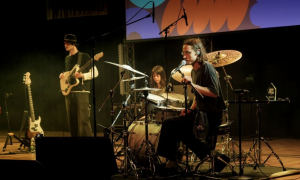
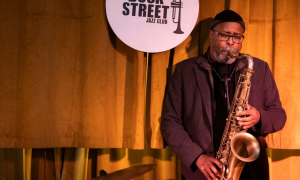
Acoustic Ladyland took to the darkened Arts Centre stage, and the crowd began to cheer and whistle. Pete Wareham, tenor saxophonist, bandleader and composer, peered through his sunglasses and beckoned the audience towards the stage. The crowd, mostly younger than the musicians, dutifully moved forward as the band kicked into "Glasto." For the next 75 minutes Acoustic Ladyland played a frenetic, involving, funky and powerful set of tunes that left the musicians and the audience exhausted but grinning widely.
Wareham and drummer Seb Rochford have been together in Acoustic Ladyland since it formed in 2001; the other half of the band, consisting of guitarist Chris Sharkey and bass guitarist Ruth Goller, have been members for less than a year, joining just before the recording of the band's fourth album, Living With A Tiger (Strong and Wrong, 2009). The newness of the lineup is never an issue here: this is a tight unit of top-flight musicians, playing with a mutual understanding that suggests years, not months, of working together.
The band's set consisted mostly of tunes from Living With A Tiger, apart from a brief three- song encore which included numbers from previous popular albums—e.g. "High Heel Blues" from Last Chance Disco (Babel, 2005). Following the opener "Glasto," the momentum had been building without incident, until a minor crisis occurred when Goller broke a string on her bass guitar. A replacement instrument was quickly borrowed from supporting act The Fuzz, and the band resumed "Living with a Tiger," quickly regaining its edge with Goller's playing appearing unaffected by the change of instrument. The set seemed to fly by in minutes as the band moved seamlessly between numbers, while maintaining the pace it had set earlier.
Far from relegating the instrument to a perfunctory role, the ensemble centered on Ruth Goller's bass guitar, which throughout provided the pulse at the core of the band's sound. Her playing was crucial, moreover, to the band's focus: however frenetic and wild the playing, it never strayed far from a strong and often danceable beat.
Rochford's drumming was a particular joy to hear and to watch—the percussionist playing a modest, basic, Buddy Rich-type kit of bass drum, snare, tom-tom, hi- hat and a single cymbal, his arms and hands a blur of movement even as the rest of his body scarcely betrayed any physical movement while he constructed a wall of sound most drummers would have had difficulty approaching with twice the equipment and twice the number of limbs. Meanwhile, Wareham and Sharkey provided equally strong, rhythmic playing, especially the chordal work provided by the latter. But they were also assuredly melodic, making expressive use of effects pedals—Wareham's center- stage, sitting on top of a beer crate on top of a piano stool, a configuration that enabled him to operate them with one hand, as he continued to play the sax with the other, while managing to coax feedback out of the system and hammering the saxophone keys in a frantic staccato style.
Acoustic Ladyland has been labelled as "punk jazz" by some segments of the media, but such hasty categorizing is to deny their technical skill and their ability to move between styles and genres. Yes, there were elements of punk in the performance—in the pace, volume and energy of the playing, as well as Wareham's own dance style. But the group's performance offered much more. The opening to "The Mighty Q" was reminiscent of late 1960s heavy rock, "You and I" referenced 1980s post-punk, and when Wareham played at the lower end of his tenor's range, he could have been honking away in a 1950s R&B horn section.
By the end of the set a small but extremely enthusiastic mosh pit had developed, Wareham's sunglasses had been cast aside, and the sweat-soaked band members were smiling as they left the stage. The scene was an object lesson in what can be achieved by a talented and original band that responsively reaches out to its audience, practically drawing them in as participants in the performance. Suffice it to say, Acoustic Ladyland rocked.
 FOLLOW Bruce Lindsay
and get notified whenever a new article published.
FOLLOW Bruce Lindsay
and get notified whenever a new article published.
My new book on dance music, "Dancehalls, Glitterballs and DJs," is out in early 2025. I'm not currently undertaking reviews due to other commitments.
About Acoustic Ladyland

Tags
PREVIOUS / NEXT


Become a Sustaining Member

Since 1995, All About Jazz has championed jazz as an art form and supported the musicians who create it. Over three decades, it has grown into one of the world's leading jazz resources, serving hundreds of thousands of readers, musicians, presenters and industry professionals each month.
Help Build the Future of All About Jazz
Your support helps us continue building All About Jazz for the next generation—expanding our editorial coverage, preserving jazz history, developing new community features and creating better ways to discover the music and the people behind it.
Become a sustaining member for as little as $20 per year and you'll immediately enjoy an ad-free experience along with access to subscriber features and future articles for a full year.
Together, we're not simply sustaining All About Jazz—we're building its future. Thank you for being part of the journey.