Home » Jazz Articles » Live Review » ECM: A Cultural Archeology
ECM: A Cultural Archeology


Haus der Kunst
München, Germany
November 23, 2012-February 10, 2013
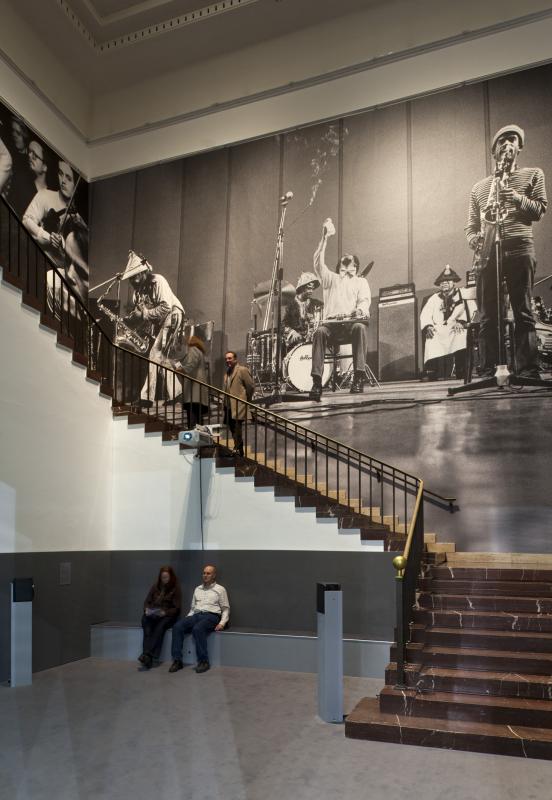
A trip to München (Munich) is a bit like a pilgrimage for fans of Germany's ECM label, especially right now, with the city's Haus der Kunst hosting a three-month exhibition, ECM: A Cultural Archeology, celebrating the music of this nearly 44 year-old label on the cusp of founder and primary producer Manfred Eicher's 70th birthday in 2013. The exhibition, curated by Okwui Enwezor and Markus Müller, combines visuals that include video performances and plenty of still images from the label's massive archives, with historical information and listening stations, where it's possible to hear a broad cross-section of the label's history, documented on over 1,300 recording that range from the more straight-ahead but never mainstream jazz of saxophonist Charles Lloyd to the tremendous body of work from Estonian composer Arvo Pärt.
Eicher—who, in addition to being one of the few active producers left, often assumes the responsibility of sequencing tracks on a recording in order to give it an overarching narrative—has also programmed a series of samplers exclusive to the exhibition. At these listening stations, equipped with high quality headphones, it's possible to sit, relax and absorb the breadth and depth of a label that certainly stands alone as the only one in history to create such a broad body of work that—with Eicher's direct involvement in virtually its entire discography—not only reflects the aesthetics of those artists who collaborate with him (and it is collaboration; Eicher being the third member of every duo, the fifth member of every quartet), but Eicher's aesthetics as well. The often-referred "ECM Sound" may not be the reductionist series of characteristics to which some attempt to attribute an easy description (it's far more complex than that), but it is, indeed, an undeniable reflection of the man who has been at the helm since its inception.
"Okwui called me," Eicher explains, "and said 'I'm in Munich now, and director of the Haus der Kunst.' He said that he was a friend of [pianist] Jason Moran, and he [the pianist] had called him in Munich and said, 'You should make a step towards ECM and see what they're doing.' So he [Okwui] came and talked to me and saw the warehouse. He wanted to see all the tapes where they were laying, and asked me if we would be interested in collaborating with him, because he had the idea to make an exhibition about ECM.
 "I said, 'Well, let me think about it,' and so I thought about it for a few days and then said, 'Yes, let's do it," Eicher continues. "So we gave him more or less carte blanche; we opened the archives for the curators, for Okwui and Mr. [Markus] Müller, and they came to the office to select photos and have several meetings. It was then that they decided to limit it to the first 15 years, the early years, without the New Series except, perhaps, for [Arvo Pärt]'s Tabula Rasa (1984) and Steve Reich [whose ECM debut, the now-classic Music for 18 Musicians, was released in 1978]. It was very much focused on those first years and I think they decided to do that because it's better to unify the conceptual aesthetic, because you can't introduce an entire label and 40 years of work; it then becomes too much a kaleidoscope of everything."
Of course, even looking at just the first fifteen years of ECM provides more grist for consideration than any other label, even heralded American imprints like Blue Note and Impulse!. And, had ECM only survived that relatively brief span of time, it still would have made a significant mark in the history of recorded music; that it's lasted nearly another three decades only further justifies its position, like the label or not, as the single most important label in the history of recorded music.
Eicher's accomplishments during those first fifteen years are almost impossible to count, but amongst the many high points during this time were the release of seminal recordings from the Art Ensemble Of Chicago and the placement of Norway and Sweden on the international map with the introduction of five important artists: saxophonist Jan Garbarek, guitarist Terje Rypdal, pianist Bobo Stenson, bassist Arild Andersen and drummer Jon Christensen, all of whom would go on to significant careers in a variety of constellations as collaborators and bandleaders.
The label has also been the instigator in the formation of groups that exist to this day, like the 40 year-old duo of pianist Chick Corea and vibraphonist Gary Burton, and the "Standards Trio" of pianist Keith Jarrett, bassist Gary Peacock and drummer Jack DeJohnette.
Solo piano recordings were by no means of unheard of prior to the label's emergence, but starting with Corea's Piano Improvisations Vol. 1 (1971), Jarrett's Facing You (1971) and Paul Bley's Open, To Love (1973), and continuing straight through the years to recent entries like Craig Taborn's Avenging Angel (2011), Jarett's Rio (2011), ), Jon Balke's Book of Velocities (2009) and Stefano Bollani's Piano Solo (2008), ECM has set a high standard for solo recordings against which all others are measured.

Eicher has also been a significant catalyst for a number of cross-cultural groups including the Solstice quartet, with American guitarist/pianist Ralph Tower, Jan Garbarek, German bassist Eberhard Weber and Jon Christensen; the sublime Magico trio with Garbarek, Brazilian guitarist/pianist Eberhard Weber and American bassist Charlie Haden; and, perhaps most importantly, the CODONA trio that collected Towner's band mate in Oregon, sitarist/tablaist/percussionist Collin Walcott, trumpeter/percussionist Don Cherry (Americans, both) and, from Brazil, berimbau player/percussionist Nana Vasconcelos.
CODONA's importance, in fact, in introducing the concept of bringing together not just musicians, but instruments and traditions from many cultures, and cross-pollinating them in new and wonderful ways, was clearly a touchstone for Enwezor and Müller, as the exhibition commissioned a film from The Otolith Group called New Light, which tells the story of this transcultural trio, largely through stills patiently edited together (since there isn't much live footage of the trio to be found), and its ongoing influence, despite two of its three members now gone for nearly 20 and30 years respectively, in the case of Cherry and Walcott.
"It was a very good work," Eicher says about the film, "because they only had still photos they had no moving pictures from the band, only the photos that were done during the photo sessions by Roberto Massoti, and others. They're very significant for the time, as they tell the very characteristic milieu of that time, how these musicians came together. It was a transcultural kind of event, one could say, coming from different places. It was wonderful to see them, and how they incorporated the moving pictures and what they made aesthetically out of this idea, together with the original soundtracks from the albums. It's quite amazing. I was very pleased to see that.
"I think CODONA remains a very influential group," Eicher continues, "with two members passed away and with Nana Vasconcelos living in Brazil. It's really touching to see them together. This music really is timeless. None of these records will ever age. I listened again to the music that they have chosen for this exhibition, and I was amazed at how much the incredible energy, sensitivity and foreseeable concepts were there in the music. And then we also had this wonderful recording with Don and [drummer] Ed Blackwell, El Corazon (1982). This is also a wonderful statement."
Perhaps the most eminently impressive perspective, reflecting just how big ECM's contribution has been to the world of music was a massive wall containing everything from 2' multi-track tapes to ¼" masters and the Alesis Digital Audio Tapes (ADATS) that represented the early sign of a recording industry moving from analog to digital recording.

Hours could easily have been spent simply examining each and every session reel, from an inauspicious 1977 box that simply read, on the spine, "Pat Metheny—'Quartet,'" but which would become such a massive seller for the label when released a year later as Pat Metheny Group (1978). Tapes from Terje Rypdal's Odyssey sessions have particular immediate significance, since the label only released the full, two-LP set on CD this year in the three-disc Old and New Masters Series box, Odyssey: In Studio & In Concert (2012). Elsewhere, tapes from other successful projects, like Garbarek's first collaboration with the Hilliard Ensemble, 1993's Officium, juxtapose with lesser known titles of no less artistic significance by artists like the late reed player Joe Maneri, and pianist Larry Karush's simply titled, overlooked little gem of a duet with Oregon bassist Glen Moore, May 24, 1976 (originally released on ECM's subsidiary Japo label that same year)—all reminders of the many fine recordings that, if not exactly forgotten, certainly beg revisitation.
Attending the exhibition, and spending time in one room devoted to the album design work that has given the label such a strong and readily identifiable visual identity, and a second room which addresses Eicher's connection with cinema and, in particular, director Jean-Luc Godard, put the label's sheer number of releases into perspective. ECM's release schedule (59 releases in 2012 alone), which seems to increase each year despite a relatively small number of people working for the label, demonstrates that it is, indeed, possible to combine quantity and quality.

To further put the sheer scope of ECM's accomplishments in perspective: the idea of listening to every single ECM recording—starting with ECM 1001, (pianist Mal Waldron's 1969 release, Free at Last and continuing straight through to forthcoming 2013 albums by Polish trumpeter Tomasz Stańko New York Quartet (Wislawa), film composer Eleni Karaindrou (The Athens Concert), saxophonist Chris Potter (The Siren), world music explorer Stephan Micus (Panagia) and a long overdue, complete reissue of Jarrett's 1976 solo work for church organ (Hymns / Spheres)—would take, if done without break and without sleep, nearly two months solid; listening to just one recording per day would take nearly four years.
Enwezor and Müller's exhibition, despite the voluminous amount of audio and video archival information presented—and those wishing to really dig deeply into its content should be prepared to spend at least an entire afternoon there; those lucky enough to live in München could easily come back a number of times and find new things to discover with each visit—still manages to retain the same austerity of the label it honors. One room features a number of videos, some with headphones and one through speakers into the air: Jarrett's "Belonging" Quartet with Garbarek, Christensen and Swedish bassist Palle Danielsson in performance on NRK, Norwegian public television; footage of Rypdal's 1980s Chasers trio with bassist Bjørn Kjellemyr and a very young Audun Kleive on drums; a documentary using footage of Norwegian waterscapes integrated with Jarrett's 1976 orchestral work Arbor Zena , with Garbarek and Haden which, if the term "Nordic Cool" has since become overused and abused, is surely evocative of just that, in a perfect synchronicity of sight and sound; and some relatively rare interview footage with a much younger Eicher, who sums up his approach to each recording quite succinctly: "You have to be empty before you come to a recording, and then start again."
Elsewhere, three small alcoves make it possible to sit on a bench in relative darkness, and completely immerse into the worlds of seminal recordings like Norwegian trumpeter Nils Petter Molvaer's groundbreaking Khmer (1997) and Gary Peacock's too-overlooked Voices from the Past—Paradigm (1982), heard through superb, high-end stereo systems.
Additional films include Meredith Monk's darkly powerful Ellis Island (1981), Dorothy Darr's Home: Charles Lloyd and Billy Higgins (2001), which documents the recording of the duo's Which Way is East (2003), a segment of Peter Greenaway's Four American Composers (1983) devoted to a performance of Meredith Monk's Dolmen Music (1981) and, of course, Peter Guyer and Norber Widermer's recent revelatory yet still enigmatic Sounds and Silence: Travels With Manfred Eicher (ECM, 2011).

Most moving, perhaps, was Burril Crohn's 1985 film, An Evening of Music and Theatre for Collin Walcott, which documents a tribute to the percussionist, who was tragically killed in a road accident while Oregon was on tour in Germany in November the previous year. Stan Douglas' Hors-champs (1982), a black and white performance of trombonist George Lewis, saxophonist Douglas Ewart, bassist Kent Carter and drummer Oliver Johnson, performing saxophonist Albert Ayler's "Spirits Rejoice," with strains of the American and French national anthems, was also impressive, projected onto two sides of a screen hanging diagonally in the middle of an otherwise empty room of neutral whites and grays.
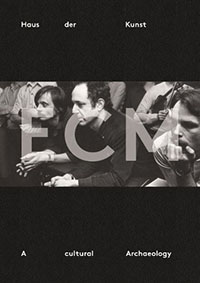 A small but informative printed guide was provided to those entering the exhibition, free of charge, which described each room and the various films and audio samples (in German and English), as well as including some choice photos from the ECM archives. But for those who want more, a new book has also been published to coincide with the exhibition (also in English and German editions), ECM: A Cultural Archeology (ECM: Eine kulturelle Archäologie) (Prestel, 2012)—edited by the exhibition's curators and put together, according to ECM's Steve Lake, in the almost unbelievable timeframe of thirty days. A gorgeous, 300-page black hardback book, with a wraparound high quality paper photo, it includes new essays from Enwezor, Müller, Wolfgang Sandner, Deidrich Deiderichsen, Renée Green, Kudwo Eshun and Jürgen Stenzl; a roundtable discussion between the curators, Eicher, Lake and music journalist Karl Lippegaus; a new ECM timeline, compiled by Lake; and a complete discography of the label from 1969-2012. For those unable to make the trek to München for the exhibition, the book is the next best thing to being there, and a terrific partner to Steve Lake and Paul Griffith's sadly out-of-print Horizons Touched: The Music of ECM (Granta, 2007).
If this were all there were, it would be plenty. But in addition to the exhibition, Haus der Kunst is hosting a series of evening screenings throughout its three-month run, including a number of films which feature ECM music in their soundtracks, like those of Greek director Theo Angelopoulos, who regularly uses the music of Eleni Karaindrou; Russian director Andrei Tarkovsky. who was the subject of a three albums by French pianist Francois Couturier, which wrapped up with 2011's Tarkovsky Quartet; and, of course, director Jean-Luc Godard, who has shared a long partnership with Eicher, who released the audio soundtrack—dialog, music and all else—to Nouvelle Vague (1997), as well as the beautiful five-CD box set that is the complete soundtrack to Godard's Histoire(s) du Cinéma (1999), complete with the film's narration in four books, translated from French to both German and English.
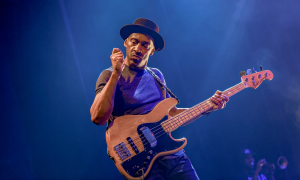
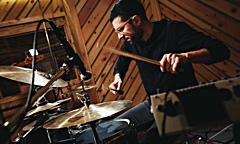
ECM: A Cultural Archeology is also hosting a series of live performances throughout the exhibition's run. For the opening weekend in November, Couturier's Tarkovsky Quartet, Tunisian oudist Anouar Brahem's Quartet and Italian trumpeter Enrico Rava's Quintet were all on-hand. In January, performances are scheduled for Swiss pianist Nik Bärtsch; a double-bill featuring British saxophonist Evan Parker's Electro-Acoustic Quartet and Anglo/Norwegian duo Food; American saxophonist Tim Berne's Snakeoil quartet; pianist András Schiffl and others, while in February, saxophonist Charles Lloyd will perform in a new duo with pianist Jason Moran, who's been a member of the saxophonist's quartet for the past several years; Italian pianist Stefano Battaglia's trio will perform music from its upcoming follow-up to its sublime River of Anyder (2011), and the exhibition will close with Tomasz Stańko's New York Quartet and a final evening with Jan Garbarek and the Hilliard Ensemble.
But for this weekend in December, 2012, it was two classical performances: the first, on December 14, by American singer/composer Meredith Monk, who delivered a tremendous program of solo pieces, duos with singer Katie Geissinger and, for a finale, a quartet piece with pianist Alexei Lubimov and clarinetist Kyrill Rybakov, who would perform the following evening in a program that was meant to be a double bill with cellists Thomas and Patrick Demenga, but which unfortunately had to be altered due to illness.

For a first-time encounter with Monk, the avant-vocalist/composer couldn't have presented a better program. With music dating as far back as 1969, Monk sang alone, accompanied herself on piano and harmonium, and duetted with Geissinger on material traversing her ten ECM recordings, including 1993's Volcano Songs, 1992's Facing North, 2004's Impermanence, 1993's Atlas and the most recent Songs of Ascension (2011).
It's hard to believe the spry and sprightly Monk turned 70 this year. With her long hair tied into two pigtails and dressed as youthfully as ever, Monk also demonstrated that her music may, at times, sound serious, but it's performed with a great deal of fun...humor, even, especially in the duet pieces where Monk and the considerably taller Giessinger played off each other to great effect. Her introductions revealed a woman comfortable in her own skin and life experiences, even the more painful ones, as she revealed that Impermanence was a reflection on the loss of her life partner, choreographer Mieke van Hoek, who died of cancer in 2002, while Songs of Ascension clearly reflects her ultimately coming to terms with that loss.
Often cited as an influence on singers like Norway's Sidsel Endresen, beyond the fact that Monk's material is composed as opposed to Endresen's current improvisational slant, it's also clear that their studies in extending the human voice beyond its conventional capabilities have taken them down completely different paths. Like Endresen, Monk has experimented with the concept of resonance, but has also worked with the idea of creating compositions where the singing amongst its participants is more akin to conversation than harmonizing.

Nowhere is this clearer than on her ECM debut, Dolmen Music (1981), from which she performed its first three pieces. "Gotham Lullaby," was for solo voice and piano. Still, as melodic as its base construct was, Monk's use of sound as language—despite being a language that's not been heard before—has clearly been a touchstone for Endresen's own distinctive vernacular and, in the same way, managed to evoke ideas and emotions despite being linguistically incomprehensible. Broad ululations and high pitched swirls defined her performance of "Travelling," a 5/4 piece that, like some of her other music, reflects her being a part of the same community that included minimalist composer Steve Reich—as did "The Tale," where Monk shifted between laughter and her character looking to celebrate or, at least, assert her life's ongoing relevance: "I still have my hands; I still have my mind; I still have my money; I still have my telephone."
But throughout a show that felt more like informal living room performance than rigorous recital, the most moving moment came when Monk was joined by Geissinger, Lubimov and Rybakov for a closing performance of impermanence's "Between Song," with Monk and Geissinger trading lines as Lubimov delicately delivered the dark accompaniment, with Rybakov layering simple but evocative lines. The full house responded with rapturous applause, and while Monk, Geissinger, Lubimov and Rybakov took a number of curtain calls, there was no way Monk was going to get away without an encore, an a cappella solo piece that explored the myriad potential of something seemingly so simply: a whisper. But that brief final piece epitomized a lifelong career which has explored the intersection of the human voice and experience, and was the ideal ending to a perfect performance.
With the Demenga brothers unable to perform the following evening, the weight fell upon Lubimov and Rybakov to expand a program where, originally, Lubimov was to perform material from his recent Claude Debussy: Préludes (ECM, 2012), and, in duo with Rybakov, the French composer's "Première Rhapsodie pour clarinette et piano."
And Lubimov did, indeed, perform material from the recording, in a solo recital that only served to strengthen impressions from his 2009 recital at the Enjoy Jazz Festival's ECM 40th anniversary celebration in Mannheim, Germany, where the pianist performed in a trio with Rybakov and violinist Alexander Trostiansky. The highlights of that performance were Lubimov's reading of Arvo Pärt's sublime "Für Alina," and his duo with Rybakov on the Estonian composer's arpeggio-driven "Spiegel in Spiegel," and it was this latter piece that the duo added to its München recital, in a set-closer that may actually have eclipsed the Mannheim rendition.
But if the two brought sublime tranquility to Pärt's composition, Lubimov's series of Debussy Préludes evoked even greater emotional resonance. A friend and contemporary of renegade composer Erik Satie, it's no surprise that, amidst the delicate lyricism of his Préludes, there were harmonic elements that somehow spoke of jazz in its nascency, and Lubimov captured those elements in definitive fashion. Debussy's Préludes are a standard part of the classical piano repertoire, just as Bach's Well-Tempered Clavier, and yet both Lubimov's recent recording of the Debussy and label mate/pianist András Schiff's recent four-disc set, Das Wohltemperierte Clavier (ECM, 2012) prove that, just as the standard repertoire in jazz still has plenty of life and potential in the hands of artists like pianist Brad Mehldau, saxophonist Lee Konitz and recently deceased drummer Paul Motian, so, too, do these classical staples possess something that, in the right hands, can continue to be approached and reinterpreted with fresh life and vitality.
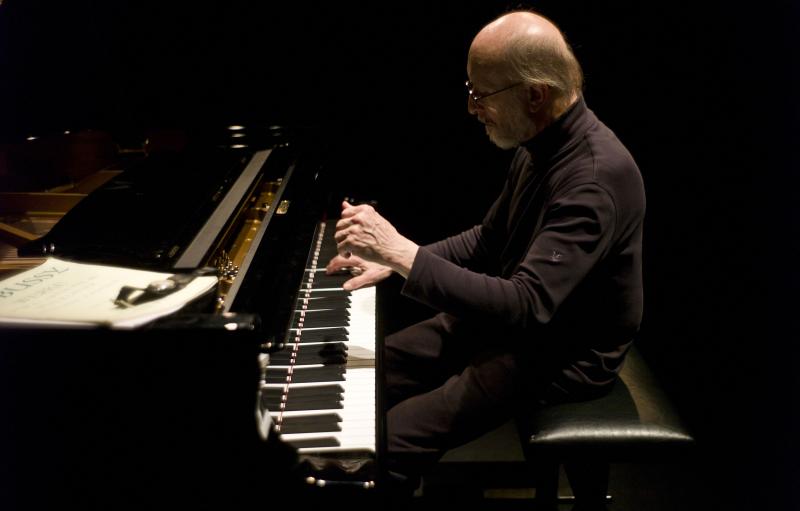
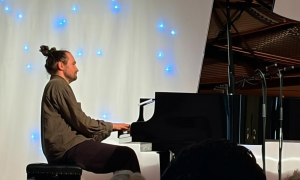
Lubimov was as compelling to watch as he was to hear. The delicacy with which, at times, he approached his instrument was something to be experienced even more clearly in performance, where it was possible to see how his right hand gently crossed over his left to caress the lower register of his piano; his hands, at other times, seeming to almost float above his instrument, while still rendering greater power when needed.
It was a superb performance where, faced with a certain degree of adversity in the absence of the Demengas, Lubimov and Rybakov managed to adopt, adapt and improve, making it a memorable recital that continued to resonate as, just a few hours later, it was back onto a plane to return home after a brief but fulfilling visit to ECM headquarters, the ECM: A Cultural Archeology exhibit, and two wonderful live performances. Given how these three days were really a very personal way to celebrate the accomplishments of ECM, Eicher's reflections on the exhibition's title provide, perhaps, the best closure.

"It means that we are still alive," says Eicher. "Archaeology can be interpreted in many ways and everybody can do so the way that they want. But to me, it is a beginning; you can say that you can look through a glass darkly to the retrospective ideas and within them, the future. To me this is also a point of reference—of how things began, of how things were done lightly, and I must say lightly in the sense that I don't see any burden and I don't remember any kind of difficult times. I don't remember any kinds of walls.
"So when I see pictures from people who are still with us," Eicher concludes, "others who left us because they passed away, or those who left ECM to do their own things, it's a very good feeling to see all of them together to celebrate, in my mind, what we have done. We never think about how the music will be heard a few years later. No; you do it in the moment, in the mood and in the emotion and you do it as well as you can. It's amazing, though, how this music still interacts with our time. We did nothing else other than try to make good music of the time that we were in."
Photo Credit
Live Performance Photos: Nadia Romanini
All Other Photos: Wilfried Petzi
Tags
PREVIOUS / NEXT


Become a Sustaining Member

Since 1995, All About Jazz has championed jazz as an art form and supported the musicians who create it. Over three decades, it has grown into one of the world's leading jazz resources, serving hundreds of thousands of readers, musicians, presenters and industry professionals each month.
Help Build the Future of All About Jazz
Your support helps us continue building All About Jazz for the next generation—expanding our editorial coverage, preserving jazz history, developing new community features and creating better ways to discover the music and the people behind it.
Become a sustaining member for as little as $20 per year and you'll immediately enjoy an ad-free experience along with access to subscriber features and future articles for a full year.
Together, we're not simply sustaining All About Jazz—we're building its future. Thank you for being part of the journey.