Home » Jazz Articles » Interview » Duduka Da Fonseca: The Guy From Ipanema
Duduka Da Fonseca: The Guy From Ipanema
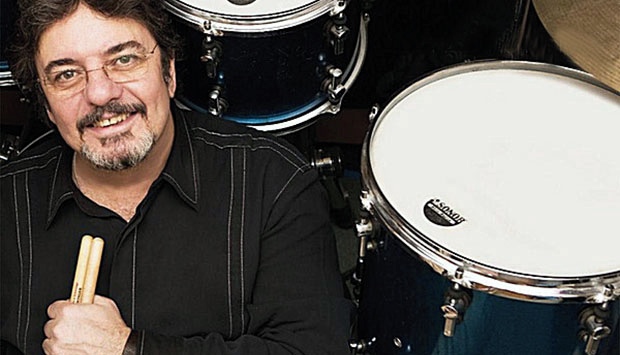

One young man from Ipanema, in the southern region of Rio de Janeiro in Brazil, was taking it all in. An artist in the making, he was captivated by not only the music, but the spirit of the times. In the early '60s, at age 13, he started teaching himself to play the drums. He played along with jazz records and the samba musicians he saw on television shows. Eventually, he became one of the sweetest and strongest drummers representing that music on the scene. He remains that, to this day. The first-rate musician also cooks like hell on straight-ahead jazz material.
"I was born in a time that was a very good time," says Duduka Da Fonseca, now 61. "Brazil was having a cultural revolution. Bossa nova was created in the '50s. We had a president that most of the people loved. And Brazil for the first time was world champion in soccer. That's a big thing in Brazil. In 1958, Brazil won, in Sweden, a first world championship. It was a fantastic time. It was so romantic, so beautiful, the sense of pride of the people. It's pretty amazing in the '50s and '60s, all over the world ... Art Blakey, Wes Montgomery, John Coltrane and Miles Davis. Pretty amazing, how beautiful."
Da Fonseca says the music of that period "serves to help every musician, and everyone that plays now. All that music that was created a long time ago by Miles, by Coltrane, by Monk-all those great geniuses. Antonio Carlos Jobim and Joao Gilberto. It still helps the musicians these days. It's a platform you can learn from and try to do your own thing, learning from it."
Da Fonseca mastered the drums learning that music. His career in Brazil and the U.S., where he landed in 1975, includes playing with Jobim, Astrud Gilberto, flautist Herbie Mann, trumpeter Claudio Roditi, pianist JoAnne Brackeen, bassist Eddie Gomez, guitarist John Scofield, trumpeter Tom Harrell,saxophonists Joe Lovano and Gerry Mulligan, pianist Dom Salvador, bassist Rufus Reid, pianist Kenny Barron, and many more. The drummer works in many styles of music, but one of his goals is to keep alive and vibrant the jazz samba music and the compositions of the greats from that era, so many of which he has played with and befriended over many years.
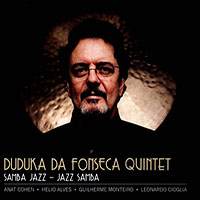
To that end, this year saw the release of a new album from his splendid quintet, Samba Jazz-Jazz Samba (Anzic, 2012), that presents the music with beauty and verve. It's the second such effort by the band-Samba Jazz in Black & White (ZOHO Music) was done in 2006- and is equally outstanding. The quintet-in addition to Da Fonseca, including Helio Alves on piano, Anat Cohen on saxophones and clarinet, Guilherme Monteiro on guitar and Leonardo Cioglia on bass-excels at this blissful music.
 "While bossa nova focused on the beautiful melodies, lyrics and a gentle approach, samba jazz was based on jazz improvisation with an open approach. It was, and still is, very common to play classic hits of bossa nova with a samba jazz approach," explains Da Fonseca. "Bossa nova came from samba ... it's just a subtle way to play samba ... a very soft way to play samba. But the rhythm of bossa nova is samba. It's parallel. In the late '50s, when bossa nova was created by Joao Gilberto and Antonio Carlos Jobim, and many other young composers that never got the recognition that they should have; parallel to that, all those musicians-the rhythm section and the horn players that were playing on the bossa nova great albums-they were playing also what we call samba jazz. It was created the same time that bossa nova was created."
"Those musicians that were part of the great bossa nova albums, they loved to listen to [pianists] Horace Silver and Thelonious Monk, and to Art Blakey and the The Jazz Messengers. They loved to listen to jazz. Like the Blue Note label. [Saxophonist] Wayne Shorter, Miles. That's how samba jazz was created. The rhythm is samba, but incorporated with jazz improvisation."
Da Fonseca notes the importance of the two seminal American albums that led to the bossa nova craze coming north to the U.S., Jazz Samba (Verve, 1962) by guitarist Charlie Byrd, and Getz/Gilberto (Verve, 1964) by saxophonist Stan Getz with the smoky, sensual vocals by Astrud Gilberto, containing the huge hit, "Girl From Ipanema."
The Getz album "is a beautiful album to this day. It's a great album. It's a perfect mixture of the bossa nova rhythms with jazz improvisation. It was very important to promote and launch bossa nova," he says. "I heard that this classic album, when it was released by Verve, they didn't think it would be very successful. It stayed for a year on the shelves waiting to be released. The somebody, for tax purposes, said, 'Let's release this one.'" It won Grammy Awards for Album of the Year, Best Jazz Instrumental Album-Individual or Group, and Best Engineered Album, Non-Classical.
"Astrud, the singer that sang 'The Girl from Ipanema' ... Stan Getz was the one who had the idea (to use her), because Joao Gilberto didn't speak English. Astrud Gilberto was married to Joao Gilberto. Stan Getz had the idea to call her because she already spoke very good English. But she never sang in her life, professionally. So she went to record and it was a big hit. She never signed any contract, so she never made a dime with that. I know that, because I worked with her for several years in the '80s, so I know a lot of things that went down. But on the other hand, if it wasn't for that, I believe she would never have been as successful as she was. If it wasn't for that recording."
The new Da Fonseca CD presents jazz sambas except for saxophonist Ornette Coleman's "Blues Connotation," which was brought in by Cohen, who does an arrangement of it in her own band, and "The Peacocks," by pianist Jimmy Rowles, whom Da Fonseca met in the 1970s at the famed piano bar Bradley's in New York City (now nonexistent). Others are by his friends, Alfredo Cardim ("O Guarana"), Raul Mascarenhas ("Sabor Carioca") and Dom Salvador ("Depois da Chuva"), Haroldo Mauro Jr. ("Obsinado"), Toninho Horta ("Dona Olympia"), and Rique Pantoia ("Melancia"), as well as one Da Fonseca original ("Flying Over Rio").
"Whenever I can, I record their songs," the drummer says of his amigos. "Because those are songs I used to play when I was back in Brazil; songs that I love to play. I think they should be heard."
The quartet has been together since 2002. Cohen was a student at Berklee College of Music, as was bassist Cioglia, who introduced the young lady from Tel Aviv to Da Fonseca. "We started playing and I loved the way she played. She's so lyrical and plays so beautiful that I had the idea to form a quintet. One of the great things about Anat, she's from Israel, but she went to Brazil many times and she speaks fluent Portuguese. Also, she played with the masters of a kind of music we have in Brazil called choro. It's classic Brazilian music that came before samba. It came in the late 19th century. She is a master. She played with the guys, downtown in Rio, this music. In my opinion, she can play Brazilian music with no accent. She is really something."
Cohen up to her usual high standards on the disk, adding great sound and feeling that blends seamlessly with the samba tapestry woven by these marvelous musicians. Alves, a longtime colleague of Da Fonseca, feels he music like breathing and sparkles. Monteiro's guitar lines are remarkable and Cioglia's bass lines help the drums inject vitality into the compositions. The music is packed with emotion, beauty, excitement, and intensity. The band is so tight it gives the illusion of being effortless. The effort given is as joyous as it is expert, coming through the heart of the leader.
The album was recorded at Avatar Studio in New York City and engineered by the renowned James Farber, a big plus for the project, says Da Fonseca. "It was a pleasure, because when you are in a studio and you have a good sound engineer and a good studio, and you go hear what he did in the booth. You hear that beautiful sound coming out. You don't hear any harsh things coming from the instruments-the guitar, the piano, or piercing cymbals. That encourages you, inspires you, to play better. When you hear a good sound coming out as a reference, it's a big inspiration to make you try to play better. It's not stressful ... Working with people like James, it inspires. So he becomes one of the musicians, because he helped inspire us to play better."
His musical standards were being formed early. As a youngster, he listened to the sound being played on records in his home and seen on TV-those of Jobim, Gilberto, Dori Caymmi, Luiz Bonfa, Louis Armstrong, Nat King Cole, Frank Sinatra, Ray Charles and others. Ipanema itself wasn't yet the "in" place to be. The beaches weren't crowded. But, between the famous song and the government building a tunnel through the mountains, making passage between the northern and southern zones much easier, it grew in popularity. "We don't have many beaches in the north zone. It's not particularly pretty. But the south, with Ipanema, Leblon and Copacabana, is very beautiful. It's astonishing. You have the mountains and the sea next to each other. That makes it so unique. It's a beautiful place."

"I was very lucky because at that time they had so many shows of bossa nova and of jazz instrumental Brazilian music (on TV). I was raised watching my idols at the time playing live. I was listening to albums. I was introduced at a very early age to jazz albums. I started to listen to Art Blakey, Elvin Jones and Miles with Tony Williams, at an early age right after I started playing. That's how I learned, playing along with the albums of great American jazz musicians and great Brazilian jazz musicians. Watching the great Brazilian jazz musicians playing live. I never studied. I never had a formal education.
At age 14, he started his first group, Bossa Trio, with his brother Miguel on bass. They performed on television and around Rio. In the early '70s, he cofounded Mandengo, a sextet, which performed around Brazil until the drummer finally made the move to New York City. By that time, he had played with the best in Brazil-Toninho Horta, Victor Assis Brasil, Claudio Roditi, Dom Salvador, João Donato, Nana Vasconcelos, Mario Adnet, the São Paulo Symphony Orchestra, Milton Nascimento, Dori Caymmi, Raul de Souza and others.
After moving to New York, Da Fonseca established numerous Brazilian jazz groups and went to the various jazz venues in the Big Apple, meeting musicians and getting acquainted. One band in the 1980s featured saxophonist Bob Mintzer, trumpeter Randy Brecker, pianist Eliane Elias, guitarist Romero Lubambo, bassist Nilson Matta, percussionist Café and Gilherme Franco. It was in the '90s that Trio Da Paz was formed, a group still active today. Besides appearing on more than 200 albums and playing in notable bands, Da Fonseca had an encounter with a friend who got him into teaching, something that had a big impact on his career.
The friend was Bob Weiner, who taught at Drummers Collective in New York City. "In the early '80s, he started to say, 'Hey Duduka. You gotta teach here.' But I told him I never taught before and I don't read music. He created a course at Drummers Collective, called Third World Rhythms ... I got my courage and called a friend of mine, a percussion player, Cyro Baptista. We went together and I taught a class on drums and percussion and I felt good. Then I decided to teach by myself. I stayed 16 years teaching, then Bob said, 'Let's do a book.' I said OK.
The pair spent time over a four-year span working things out in the basement of Da Fonseca's West Village apartment. "I played the patterns and Bob recorded the patterns and took notes. We worked on it, figuring what is going to be understandable for the students, step by step. It took a long time. But we did the book (Drummers Collective Series: Brazilian Rhythms for Drum Set, by Duduka Da Fonseca and Bob Weiner") and it became like a best seller. Manhattan Music published it first, then Time Warner, and now Alfred Publishing. It's been selling good since 1991. It's a book that comes with a CD ... We are very proud of the work we did. If it wasn't for Bob, I would never teach or write a book."
"Teaching is the best way for your to learn. It was very good because, since I never had a formal education, I started teaching and the students ask me, 'What do you do with your left hand?' or 'What do you do with your bass drum.' I never thought about that. I'm a street guy. I just learned and tried to play like the cats that were playing when I started to play drums. So I never really analyzed. I'm not the kind of musicians that analyzed things. I follow my intuition," he says.
"Intuition is something that, in some ways, we're missing. Because we have so much information through computers and technology that intuition sometimes...People forget about how important it is to use when you go to a situation to play and you need to learn the music at that time. If you don't read music, you can use your intuition to develop something and play and react to the music. It helps you to react. Listen to the direction of the soloist. Or sometimes you can even use your intuition to predict, in order to synchronize with the soloist and with the way the music is going, so you get in synch by developing your intuition. You get in synch to follow where the music is going in a more spiritual manner, not just reading the part; that is when you become a personal artist in whatever you do."
A very personal statement to the drummer was the first recording under his own name. It resulted in Samba Jazz Fantasia (Anzic, 2002), a project that is close to his heart.
"One of the most touching things happened in 2000 before I became 50," he recalls. "I said I want to do an album. It was my first solo album. Before that I made a few albums with Trio da Paz and as a co-leader I did a few albums, and recorded with a bunch of people. But that was my first solo album. I called a few of my good friends I had been playing and recording with through the years. So I called 11 Brazilians and 11 Americans. Among them were people from Trio da Paz-Romero Lubambo and Nilson Matta-and my American friends, like Tom Harrell, Joe Lovano, John Scofield, Eddie Gomez, [pianist] Marc Copland-a bunch of people.
"I produced everything the best way I could. My wife (Maucha Adnet) helped me a lot to organize the session because there were 22 musicians. I tried to sell the album to record companies. For more than one year, nobody wanted to buy it. They would says, 'It's beautiful music, but..." There was always 'But.' Finally, a small company from Ohio said we don't have money, but we can give you X-amount of albums and you can recover some of the money you spent when we release the album. And they did. And six or eight months later it was nominated for an American Grammy. So I wasn't doing something that wrong, you know?," he says with rightful satisfaction.
The album is superb samba jazz, from top to bottom, the musicians working in different combinations exquisitely, bringing great tunes-including four originals-to life. "I'm on a mission to make it popular, this style of music, a mix of Brazilian and American jazz," he says. Da Fonseca's recorded output has been steady and consistently exceptional since that session.
He admits it is "a non-stop battle" to make a good living and keep things moving for a jazz artist in today's turbulent times for the U.S. economy and in a music business climate that is in the midst of major changes. "I'm not crying the blues. I'm very thankful for everything I have." He's been getting more recognition for his accomplishments over the years. It may have taken a while, but it is greatly deserved.
"I'm happy people are realizing there's something there. You feel your work is being heard, and that is encouraging," he notes as he looks back. "To have the chance to play with those great American musicians is fantastic. That's the reason I moved to America, to have the opportunity to play with my idols. I was lucky enough to play and record with [alto saxophonists] Phil Woods and Lee Konitz, Gerry Mulligan, Eddie Gomez ... As a teenager, I used to play with the album Bill Evans at Montreux Jazz Festival (Verve, 1968), with Eddie Gomez and [drummer] Jack DeJohnette. I used to play along with that, then years later to be able to play with (Gomez's) trio is super rewarding."
The music of Cuba, Brazil and other regions of Latin America has a high popularity in the U.S. The strong, infectious rhythms and elements of improvisation combine superbly with jazz music.
"I've played a lot since 2007 with Rufus Reid, a great bassist and composer. We play a lot of straight-ahead [jazz], which is great. I love it. But you think in 4/4. But in samba, and samba jazz, you're not thinking in 4/4, you're thinking half time. You're thinking 2/4. The samba rhythm is in 2/4. Even though you can improvise over it in 4/4, the rhythm section is playing 2/4. They are like fruits from the same tree. Brazilian music and American music, being in North and South America, they have a lot in common. Since as long time ago, before Carman Miranda in the 1940s. In the beginning of the 20th century, groups of Brazilian musicians had already traveled to Europe and the United States. You see the convergence of Brazilian and American music. It's a long friendship. It's a long love story between Brazil and America."
Da Fonseca knows. After all, he's been right inside it, with his unshakable rhythmic individuality and never-ending good taste.
Selected Discography
Duduka Da Fonseca, Samba Jazz-Jazz Samba (Anzic, 2012)
Duduka Da Fonseca, Plays Toninho Horta (ZOHO Music, 2011)
Rufus Reid, Out Front (Motema Music, 2009)
Claudio Roditi, Brazilliance X4 (Resonance Records, 2009)
Dom Salvador, Dom Salvador Trio, (Biscoito Fino, 2007)
Duduka Da Fonseca, Samba Jazz in Black & White (ZOHO Music, 2006)
Trio da Paz, Somewhere (Blue Toucan Music, 2005)
Maucha Adnet, The Jobim Songbook, (Kind of Blue Records, 2006)
Helio Alves & Duduka Da Fonseca, Songs From the Last Century, (Blue Toucan Music, 2006)
Duduka Da Fonseca, Samba Jazz Fantasia (Anzic Music, 2002)
Kenny Barron & Trio Da Paz, Canta Brasil, (Sunnyside Records, 2002)
Tom Harrell, The Art of Rhythm, (RCA, 1998)
John Scofield, Quiet (Verve, 1996)
Trio da Paz, Black Orpheus (Kokopelli Records, 1994)
Astrud Gilberto, Astrud Gilberto Plus James Last Orchestra, (Verve, 1990)
Photo Credit
Page 1: Courtesy of Duduka Da Fonseca
Page 3: Ines Kuusik
< Previous
Songs for Kommeno
Comments

About Duduka Da Fonseca
Instrument: Drums
Related Articles | Concerts | Albums | Photos | Similar ToTags
Duduka Da Fonseca
Interview
R.J. DeLuke
United States
New York
Albany
Antonio Carlos Jobim
Joao Gilberto
Astrud
Art Blakey
Wes Montgomery
[John] Coltrane
Miles [Davis]
Herbie Mann
Claudio Roditi
Joanne Brackeen
eddie gomez
John Scofield
Tom Harrell
joe lovano
Gerry Mulligan
Dom Salvador
Rufus Reid
Kenny Barron
Helio Alves
Anat Cohen
Guilherme Monteiro
Leonardo Cioglia
Horace Silver
Thelonious Monk
Jazz Messengers
Wayne Shorter
Charlie Byrd
Stan Getz
Ornette Coleman
Jimmy Rowles
Dori Caymmi
Luis Bonfá
Louis Armstrong
Nat "King" Cole
frank sinatra
Ray Charles
Elvin Jones
Tony Williams
Toninho Horta
Nana Vasconcelos
Milton Nascimento
bob mintzer
randy brecker
Eliane Elias
Romero Lubambo
Nilson Matta
Trio Da Paz
Cyro Baptista
Marc Copland
Phil Woods
Lee Konitz
Jack DeJohnette
For the Love of Jazz
 All About Jazz has been a pillar of jazz since 1995, championing it as an art form and, more importantly, supporting the musicians who create it. Our enduring commitment has made "AAJ" one of the most culturally important websites of its kind, read by hundreds of thousands of fans, musicians and industry figures every month.
You Can Help
To expand our coverage even further and develop new means to foster jazz discovery and connectivity we need your help. You can become a sustaining member for a modest $20 and in return, we'll immediately hide those pesky ads plus provide access to future articles for a full year. This winning combination will vastly improve your AAJ experience and allow us to vigorously build on the pioneering work we first started in 1995. So enjoy an ad-free AAJ experience and help us remain a positive beacon for jazz by making a donation today.Near


Giveaway

Eligible winners: 15
Days remaining: 4
Days remaining: 4