Home » Jazz Musicians » Duke Ellington
Duke Ellington
By the time of his passing, he was considered amongst the world’s greatestcomposers and musicians. The French government honored him with theirhighest award, the Legion of Honor, while the government of the UnitedStates bestowed upon him the highest civil honor, the Presidential Medal ofFreedom. He played for the royalty and for the common people and by theend of his 50-year career, he had played over 20,000 performancesworldwide. He was The Duke, Duke Ellington.
Edward Kennedy Ellington was born into the world on April 29, 1899 inWashington, D.C. Duke’s parents, Daisy Kennedy Ellington and James EdwardEllington, served as ideal role models for young Duke, and taught himeverything from proper table manners to an understanding of the emotionalpower of music. Duke’s first piano lessons came around the age of seven oreight and appeared not to have had that much lasting effect upon him. Itseemed as if young Duke was more inclined to baseball at a young age.
Duke got his first job selling peanuts at Washington Senator’s baseballgames. This was the first time Duke was placed as a "performer" for a crowdand had to first get over his stage fright. At the age of 14, Duke begansneaking into Frank Holliday’s poolroom. His experiences from the poolroomtaught him to appreciate the value in mixing with a wide range of people.
As Duke’s piano lessons faded into the past, Duke began to show a flare forthe artistic. Duke attended Armstrong Manual Training School to studycommercial art instead of going to an academics-oriented school. Dukebegan to seek out and listen to ragtime pianists in Washington and, duringthe summers, in Philadelphia or Atlantic City, where he and his mothervacationed .
While vacationing in Asbury Park, Duke heard of a hot pianist named HarveyBrooks. At the end of his vacation, Duke sought Harvey out in Philadelphiawhere Harvey showed Duke some pianistic tricks and shortcuts. Duke laterrecounted that, "When I got home I had a real yearning to play. I hadn’t beenable to get off the ground before, but after hearing him I said to myself, ‘Manyou’re going to have to do it.’" Thus the music career of Duke Ellington wasborn.
Duke was taken under the wings of Oliver "Doc" Perry and Louis Brown, whotaught Duke how to read music and helped improve his overall piano playingskills. Duke found piano playing jobs at clubs and cafes throughout theWashington area. Three months shy of graduation, Duke dropped out ofschool and began his professional music career.
Read more The Jazz legend, Ellington become the first blackAmerican to be prominently featured on a U.S. coin in circulation with therelease of a quarter honoring the District of Columbia.
Tags
Lost and Found, part 3: Rare recordings of Ellington, Ben Webster, Art Tatum and Gil Evans

by Larry Slater
There are so many Duke Ellington recordings available. How much undiscovered music of the band can there be? In this hour, you'll hear rarely heard gems from the Ellington discography. Music that's so rare, I doubt even die-hard Ellington aficionados have heard some of these tracks. The Duke Ellington Orchestra with Django Reinhardt at Carnegie Hall. A home recording of Ben Webster on clarinet. Duke Ellington's late great extended work “The River." Also featured are Art ...
Continue ReadingDuke Ellington's Concert of Sacred Music
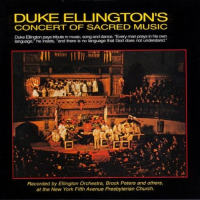
by Chuck Lenatti
In 1964, Dean D.J. Bartlett and the Reverend John S. Yaryan invited Duke Ellington and his orchestra to present a concert to consecrate the renovated Grace Cathedral on Nob Hill in San Francisco during a year-long festival of Grace. At first, Duke demurred. In his autobiography, Music Is My Mistress (Da Capo, 1976), Ellington explained why he changed his mind: It has been said once that a man who could not play the organ or any ...
Continue ReadingJack Chambers: Rethinking Duke Ellington
by Jack Kenny
Jack Chambers is professor at the University of Toronto and teacher of music and language. His jazz writings include the prize winning biography Milestones: The Music and Times of Miles Davis (Da Capo Press, 1998) and Bouncin' with Bartok: The Incomplete Works of Richard Twardzik (Mercury PR, 2008). Sweet Thunder: Duke Ellington's Music In Nine Themes (Canam Books, 2019) was Chamber's first book on Duke Ellington. His 2025 book, A Tone Parallel to Duke Ellington:The Man In The Music (University ...
Continue ReadingA Tone Parallel to Duke Ellington: The Man In The Music
by Jack Kenny
A Tone Parallel to Duke Ellington: The Man In The Music Jack Chambers 259 Pages ISBN: # 9781496855756 University Press Of Mississippi2025 There are rare insights into Duke Ellington in this book from Jack Chambers, his second on Duke Ellington. Chambers has also written important books on Miles Davis and Richard Twardzik. He is predisposed to enjoy Ellington's music, can see the flaws in Ellington's personality and throughout the book he describes the ...
Continue ReadingTrio Jungle (A "Classic" Episode)
by Patrick Burnette
As we noted so succinctly way back in 2014: Some trios play nicer together than others--Pat and Mike investigate.Playlist Discussion of Duke Ellington's album Money Jungle (United Artists) 4:09 Discussion of Terri Lyne Carrington's album Money Jungle: Provocative in Blue (Concord) 26:29 Discussion of Jean Michel Pilc's album Welcome Home (Dreyfus) 40:16 Discussion of Herbie Nichols' album Love, Gloom, Cash, Love (Bethlehem) 54:36 Pop Matters 1:08:04 ...
Continue ReadingJazz: Cultural Diplomacy, Art or Show Business?

by Anastasia Bogomolets
There is a firm belief among scholars that jazz and the American Jazz Ambassadors programme played an important role during the Cold War era. Extensive literature explores the significance of jazz in shaping global post-war relationships. The world has changed dramatically since then. On one hand, music, including jazz, has become increasingly commercialized; on the other, unlimited access to free streaming platforms has significantly reduced governments' ability to influence musical preferences. Do you think we are entering another historical period ...
Continue ReadingThe Jazz Men: How Duke Ellington, Louis Armstrong and Count Basie Transformed America
by Richard J Salvucci
The Jazzmen: How Duke Ellington, Louis Armstrong, and Count Basie Transformed America Larry Tye 416 pages ISBN: 035838043X Mariner Books 2024 In 1986, a guy walked into a Post Office in South Texas--no, this is not the opening line of a joke. He lined up to buy some stamps. Big deal, right? But there was a bit of an altercation up front. Things moved more slowly than usual. When the customer got to ...
Continue ReadingDuke Ellington at Grinnell College, 1957
Source:
JazzWax by Marc Myers
On January 10, 1957, during a snowy Thursday evening, the Duke Ellington Orchestra played a concert at Grinnell College in Grinnell, Iowa. The performance was taped by the school with sophisticated gear, and the subsequent LP was released in limited supply. As a result, it has always been a highly sought-after album. Last week, Carl Woideck emailed with news that all the tracks were up on YouTube. Which is great to hear, since copies of vinyl copies very hard to ...
read more
Jazz Musician of the Day: Duke Ellington
Source:
Michael Ricci
All About Jazz is celebrating Duke Ellington's birthday today!
By the time of his passing, he was considered amongst the world’s greatest composers and musicians. The French government honored him with their highest award, the Legion of Honor, while the government of the United States bestowed upon him the highest civil honor, the Presidential Medal of Freedom. He played for the royalty and for the common people and by the end of his 50-year career, he had played over 20,000 ...
read more
Count, Duke, Stan, Harry, Gerald and Tubby in '65

Source:
JazzWax by Marc Myers
Thought to be over and done in 1965, big bands staged a comeback. Most of their acclaim came on tours in Europe and and on TV, but the truth is that bands led by top names were undergoing a renaissance. With their kids in college or out of the house and rock starting to dominate, many older listeners in the U.S. began paying attention again to artists who had shaped their youth. Abroad, a generation of young adults marveled at ...
read more
Jazz Musician of the Day: Duke Ellington
Source:
Michael Ricci
All About Jazz is celebrating Duke Ellington's birthday today!
By the time of his passing, he was considered amongst the world’s greatest composers and musicians. The French government honored him with their highest award, the Legion of Honor, while the government of the United States bestowed upon him the highest civil honor, the Presidential Medal of Freedom. He played for the royalty and for the common people and by the end of his 50-year career, he had played over 20,000 ...
read more
Duke Ellington: Berlin 1959

Source:
JazzWax by Marc Myers
After my post last week on 16 jazz geniuses, I predictably received a flood of emails asking why Duke Ellington was missing from my list. As I explained, while Duke was exceptional, his piano didn't change the direction of jazz nor did a school emerge that emulated his approach. But the emails did give me pause. Perhaps Duke's influence was more subliminal, I thought. That's when it came to me. Ellington's genius was beauty and greater artistic self-worth. Prior to ...
read more
Jazz Musician of the Day: Duke Ellington
Source:
Michael Ricci
All About Jazz is celebrating Duke Ellington's birthday today!
By the time of his passing, he was considered amongst the world’s greatest composers and musicians. The French government honored him with their highest award, the Legion of Honor, while the government of the United States bestowed upon him the highest civil honor, the Presidential Medal of Freedom. He played for the royalty and for the common people and by the end of his 50-year career, he had played over 20,000 ...
read more
Videos: Three Ellington Reeds
Source:
JazzWax by Marc Myers
Duke Ellington was a tonal impressionist. Each musician in his band had two functions—to be able to play and to have a special sound. Taken as a whole, his orchestral pieces were like canvases, with different hues layered on top of each other. Here are three of Ellington's top saxophonists on solo showcases, providing an opportunity to hear their distinct sounds isolated: Here's Ben Webster on Chelsea Bridge... Here's Harry Carney on Sophisticated Lady... And here's Johnny Hodges on I ...
read more
Jazz Musician of the Day: Duke Ellington
Source:
Michael Ricci
All About Jazz is celebrating Duke Ellington's birthday today!
By the time of his passing, he was considered amongst the world’s greatest composers and musicians. The French government honored him with their highest award, the Legion of Honor, while the government of the United States bestowed upon him the highest civil honor, the Presidential Medal of Freedom. He played for the royalty and for the common people and by the end of his 50-year career, he had played over 20,000 ...
read more
New Duke Ellington Videos
Source:
JazzWax by Marc Myers
Yesterday, I was craving Duke. You know how it is. You find yourself in the mood for Ellington's earthy compositions, elegant arrangements, crisp horns, mournful trombones and mink-like reeds, and you have to hear it. So you listen to his Blanton-Webster band of the early 1940s and the Gonsalves-Terry band of the early '50s and beyond, and suddenly you feel alive in a different way. A day of Ellington inspired me to share five recently posted YouTube clips of the ...
read more
Five Videos: Duke Ellington
Source:
JazzWax by Marc Myers
The rise of swing and jazz's sophisticated elegance starts with Duke Ellington. His first recordings were with Wilbur Sweatman and His Acme Syncopators in August 1924. His first leadership 78 was recorded in November of that year, billed as the Washingtonians. His first Columbia recording came in March 1927, with East St. Louis Toodle-oo, Hop Head and Down in Our Alle Blues. From there, he would go on to compose beautiful jazz songs and change the direction of the music, ...
read more
Marc Smason
trombone
Matthew Steckler
saxophone
Richard Kalman
vocals
Brian Nova
guitar
Mary Ann Hurst
vocals
Roberto Magris
piano
Max Perkoff
trombone
Meg Okura
violin
Chris Abelen
trombone
Frank Macchia
composer / conductorwilson somers
piano
Maria Schneider
composer / conductor
Andy Milne
piano
Lisa Rich
vocals
Matt Savage
piano
Greg Poppleton
vocals
Rob Garcia
drums
Matthieu Marthouret
organ, Hammond B3
Reggie Watkins
trombone
Seth Kibel
clarinet
Jeff Lofton
keyboards
Solitaire Miles
vocals
Andrew Hadro
woodwinds
James Zollar
trumpet
Knoxville Jazz Orchestra
band / ensemble / orchestra
Lisa Hilton
piano
Ofer Shapiro
saxophone
John Nyerges
piano
Sylvia Brooks
vocals
Anthony Brown
percussion
Patrick Manzecchi
drums
Harley White Jr.
band / ensemble / orchestra
Earl Okin
vocals
Alan Lewine
bass
Ryan Burns
piano
Ben Rubin
bass
Thomas Matta
trombone
Charlie Porter
trumpet
Scott Reeves
trombone
John Lang
bass
Anna Elizabeth Kendrick
vocals
Scott D Marshall
saxophone
Jason Arce
saxophone
Gui Duvignau
bass, acoustic
Chris Gale
saxophone, tenor
Phillip Johnston
saxophone
Eyran Katsenelenbogen
piano
Eli Yamin
piano

Paul Cosentino
clarinet
Ulysses Owens, Jr.
drums
Michika Fukumori
piano
Benoit Viellefon
guitar and vocals
Nick Finzer
trombone
Ed Puddick
arranger
Bob Niederriter
guitarPleayo Tovaranonte
piano
John Bacon
drums
Leigh Pilzer
saxophone, baritone
The GroovaLottos
band / ensemble / orchestra
Beppe Aliprandi
saxophone, alto
Laura Marks
vocals


Milo Mannino
trumpet
Matthias Broede
harmonica
Jimmy Hobson
drums
Brent Fischer
composer / conductor
Jonny Gee
bass, acoustic
Nick DePinna
trombone
Victor Monsivais
guitar and vocals
Bob Wijnen
piano
Jeremy Shoham
saxophone
John Bauers
piano and vocals
Lyn Stanley
vocals
Yiannis Kassetas
saxophone, tenor
Mimika Orchestra
band / ensemble / orchestra
Ian Rashkin
bass, acoustic
Jessika Smith
saxophone
Halley Shoenberg
clarinet
Duo Laroo-Byrd
band / ensemble / orchestra
Simon Read
bass, acoustic
Riyoko Takagi
piano
Ellister van der Molen
flugelhorn
Christy Bennett
vocals
Pavel Wlosok
piano
Charleston Jazz Orchestra
band / ensemble / orchestra
Freysteinn Gíslason
bass, acoustic
Simon Vincent
piano
Devin Reilly
composer / conductor
Levi Saelua
saxophone
Karla Bauer
vocals
Yerik Nuñez
vocals

Roberto Spadoni
composer / conductor
Jeff Lopez
bass, electricBill Stieger
drums
John Roth
bass
Carl Cornwell
saxophone
Suzanna Ross
vocals
Marley Edwards
bass
Ed Harlow
saxophone
Chris Bakriges
piano
Rasmus Henriksen
composer / conductor
KUHN FU
band / ensemble / orchestra
Peter Hostage
piano
AZ Lindy Hop Society
various
Nanna Carling
saxophone, soprano
F. Leone
guitar
David Ecker
piano
Tracy Yang
composer / conductor
Joseph de Dominicis
guitar, acoustic
George Lake BIG Band
band / ensemble / orchestra

K Quintet
band / ensemble / orchestra
Christian Klinkenberg
piano
Carol J Levin
harp
Matteo Mosolo
bass, acoustic
Zack Varner
saxophone
Stephen M Kerr
bass, acoustic
Brian Woods
piano
Emily J Andros
vocals
Larry Wolf
vocals
Quentin Walston
piano
Lounge Jazz
band / ensemble / orchestra
Kent Youth Jazz Orchestra
band / ensemble / orchestra
Andres Hayes
saxophone, tenor
Todd Cochran
piano
Oscar Laven
saxophone, tenorKEENAN J RUFFIN
guitar
Sergio Alessandro Buslje
composer / conductor
E.G. Phillips
author
Vasco Belo Agostinho
guitar
Zach Green
composer / conductor
Richard Davies
saxophone, tenor
Henry Godfrey
drums
Stardust Big Band
band / ensemble / orchestra
Michael Sassi
drums
Orvel Ray Wilson
drums
Flatirons Jazz Orchestra
band / ensemble / orchestra
Matias Jarsun
piano
Simon-Mary Vincent
piano
Angelo Bernardi
bass
Maurice Lynch
producer
Wilson Corniel, Jr.
congas
Jazz'on Parma Orchestra
band / ensemble / orchestra
Graham Griffith
guitar, steel
OTAKA
piano
Alberto Forino
piano
Yver Sorród
vocals
Mike Benjamin
keyboards
Al Lloyd & His Orchestra
band / ensemble / orchestra
Yooyoun Cho
guitar
Benoit Viellefon & His Orchestra
band / ensemble / orchestra
Nichapa Jittaleela Air
piano
Ramiro Zayas
piano
Phil Raskin
drums
Noah Pettibon
saxophone, baritone
Giacinto Piracci
guitar
Scott Alberti
trombone
JohnnyG
saxophone, tenor
Sunny Side
band / ensemble / orchestra
Ilario Ferrari
piano
Ilario Ferrari
piano
Kyle Beck
percussion
Barbara Bruckmueller
composer / conductor
Rutger Mathys
harmonica
Marie-Claire Giraud
vocals
Farang Big Band
band / ensemble / orchestra
Nick Heide
piano
Diana Leoport
vocals
Victor Prado
french hornKen Teel
guitar
Albany Jazz Big Band
band / ensemble / orchestraPhotos
Music


Videos
Similar

Miles Davis
trumpet
Thelonious Monk
piano
Charlie Parker
saxophone, alto
Count Basie
piano
Charles Mingus
bass, acoustic
Ella Fitzgerald
vocals
Nat King Cole
piano and vocals
Benny Goodman
clarinet
Glenn Miller
trombone
Rahsaan Roland Kirk
woodwinds
Fletcher Henderson
saxophone
Cab Calloway
composer / conductor
Joe Williams
vocals
Jimmie Lunceford
composer / conductor