Home » Jazz Articles » Live Review » Undead Jazz Festival: Day 3, June 25, 2011
Undead Jazz Festival: Day 3, June 25, 2011

Undead Jazz Festival
New York, New York
June 23-26, 2011
Most jazz festivals in their later incarnations look for fancier, more illustrious places to play than they did at inception. The third night of the Undead Jazz festival momentarily shifted that trend in reverse. After spending their first night where they originally began, in the hip, bustling, restaurant-and-bar laden streets of Greenwich Village, and the second night in the nicely furnished but remotely located Bell House in Gowanus, Brooklyn, the festival decided to allow the eclectic, DIY, loft jazz atmospherics of its music to be reflected in the venues themselves. Though Park Slope's Littlefield is naturally accustomed to hosting musicians, Homage Skate Park and the CrossFit South Brooklyn gym were unusual venue choices to say the least. To add to the aesthetic, the latter two sports/fitness areas showed little-to-no signs of any formal conversion into a music hall. Patrons sat in the gym on folding mats and weight benches under neutral fluorescent lighting, while in the skate park, audience members were seated on grind boxes and propped up on vert ramps, ominously lit by a single, spherical ceiling lamp and séance-like candles.
Saturday night also featured some of the more experimental and lesser known performers (which for this festival is saying something). While some of the names had the potential to perk up ears within the downtown jazz world, such as David S. Ware and Matt Wilson, the night was filled with names that aimed to stir up intrigue and introduce new faces (and new configurations by familiar faces). The chasm of eclecticism was wide and open; everything from neo-traditional gospel to glitchy, electronic improv to Jewish jazz-dub was represented.
Jeff Lederer's Sunwatcher
Albert Ayler was a beloved and too-quickly-departed member of the post-Coltrane clan of avant-garde free jazz saxophonists. Reedist Jeff Lederer's quartet allowed itself to be partially possessed by the ghost of Mr. Ayler at Littlefield, channeling the saxophonist's primal aggression, wistful passion and Salvation Army band march melodies. Rounded out by bassist Chris Lightcap, drummer Matt Wilson and pianist/keyboardist Jamie Saft, the group let the spirit of Ayler's music propel it into levels of unbridled enthusiasm.
Some of Sunwatcher's music, within the context of the rest of the festival, was among the most traditional. Many of the pieces, such "Albert's Son," were fueled by Matt Wilson's big, joyous swing feel and painted in big, sun-kissed colors by Saft. However, it wasn't just the tradition of swinging that gave the quartet an old-school sound, nor did that old-school sound make the music conservative. A lot of the music harkened back to the time when quartets with histories of bebop, such as John Coltrane's classic foursome, began to use their sounds to move outwards. Saft and Lightcap would hit and react like McCoy Tyner and Jimmy Garrison used to do. Some of Lederer's solos pursued a modal, "out in the context of in" approach, ascending high and then dive-bombing. There was also no mistaking each quartet soloist's ability to play in the context of history. Lightcap soloed with a simmering swing in his slowly descending lines and Saft, who had thus far represented himself as an electrical wizard the night previously and would prove himself to be a dub reggae aficionado later in the night, established himself as a pianist to watch out for, playing lush, languid blues solos and thick, fully constructed chords at the piano. His most surprising display of musicianship came when he reached inside the piano and, instead of playing disjointed plunks, etched out a melody that sounded like a jukebox.
It wasn't all polite swing and friendly chord voicings, obviously. Lederer exhibited his most potent Aylerian scream on tenor, alto and soprano saxophones, soloing like a cyclone over charging rhythms. Saft may have been capable of channeling Red Garland but he was also capable of melting his 50's style block chords into elephantine crashes in sound. The rhythm section swirled and pounced on lulls in Lederer's soloing, setting up the necessary call and response ethic. Sunwatcher is a group that embodies the spirit of the 60's, when jazz had its pick of present and past influences.
Min Xiao-Fen's Dim Sum
Dim Sum is the Asian-American answer to the Afro-Futurist movement of the 60's and 70's. In the spirit of that cultural and artistic movement concerned with blending African identity into modern and futuristic modes of expression, Min Xiao-Fen's duet with drummer/percussionist/electronic musician Satoshi Takeishi is a musical project thousands of years in the making, and merged traditional vocals and instrumentation with electronic methods of music making.
Dim Sum's cultural roots lay in Xiao-Fen's masterful folk singing and lute playing. She used an assortment of pipas (four-stringed Chinese plucking instruments) to create wild, windswept flurries of notes with the intensity of punk rock. Takeishi accompanied on traditional frame drums and gongs, using brushes with enough intensity to create loud, percussive splashes. Xiao-Fen also played the role of songstress, singing Chinese lyrics in unison with her lute in a warbling vibrato, accented by Takeishi's cymbals.
These elements provided the groundwork for which Dim Sum launched Chinese music into the stratosphere. Xiao-Fen's singing was occasionally accompanied by an electronic vocal auto-harmonizer, splitting her voice into several parts with computerized harmonic accuracy. At one point, she looped vocal tones to create a haunting atmosphere to improvise over, blending the sounds of the lute and her echoed voice. Takeishi was armed with a Macbook Pro to manipulate the raw acoustic sounds, distorting and recreating the sounds of his drums to make the sounds of a tidal wave crashing. The duo created vast, artificial sound landscapes, making it seem like several musicians hundreds of feet apart were playing at once. Dim Sum was concerned with claiming Asian music and culture as a legitimate means of expression, not just a caricature.
Briggan Krauss's H-Alpha
One of organizer Adam Schatz's favorite catchphrases for introducing a group was "You cannot possibly be ready." For saxophonist Briggan Krauss's H-Alpha, that was not an empty statement. Even listeners accustomed to sound experiments between acoustic horns and electronics could have been caught off guard by the otherworldly trialogue between Krauss's sputtering buzzes, Ikue Mori's ambient sound walls and Jim Black's famous break beats. H-Alpha was an experimental trio set-up that managed to sound more experimental than one would expect.
Krauss, unlike other horn-playing leaders, did not play that much. His guttural, sometimes sock-stuffed alto saxophone playing, acted as one piece of a larger puzzle. Despite being the trio's only melodic voice, he occasionally acted as another texture maker, growling and revving like a motorcycle in deliberate dynamic arcs. When he did stretch out, his lines were spidery, unpredictable and reminiscent of Anthony Braxton's quavering alto sound. Krauss also proved his excellent control of his horn during a compositionally lucid piece, in which he played multiphonic "chords" over digital ambience.
More surprising than the combination of horn, electronics and drums was the synthesis of the aforementioned sounds. Members of the trio would create successful impressions of each other: Krauss used his altissimo register to imitate Mori, Mori's percussive electronics imitating Black, and Black's sawing cymbal screeches imitating Krauss. Conversations between two members of the trio would allow the third space to move. Aggressive drum-and-bass breaks between Mori and Black begat Krauss' mournful, long tones and Krauss/Mori conversations would goad Black into dropping bombs. H-Alpha was a kind of cyborg: a living, breathing trio for the digital age.
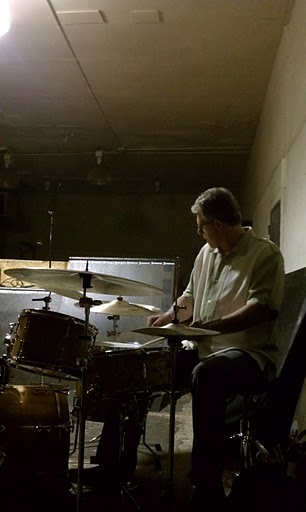 Matt Wilson solo
 Homage Skatepark's reverberating acoustics and David Lynch-style lighting provided the perfect atmosphere for its three solo performance. Drummer Matt Wilson, set up on the floor next to a vert ramp, played a long and intriguing set of solo drum performance. The challenge set before him was to retain audience interest for upwards of 50 minutes in a style of drumming that even the most historically loquacious of drummers typically did not attempt for more than 10.
Wilson began slowly, filling the space with a big, rising and falling roll. The snare sound didn't fade away, however. His compositional style was to create little cells and drum melodies and let them overlap each other to create new sounds, and through slow execution exhibited every piece of the puzzle before arranging them into tangible songs. The drummer's pitched tom-toms were used to create bouncy melodies amidst the wash of his cymbal (which, once listened to long enough, started to reveal its own melodic capability). Wilson, unlike many solo performers, was not solely composing or improvising for an hour's time. He did both, using his diligence to create drum patterns that he also soloed over.
The secret to Wilson's success was his innovation within accessibility. Everything he did, be it an affected, ride-heavy swing rhythm or a lyrical 6/8 rumble, simply felt good. He announced after the first piece that he was paying musical tribute to musicians like Mel Lewis and even Michael Jackson (during which his wry humor came through as he sang and whistled the melody to "I'll Be There"). Some of his material during the second half came from familiar sources, such as Thelonious Monk's "We See." In an impressive display of musicianship, Wilson dedicated a solo performance of "Body and Soul" to his wife Felicia, in which every note of the melody was audible. It's a testament to how organized a drummer is in his execution when you can even hear an ending tag without the aid of any harmonic or melodic instruments.
Dean Bowman solo Modern jazz and creative music does a good job in absorbing other genres of music, like punk, klezmer, reggae and Balkan music. With vocalist Dean Bowman, creative jazz just got its latest addition: gospel. Bowman's conception is not the Tye Tribett brand of bombastic worship music, but rather the type of music conceived at the mouths of rivers and in the stalks of cornfields. In his performance, Bowman spoke fondly and knowledgeably about gospel music and Negro spirituals, knowing full well that those forms still need to be brought out of church and into festivals like these.
Bowman's voice was extraordinarily rich; even without the aid of acoustic echoes, his voice would have been reverberating with a full dramatic tone. The singer introduced his music as "avant-garde gospel" but the avant-garde elements were mostly textural: occasionally he choked his timbre into an expressive nasal tone, and frequently used an almost yodeled effect in his upper register, rapidly toggling between falsetto and chest voice. Another noteworthy extended approach was a multiphonic technique where he hummed one note and whistled another.
Bowman's avant-garde sensibilities were below the surface most of the time, though. Many of these songs could only reach the ears of old church members and gospel historians, so his singing old gospel pieces like the Reverend Gary Davis' "I Heard the Angels Singing" to a curious audience was an avant-garde act in and of itself. In church music fashion, he encouraged the audience in clapping and singing along with choruses like "John the Revelator." The unaccompanied solo pieces required him to supply his own bass lines and voice part accompaniment, which gave the effect of a one-man gospel choir. Dean Bowman's involvement in Search and Restore's produced music scene promises to be one of the most intriguing collaborations in the improvised music world.
Jeremy Udden's Plainville
Toward the wee hours of the morning, the streets were quiet, the audience was dwindling and this was the most appropriate group to close the night set up on stage at Homage Skatepark. Saxophonist Jeremy Udden's group Plainville allowed the weary audience to mentally leave New York for a brief moment. Made up of keyboardist Leo Genovese, drummer RJ Miller, bassist Eivind Opsvik and guitarist Ryan Scott, this music is part of the aesthetic practiced by musicians like Bill Frisell and Pat Metheny: a painting of small-town life and optimism, mixed with Southern gothic maturity, folk song simplicity, and garage rock pathos.
Plainville's writing took rock and folk die casting, and colored it with an advanced harmonic and rhythmic sense. The composition "Red Coat" walked around different key centers that had a playfulness as well as a gentleness. "Hammer" was a strummed folk tune with a pulse from Opsvik and Miller that thumped like a heartbeat and "Thomas" featured the steely twang of Scott's resonator guitar under Udden's alto. Compositions like "Sad Eyes" turned up the heat a bit, with Scott churning out melodic riffs with the same knowledge of the medium as jazz musicians have about theirs.
Udden's sound was a steampunk arrangement of ideas, as if Lee Konitz were reimagined as a folk hero, with lines that flowed in effortless threads. When the music picked up intensity and thrust itself into garage rock wails, Udden and the band stayed composed, too at peace to get ahead of themselves. Even Genovese's ear-bending outside harmonies seemed within the calm of the storm. Udden, face obscured by the shadows of the skatepark, looked at the audience and said, "It's 2:00 am and we're still here." The statement ended up not being just a thank you, but rather pointing out the dedication and resilience of the festival and its participants.
Day 1 | Day 2 | Day 3 | Day 4
< Previous
Marty Khan: Outward Visionary
Next >
Straight Life
Comments
Tags
Live Reviews
Daniel Lehner
United States
New York
New York City
David S. Ware
Matt Wilson
Albert Ayler
Jeff Lederer
Chris Lightcap
Jamie Saft
John Coltrane
McCoy Tyner
Jimmy Garrison
Red Garland
Satoshi Takeishi
Briggan Krauss
Jim Black
anthony braxton
Mel Lewis
Michael Jackson
Thelonious Monk
Reverend Gary Davis
Jeremy Udden
Leo Genovese
RJ Miller
Eivind Opsvik
Ryan Scott
Bill Frisell
pat metheny
Lee Konitz
For the Love of Jazz
 All About Jazz has been a pillar of jazz since 1995, championing it as an art form and, more importantly, supporting the musicians who create it. Our enduring commitment has made "AAJ" one of the most culturally important websites of its kind, read by hundreds of thousands of fans, musicians and industry figures every month.
You Can Help
To expand our coverage even further and develop new means to foster jazz discovery and connectivity we need your help. You can become a sustaining member for a modest $20 and in return, we'll immediately hide those pesky ads plus provide access to future articles for a full year. This winning combination will vastly improve your AAJ experience and allow us to vigorously build on the pioneering work we first started in 1995. So enjoy an ad-free AAJ experience and help us remain a positive beacon for jazz by making a donation today.Near


Giveaway

Eligible winners: 15
Days remaining: 4
Days remaining: 4