Home » Jazz Articles » Interview » Gutbucket: Cascades and Collisions
Gutbucket: Cascades and Collisions
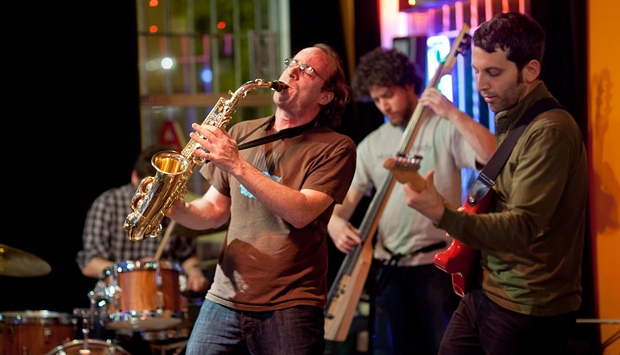

It is not that it never arrives at a satisfying formula. Each effort has opened up new paths of aural adventure for its followers. But Gutbucket is about more than art for art's sake. For its four members, the way they explore the properties of their instruments, and the modes of communication that reveal themselves as they interrelate while playing them, point to new ways of forging social interaction on a larger scale, toppling old orders and shaking things up.
Guitarist Ty Citerman spoke with All About Jazz about this search and aim, as well as Representing, by proxy, the band's three other members: Adam Gold (drums), Eric Rockwin (bass) and Ken Thomson (reeds). Speaking in slow, measured tones and choosing his words carefully, he reflected the methodical conscientiousness that goes into the process of making Gutbucket's music—scientific but very listener-conscious as well; and, to be sure, belying the apparent chaos of its promiscuous genre crossing, which on closer study has an order along the lines of an atomic orbit cascading through space with its colliding electrons.
All About Jazz: You have mentioned that you want to end global capitalism... I would like to know how politics plays through your music. Are you the leader of Gutbucket?
Ty Citerman: All good questions. I play a leadership role in the group, but the band is a collective. And I don't want that to sound like a cop out. We actually do function as a collective, which doesn't mean that everyone does the same thing. We all share writing duties, we all write music in the group, so there's the composer collective aspect, and then the actual functioning of the band, from scheduling rehearsals, running rehearsals, booking tours, or organizing the details around what our booking agent does for us—we do different stuff in that regard. Our saxophonist, Ken, and I do all the booking that's not done by our agent. So, back to your question: yeah, I play a leadership role but I'm not the leader.
And yes, I was serious about wanting to end global capitalism. Although that's a debate we have within the band. It's not a mission statement of Gutbucket. But I do think our music is political, both in its aesthetic and in how it falls outside of the mainstream. And I do think that human beings can come up with a better system than capitalism.
 AAJ: You always seem to be searching, jutting from one style to another—cut- and-paste. Does the mix-and-match style of your music say something in itself, politically?
 TC: I think our music has actually gotten less mix-and-matchy or cut-and-pasty over the last couple of years. And that I think varies from one writer in the band to another. Our bassist Eric, I think he was very much into the jump cut sound and structure for a while, but I think less so now, although his music still might hint at that. I think my music in the band tends to be more singular in terms of digging into one thing.
AAJ: You seem to be the rock link in the band. Ken is a very jazzy saxophone player.
TC: In some ways, although Ken wants me to play power chords a lot of the time. He gets excited about that. I think "Murakami" [Flock, Cuneiform (2011)] in some ways sounds more like a lot of free jazz in terms of pastiche and texture, and real thick, dense tones that are then covered by an improvised drum solo throughout the first three quarters of the song. So that's new terrain and more unified than a lot of other stuff.
It's interesting, what does it mean for a music to be political. Any time you get people together where the goal is to create something interesting and compelling—that by nature is political. And I guess it's political for people to sit down and say, "I want to write a hit song in order to make money..."
AAJ: Do you feel you are successful?
TC: I'm pleased with what we've done, and with what we're continuing to do. I think we're high profile in a certain music community. In a larger scheme of things we're not as high profile as a lot of equally compelling, interesting bands.
AAJ: England's Led Bib comes to mind.
TC: Yes. I think they're great... That stuff, it's funny. It's hard to measure. We can go to one city and have a very appreciative audience and then be relatively anonymous in another.
AAJ: The Honey Ear Trio has a similar approach, but with a swing and bebop base.
TC: With Allison Miller on drums... Her other group played at our CD release party. She's great.
AAJ: Two touchstones that occur to me for your band are John Zorn's Naked City and George Cartright's Curlew. How do you relate to them?
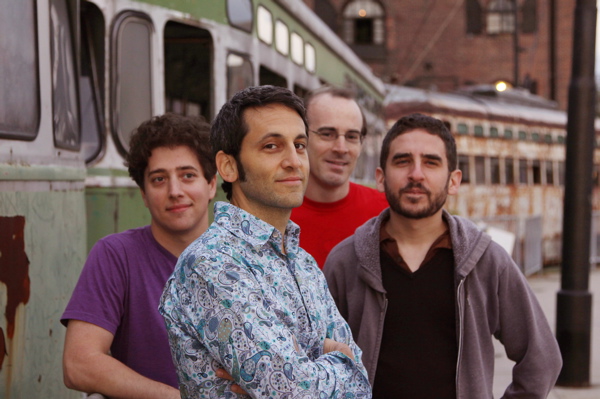
From left: Eric Rockwin, Ty Citerman, Ken Thomson, Adam Gold
TC: I don't actually know Curlew's music (though I know of them). Naked City is a group we argue about. There's a lot of push-and-pull where we debate and dissect a lot. We have an appreciation for Naked City, and certainly for John Zorn and all of his work, and for all the players in Naked City, who are incredible. We played at a jazz festival in Warsaw in 2003, and Naked City was performing, with guest vocalist Mike Patton. I seemed to be the one who liked it, and Ken and Eric, for sure, were not that excited about it. But I think Naked City has done some amazing things, especially in their heyday.
AAJ: Do you have any other bands that you admire and use as reference points?
TC: We're a group of music lovers. We're all people who have some relationship to playing rock, some relationship to playing jazz and some relationship to playing some kind of classical... I think as musicians we all have some relation to playing each of those three strains of music, and where we have more or less experience or interest varies from one to the other, but I think when we were starting out the band, I at least felt we were coming out of a jazz place that was kind of pushed in a certain direction by the nature of our instrumentation: when you have an electric guitar and an electric upright bass, that kind of defines your sound, in a way—just like if you have a saxophone, an acoustic bass and a piano, it defines your sound.
And we wanted to make music that had tunes and had improvising. I think that was our framework. We want songs, and we want improvising, and we want it to be performable. The idea of recording it actually came—it was in our heads—but I think what we are as a live band has evolved as we've let our imaginations run with our compositions. Really, a striking document of how we've developed as a recording band is what's happened from one CD to the next, and how that's evolved.
AAJ: You really strike me as a jazz band, and I think that's a good thing.
TC: I think there was a time we weren't sure perhaps, because the jazz scene wasn't having us, and the rock scene wasn't having us. But I think we've come to embrace playing a role in the jazz community. It struck me recently because I've been reading the Robin Kelley biography of Thelonious Monk [Thelonious Monk: The Life and Times of an American Original, Free Press (2009)], about how in the early years, in the '40s and early '50s, how Monk was both this pioneer and this kind of outsider—how he felt he was received by the press and some of his peers at times... We are part of the jazz world, even if we're not at the center: we occupy some space in the jazz world. It's not the same as Thelonious Monk's either.
 AAJ: T.S. Eliot wrote that great poets steal. You do a lot of stealing, in that sense. But what to you feel you are giving, or contributing to the music?
 TC: I think by nature the fact that we are the people we are, what we write won't be like what Vijay Iyer or what Jason Moran writes. But I think there's a really wonderful way we use the instrumentation. We have to create this kind of synergistic quality to the music. We've always prided ourselves on having a big sound, and one of the compliments I've looked to is when people after hearing us say, "I didn't understand how so much sound or how such a powerful sound could come from just four musicians." I think there's that quality to our music, and I think there's a really wonderful interplay between me and Ken as melodic voices, but I think beyond that, we also don't hold to the rigid definitions of the roles that our instruments play. There's a lot of counterpoint between all four of us, or there are a lot of passages where the drum is the primary melodic voice and the rest of us are supporting that. I think there's a fluidity that a lot of good bands have, and I think we really treasure that.
But what is our mark in history? I don't know! I don't think the jump cutting, attention deficit disorder thing is the key to what we do, but I do think there is forcefulness and a ferocity to what we do. And at the same time an ability to be very tender and delicate, so in that sense, not necessarily from one measure to a next, but that broad reach is something we pride ourselves on.
AAJ: How old were you when you started playing guitar?
TC: I think I was eight. I played violin for a couple of years, played recorder; then I switched to guitar.
AAJ: This would have been...
TC: 1982.
AAJ: The Prince-Madonna era.
TC: I was a big fan of Prince, not so much of Madonna, though I've come to appreciate what she does. I was a big fan of Prince and his multi-instrumentals and his guitar playing, his groove. I was really into Led Zeppelin. That was probably my first big guitar love. Van Halen, in the David Lee Roth era, especially, although I did see them in concert on the O U 8 1 2 tour. I grew up in St. Louis, which is big classic rock country, so Jimmy Page and Jimi Hendrix were the guys.
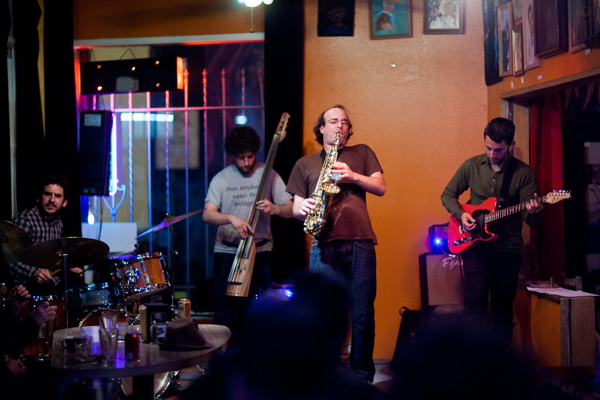
From left: Adam Gold, Eric Rockwin, Ken Thomson, Ty Citerman
I started playing in a band when I was 14. It was two guitars, bass, drums, and later we found a singer. And we kind of did The Rolling Stones and Beatless covers. And I started playing jazz, I guess in my middle school and then high school jazz bands. But I didn't really have much context for it. I was a kid who played electric guitar, and I liked playing music, and I had a band, but in school my instrument sort of dictated that I wasn't going to play in the concert band and for whatever reason I decided not to take up another concert band instrument. So I started playing in the jazz band and started learning these Count Basie tunes and Duke Ellington tunes, and Neil Hefti arrangements and Benny Moten swing—all these kind of big band songs. And I think I was encouraged to play in a Freddie Green style, without really knowing who Freddie Green was.
And that was my point of entry to jazz. And then I had a jazz band teacher after my junior year in high school, 1990-91. He was a trumpet player and he said, "Ty, the stuff you're playing is cool, but if you really want to learn how to play jazz guitar, this summer get yourself some Wes Montgomery records and learn to do everything he's doing!" And I was still playing in this rock band and that turned into this other band, and I was doing bar gigs when I was 16, or even 15 even, when a lot of my friend couldn't even get into the bar. But I actually did go out and buy some Wes Montgomery records and I listened to them and I was floored, and I had no idea how to play like Wes Montgomery. So I was still at a rudimentary level in the jazz world, but much more experienced playing rock and pop music. Towards the end of high school I also started getting into James Brown's music and really listening to his guitar players, and Parliament and Funkadelic, and really listening to those guys, like Blackbyrd McKnight and Eddie Hazel.
It was actually in college, where I met Ken, when we were both working at WKCR, Columbia's radio station, which has this phenomenal jazz record collection. That's when I started to get a bigger picture of jazz out of the big band era. People introduced me to The Art Ensemble Of Chicago and that blew me away. The free jazz movement, Albert Ayler—the first time I heard Ornette Coleman or Cecil Taylor—these were all musicians who were highly musically educated individuals who also play very freely. This was when my jazz education really started to open up.
I came to love Sonny Sharrock's music and James Blood Ulmer. With jazz I had this big band introduction, and then, rather than tracing my way chronologically through musical history I jumped to the '60s and '70s on the fringe of the avant-garde and then found my way around.
AAJ: There's Bird in your work, too.
TC: I love Charlie Parker. Trying to work through Charlie Parker's music is very hard for a guitarist! I had a guitar teacher who said, when I complained about that, "Yeah, but ask any saxophonist to play Jimi Hendrix and you'll get them shaking their heads, too!"
AAJ: Is that something you strive for in Gutbucket—maybe a contrarian ethic of trying the most difficult things—jumping across the bridge and trying things that are almost too difficult to try?
 TC: I don't think we try things that are difficult for the sake of being difficult, but I think we do, giving our commitment to the group, have a mentality that's understood, which is that each of us as composers can try things that challenge the others and that's welcome and that's interesting. I've played some notes on the saxophone but I'm not a saxophonist, but over the years I've learned what Ken can do, what's challenging for him, what's easier for him, and I'm writing for the saxophone but I'm also writing for him. And he's not a guitarist but he'll bounce ideas off of me, like "Is this possible on the instrument, or could it be—or would it require some sort of alternate tuning?" There is that elasticity in our music.
 AAJ: Can you tell us about the other band members? Ken seems to be the co- leader, though Eric, the bassist, has been with you for the long haul.
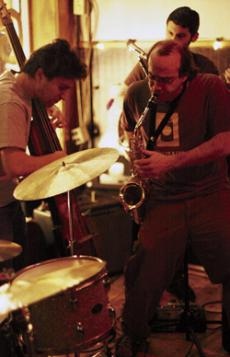 TC: The band is a collective without a single leader, but each of us plays a particular role. I think it was only on the recent CD, Flock, that Adam, our drummer, composed something that we recorded. So this is the first disc that has all four writing voices represented. So Eric's written a lot of material, Ken and I have written a lot, and we all contribute a great deal, in that regard.
 Ken studied classical clarinet, but taught himself alto saxophone, and has developed his own voice on that over the years. He also plays bass clarinet and baritone saxophone, and you hear all of that on most of our recordings, although he doesn't travel with those instruments most of the time. He's a wonderful improviser.
He's another person who has a very eclectic musical background. When he was in high school he played in rock and roll cover bands playing keyboards. As a very young child he would play around on the piano and write songs, and the way he tells it it was unfortunate his parents then decided to get him piano lessons because that frustrated him, someone else trying to define or direct something he was just naturally experimenting with. He started playing jazz saxophone, I guess as a teenager. Like me he has experiences with rock, with classical, with jazz. And he studied music in college. He's an interesting composer. He's written a lot for Gutbucket but he's also very connected to the Bang on a Can new music scene. He's gotten composer commissions from Bang On A Can, he teaches music at the Bang On A Can summer music institute.
AAJ: Eric seems very modest.
TC: Ken and I are the voices on the stage, more directly, verbally interacting with the audience. Eric may come across as being more modest, but I don't think he's modest at all! He's a great musician. His parents are both musicians, he started out as a saxophonist and switched to bass as a teenager. He just really worked at it and developed a sound and identity with the instrument that was really amazing—and at the same time has always had a love of songwriting, a great appreciation for popular music—The Beatles, the James Jamerson bass lines and Motown catalogue. But at the same time his dad was a classical trumpet player so Eric knows classical music pretty deeply and also started to get into jazz as a late teenager. I know he points a lot to the bass playing of Scott LaFaro as something that was very influential because LaFaro took the bass in a new direction: rather than the bass holding down the rhythm, playing four notes—walking—he was more of a melodic voice, and one of the earliest proponents of the bass as a melodic voice in modern ensembles.
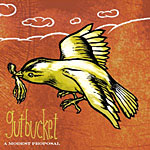
A lot of the music he wrote for A Modest Proposal (Cuneiform (2009)) he wrote in the middle of the night when we was trying to soothe his then-infant daughter back to sleep. I too have a daughter and couldn't imagine writing any music in that situation. We thought that when his daughter Lucy was born he would have to back up a bit, but he showed up a few months into her life with all these new tunes for us to play, and it was kind of a wonderful thing.
AAJ: Eric seems to be a very active bassist, but it's like a rushing river—it's almost like it's in the background even though it's so loud and so present. It's a good quality. It's unobtrusive. He's there all the time and supporting the band.
 TC: I think a lot of that comes from his choice of instrument, which, rather that playing an acoustic bass with a microphone or a pickup—or a standard solid body electric bass— which he plays in other situations; but in this band he plays a semi-hollow, bodiless, upright electric that has five strings, so it has this lower b-string. I think the sound of the instrument—he's developed the sound of it with this band. I think he actually got the bass a few months before he auditioned for the band in 1999. That instrument has this really wonderful combination of tone and depth and warmth but it also doesn't sound like a [Fender] Precision bass. And he can play arco, with a bow, and I love writing arco parts for him.
 AAJ: Now earlier you mentioned "Murakami," from Flock. It's reminiscent of Wayne Shorter's "Nefertiti" [from Miles Davis' Nefertiti (Columbia (1968)], the way you reverse the roles of the upper and lower instruments, and it sort of begins and the end and ends at the beginning...
 TC: When I was writing that I was concerned with very long- toned, thick, rich harmony and texture, contrasting it with the tune "Set the Trapeze to Gravity" (another that I wrote tune from Flock) which is very notey—although it's kind of a low register unison line. With "Murakami" I had the notion of creating music with a very dense sound, without the interruption of note articulation. Especially given that the band has been experimenting with looping pedals for number of years, it's something that I like to play around with in solo guitar endeavors as well. I love the synergistic effect of long tones looping and creating these dense harmonies.
 And so, with "Murakami" I thought it would be interesting to use the bass, guitar and saxophone for that, and let the drums add the notes, and the kind of percussive contrasting voice—and let it be improvised. Because we do have a lot that's so written and highly composed nowadays I thought it would be interesting to offer Adam the opportunity to explore. The beginning, the first two minutes of his part is composed, but it's very sparse, and once the tune reaches this moment where everyone kind of backs away, it begins this drum solo which I really love what he did with it. And basically he's given a departure and an endpoint, where we launch into the last section of the song.
AAJ: Are you into Japanese fiction like Haruki Murakami?
TC: Yes. Actually the title of that song came from a nonfiction book of his, What I Talk About When I Talk About Running (Vintage, 2008). I'm a runner, although not a competitive runner. He's a serious marathon runner, and his book is about how that parallels his work as a novelist. He talks about having a long-range perspective as both novelist and runner. I think the patience of Murakami, and the way it evolves so slowly and organically is what I was thinking about when I titled the song with it in mind.
I studied Japanese in college. I lived in Japan in the summer of 1994, outside of Kyoto. I wasn't thinking about writing music too much at that point, though at the same time there's a lot of interesting Japanese bands that I've become aware of, for example The Ruins.
AAJ: Now you are a very young band, but you've been together for a long time. Are you going to stay together? Gutbucket is such a great group. It's evolved so quickly, and it's got so much more room to evolve, I guess you can't even predict. But do you have any intentions?
TC: We all have somewhat different musical lives. But we're all very committed. All of us get a lot out of the group creatively.
AAJ: Going back to Monk: one difference between Gutbucket and Monk is this continual radical evolution—whereas Monk was pretty much defined stylistically very early on— 1950, even. He had a template and he just varied that template. He's one of the greatest artists who ever lived, but Gutbucket will make more of a mark, too, in the long run; even what you are doing now will be seen as having been significant and important work. That plus what you're going to be doing in the future: there's the inertia and momentum that you still have, but it really seems that there are some radical innovations to come.

From left: Eric Rockwin, Ty Citerman, Ken Thomson, Adam Gold
TC: I appreciate the prophecy. I know we'll continue to explore the way we do, and given the way the worlds of jazz and classical and rock—the genres are less stratified than they were 15 or even 20 years ago, there is this kind of fluidity in terms of performance venue, opportunities to collaborate. No one expects just one thing from Gutbucket—and perhaps if we become more famous someday, people will start to expect that; though I sincerely doubt that, because part of what defines the band is that it's a very expansive and broad-sounding group.
AAJ: Also your idealism: you're not there to just prove that you're innovative or clever; you have ideas about what music can do and how it can bring people together. The group itself is a collective...
TC: I think if we were out to prove something we would have lost steam a long time ago. So yeah, it's a deeper interest than that.
Selected Discography
Gutbucket, Flock, Cuneiform (2011)
Gutbucket, A Modest Proposal (Cuneiform, 2009)
Gutbucket, Sludge Test (Cantaloupe, 2006)
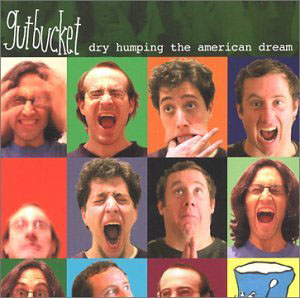
Gutbucket, Dry Humping the American Dream (Cantaloupe, 2003)
Gutbucket, Insomniacs Dream (Knitting Factory, 2000)
Photo Credits
Pages 1, 3: Daniel Sheehan
Page 2, 5: Natascha Rockwin
Page 4: Nestor Diaz
< Previous
Groove-O-Ly-O-Scene
Next >
Planetary Unknown
Comments

About Gutbucket
Instrument: Band / ensemble / orchestra
Related Articles | Concerts | Albums | Photos | Similar ToTags
GUTBUCKET
Interview
Gordon Marshall
United States
Ty Citerman
Ken Thomson
Led Bib
Honey Ear Trio
Allison Miller
john zorn
Naked City
Curlew
Thelonious Monk
V.J. Iyer
jason moran
Led Zeppelin
Jimmy Page
Jimi Hendrix
Rolling Stones
Beatles
Count Basie
duke ellington
Benny Moten
Freddie Green
Wes Montgomery
James Brown
Art Ensemble of Chicago
Albert Ayler
Ornette Coleman
Cecil Taylor
Sonny Sharrock
James "Blood" Ulmer
Charlie Parker
Bang on a Can
James Jamerson
Scott LaFaro
Wayne Shorter
Miles Davis
For the Love of Jazz
 All About Jazz has been a pillar of jazz since 1995, championing it as an art form and, more importantly, supporting the musicians who create it. Our enduring commitment has made "AAJ" one of the most culturally important websites of its kind, read by hundreds of thousands of fans, musicians and industry figures every month.
You Can Help
To expand our coverage even further and develop new means to foster jazz discovery and connectivity we need your help. You can become a sustaining member for a modest $20 and in return, we'll immediately hide those pesky ads plus provide access to future articles for a full year. This winning combination will vastly improve your AAJ experience and allow us to vigorously build on the pioneering work we first started in 1995. So enjoy an ad-free AAJ experience and help us remain a positive beacon for jazz by making a donation today.

Giveaway

Eligible winners: 15
Days remaining: 4
Days remaining: 4