Home » Jazz Articles » Live Review » Day 11 - Festival International de Jazz de Montreal, July 8, 2006
Day 11 - Festival International de Jazz de Montreal, July 8, 2006

As the 27th edition of the Montreal Jazz Festival heads for the home stretch, two unique and diverse performances showed why it is one of the largest and most successful jazz festivals in the world. For many years, Montreal's festival has succumbed to the temptation to bring in big names which are at best (if even) peripherally associated with the broader jazz continuum. But it still brings in more than enough diverse jazz acts to justify its name. Every year it also manages to bring in artists who don't play any other festivals, giving the event a unique draw which attracts fans from around the world to come every year. Media coverage from across the globe also helps make it a truly international event.
For the final day of its four-day run, the Suono Italia series featured pianist Enrico Pieranunzi, who is finally gaining international exposure through a series of records for the Italian Cam Jazz label, including Fellini Jazz (CamJazz, 2004) and Duologues (CamJazz, 2005). But while North American audiences may be most familiar with these Cam Jazz releases, Pieranunzi also has a lengthy discography on EGEA, which sponsored the Suono Italia series, including Trasnoche (EGEA, 2004) and Les Amants (EGEA, 2004). ALIGN=CENTER> 
While Pieranunzi's earlier EGEA releases fully reflected the label's Mediterranean aesthetic, his latest, Danza di Una Ninfa: Storie de Tenco (EGEA, 2005), co-led by singer and composer Ada Montellanico, is a different kind of album. The label has made that clear by abandoning its usually austere jewel case packaging for a colorful digipak designed by Cecilia Valli. This release brings much-needed exposure to the work of Luigi Tenco, whose tragic suicide in 1967 at the age of 28 robbed the world of a distinctive poet and songwriter.
Danza di Una Ninfa features an extended ensemble which includes woodwind multi-instrumentalist Paul McCandless of Oregon fame. For the group's performance last night at the Place des Arts Cinquieme Salle (an intimate room about the same size as the 450-seater Gesu), Pieranunzi and Montellanico brought a pared-down quintet. Along with McCandless, the group also featured bassist Luca Bulgarelli and drummer Walter Paoli. While the music had a strong overall European flavor, it was—like Pietro Tonolo's ensemble from the previous night—also closely aligned with the American tradition, as manifested by its harmonic perspective and at least some element of swing. But there was also a strong taste of Italian folk music, along with an American folk approach sometimes used by McCandless. It made for an intriguing combination.
Even though McCandless is an in-demand player, he never seems to appear very high on the radar of jazz listeners. Perhaps that's because of the fact that even though he understands the language of jazz, he doesn't completely operate within its sphere—his 35 years with the seminal cultural boundary-busting group Oregon provide but one example of this. However, he's a fine improviser on the more difficult double reed oboe and english horn. His classical background also changes the complexion of his solos, as does the textural variety he introduces by playing (in addition to oboe and english horn) soprano and sopranino saxophones, penny whistle, wood flutes and bass clarinet. He's also a fine tenor player, as he demonstrated on Shapeshifter (Synergy, 2004), where he played convincingly close to the tradition's center. ALIGN=CENTER> 
Last night's show featured a combination of music and lyrics by Tenco, as well as some unpublished poetry by Tenco put to music by Pieranunzi or Montellanico. It also featured a couple of new tunes, including one where Pieranunzi made his debut as a lyricist. Only Italian speakers could know how good a wordsmith he is, but Montellanico—who encouraged him to take the leap—seemed happy enough to be singing them.
Montellanico is a treasure of a singer who has great technical facility and a strong range—sounding, in some ways, like an Italian Flora Purim. Her terrific articulation allowed her to scat along with Pieranunzi and/or McCandless on some particularly difficult up-tempo tunes. Her most appealing quality is her avoidance of the kind of vocal showboating in which singers so often indulge. Montellanico may not be as subtle as Swiss/Dutch singer Susanne Abbuehl, but neither did she rely on pyrotechnics. Instead, she interpreted the songs with reverence, delivering the lyrics passionately and adding some lovely improvised scats throughout the show that were perfectly in keeping with the material's overall elegance.
Pieranunzi continued to impress with an approach that can range from abstraction to clear definition. Like McCandless, his solos are the epitome of construction, building from initial motifs in spontaneous and fully conceived ways. A sensitive accompanist, he built layers of harmony beneath Montellanico that complemented her but also led her in new directions, whether on a bright up-tempo swinger or a melancholy ballad.
Bulgarelli and Paoli make a fine rhythm section with wide-open ears. Paoli in particular seemed to be able to anticipate many of the moves of those around him, adding shots that were never non sequiturs. Both were delicate accompanists, although Paoli often hinted at more power. But on the rare occasion that he received some solo space, Bulgarelli proved himself a melodic player with a deep and inviting tone.
The majority of the solo space was reserved for Pieranunzi and McCandless, and McCandless shone the most, if only because he's proven—through a wide range of collaborations with musicians including banjo player Bela Fleck, pianist Art Lande and bassists Eberhard Weber and Jaco Pastorius—to be such a highly adaptable player. He may not receive the critical kudos he deserves from the trade periodicals, but anyone who's familiar with his work knows that he brings a special, broadly influenced improvisational quality to any project. His work during last night's performance was further evidence of his ability to fit any context, and he clearly shared a strong rapport with Pieranunzi.
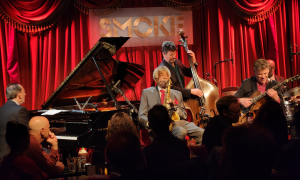
 When his name was announced at the start of his 10:30 pm performance at Gesu, clarinetist Don Byron came out in a beige suit and hat that were perfectly in keeping with the tribute he was paying to the trio of Lester Young, Nat Cole and Buddy Rich, who served as the inspiration for his most recent album, Ivey-Divey (Blue Note, 2004). "Grammy blah, JazzTimes blah, Byron self-effacingly said when he addressed the capacity crowd after the first couple of tunes, culled from the disc, featuring pianist Jason Moran and drummer Billy Hart (who replaced Jack DeJohnette from the record). "It's a good record. It's yellow—you can't miss it, Byron continued.
Byron, a member of Mensa, may have a brilliant mind, but he knows how to establish a connection with his audience and never comes off as too cerebral. In fact, the entire ninety-minute set was characterized by deep passion for the music. The material included the music of Lester Young; Byron's own music from a soundtrack where he was asked to put to music the infernal arguing of a couple that have simply been together too long and don't care who hears them arguing; and brilliant interpretations of Miles Davis' title track to In a Silent Way (Columbia, 1969) and "Freddie Freeloader," from Miles' classic Kind of Blue (Columbia, 1959). The set also reflected a dry sense of humor and a shared cameraderie between Byron, Moran and Hart.
While virtuosic, Byron's playing was firmly grounded in the material, which spanned more than half a century. His impassioned delivery was an edgy alternative to Gabrielle Mirabassi's more overtly lyrical performances at the Suono Italia series, but he didn't operate in any kind of vacuum. The interplay between the members of the trio allowed "In a Silent Way to transform from the more inside reading on the disc into a dramatic tour-de-force, ranging from the delicate statement of its theme to the more aggressive stance of Moran's solo, where he sometimes seemed to violently attack his piano.
Jason Moran is something of a curiosity. While Soundtrack to Human Emotion (Blue Note, 1999) was a strong debut from this young artist, his subsequent records, though critically acclaimed, have been somewhat inconsistent. He may in fact shine more as a support player, in particular on records with saxophonist Greg Osby. Last night's performance was in character; Moran is especially adept at taking music from, say, sixty years ago and applying a more modernistic bent. ALIGN=CENTER> 
Billy Hart may not have DeJohnette's cachet, but he should. A listening drummer with a surprising flair for the unpredictable, his open-minded approach to the material found him swinging with bluster when required, but equally capable of adopting the textural approach that some of the music demanded.
Byron, who is usually known for his clarinet work, reacquainted himself with the tenor saxophone for Ivey-Divey. With a couple of years under his belt since the recording, he's developed a tone that's not as harsh or brash as some but, instead, possesses a softer tone that is in keeping with Young's own sound. Byron's emotional involvement with the music was clear: he occasionally jumped out of his chair and uttered raspy "ows when he executed a particularly difficult phrase or wanted to express appreciation for Moran and Hart.
That appreciation was also shared by the audience. Montreal audiences are known around the world as some of the most appreciative, and the demand for an encore—as has been the case at all the shows attended over the past four days—was completely heartfelt and never felt perfunctory or attached to entitlement. It's why artists come back to Montreal year after year, and with shows as strong as Byron's and as unique as the Sonora Italia series, it's also why a significant number of fans also make the Montreal Jazz Festival a regular destination.
Tomorrow: The festival's Le Grand Concert de Cloture closes out the 27th edition of the Montreal Jazz Festival with a large multimedia show featuring the Balkan music of Goran Bregovic.
Visit Ada Montellanico, Don Byron and Festival International de Jazz de Montreal on the web.
Photo Credit
John Kelman
< Previous
Soft Machine: Grides
Next >
Copperopolis
Comments

About Enrico Pieranunzi
Instrument: Piano
Related Articles | Concerts | Albums | Photos | Similar ToTags
For the Love of Jazz
 All About Jazz has been a pillar of jazz since 1995, championing it as an art form and, more importantly, supporting the musicians who create it. Our enduring commitment has made "AAJ" one of the most culturally important websites of its kind, read by hundreds of thousands of fans, musicians and industry figures every month.
You Can Help
To expand our coverage even further and develop new means to foster jazz discovery and connectivity we need your help. You can become a sustaining member for a modest $20 and in return, we'll immediately hide those pesky ads plus provide access to future articles for a full year. This winning combination will vastly improve your AAJ experience and allow us to vigorously build on the pioneering work we first started in 1995. So enjoy an ad-free AAJ experience and help us remain a positive beacon for jazz by making a donation today.

Giveaway

Days remaining: 2