Home » Jazz Articles » Live Review » Day 10 - Festival International de Jazz de Montreal, July 7, 2006
Day 10 - Festival International de Jazz de Montreal, July 7, 2006

As the Montreal Jazz Festival has continued to grow in size, one of the problems it has faced is finding enough suitable indoor venues to accommodate the growing number of series that are still within walking distance from the core of the festival, which is at the city's Place des Arts. The Suono Italia series, for example, takes place at Cabaret, a small club that's a good fifteen minute walk from festival headquarters. But it's worth the walk: the series has been uniformly excellent and introduced a wide variety of Italian artists to festival audiences from around the world. The Chapelle Historique du Bon Pasteur is even further away—another five minutes past Cabaret. But it's a wonderful venue, set inside an historic church, but with a small but modern room that, seating less than a hundred people, feels more like a house concert than a festival event.
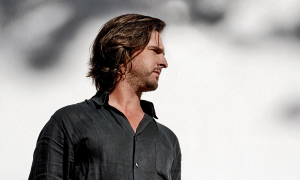
 Jean Michel Pilc continued the Piano Solo a Bon Pasteur series, which has been running since the start of the festival. An immensely talented and creative pianist, Pilc is probably best known to North American audiences for his recent trio recording Live at Iridium, New York (Dreyfus Records, 2005). But at his 5 pm show yesterday afternoon, he proved himself equally capable in a solo piano context.
Pilc is a curious reflection of the kind of stream-of-consciousness playing that characterizes Keith Jarrett's solo work, but not everything he performed was pulled out of the ether. Pilc referred to written music at various times throughout the seventy-minute performance. Still, whether he was interpreting Schubert, Ellington, Gershwin, Monk or his own material, including "The Land Suite," he treated even the most through-composed music with a rare degree of freedom.
A dynamic player with incredible dynamic control, shifting from pianissimo to fortissimo in the blink of an eye, his improvisations ranged from serious and thought-provoking to light and humourous. Pilc possesses a dry sense of humour, and he chose to single me out while I was busy taking notes at a point during the show where he actually had the audience clapping along with a quirky but nevertheless rhythmically defined passage. With little choice in front of the one hundred or so attendees, I summarily dropped the pen and brought my hands together along with the rest of the audience. Embarrasing? Yes—but proof that a solo recital can be more than satisfying music; it can be fun as well.
Not all of Pilc's performance was light, however. Capable of converting the most familiar pieces into more abstract music, Pilc played a medley of songs written or made popular in the jazz world by John Coltrane. He introduced individual songs serially, but by the medley's end, they had all magically converged into a truly remarkable integrated whole. When interpreting his own material, he would juxtapose dynamic flourishes of cascading notes with delicate embellishments, exploring the full range of his instrument's possibilities—including pressing on strings inside the piano while pressing the keys to create a staccato effect, and tapping the strings and/or piano body to create a percussive sound that nevertheless also contained an abstract harmonic component.
Some might find a certain melodramatic bravado in Pilc's music. But while he could and sometimes did take things to the extreme, his innate sense of humour almost always prevented him from being taken too seriously. There's no doubt thaat Pilc is a serious musical contender, but by keeping a certain levity with the audience, even during the most powerful parts of the performance, he demonstrated something that the all-too-serious Keith Jarrett, despite his significance as an artist, seems to lack: a self-efacing levity. And that made this show one of many festival highlights.
Drawing on a wealth of material with which most North American audiences are unfamiliar, saxophonist Pietro Tonolo continued the Suono Italia series with a 7 pm performance at Cabaret. As has been the case with the entire series, it continues to present the unique Mediteranean aesthetic of the EGEA label and its roster. While the album from which the material was drawn, Italian Songs (EGEA, 2005), featured a group of North American-based musicians including pianist/accordionist Gil Goldstein, bassist Essiet Okun Essiet and drummer Joe Chambers, only Goldstein was at the performance. Pianist Paolo Birro, bassist Pietro Leveratto and drummer Alfred Kramer fleshed out the ensemble, changing the group's complexion, but the performance were no less compelling than the album.
 Goldstein is a remarkable musician and arranger. He may not show up on the larger listening public's radar, but many people have heard his work. He has created new arrangemments of classic material by Herbie Hancock, John Coltrane and Ornette Coleman for the SF Jazz Collective; participated in both the recording and tour of guitarist Pat Metheny's Secret Story (Geffen, 1992); and arranged/conducted the music on trumpeter Chris Botti's To Love Again: The Duets (Columbia, 2005).
But too few people recognize his talents as a player, and at last night's performance he showed why Tonolo had recruited him for the project. Fully conversant with the sometimes folkloric nature of the writing on Italian Songs, Goldstein also comes from the jazz tradition, and he brings that harmonic sensibility to the accordion. The accordion is often the butt of musicians' jokes, but in the hands of Goldstein—and, for that matter, the other accordionists who have performed at the Suono Italia series this year—it's a totally relevant instrument, not just for the cultural nature of the Italian music which EGEA emphasizes, but for music in general. Goldstein found ways to broaden its textural possibilities, and when he took a solo, it was passionate and undeniably jazz-centric.
Tonolo's generally deadpan persona on stage may suggest a lack of emotion in his playing. But while he does favour strong melodism, and even when he goes to the border of his musical box and stretches a bit beyond it, the material always reflects a strong relevance and a deep commitment. But more than any other Suono Italia show thus far, the performance by Tonolo and his group were as much about playing and soloing as the actual meat of the compositions. The band even swung at times, with Leveratto and Kramer providing a soft but insistent pulse throughout. Neither the bassist nor the drummer received many opportunities to solo, but when they did, they were just as concerned with the core of the material as Tonolo, Goldstein and Birro.
Birro proved himself an astute acompanist and soloist—like Goldstein and Tonolo, fully conversant with the language of jazz and culturally-informed material by Italian composers including Enrico Morricone, Paoli and Peiro Piccioni. While some of the material Tonolo's quintet played was sourced from Italian film scores, this performance focused on the improvisational potential of the material, much the way trumpeter Enrico Rava did on La Dolce Vita (CamJazz, 2005). This was a significant contrast to Ensemble Misto's performance the previous evening, which was more about interpreting Enrico Blatti's detailed compositions than improvisational interplay.
The group also differentiated itself in the interaction that went on throughout the performance. Most times the chemistry was understated in nature, and Kramer often reacted, but so subtly that it was felt more than heard. And the way that Birro and Goldstein worked together as accompanists during Tonolo's solos demonstrated the kind of open ears that prevented them from stepping on each others' harmonic toes—a clear challenge that any group with more than one chordal instrument faces.
One of the show's highlights was a folkloric duet between Tonolo and Goldstein—perhaps the most visual song of the set, evoking images of small Italian villages under a hot Mediterranean sun. Like many other songs during the 75-minute performance, which was well-received by an audience which would not take no for an answer by the end, the melodies often seemed familiar, but with slight twists and turns that took them to unpredictable places. ALIGN=CENTER> 
The show's closer was a curious piece that, by juxtaposing free improvisation with stronger form, demonstrated the breadth of these fine players in a way that the more overtly melodic material did not. It may not have been jagged or abstruse, but it showed that Tonolo and his group can expand EGEA's Italian-centric aesthetic and take more risks.
One of the advantages of living in Ottawa, which is very close to Montreal, is the crossover factor between the Ottawa and Montreal jazz festivals. It allows a unique opportunity to see the same group days apart, and discover just how much of the music is scripted and how much is truly spontaneous. Vibraphonist Stefon Harris and his band Blackout put on a terrific performance in Ottawa on June 27 at the festival's main outdooor stage, even though it was poorly attended because of inclement weather. Still, they had the small audience buzzing afterwards, giving everything they had despite the less-than-perfect conditions. Their performance at the Montreal festival's Gesu theatre was even more exciting and open-ended.
This band has made significant leaps beyond its fine debut, Evolution (Blue Note, 2004). King Crimson co-founder Robert Fripp always described his group's studio albums as love letters, its performances hot dates. The same could be said about Blackout. But what is most striking about comparing the two shows is just how different they were. There was no setlist, even though the Ottawa and Montreal performances shared some common tunes. Instead it was totally unscripted, and the group's totally open approach to the material made it a highlight of both festivals. Blackout might have repeated a tune, but each interpretation was completely different.
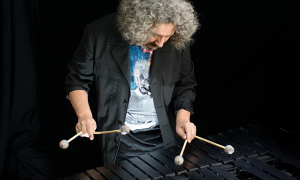
 The group opened with a lengthy medley of two pieces: Harris's title track from Evolution and Cary's "Gentle Wind." What has become increasingly clear is how Harris—aside from his clear virtuosity—can integrate vibes and marimba into almost a single instrument. Placing them perpendicular to each other, Harris is able to move effortlessly between the two. But even more significantly, he can play on both at the same time, his right hand mallets on the vibes, his left on the marimba. In doing so he created a denser texture that combined the vibraphone's more bell-like tone with the marimba's deeper tone, creating a new sound that's greater than the sum of its parts. Watching Harris' head move rapidly back and forth between the vibes and marimba highlighted just how difficult this integration can be, and while it was clear that he was working hard, the music never felt that way.
In many ways a bandleader in name only, Harris never placed technique ahead of the music. He understood the importance of space—which was especially effective on his solo intro to Sting's "Until," also from Evolution. Although he contributes the majority of the writing, it's clear that Blackout is a real collective where everyone's on equal footing and anyone can be the motivating force behind the shape the music takes. His introduction of his bandmates—Cary, bassist Derrick Hodge, altoist/keyboardist Casey Benjamin and Terreon Gully—demonstrated the kind of trust and mutual respect that explain why Blackout is evolving into one of the finest working units on the scene today. It's capable of a near-perfect combination of spontaneity, complex composition, visceral energy and sheer soulfullness that few other bands can acheive in a similar space.
Harris—as comfortable communicating with the audience as he was in Ottawa—explained that there was no setlist, and so every night is just a matter of waiting to see what happens. Of course, the individual players created signposts by introducing each new song with an opening solo. Derrick Hodge's bass solo led to a medley that began with a Blackout piece but ended up as a kind of free-for-all medley of Monk tunes. The excitement of never knowing exactly where any given tune would end up infected both the group and the audience.
Individually and collectively, these players deserve—and, for the most part, are receiving—greater recognition. Gully is a force of nature, powerful when required, but also capable of greater delicacy. But he's always listening to what's going on around him, and sometimes he almost seems to respond to an idea before another player is even finished getting it out. Hodge can be a solid anchor, but he's an equally responsive player; he and Gully make an expansive and capable rhythm section well beyond the norm.
Cary's piano work is filled with the harmonic language of the tradition, but he's equally capable of creating synthesizer tones that are more textural in nature, and it's about time that people began to explore his own not insignficant discography. Benjamin may be the least well-known of the quintet, but that's not likely to last. A fine alto player who combines a pure tone with occasional electronic processing, he's clearly in tune with the greater jazz vernacular, just like Cary. But he's also hip to contemporary ideas, and his solos demonstrated a vivid blend of old-school bop and new-school soul.
When the group performed a tune that found Benjamin bringing out his vocoder, as he did in Ottawa, it provided evidence of just how differently Blackout can treat even the material they perform night after night. In Ottawa, Benjamin's vocals were backed by a sensual funk groove; in Montreal, it was a more rubato treatment. Gully played more texture and less backbeat.
ALIGN=CENTER>  Harris is releasing a new large ensemble disc in October, and Blackout will head into the studio around the same time to record a followup to Evolution. So the next couple of years are going to be exciting for anyone who has been following the mallet player since he emerged in the mid-1990s. These two projects will no doubt place Harris' deep musical thinking front and center, but the Blackout disc wiil most likely also evince a greater passion and soulfulness that's less visible on impressive but more cerebral albums like Grand Unification Theory (Blue Note, 2003). Clearly Harris has found a balance between head and heart. One can only hope that not only will he be able to maintain this equilibrium, but Blackout will continue to be an ongoing concern for years to come.
Tomorrow: Pianist Enrico Pieranunzi and singer Ada Montellanico's Danza di Una Ninfa project featuring with Oregon woodwind multi-instrumentalist Paui McCandless, and clarinetist Don Byron's Ivey Divey project.
Visit Jean-Michel Pilc, Stefon Harris and Festival International de Jazz de Montreal on the web.
Photo Credit
John Kelman
< Previous
Twenty Five
Next >
Tennis Balls & WBEZ Balls
Comments
Tags
For the Love of Jazz
 All About Jazz has been a pillar of jazz since 1995, championing it as an art form and, more importantly, supporting the musicians who create it. Our enduring commitment has made "AAJ" one of the most culturally important websites of its kind, read by hundreds of thousands of fans, musicians and industry figures every month.
You Can Help
To expand our coverage even further and develop new means to foster jazz discovery and connectivity we need your help. You can become a sustaining member for a modest $20 and in return, we'll immediately hide those pesky ads plus provide access to future articles for a full year. This winning combination will vastly improve your AAJ experience and allow us to vigorously build on the pioneering work we first started in 1995. So enjoy an ad-free AAJ experience and help us remain a positive beacon for jazz by making a donation today.

Giveaway

Days remaining: 13