Home » Jazz Articles » Live Review » Day 2 - Festival International de Jazz de Montreal, June 29, 2006
Day 2 - Festival International de Jazz de Montreal, June 29, 2006

Day 2 began with a blast. Performing at the same venue and time slot as Brad Mehldau on Day 1, John Zorn's Acoustic Masada had one of the best sets in recent festival memory. Before the concert began, the Theatre Maisonneuve, which holds approximately 2000 people was sparsely filled, making Zorn's appearance there seem strange. This venue is usually used during the festival for a wide range of performers (Dee Dee Bridgewater plays Day 3 there for example) who have massive followings. Given the type of music that Zorn would present, it seemed Acoustic Masada (Zorn on alto, Dave Douglas on trumpet, Greg Cohen on bass and Joey Baron on drums) would have been better suited for a Contemporary Art Museum of Montreal gig or maybe a late evening at the Gesu Creative Center. But just before show time, the hall was filled almost to capacity with one of the rowdier crowds this correspondent has seen at the Festival. Much like in his home base of New York, Zorn attracts a particularly eclectic crowd.
For the next hour, the whooping crowd was treated to Zorn's highest accomplishment - his Masada songbooks. But where, for example, the Masada String Trio is delicately beautiful, Acoustic Masada (and Electric even more so) is a raucous affair, a hyper energetic mix of Zorn's love of bebop and Jewish musics. The show was remarkable if only for the fact it seemed to go too fast for both the performers and the audience - not in length but in pace. Across 60 minutes, the quartet played quite a number of tunes, either featuring Zorn's bleating alto, Douglas' strident horn or some part of the wonderful rhythm section of Cohen and Baron. An example of how the hurtling momentum could not be stopped was when Baron broke his bass drum pedal during one portion of a song and Zorn seemed to have fun having the set continue uninterrupted (he would later break another one). Throughout, as befits a composer of his stature, Zorn knew what he wanted precisely, calling for more more more drums, or starting and stopping the various sections of each piece. For those who may not be completely enamored of all of Zorn's various projects (and his playing in them) should pay close attention to him in Acoustic Masada. Here he displayed his legendary bebop skills and his moments of screeching dissonance were always in service to some beautiful melodies. One particular highlight of his playing was a brief circular breathed segment into which Zorn somehow managed to intersperse percussive pops. After the performance was completed, the crowd gave such a loud standing ovation that the band came back for two sets of encores, including as Zorn put it, "in the tradition of Masada, a world premier . [Note: photography was disallowed at this concert.]
Going to three shows after such an experience was difficult. And while the three were well played, most of this correspondent's energy was spent by 7:30 pm. The next concert was the second installment of Bireli Lagrene's Invitation Concert Series. After an evening of solos and duos with accordionist Richard Galliono, Lagrene brough his New Gypsy Project to the Theatre Jean Duceppe, a smaller theater than Maisonneuve located directly below. The last several years of the Invitation Series have taken place at the charming old Momument National, just off the festival site. Its classic ambience was slightly missing. Lagrene's set was also energetic in its way, with lots of virtuosic playing by the leader. His articulation is near perfect and his recreation of a very old form was quite authentic. But since there was no real updating of that form, the point seemed to be to prove that the quartet (Lagrene with Franck Wolf on tenor and soprano saxophones, Hono Winterstein on second guitar and Diego Imbert on double bass), could play this music as fast and flawlessly as possible. It does seem that a certain flashiness is always expected from guitarists, especially one as indebted to Django Reinhardt and the addition of a second guitar, who grounded the proceedings with a constant rhythmic pulse in lieu of drums, made that flashiness easier to accomplish.
Moving to one of Montreal's more intimate venues (the Contemporary Art Museum's basement performance space), the next performance was by Joost Buis Astronotes. This ten-piece ensemble is made up of some of the fine players that must make Holland a wonderful place to hear music. The leader is a veteran of ensembles like Willem Breuker's and Ab Baars' but on his own, he is a compelling and generous composer. The Astronotes instrumentation - Joost Buis - trombone; Jan Willem van der Ham - altosax, bassoon; Tobias Delius - tenorsax, clarinet; Frans Vermeerssen - baritonesax; Paul Pallesen - guitar; Wilbert de Joode - contrabass; Alan Purves - percussion; Michael Vatcher - percussion; Achim Kaufmann - piano; and a trumpeter who was not a regular in the group - gives Buis a wide palette to use for his writing. What made this performance different than say the ICP was the very deliberate arrangements, which kept any ragged freedom to a minumum. And what kept it interesting were the various sub-groupings that arose throughout the concert, making it obvious that Buis is more interested in texture than bravado (and any chance to see the wonderful Delius should not be missed). One strange thing about the performance was that even though the song titles and the brief explanations that Buis gave for them were not particularly amusing, the audience tittered and roared during the pauses between compositions. One wonders whether other groups from Holland have not made it inevitable that Dutch groups are considered funny entertainment. For most of the performance, the music was not especially quirky or bombastic but there may have been a case of transferance going on in the crowd.
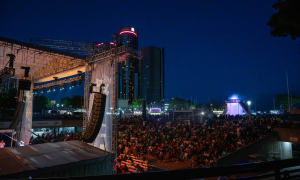
[On a side note: normally the festival is a marvel of organization but the free outdoor performance by the Neville Brothers tested everyone. Moving through the crowd in between sets - as the venues are normally within a few minutes walking distance - was a challenge. A photo is included for reference]
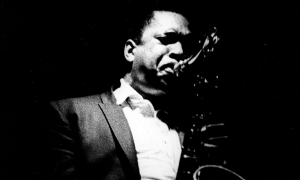
The final performance of the evening for this correspondent was at his favorite venue of years' past - The Gesu Creative Center, a lovely warm venue in the basement of a church, holding no more than a few hundred people. At other editions of the festival, this room has been used for some really inventive performers but this year it is the small ensemble room. The first group to perform there was Ravi Coltrane's Quartet with Luis Perdomo (piano), Drew Gress (bass) and E.J. Strickland (drums), making its festival debut. In brief, this was a fairly pedestrian performance. While it is safe to assume that the younger Coltrane is not trying to gain advantage from his name, listeners might be excused for assigning him greater achievement because of it. There are many other saxophonists of the same age who are of the same talent level or higher and who write more interesting music. Coltrane's tone is a little thin and his soloing can often come across as perfunctory. Such was the case here. It is hard to fault Coltrane but, like New York Yankee fans and Alex Rodriguez, one expects more for some reason and is usually disappointed. Not too say that the performance was unpleasant - the rhythm section was strong and inspired - but perhaps there was little left for Coltrane at 11 pm when Acoustic Masada had ended almost five hours before.
Your correspondent is off to a wedding today back in the States. Coverage will be taken over for Day 3 by local writer Mathieu Belanger.
Photo Credit
Andrey Henkin
Tags
PREVIOUS / NEXT
Become a Sustaining Member

Since 1995, All About Jazz has championed jazz as an art form and supported the musicians who create it. Over three decades, it has grown into one of the world's leading jazz resources, serving hundreds of thousands of readers, musicians, presenters and industry professionals each month.
Help Build the Future of All About Jazz
Your support helps us continue building All About Jazz for the next generation—expanding our editorial coverage, preserving jazz history, developing new community features and creating better ways to discover the music and the people behind it.
Become a sustaining member for as little as $20 per year and you'll immediately enjoy an ad-free experience along with access to subscriber features and future articles for a full year.
Together, we're not simply sustaining All About Jazz—we're building its future. Thank you for being part of the journey.