Home » Jazz Articles » Big Band Report » Buddy Rich: In a Zone of His Own
Buddy Rich: In a Zone of His Own

The Best Keeps Getting Better
As if things weren't impressive enough already, Ken Poston has announced a special Sunday event to be held as a part of the Los Angeles Jazz Institute's Big Band Spectacular, set for May 23-26 at the L.A. Marriott Airport Hotel. The Sunday brunch, under the rubric "Birth of the Cool and Origins of the West Coast Sound," will consist of three concerts: The Real Birth of the Cool (Music of Claude Thornhill), The Birth of the Cool (Music of the Miles Davis Nonet) and Miles Ahead (The Classic Miles Davis +19 Collaboration with Gil Evans). Details are being finalized, but each group will feature star soloists and other special guests. The $75 cost covers the three concerts and brunch.
In addition to Sunday's special event, two more bands have been added to the weekend lineup, bringing to eleven the number of groups scheduled to take part. The newcomers are big bands led by Don Menza and David's Angels. They join the ensembles already signed and ready to play: The Bill Holman, Tom Kubis, Mike Barone and Steve Huffsteter bands; Gordon Goodwin's Big Phat Band; Bob Curnow's L.A. Big Band; Roger Neumann's Rather Large Band; the Kim Richmond Concert Jazz Orchestra, and the L.A. Jazz Orchestra playing the music of William Russo. For information or reservations, phone 562-200-5477 or go online to www.lajazzinstitute.org
The New York What . . . ?
I don't know how it slipped past me, but I never knew there was a New York Jazz Museum. Apparently, it opened in 1972 and lasted only about five years, brought down by a struggle for control within its ranks that led to lawsuits and its demise. The story of the ill-fated museum is recounted in a new book, Jazz Expose: The New York Jazz Museum and the Power Struggle That Destroyed It, written by Howard Fischer, the museum's founder and executive director. For information about the book, phone Howard Fischer, 212-864-1479. An e-book version is available at Amazon.com and Smashwords.
The Wilbur Ware Institute
Unlike the New York Jazz Museum, the Wilbur Ware Institute, also founded in the 1970s, continues its mission to preserve the history of jazz as seen and experienced by the innovators and master musicians who create, perform and perpetuate the art form. This is done by creating performance opportunities, seminars, workshops and other educational opportunities by and enlisting the musicians as primary sources while focusing on young people and using seasoned members of the community. The Institute is named for bassist Wilbur Ware who died in September 1979. Among the organizers were Ware's widow, Gloria, and Clifford and Sandra Jordan. It also seeks to ensure appropriate compensation and benefits for musicians, to establish a mentoring program that includes pairing master musicians with novices, and to seek greater national and international exposure within mainstream and popular culture for these music masters, using whatever technology and techniques prove effective, with an over-all goal of perpetuating the music that has been called "America's National Treasure." For information, phone / fax 347-523-9886 or go online to www.wilburwareinstitute.org
Savannah Music Festival to Welcome High School Bands
Swing Central Jazz has chosen a dozen high school jazz ensembles to take part in the 2013 Savannah (GA) Music Festival. Participating students will interact with professional jazz musicians, perform in showcases on Savannah's River Street, play in competition rounds, and attend a variety of SMF performances during their three-day stay, from March 27-29. The bands will be competing for $13,000 in cash awards. The bands are:
Agoura (CA) High School Studio Jazz Band; Agoura High School Jazz Band "A"; Charleston (SC) School of the Arts Jazz; Camden (NJ) Creative Arts Jazz Band; Denver (CO) School of the Arts Jazz Workshop Orchestra; Downers Grove South (IL) High School Jazz Ensemble; Grissom (AL) High School "A" Jazz Band; Lower Moreland (PA) High School Jazz Ensemble; Overton (TN) High School Blue Jazz Ensemble; Savannah (GA) Arts Academy Jazz Band; Tarpon Springs (FL) High School Jazz Ensemble; Lovett (GA) High School Jazz Ensemble.
The 2013 Swing Central Jazz clinicians are Jim Ketch, Marcus Printup, Terell Stafford: trumpet; Bill Kennedy, Stephen Riley, Jack Wilkins: saxophone; Wycliffe Gordon, Ron Westray, Paul McKee: trombone; Dave Stryker: guitar; Jason Marsalis, Leon Anderson, Herlin Riley: drums; Carlos Henriquez, Rodney Jordan, Rodney Whitaker: bass; Marcus Roberts, Aaron Diehl, Dan Nimmer, Bill Peterson: piano. The SMF, which takes place March 21-April 6, is in its twenty-fourth year.
Fond Farewells
January 10, 2013, was a dark day for Swiss jazz, as that country lost not one but two of its leading lights: entrepreneur Claude Nobs and bandleader George Gruntz. Nobs, age seventy-six, was founder and manager of the world-renowned Montreux Jazz Festival. He had been in a coma for several weeks following a skiing accident in the mountains overlooking Montreux. He founded the Montreux festival in 1967 with pianist Geo Vournard and journalist Rene Langel, with support from the then-president of Atlantic Records, Nesuhi Ertegun. Gruntz, a pianist, composer and arranger, led the popular George Gruntz Concert Jazz Band, known for its free-spirited and stylistically unorthodox approach to big-band music, from 1972-2012. Like Duke Ellington, Gruntz wrote with specific members of the orchestra in mind, and they included over the years trumpeters Jon Faddis and Woody Shaw, saxophonists Lee Konitz and Joe Henderson, drummers Elvin Jones and Paul Motian, and many other stars from Europe and the States. Gruntz was eighty years old.
On December 24, 2012, Great Britain lost one of its most celebrated and versatile musicians, Sir Richard Rodney Bennett, who died in New York City, age seventy-six. Although better known as a film composer with classical leanings (three of his movie scores were nominated for Academy Awards), Bennett was a jazz devotee from early childhood who wrote and arranged in the jazz and pop fields as well. In the ballet Jazz Calendar (1964), danced by Rudolf Nureyev to choreography by Frederick Ashton, Bennett composed a score that was pure jazz. From the 1970s onward, he worked regularly as a jazz pianist, forming a duo with vocalist Marian Montgomery, continuing as a composer / arranger / pianist with Mary Cleere Haran and, more recently, Claire Martin. There is a big-band CD from 1960, by Johnny Bassett's orchestra (Harkit 8054), in which Bennett is teamed as an orchestrator with another excellent jazz musician best known for other pursuits, the pianist Dudley Moore (who also performs on the album). In 1979, two years after he was appointed a Commander of the British Empire, Bennett moved to New York City, where the patrons for his Green Card included Leonard Bernstein and Stephen Sondheim. Once there, his involvement in jazz increased, and he could regularly be found at various nightspots, jamming on piano. In 1995, Bennett was appointed to the International Chair of Composition at his alma mater, the Royal Academy of Music, and was knighted three years later.
Recent Big Band Releases
 Steve Williams & Jazz Nation
With Eddie Daniels
OA2 Records
2012
Saxophonist Steve Williams' Jazz Nation is centered in and around our nation's capital, which is where most of his sidemen (and one woman, trumpeter Liesl Whitaker) have day gigs with the area's leading armed services bands. No less than seven (including the leader) are present or former members of the Navy Commodores; two were recruited from the Army Blues and two more from the Army Jazz Ambassadors, while lead trumpet Brian MacDonald and drummer Joe McCarthy perform the same duties for the Air Force Airmen of Note and U.S. Naval Academy Band, respectively. The only non-service members (aside from guest artist Eddie Daniels) seem to be bass trombonist Mark Morganelli and the rest of the rhythm section: guitarist Pete McCann, pianist Harry Appelman, bassist Mike Pope.
What does this have to do with the music? In terms of quality control, almost everything. These are among the finest musicians Williams could have enlisted, not only in DC but anywhere else. All that remained was to give them engaging charts to play, and this he has done in spades, thanks in part to Daniels who wrote three of them (and solos on two). Williams penned the others, starting with the walking blues "Certified," which embodies certified grade A solos by alto Joe Henson (Blues), trumpeter Justin Kisor (ex-Commodores) and Pope. Daniels, best known these days as a clarinetist, was first employed as a tenor saxophonist with the Thad Jones / Mel Lewis (now Vanguard) Orchestra, among others, and shows on the first of his compositions, the groovy samba "Inner Lines," that he hasn't lost the touch, dueling earnestly with tenor Luis Hernandez (Commodores) and Appelman. Daniels returns to the clarinet to fashion a free and easy solo (reinforcing another by lead trombonist / Ambassadors alum Jim McFalls) on his buoyant "Hook or Crook?" and lays out on the last of his themes, the gentle waltz "Thad's Lament," whose emotive soloists are Williams (who makes the most of his lone moment in the spotlight) and McCann.
Williams takes it from there, and his charts are no less agreeable, starting with the forceful "Entre Nous" (solos by Appelman and the Commodores' trumpeter Tim Stanley) and including "Where's Marty?," "Elyeska" and the loping "Cathel Brugha Blues," the last of which embodies an agile statement by baritone saxophonist and former Commodores player / arranger Scott Silbert (and another by tenor John DeSalme from the Blues). Stanley solos again with McCann on the waggish "Marty," while Hernandez brightens his personal playing field on the soulful "Elyeska" (Williams' singular pronunciation of "Alaska"). A Jazz Nation that anyone with even a modicum of musical awareness and taste would be happy to call home.
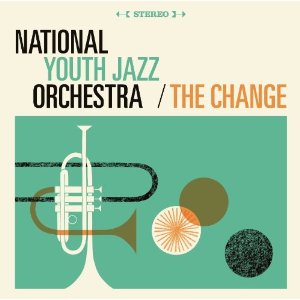 National Youth Jazz Orchestra
The Change
NYJO Records
2012
Even within the most well-run and successful groups change is inevitable, and so it has been for Great Britain's foremost group of young prodigies, the National Youth Jazz Orchestra, still going strong after more than forty-five years of memorable music-making. Bill Ashton, who founded the orchestra in 1965, has stepped aside as music director, succeeded by trumpeter / composer Mark Armstrong who came up through the ranks and is now a professor at the Royal College of Music in London. The Change is NYJO's first CD under Armstrong's direction, and whatever change it may represent is, to these ears, all to the good. In other words, the time-honored tradition of excellence continues.
Yes, there are a few departures from the beaten path: Tim Garland's fusion pieces, "Dark Before Dawn Before Dark" and "Agro Alegria," pianist Nikki Iles' temperate, chorale-like "Hush," baritone saxophonist Chris Whiter's "The Change" —but this is for the most part straight-from-the-hip big-band jazz, admirably performed by musicians who have no business playing so well at such a young age. That is to say, typical NYJO. Alumnus Callum Au arranged Juan Tizol's well-traveled "Caravan," Armstrong Monk's "'Round Midnight" (on which he adds his seductive flugel to Garland's tenor) and the Gershwin brothers' "Lady Be Good." There are two vocals, on "Summer Sundays" and "Feeling Good," by Emma Smith, the latest in what seems an unbroken line of first-rate band singers who've made their mark with NYJO. Completing the program are Tom Stone's smooth and restful "Return Flight" and Julian Joseph's lyrically enchanting "Barbara."
Guest Mark Mondesir is the drummer on "Dawn Before Dark" and "Agro Alegria," the first of which was composed, Garland writes, with the late great Chris Dagley, arguably the finest drummer NYJO ever had, in mind. While Mondesir is splendid, NYJO has a pretty fair drummer of its own in Scott Chapman, an appraisal that is especially borne out on "Caravan," "The Change," "Return Flight" and "Lady Be Good," wherein he drives the ensemble with adeptness and enthusiasm. One conspicuous misstep, uncommon for an album by NYJO, is the failure to include the names of the orchestra's soloists, who are, as always, quite good. Yes, I could have overlooked the names but have searched everywhere and haven't found them yet. A wee blemish, it should be noted, on an otherwise exemplary album by an orchestra that declines to rest on its laurels but instead keeps getting better while exploring new avenues of musical artistry and growth.
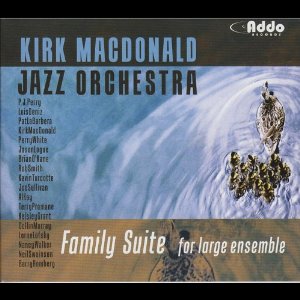 Kirk MacDonald Jazz Orchestra
Family Suite for Large Ensemble
Addo Records
2012
Canadian composer / saxophonist Kirk MacDonald's Family Suite first appeared on CD in 2009 as a thematically connected medley for quartet (romhog 116). That might have been the end of its save for the fact that MacDonald and others who heard the various sections started thinking that more could be done, such as, for example, broadening the initial concept by transforming what had been conceived of as a small-group endeavor into something grander, transplanting its themes to a big-band framework and making it a Family Suite for Large Ensemble. To carry out the daunting assignment, MacDonald called on veteran trombonist Terry Promane, an associate professor in the Jazz Studies department at the University of Toronto, who set to work revising and expanding MacDonald's original design to produce Family Suite, Version 2.0, which is essentially what is heard on this superlative album, recorded in January 2012 at Humber College in Toronto.
Setting aside the thematic framework (which is largely inapposite), what MacDonald has written (and Promane has orchestrated) is a series of musical essays that bring out the best in the orchestra, even though in most instances they are far removed from the more conventional straight-ahead swing of a Basie, Herman, Rich or even Rob McConnell. There are, however, exceptions to the order, as for example the aggressive "Blues for Jerome," which produces sparks about as often as anything devised by the aforementioned bands of days gone by; the buoyant "Four Shades of Light" (with flashy solos by trumpeter Brian O'Kane and guitarist Lorne Lofsky); or MacDonald's fiery tenor solos on "Thank You for the Life You Have Given Me" and again on the closing reprise of "Dark Autumn" (a briefer version of which opens the album). Elsewhere, the music is relatively more sedate albeit no less seductive. Bassist Neil Swainson is superb on "The Prod," MacDonald likewise on soprano ("The Prod") and tenor (with trumpeter Kevin Turcotte) on the playful "Sister Kim." Trombonist Al Kay and tenor Pat LaBarbera help brighten "Four Shades of Darkness." "Chorale" is a lovely set piece that leads to the syncopated "Martha" (perceptive solos by MacDonald on tenor and Nancy Walker on piano). Mention should also be made of alto saxophonist PJ Perry's lone solo, on "Blues for Jerome," as it is a corker and one of the session's highlights.
While MacDonald has assembled a world-class ensemble, loaded with alumni from celebrated groups led by McConnell, Dave McMurdo and others, what sets it apart are his tasteful compositions and Promane's astute orchestrations. The Family Suite for Large Ensemble should quickly earn approval and applause from any family anywhere.
 Dani Felber Big Band Explosion
Thank You, Fos!
Musiques Suisses
2013
If Frank Foster were still with us, a sure guess is that he would warmly embrace this scintillating tribute by trumpeter Dani Felber's superlative Swiss-based Big Band Explosion, which crackles with good-natured charm and energy from stem to stern and port to starboard. The reason is simple: this is Foster's kind of music—melodically engaging, rhythmically strong, and invariably swinging, as were the compositions and arrangements produced by Fos for his best-known employer, the legendary Count Basie.
Felber met Foster in 2009, two years before Frank's passing, and the kindred souls became close friends. Foster encouraged his young companion to move in new directions, offered helpful advice and even gave Felber a number of his superlative charts including a new arrangement of his most memorable theme, "Shiny Stockings." Of the dozen tunes on Thank You, Fos!, all save one (Neal Hefti's meteoric "Whirly Bird") were written by Foster (seven) or Felber. To amplify their import, Felber recruited a trio of eminent Basie alumni—alto saxophonist Brad Leali, vocalist Carmen Bradford and drummer Butch Miles—plus tenor saxophonist Eric Marienthal, long a mainstay in pianist Chick Corea's Grammy Award-winning Elektric Band, who further strengthen an already impressive ensemble. Bradford is heard twice, on Foster's pensive "Bring on the Raindrops" (complete with aqueous sound effects) and groovy "Papa Fos," on which her range and depth are no less than awesome.
While the music on offer embodies ingredients from ballads to blues, swinging is what Felber's band does best and most often, opening on an upbeat note with the leader's "Thank You, Fos!," which encompasses lively solos by Marienthal and pianist Jura Waida. Following "Shiny Stockings" (solos by Waida and trumpeter Gabriel Keogh) and "Raindrops," the ensemble dashes headlong into Felber's strapping "One Two Three" and Foster's galvanic "Love Handles" before slowing the pace on Foster's "Lady Carolyn" (earnest solos courtesy of Leali and trombonist Jurgen Neudert). Another barn-burner, Felber's finger-popping "Jorg on the Road," precedes Foster's soulful "Ode to Joe Newman" (showcasing trumpeters Rich Laughlin and Andrea Tofanelli with Felber on flugelhorn) and "Whirly Bird." Another sensuous ballad, Felber's "Sina's Dream" (spotlighting Marienthal's burnished soprano sax) leads to Foster's genial "Come On In" and the bustling finale, "Papa Fos." Leali solos nimbly on "Come On In," as he does on "Lady Carolyn," "One Two Three," "Jorg on the Road," "Whirly Bird" and "Papa Fos." Although Miles has no extended solos, his enthusiasm is contagious, and he makes sure the rhythm section is alert and cooking on every number, as he did for so many years as overseer of the renowned Basie orchestra.
While Felber would surely agree that there's no way he could ever fully repay Foster for his encouragement and friendship, Thank You, Fos! is at least a generous down payment on that debt. More to the point, this is a sharp and persuasive big-band scrapbook that swings with gusto—exactly as Fos would have wanted it.
 University of North Texas One O'Clock Band
Lab 2012
UNT Jazz
2012
The University of North Texas Jazz Studies program, which was established in the mid-1940s, has continued since then to improve and impress by every standard, measurable or personal. The same holds true for the university's renowned flagship ensemble, the One O'Clock Lab Band, whose annual Lab (fill in the blank) recordings achieve ever-higher standards for artistry and musicianship while setting the bar at a level to which most other college-level bands can only gaze in appreciation and aspire to reach. Lab 2012 is no exception, as the One O'Clock Band deftly unravels five student-composed themes and one each by director Steve Wiest, composing / arranging professor Rich DeRosa, former director Neil Slater and the late Frank Foster, one of the Count Basie Orchestra's most celebrated writers. Ordinarily, Foster's "Shiny Stockings," even though performed almost non-stop since it was composed in 1955, would be a centerpiece, but the remarkable quality of the other themes reduces it to simply another tasty hors d'oeuvre on a large and appetizing menu.
The ensemble sprints from the starting blocks to devour the first course, lead trumpeter Tyler Mire's succulent "Be That Way" (tangy solos courtesy of trombonist Kevin Hicks, baritone Spencer Liszt, bassist Brian Ward and drummer Greg Sadler). Speaking of highlights, as we were a moment ago, the second number, "Abby Song," written by trombonist Jenny Kellogg in memory of her golden retriever who died in August 2011, is an elegant masterpiece whose 11:38 playing time is sundered into five sections (birth / puppyhood / adulthood / old age and dying / reflections after loss), each of which is musically and emotionally rewarding. Kellogg solos with soprano Justin Pierce and trumpeter Jordan Gheen. Gheen (electric trumpet) is showcased with bassist Ward on the album's most ambitious piece, DeRosa's multi-layered "Fugue for Thought" (reminiscent of some of the late trumpeter Don Cherry's work).
"Shiny Stockings" (solos by Sadler, trumpeter Miles Johnson, pianist Sean Giddings) precedes Wiest's funk-fusion opus "Fifth Shade" (Sean Casey, bass trombone; Giddings, piano; William Flynn, guitar) and tenor saxophonist Aaron Hedenstrom's sunlit theme, "The Sparrow Was Gone in an Instant." Hedenstrom is the soloist on his second composition, "From Above," which is followed by Slater's picturesque "3rd and 55th" (Johnson, flugelhorn; Hedenstrom, tenor sax) and the fast-moving finale, tenor Drew Zaremba's explosive "Race to the Finish" (on which he solos with Sadler and alto Alex Fraile). With somewhere around a dozen first-rate ensembles in the UNT program, the members of the One O'Clock Band couldn't be faulted for glancing over their shoulders from time to time to see if the others are gaining ground. Judging from Lab 2012 they needn't bother; their seats at the head of the class would seem to be perfectly safe until they have earned their degrees and moved into the wider and more perilous world of professional music-making.
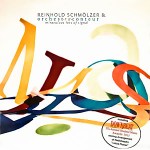 Reinhold Schmolzer & Orchest*ra*conteur
Miraculous Loss of Signal
Unit Records
2012
To say that Austrian Reinhold Schmölzer marches to a different drummer would be redundant, as Schmolzer is a drummer. He is also a composer / arranger who has produced a debut album that embraces his vision of what a big band should be and where it should be going. Whether that's a path the listener wishes to travel is entirely personal; suffice to say that Schmolzer has a definite plan in mind, and that his Orchest*ra*conteur (nothing pretentious there) does its utmost to transpose his blueprint into comprehensible sound. There are times—more often than not—when it works handsomely, others when sharp focus and utmost patience are required.
"Wheeling Around That SO.FI," for example, is sheer beauty, with shapely solo work by pianist Manuel Schmiedel and trombonist Simon Harrer, whereas "Lotus Flower," which follows, includes passages that emulate the sounds of a race car and other exotic contrivances, meanwhile changing mood and tempo to suit the moment. Again, the trombone (Philip Yaeger) is prominent, as are Schmolzer's ever-persuasive drums. Soloists as a rule are quite good within the compass of Schmolzer's precepts, with bassist Andreas Waelti and trumpeter Matthias Spillmann enhancing the translucent "Miraculous Loss of Signal." The penultimate "Enacted Disorder" is more trim than untidy, while the skittish "Hurdles" gives vibraphonist Raphael Meinhart a chance to shine, which he does. The opening numbers, "A Forwaholic's Passion," Parts 1 and 2, present a foretaste of Schmolzer's perspective and what is yet to come. Webster's has no definition of "forwaholic." If the disc is allowed to play for a minute or so after the end of "Hurdles," there's a brief "bonus track" wherein the band sings "happy birthday" to Schmolzer.
As noted, an album not suited to everyone's taste, but one that should reward any listener with an open mind who is pleased to explore bright new avenues and to travel wherever they may lead.
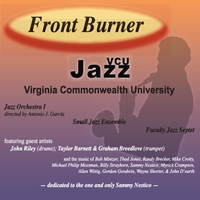 Virginia Commonwealth University
Front Burner
VCU Jazz
2012
Virginia Commonwealth University's Jazz Orchestra is no stranger to recording game plans and techniques, having produced half a dozen superb albums prior to the latest one, Front Burner, which was recorded live (no dubs or intercuts) either on-campus in Richmond, VA (four concerts) or at the Notre Dame Intercollegiate Jazz Festival (three tracks) in March 2012. The orchestra performs ably on eight of eleven numbers, complementing two by the Faculty Jazz Septet and another by the VCU Small Jazz Ensemble.
If the main song's name sounds familiar that's probably because it was written by the eminent Sammy Nestico, to whom the album is dedicated. While that's the only Nestico composition on the menu the album doesn't suffer for it, with master works by Bob Mintzer, Thad Jones, Randy Brecker, Michael Philip Mossman, Billy Strayhorn, Gordon Goodwin, Wayne Shorter and others on tap to overcome the breach. Trumpeter and artist in residence John D'Earth goes beyond Strayhorn to sketch "Some Graffiti on the 'A' Train" for the faculty septet. The orchestra makes it known from the opening measures of Mintzer's impetuous "Runferyerlife" that it has no problem, either individually or collectively, keeping pace with the demands of a live recording. Having guest John Riley manning the drum kit certainly doesn't hurt the cause. He's present as well, this time wielding brushes and sticks, on Jones' groovy "Second Race," which leads nicely into Brecker's lyrical "Tijuca," Mossman's Latin showpiece, "Cubauza," Strayhorn's mournful "Blood Count" and the zephyr-like "Front Burner."
The small jazz ensemble (a quintet) swings through tenor saxophonist Myrick Crampton's Middle Eastern flavored "No Waddi" before the orchestra returns to perform student Allen Wittig's lively "Armando's Big Band" and Goodwin's powerful "Swingin' for the Fences" (a.k.a. "Sweet Georgia Brown") and the faculty septet wraps things up with Shorter's "Lost" and D'earth's colorful "Graffiti." Crampton, whose plain-spoken style calls to mind Mintzer, among others, leads a phalanx of resourceful and engaging undergrad soloists that includes trumpeters Victor Haskins and Ben Heemstra, trombonist Chris Bates, pianist Brian Mahne, alto Brendan Schnabel, baritone Trey Sorrells, bassist Andrew Randazzo and drummer C.J. Wolfe. For concert performances, over-all sound quality is well above average. Another first-rate album from the VCU orchestra and its able director, Anthony Garcia.
Sight and Sound
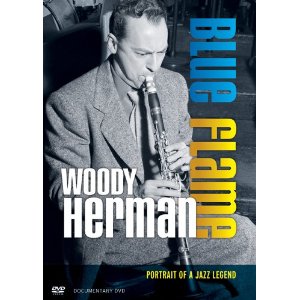 Woody Herman
Blue Flame: Portrait of a Jazz Legend
Jazzed Media
2013
Woody Herman's many fans—and others who may have heard the name but know little else about the man—are bound to appreciate Blue Flame, filmmaker / Herman enthusiast Graham Carter's earnest and well-composed homage to one of the twentieth century's most beloved and influential bandleaders. The 110-minute-long documentary, which touches all the bases from Herman's childhood in Milwaukee, WI, to his passing in October 1987, is divided into a dozen chapters, each of which sheds light on Herman's singular talents and larger-than-life personality, epitomized in commentary by some thirty-five friends, colleagues, jazz historians and former sidemen. The picture that emerges is that everyone (who was interviewed) loved and respected Woody not only as a successful bandleader and a warm and generous human being but as a musician as well (among other talents, he had a knack for editing other writers' charts and making them better).
Having paid his dues in bands led by Tom Gerun, Harry Sosnick, Gus Arnheim and Isham Jones, Herman took command of the Jones orchestra when the leader retired in 1936 and remained a bandleader for the rest of his life, more than half a century, somehow managing to keep his various groups (commonly known as "Herds") afloat even when tastes changed and most big bands had been consigned to the dust bin of history. Herman's remarkable staying power is among the themes that runs through the DVD, as even serious health problems toward the end of his life slowed Herman down but failed to stop him. One reason, as he remarked late in life, was that "this [leading a band] is really like a hobby," not like work. That "hobby" began with "The Band That Plays the Blues" (1936-43) and continued through the several Herds (the name was coined by writer George T. Simon), the last one of which was The Young Thundering Herd (1980-86). Although "Blue Flame" was Herman's "official" theme song, he was better known for another composition, Jimmy Giuffre's irrepressible "Four Brothers," which (with Ralph Burns' "Early Autumn") placed the Second Herd at the forefront of late-'40s bands, and Blue Flame opens, appropriately enough, with a concert version of that jazz classic, albeit from an Iowa Public Television broadcast in 1976 (alas, no footage of the original "Brothers"—Stan Getz, Zoot Sims, Herbie Steward, Serge Chaloff—is known to exist). Chapter 1, "Road Father," summarizes Woody's years as a leader and his remarkable rapport with musicians of all shapes, sizes and tastes (including drugs and alcohol). Commentary is provided by a number of former sidemen as well as jazz historians Dan Morgenstern and Herb Wong and Al Julian, head of the Woody Herman Society. Trumpeter Bobby Shew sums up the feeling of many sidemen and others in the music business, saying that time spent playing in one of the Herds was like "earning a degree in jazz from the university of Woody Herman; almost as if you'd never played on Woody's band you'd never played anywhere . . ."
Chapter 2, "The Early Years," begins with Herman's birth in Milwaukee and continues through his time as a sideman in various orchestras. After "The Band That Plays the Blues," Woody formed his first Herd in 1944, one that Dr. Wong says "set a standard for other bands" through 1946. One year later, the Second Herd burst on the scene with an all-star lineup playing bop-oriented charts by Giuffre, Burns, Shorty Rogers and others. Still widely acclaimed as the "Four Brothers" band, it was known by some closer to the scene as the "junkies' band." (According to vibraphonist Terry Gibbs, he was one of the few members of the band who was "clean"). Even so, the music the Second Herd produced was second to none. The Second Herd was succeeded by the Third (1950-55), the Fourth (1956-59), the Swingin' Herd (1960-67), the Fusion Herd (1968-79) and finally, the Young Thundering Herd (1980-86). Through it all, Herman remained essentially the same, a genial taskmaster for whom almost everyone wanted to play. Judging from their comments, those who were lucky enough to earn a place in one (or more) of Woody's bands are still in awe of the man, and one senses that were he still here, many of them would relish a chance to get back on the bus for one more trip with the Road Father.
Carter has done his best to unearth film clips of the various Herds in action, and there are some pretty good ones, especially a driving version of "Caldonia" from the Ed Sullivan TV show in 1963 (featuring the incomparable Sal Nistico on tenor sax) but much of the "vintage wine" has either been lost or was never recorded. What little footage of the band remains is so well-worn that it has been widely shown and seen elsewhere. An exception is the concert on Iowa Public Television, which should be new even to many of Herman's fans, and on which the band plays not only "Four Brothers" but "Early Autumn" (with Frank Tiberi sitting in for Getz) and another Herman perennial, "Woodchopper's Ball." There is one more film clip of interest, "Giant Steps," recorded in 1979 in Warsaw, Poland.
In the penultimate chapter, "Early Autumn," mention is made of Herman's troubles with the IRS after his manager, Abe Turchin, failed to pay federal taxes for a number of years, leaving Herman with a $1.5 million debt. Again, Woody weathered the storm (but lost his house), and was on the road again in January 1987. His last concert as leader was given in March '87 in Grand Meadow, MN, shortly before he was hospitalized for the last time. Before leaving, he turned the reins of the Herd over to Tiberi with the wish that he should keep it going (which he has). "The Chopper" closes the documentary with observations about the Herman legacy, again from former sidemen, historians Morgenstern and Wong, and author Bill Clancy. Woody, says Gibbs, "never led a bad band . . . every one of his bands was great." "Woody," adds drummer Ronnie Zito, "had to be on the road." And he loved nothing more, adds drummer Joe LaBarbera, "than standing in front of that band." Herman loved it so much that he stood in front for more than half a century, almost to the day he died. He not only loved leading the band, he loved being a member—playing clarinet, soprano saxophone and singing, all of which he did quite well, far better than many have given him credit for. Woody wore his heart on his sleeve; as he once said, "I get carried away by good sound." Which is one reason his bands always sounded so good. To hear how good, and to hear why those who knew Woody Herman were so charmed by his congeniality and awed by his talent, consider seeking out a copy of Blue Flame, a worthy successor to Carter's earlier narratives: Phil Woods: A Life in E Flat, Bud Shank: Against the Tide and Stan Kenton: Artistry in Rhythm.
 Steve Taylor Big Band Explosion
To Buddy Rich and Beyond . . .
i2iDVDeye
2013
Comments

Tags
Buddy Rich
Big Band Report
Jack Bowers
United States
Artie Shaw
Claude Thornhill
Miles Davis
Gil Evans
Don Menza
David Angel
Bill Holman
Tom Kubis
Mike Barone
Steve Huffsteter
Gordon Goodwin
Bob Curnow
Roger Neumann
Kim Richmond
William Russo
WIlbur Ware
Jim Ketch
Marcus Printup
Terell Stafford
Stephen Riley
Jack Wilkins
Wycliffe Gordon
Ron Westray
Paul McKee
Dave Stryker
Jason Marsalis
Leon Anderson
Herlin Riley
Rodney Jordan
Rodney Whitaker
Marcus Roberts
Aaron Diehl
Dan Nimmer
Bill Peterson
George Gruntz
duke ellington
Jon Faddis
Woody Shaw
Lee Konitz
Joe Henderson
Elvin Jones
Paul Motian
Marian Montgomery
claire martin
John Bassett
Dudley Moore
Steve Williams
Liesl Whitaker
Joe McCarthy
eddie daniels
Mark Morgan
Pete McCann
Harry Appelman
Mike Pope
Thad Jones
Mel Lewis
Luis Hernandez
Jim McFalls
Scott Silbert
Bill Ashton
Tim Garland
Nikki Iles
Juan Tizol
Julian Joseph
Mark Mondesir
Kirk MacDonald
Rob McConnell
Lorne Lofsky
Neil Swainson
Kevin Turcotte
Nancy Walker
P.J. Perry
Dave McMurdo
Frank Foster
Dani Felber
Count Basie
Neal Hefti
Brad Leali
CARMEN BRADFORD
Butch Miles
Eric Marienthal
Chick Corea
Joe Newman
Andrea Tofanelli
Steve Wiest
Don Cherry
Reinhold Schmolzer
Phil Yaeger
Sammy Nestico
bob mintzer
randy brecker
Michael Philip Mossman
Billy Strayhorn
Wayne Shorter
John D'Earth
John Riley
Woody Herman
Gus Arnheim
Isham Jones
Jimmy Giuffre
Ralph Burns
Stan Getz
Zoot Sims
Herbie Steward
Serge Chaloff
Bobby Shew
Shorty Rogers
Terry Gibbs
Sal Nistico
Frank Tiberi
Phil Woods
Bud Shank
Stan Kenton
pat metheny
Steve Marcus
Jay Corre
Mike Longo
Dizzy Gillespie
Paul West
Paul Desmond
Dave Brubeck
Larry Koonse
ED CZACH
Luther Hughes
Steve Barnes
Gerry Mulligan
Miles Osland
Keith Jarrett
Ron Carter
Thelonious Monk
carla bley
For the Love of Jazz
 All About Jazz has been a pillar of jazz since 1995, championing it as an art form and, more importantly, supporting the musicians who create it. Our enduring commitment has made "AAJ" one of the most culturally important websites of its kind, read by hundreds of thousands of fans, musicians and industry figures every month.
You Can Help
To expand our coverage even further and develop new means to foster jazz discovery and connectivity we need your help. You can become a sustaining member for a modest $20 and in return, we'll immediately hide those pesky ads plus provide access to future articles for a full year. This winning combination will vastly improve your AAJ experience and allow us to vigorously build on the pioneering work we first started in 1995. So enjoy an ad-free AAJ experience and help us remain a positive beacon for jazz by making a donation today.

Giveaway

Eligible winners: 15
Days remaining: 4
Days remaining: 4