Home » Jazz Articles » Live Review » Alan Wilkinson/John Edwards/Steve Noble: London, England...
Alan Wilkinson/John Edwards/Steve Noble: London, England, January 9, 2013

Café Oto
London
January 9, 2013
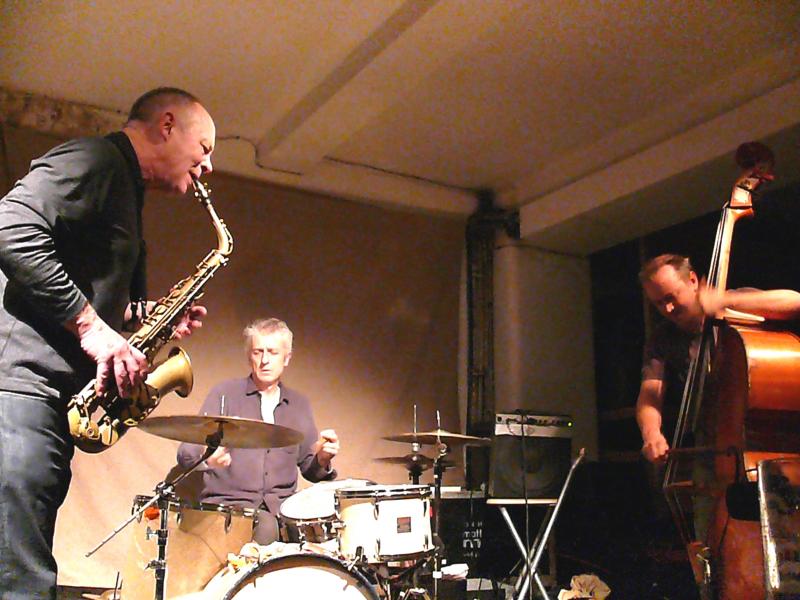
It didn't look promising to begin with. In the dark days of January with the New Year festivities over and done, there's not a lot of enthusiasm for nocturnal adventure, so it was no surprise to see just a couple of people waiting outside before the doors of north London's Cafe Oto opened. But clearly there was promise in the air. By the time saxophonist Alan Wilkinson took to the stage 45 minutes, later there was quite a crowd in attendance—even though Wilkinson appears frequently in the city, helming his own improv night, Flim Flam at Ryan's Bar, just up the road.
Although his name has long been a byword for off-the-dial free jazz mayhem in post-Albert Ayler mode (witness his work as part of the Hession/Wilkinson/Fell triumvirate which made The Horrors of Darmstadt (Shock, 1993) and St. John's (Ecstatic Peace, 1994)), in person the reedman wasn't averse to either melodic or understated passages. During the sound check he could even be heard running through what sounded like Charlie Parker's "Confirmation" to get himself in gear.
Though to be fair, the predominant mood of he evening was confrontational rather than comforting. Of course, the saxophonist was only one component in a well-versed though still unpredictable machine, completed by drummer Steve Noble and bassist John Edwards, both of whom are near fixtures on the London scene and perform in German reed legend Peter Brötzmann's latest trio (heard to compelling effect on The Worse The Better (OTOroku, 2011)), and as the engine for both Decoy, with Alexander Hawkins on Hammond organ, and N.E.W. with Alex Ward on guitar.
By way of introduction, Wilkinson uncorked squealing harmonics from his alto saxophone. Straight away Edwards was on the case, interweaving bowed overtones with the reedman, while Noble's mallets underpinned their out-of-tempo excursion. But before too long they were into high octane territory, though purposeful with shading and nuance. Noble and Edwards maintained a constant give and take, often settling briefly around a groove before moving on. In his cleaner moments, Wilkinson recalled Ornette Coleman, though that resemblance faded once he began overblowing, especially on baritone.
All three continually varied their attack, seeking to catalyze fresh responses. Early in the second set Wilkinson unleashed a sustained and piercing dog-bothering whistle as part of a stop-start exchange of textures, which elicited expressions of wonderment from the crowd. Later he pressed the bell of his alto saxophone against his thigh to extract a muffled snorting, then blew into the bell for a more atmospheric contribution.
However, it was his multiple tongued passages which acted as a recurring motif, meshing effectively with the insistent rhythmic fragmentation of his two accomplices. Wilkinson co-opted simple motifs as the building blocks for expansion, the foundations on which to erect loftier constructs. Often he referenced phrases from the bassman as the basis for further development, thereby creating a unifying factor which increased the cohesion of the performance.
Edwards was as inventive and energetic as ever. At one point during a flowing group interchange he alternately sawed above and below the bridge of his bass, conjuring a wavering tension. Then later he wedged the bow through strings as they were plucked, producing a rumbling undercurrent. Noble likewise balanced intensity and timbre. A favorite trope involved the placement of untethered cymbals on the drum heads, allowing him to strike both in varying combinations of tone and color. But he also smothered his snare with a towel and struck with his fingers in an unceasing quest for the most apposite offering.
Nonetheless, even though the individual parts excelled, it was as a fully integrated threesome that they lingered in the memory. With two recordings under their collective belts in Obliquity (Bo'Weavil, 2006) and Live At Café Oto (Bo'Weavil, 2008), there was a lot of shared experience to draw upon. At their best they blended tonalities and rhythms into an organic unity—one example came midway through the first set: the drummer matched Edwards' rapid fire bowing and fingering with his sticks a hyperfast blur, enticing the hornman to join with a flutter-tongued staccato which fitted in perfectly, before he swept away with unfurling overblown lines as they forged an episode of incandescent power.
There was humor as well, as in an interlude towards the end of the second set, which gave an insight into the unspoken negotiations at the heart of such freewheeling creativity. Noble laid out as a period of cantering syncopation dissolved into a breezy dialogue between Edwards and Wilkinson. The interplay became ever more delicate, until the reedman was blowing the merest whispers and the bassist voiced quiet figures from the top of the neck. As Edwards ceased, Wilkinson pressed his plaint but without response until he broke off and good naturedly berated his partners for lacking stamina. Noble responded that they might lack stamina but they did have taste, which drew delighted "oohs" from the audience.
And then naturally, they continued where they had left off, culminating in further tumult and rounding off a cracking evening, one for which it was well worth braving the winter air.
Photo Credit
John Sharpe
Tags
Alan Wilkinson
Live Reviews
John Sharpe
United Kingdom
London
Albert Ayler
Steve Noble
John Edwards
Peter Brotzmann
Alexander Hawkins
Alex Ward
Ornette Coleman

PREVIOUS / NEXT
Support All About Jazz
 All About Jazz has been a pillar of jazz since 1995, championing it as an art form and, more importantly, supporting the musicians who make it. Our enduring commitment has made "AAJ" one of the most culturally important websites of its kind, read by hundreds of thousands of fans, musicians and industry figures every month.
Go Ad Free!
To maintain our platform while developing new means to foster jazz discovery and connectivity, we need your help. You can become a sustaining member for as little as $20 and in return, we'll immediately hide those pesky ads plus provide access to future articles for a full year. This winning combination vastly improves your AAJ experience and allow us to vigorously build on the pioneering work we first started in 1995. So enjoy an ad-free AAJ experience and help us remain a positive beacon for jazz by making a donation today.Near

London Concerts

Dec
31
Wed