Home » Jazz Articles » Interview » Trish Clowes: From Shorter, Lovano and the Sphinx
Trish Clowes: From Shorter, Lovano and the Sphinx


Of course, it's doubtful if Wilde ever intended his phrase, from his 1894 poem "The Sphinx," to be used as the title of an album of twenty-first century contemporary music, but Clowes is always ready to be inspired by poetry or prose. Her love of the written word comes across strongly in conversation and has directly influenced aspects of both of her albums to date. Clowes is also one of a growing number of young musicians who are curating their own events. In Clowes' case it's a mini-festival of improvised music called Emulsion, the first of which took place at London's Vortex jazz club in May, 2012.
Clowes grew up in a musical household alongside her brother Mike Clowes, who is now a professional drummer. Her career choice could have taken a very different path however. "Both our parents are very musical, although they're not professionals. My dad and I could both have done medicine or music: he chose medicine but I chose music. He's a brass player, really into orchestral music. I heard a lot of classical music growing up; plus, I had piano lessons. My mum trained as a dancer and went to art school. I got taken to lots of concerts, ballets, while I was a kid. I think with music, even if your parents aren't musical themselves they need to encourage you, take you to things. I didn't decide, when I was a kid, that I wanted to be a musician, it was just a part of what I did. I think most of the musicians I know have parents who encouraged them in some way."
Clowes' early love of music led her to the tenor saxophone, which remains her instrument of choice, and to the Royal Academy of Music, where she began her studies in 2003. As a player she's been compared to Stan Getz, Bobby Wellins and Lester Young. There is certainly a similarity with Wellins' economy of style and with the sound of Young and especially Getz, but none of these players were influential on Clowes as a young player. So who were her influences? "In a slightly chronological order, as a teenager, 16 or 17, it was definitely Wayne Shorter and Iain Ballamy. When I was at college I had problems with my neck and arms so I switched from tenor to alto for awhile and that's when I got into Lee Konitz. Warne Marsh and Joe Lovano followed, then I got into Lester Young after college. He's incredibly lyrical."
 For Clowes, three players stand out. "Iain, Wayne Shorter, Joe Lovano are very definite influences. I don't think you can hear Lee Konitz in my playing, but he's such an incredible player and the way he improvises is absolutely mind-blowing."
Tangent (Basho Records, 2010) was recorded at the Royal Academy of Music in March 2010. It was an ambitious debut for Clowes, filled with her own compositions and featuring a host of talented young players including three musicians—guitarist Chris Montague, bassist Calum Gourlay and drummer James Maddren—who form the nucleus of the group on And In The Night-Time.
Pianist Gwilym Simcock, one of the UK's most influential and respected musicians, has played a key part in the development of Clowes' albums. Initially, Clowes was managing Tangent's creation independently: "It was humble beginnings" she says, laughing. "Later, I mentioned it to Gwilym and it kind of went to a whole other level after that." Simcock was so impressed with the young saxophonist's work that he went on to produce Tangent and play on its opening track, "Prelude To A Sketch." He's also involved with And In The Night-Time, co-producing the album with engineer Curtis Schwartz and playing piano on four tunes. "He's really, really helpful. I ran a lot of the orchestral material past him and discussed the music, how to plan the recording. He gave me feedback on the mixing and mastering as well."
Recording Tangent was an important step for Clowes and one which has proven invaluable. The album was well-received by fans and critics and helped to establish her reputation at a relatively early point in her career. "My first album changed a lot of things for me, gave me opportunities I didn't have before. Very quickly after that I felt that I knew what I wanted the next thing to be: to organize a concert with a smaller musical setting, a string quartet. Going back to things I've been doing in college, plus my band and Gwilym as a guest. I applied to Kings Place [a major London arts venue] for a date, which will be the album launch date, and it grew from there. I had a very clear idea of how it was going to be from the beginning. All the music was written with that in mind."

Tangent featured a full 35-piece orchestra on two tunes. The largest ensemble on And In The Night-Time She Is There is the nonet. Was this a decision driven by economics, logistics or the music? Clowes is emphatic in her response. "A musical decision; when I recorded the first album, it was a realization of ideas that I'd had for some time. I'd been writing for jazz groups and string quartets while I was at college. If you want to do a big project like that you have to call in a lot of favors—unless you're loaded. It seemed like a good time to do it. I started planning it and lots of very generous musicians agreed to do it. For most of them it was just a three-hour session. I'd only just left college so I was still in touch with lots of people."
Is the second album a more structured work than Tangent? "I don't know. I guess that's maybe for someone else to decide. For me, both albums are honest representations of what I'm doing at the time and that's all that matters. It's always nice to record a debut album, go through the process, and learn as much as you can. Doing the second album you know what to expect, how to prepare, etcetera."
Both albums contain tunes inspired by literary works. On Tangent there's "Coloured Eye," based on a poem by Clowes' friend, Jessie Jones, and "The Master And Margarita," which shares its title with Mikhail Bulgakov's satire on 1930's Russia (first published in English in 1967). "I like writing something that represents or says something about something I love. I'd read The Master and Margarita a lot, and then I wrote the piece and felt that it shared the magic and mystery of the book, so I gave it that title. With poems, the text directly influences the music. I'd read Coloured Eye and felt I could do something with it musically: it gave me musical images, if you like. I bought the complete works of Oscar Wilde and found "The Sphinx." I felt, again, that this was a poem that gave me musical images. Once I find the right poem I find it easy to compose the music. Both of these poems have so many images in them that I could just literally sit down and sing the text on the spot, if that makes sense. There's no point forcing anything. It's about finding things that I felt I could do something with."
The combination of literature and music is something Clowes looks set to continue with in the future. "Yes I think so. There's plenty of time. I can see myself writing a songs album at some point." Would this mean that she becomes a lyricist as well as a composer? "I don't know. That's not something I'm very comfortable with, because I don't do it very much, but who knows?"
 As a performer and writer, Clowes takes great delight in working with musicians she feels connected to on a personal level. "For me the people are really important. There's a reason why I work with each of these people: there is some sort of connection. The string quartet on the album, for instance. I knew Thomas Gould [the violinist] a little. I hadn't worked with him but Louise McMonagle, the cellist, who I'm very good friends with, recommended him. Adam Robinson, the viola player, has a group called the Threads Orchestra, which Chris [Montague] is part of. I'd written a piece for that orchestra so I had a connection with Adam too. I like to keep things like that if I can." It's a surprise to hear that the quartet hasn't worked together previously, for as improvisers they sound like a very cohesive unit. "I was so pleased, we all worked. Everyone really clicked, gelled straight away."
Heidi Parsons, another cellist who appears on both albums, is a friend of Clowes and McMonagle from their student days, while Kathleen Willison, the vocalist on "Coloured Eye" and "The Sphinx," is also an old friend. "She's a stunning singer but she doesn't gig that much at the moment. She's a lovely young mum, looking after her children. I had a few singing lessons with her while I was studying, that's how we met. I felt that her voice, her style, were close to how I might interpret something, although I'm not saying I can sing as well as her, so it seemed quite natural to involve her in my work."
 A strong thread of improvisation runs through the second album, including the nonet pieces. Clowes builds varying levels of structure within which this improvisation can appear. "For the small band tunes I gave them lead sheets: I like to create strong melodies but leave space too. On 'On Off' there is a melody and a little background riff and quite a specific bass line. The more people there are the less space there is so I need to address that. If you're going to have nine people in an ensemble you need to ensure that the music is written for nine people. It's not a problem, but it is important. As compositions get more complex, you have to balance interesting writing with space for improvisation.
"The opposite is the case too. I hate listening to jazz that boxes in improvisation, where the improvisation has to happen in a strict space between two tightly written sections. Lots of wonderful music has been written like that, coming out of the popular song form, but to me when I write I'm always thinking about where improvisation can take place rather than simply building in a section. I try to avoid that. I'll have a melody and decide that a piano or guitar could improvise over it, or a string section could have a conversation at that point. The solos don't just happen in one place." That well-established format of head, solos, head can be formulaic. I'm not criticizing that form; I just think that we should be playing around with it a lot more."
As a musician who is regularly crossing between jazz and contemporary classical music, what sort of value does Clowes see in such labels? "I just write what comes into my head. If you want to challenge, or try to challenge, ideas about genre then I think labels are okay. Used in the right way they give people an idea of where you're coming from and what to expect. We thought about that kind of thing with Emulsion, we were very careful with the language we used. We referred to improvisation rather than jazz and to contemporary composition rather than contemporary classical or contemporary jazz. If someone wants to describe my music as contemporary jazz because that's how it will be understood by their readers or their audience, then that's fine as well."
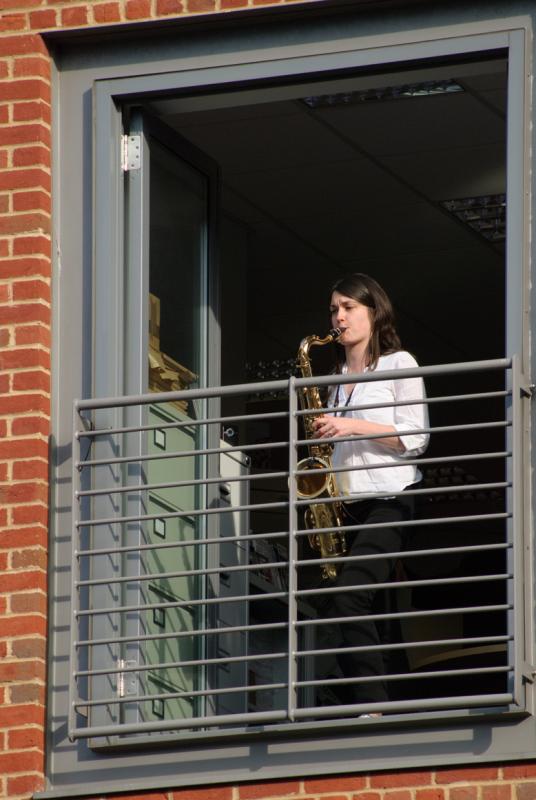
Outside her own projects, Clowes is involved in a range of other activities including the SE Collective, based in south east London, and the Odd Trio with McMonagle and drummer Tim Giles. She has also been a part of Andy Sheppard's Sax Massive, a 200-saxophone ensemble: she opened her performance with the group at the 2011 Norfolk and Norwich Festival by playing through a second floor office window while baritone saxophonist Shabaka Hutchings performed on the roof of a nearby library.
The Emulsion festival is another key project that she has initiated and which looks set to expand. The first Emulsion was a one-day festival which featured newly commissioned works from musicians including Clowes' early mentor and teacher, Iain Ballamy. It may have started small, but there are ambitious plans for its future. "The 2013 festival will mainly be led by Luke Styles, a contemporary classical musician [who currently holds the prestigious post of Young Composer In Residence at Glyndebourne Opera House]. The 2012 Festival did contain some contemporary classical music but it was in a jazz club and most people would probably describe it as mostly jazz. Next year it's at Kings Place and they want it to flip around so contemporary classical is the main focus. Luke will lead and free me up to think about the third one in 2014. We're hoping to get funding to expand the activity, adding a series of workshops through the year. I don't intend to make it change."
Clowes is part of a young generation of musicians who are keen to develop new pathways and take their chosen music in exciting new directions, while also emphasizing the importance of honesty and integrity in their craft. Clowes' closing sentence in her discussion of Emulsion serves as a neat summation of her wider musical ambition. "I want to keep true to the values we started with, but keep it going forever more."
Discography
Trish Clowes, And In The Night-Time She Is There (Basho Records, 2012)
Trish Clowes, Tangent (Basho Records, 2010)
Photo Credits
Page 1: Courtesy of Trish Clowes
Page 2: Gerry Kelly
Page 3: Bruce Lindsay
Tags
Trish Clowes
Interview
Bruce Lindsay
United Kingdom
London
Mike Clowes
Stan Getz
Bobby Wellins
Lester Young
Wayne Shorter
Iain Ballamy
Lee Konitz
Warne Marsh
joe lovano
Calum Gourlay
James Maddren
Gwilym Simcock
Tim Giles
andy sheppard
shabaka hutchings

PREVIOUS / NEXT

Support All About Jazz
 All About Jazz has been a pillar of jazz since 1995, championing it as an art form and, more importantly, supporting the musicians who make it. Our enduring commitment has made "AAJ" one of the most culturally important websites of its kind, read by hundreds of thousands of fans, musicians and industry figures every month.