Home » Jazz Articles » Record Label Profile » Rudi Records: Reviving the Avant-garde
Rudi Records: Reviving the Avant-garde
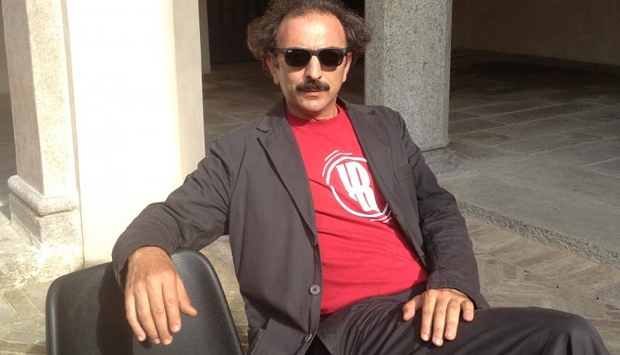

In spite of the prejudice and challenges the avant-garde faces, there are always, fortunately, record labels who support the creation of experimental music. Massimo Iudicone, who runs the Italian jazz label Rudi Records, is one of the true musical developers in his country, who has done much to expand the horizons of the listening public—both as an organizer of concerts and as label owner. Music is simply in his blood. As he says: "founding Rudi Records was almost a natural requirement. For years, I was involved in artistic productions and the organization of festivals. The step from concert production to producing records has occurred naturally, although it took several years."
Iudicone named his label Rudi Records because: "I wanted a short name and I had a graphical interest in the double R." The logo of the label is indeed beautiful, as is the sound of the words, with the perfectly palatable alliteration. The look is important to Iudicone and he is working closely with graphic artist Ale Sordi: "With Ale Sordi, we decided to have a very clear graphic layout: a Rudi Records CD must be immediately recognizable. We are working with some great photographers to give the covers a strong impact."
In true avant-garde fashion, Iudicone isn't inspired by other labels. What he cares about is the music he discovers. He prefers live recordings: "I come from the world of music production, my interest is to propose, document and protect a certain type of music. I have not been inspired by albums or labels, but only by love for this music that is full of vitality. The creative process itself is very exciting. When possible, I prefer to have live recordings. The highest moment of creativity is often during concerts. The interplay between the musicians and the dialogue with the public is crucial."
Speaking of the musical climate in his country, Iudicone says: "Jazz in Italy is not followed by mass media. This pushes many concert organizers to invite only the most prominent and famous musicians, leaving a wealth of music full of life, light and creativity behind. However, in recent years, schools of jazz, as well as the academic courses at the conservatory, are completely besieged by many young jazz musicians who feel this music could be a possible channel for communicating their art and soul."
While Iudicone senses a positive spirit of exploration among young people, he is also aware of a development that is possibly problematic: "Today, musicians are much more technically prepared than before and their knowledge of music and their instrument is certainly more thorough, thanks also to new technology. But it is as if these technicalities, or the excessive care of virtuosity, stop many musicians from finding their own voice and highlighting their own individuality. It is as if there is a standardization of music, a uniformity of the sound. The trail that Rudi Records very humbly wants to take in the wide world of jazz is to give prominence to individuality. To shed light on some strictly authentic musical voices who are often ignored."
Iudicone is succeeding. Rudi Records' catalog brims with quality music. When asked about particular highlights, Iudicone answers: "There are highlights in all of my records, some projects, such as Re-Union by Satta Bellatalla Spera, are completely created by me. The trio had never played together. After suggesting the trio for a concert, I followed the work of musicians for about a year and then persuaded them to record. Also, on Wind & Slap by Giancarlo Schiaffini and Sebi Tramontana, some of the tracks on the CD are taken from a concert that I organized in Rome during the same days of the studio recording. I think it is important because it gives the opportunity to hear another voice of the duo."
Summing up Iudicone's passionate approach to record production is his statement that: "There is something of me in all of my discs and all are a bit like little children to care for and follow with great attention and respect."
When it comes to the future of the record business, Iudicone is generally positive: "the digital revolution does not scare me, and perhaps it is a way of getting into some countries where it would be difficult for a young label like Rudi. I also think it is an efficient means to combat music piracy. Of course, the fact remains that it is important to me that there is a physical product. In addition to CDs, I would like to press on vinyl someday. l have not produced an all-digital album yet, but I just transferred the whole catalog to various digital platforms."
Speaking of his release schedule, Iudicone says: "The last album was released in May, the next will be an all-Italian project, and in the fall there will be a release with a European trio." When it comes to the future, the goal is to establish the label as a long term entity: "In just 15 months, Rudi Records has created its own identity, something that is very important to me. Album after album, I hope to follow the path I've taken so far."
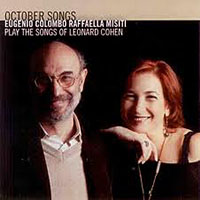 Eugenio Colombo / Raffaella Misiti
October Songs: Play the Songs of Leonard Cohen
2011
October Songs, the album by flutist and saxophonist Eugenio Colombo and singer Raffaella Misiti is one of the most traditional and experimental outings in the Rudi catalog. As the subtitle, Play the Songs of Leonard Cohen, reveals, the subject is the music of singer/songwriter Leonard Cohen.
The minimalistic approach of the duo is commendable. Without any form of embellishment, they aim straight for the existential core of the songs and dig out a naked beauty that is sometimes lost in Cohen's own arrangements of his songs.
The seemingly impossible task of finding a fresh approach to classics like "Hallelujah" and "Suzanne" is solved with natural ease. The former receives a chilling a cappella treatment, with Misiti's voice spiraling through an imaginary cathedral, while the latter is strengthened by Colombo's dancing saxophone that playfully wraps itself around the tuneful recitation of the lyrics.
The duo also contributes an original, "Little America," an elegiac composition sung in Italian, filled with mournful and passionate poetry.
In spite of the pared down line-up, the album manages to unite everything from jazz and improvisation to ancient folklore and Dadaism, all seen through the wonderfully twisted looking-glass of Leonard Cohen's compositions.
 Giancarlo Schiaffini / Sebi Tramontana
Wind & Slap
2011
Brass players Giancarlo Schiaffini and Sebi Tramontana make up another duo that mixes traditional sounds with something entirely new. Wind & Slap is built around the rambling conversations of two trombones, but during the course of the album, instruments are changed, and tuba and euphonium add further colors to the musical palette.
The opener, "Quiet as a Bone," is a good example of the album's aesthetic, at once old-fashioned and modern. The truncated blurbs of trombone, gurgling sounds and snippets of processional melody give the feeling of listening to a New Orleans march on acid. Schiaffini and Tramontana engage in a tight and transformative dialogue where every tone, color and shade of their instruments is explored.
The album can be divided into two sections: a studio session, lasting from track one to 13, and a live-session, which makes up the three remaining tracks.
It is especially fascinating to discover how the duo's expression changes, depending on the context. The studio tracks are shorter and more tranquil in their approach while the live-recordings add a gut-bucket feeling of old-time-blues and Dadaist madness, with the musicians coughing and howling like midnight wolves on the prowl in "About Sleepwalkers and Wind."
Wind & Slap is aural slap in the face, but it is also a gentle blow where the experiments never lose sight of humanity. Basically, this is the sound of two original voices engaging in a sprawling conversation and an open invitation to the listener to join in the fun.
 Dimitri Grechi Espinoza / Tito Mangialajo Rantzer
When We Forgot the Melody
2011
An accusation that is often made of improvised music is that it "forgets the melody." Saxophonist Dimitri Grechi Espinoza and bassist Tito Mangialajo Rantzer have taken this statement at face-value and humorously called their album of pure improvisations When We Forgot the Melody.
The ironic thing, though, and the good news for anyone who likes their jazz to sing, is that it is, in fact, a work that truly remembers the melody. Listening to the nine sections of the album, it is remarkable how close the music sounds to "real" compositions. The idea of instant composition really makes sense in this case.
The musicians highlight the works of saxophonist Lee Konitz and bassist Red Mitchell as an inspiration. The aesthetic of Konitz' mentor, pianist Lennie Tristano, as realized on the famous improvisations "Intuition" and "Digression," shines through on the album whose free compositions come across like finely sculpted lines of melody and rhythm, cool in sound and with a contrapuntal complexity that reaches back to Tristano's great inspiration: J.S. Bach.
It is hard to think of a more elegantly executed session of improvisations. Clocking in around 40 minutes, When We Forgot the Melody is a short, but sweet exploration of the limitless potential of free improvisation.
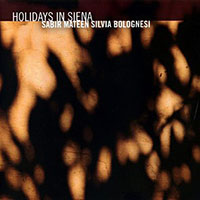 Sabir Mateen / Silvia Bolognesi
Holidays in Siena
2011
Saxophonist Sabir Mateen and bassist Silvia Bolognesi also take their point of departure in the format of the duo, but their take on it isn't as cool and tranquil as Dimitri Grechi Espinoza and Tito Mangialajo Rantzer. Instead, they favor a more expressionist approach, as in "Flavio's Wine," where there is both room for subdued screams and whispers.
Mateen has an impressive command of his instrument and makes it run like a fiery racehorse on the lengthy "Walts for Jack" while Bolognesi plucks away on the strings.
The antidote to epic compositions like "Walts for Jack" and "Hugs" are the short sketches "2 with 3" and "Double S," that manage to convey a world of tonal possibilities within the span of a minute. Adding to the variety is also Mateen's use of other instruments like flute and clarinet whose hovering tones complement the more passionate bursts of the saxophone.
On Holidays in Siena, Mateen and Bolognesi show how they easily can stretch time and bend it at will. Throughout the album, landscapes of music are created with singing saxophone and buzzing bass. A lot of things are going on and listening to the music isn't a holiday, but it is definitely a challenging journey that is worth taking.
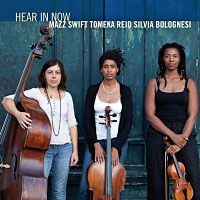 Mazz Swift / Tomeka Reid / Silvia Bolognesi
Hear in Now
2012
Silvia Bolognesi returns. Hear in Now finds her in the company of violinist Mazz Swift and cellist Tomeka Reid. Together they create a spellbinding mixture of new classical composition, world music and jazz.
The liner notes are written by bassist William Parker and he gets to the core when he writes about the music that: "The catalyst is the moment, the spontaneous now! Each musician always plays many roles, the lead player shifts from musician to musician and just like any great theater troupe it goes way past theatre into a reality that is universal in its outreach. People of all races, ages and personalities can listen to this music and get caught up in its beautiful web of poetics."
Parker truly sees the democratic nature of the group—both in its internal structure and in the way it reaches out to the listener. Nominally, the music on Hear in Now is a kind of modern chamber-music, with emphasis on various forms of string music. As the strings are plucked, strummed, twisted and bowed, they create a delicate Cajun stew of styles. It's seldom that experimental string music is as joyful and yet poetically deep as this. It's music that belongs on fields with flowers as well as in concert halls.
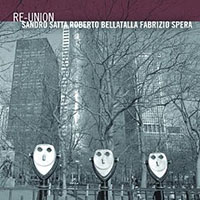 Sandro Satta / Roberto Bellatalla / Fabrizio Spera
Re-union
2011
Compared to the trio of Bolognesi, Swift and Reid, the music of saxophonist Sandro Satta, bassist Roberto Bellatalla and drummer Fabrizio Spera almost seems conservative. But in spite of a fairly traditional line-up, the music is far from predictable.
A typical example of the Rudi aesthetic, Re-union was recorded live and the intensity of the live experience really comes through with the cooking atmosphere of a jazz scene in a Jack Kerouac novel.
Speaking of the Beat Generation and bop, Satta certainly knows his fellow saxophonist Charlie Parker, but has many more tricks in his bag. He is a modern traditionalist, like the late Fred Anderson, who managed to find the connection between the great tradition and the innovations of the AACM/the avant-garde. On "Walkies," Satta plays with a dry and nonchalant swing, slyly exploring melodic motifs on the bouncing rhythmical background of bass and drums, and gradually the pressure rises until it all ends in a desperate howl surrounded by a forest of ringing bells.
The communication between the three musicians is simply top-notch as they swing, growl, howl and sing themselves through six superbly executed pieces that all bear the hallmark of improvisation: creativity and telepathic interplay.
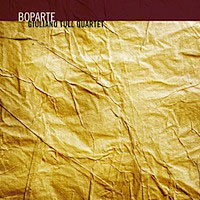 Giuliano Tull Quartet
Boparte
2012
Saxophonist Giuliano Tull is another artist who is clearly inspired by the bop-innovations of Charlie Parker and he filters them through the avant-garde musings of saxophonist Ornette Coleman on Boparte, which consists of his compositions played by a sympathetic quartet.
The title track, with its classic opening of drums and saxophone in a heated duet, becomes the blueprint for the rest of the album where complex breaks, pulsating grooves and epic sax solos are the order of the day.
While bassist Giovanni Maier and drummer Luca Colussi clearly have their chops, the deep-rooted feeling of the blues saves the music from too much flash. The quartet knows how to make a tune cook, but Tull is also an accomplished balladeer. His writing and playing skills are pleasantly on display on the tender "Corto," which also sports a tasty trombone solo from Lauro Rossi.
Enhancing the whole experience of the record is the warm and clear sound, perfectly captured by Stefano Amerio in his Artesuono Recording Studios, where pianist John Law also recorded his series The Art of Sound Vol.1-4.
In short, Boparte is a quality record in sound, writing and playing. While it may not be the most groundbreaking item in the catalog, it is a typical example of the high artistic standard of Rudi Records.
 Massimo De Mattia
Black Novel
2012
Flutist Massimo De Mattia can be counted among some of the interesting players and composers on the Italian jazz scene. Even in the always experimental Rudi Catalog, his music stands out with its spacious lyricism and exploration of alternative forms of instrumentation.
Based around the combination of flute, vibraphone, guitar, bass and piano, Black Novel sounds like a futuristic version of The Modern Jazz Quartet. Writing about the music in his liner notes, Flavio Messarutto emphasizes that: "The rhythmic layering constantly changes with urgent pulsing and cyclical repetitions. Passages are deconstructed and reconstructed with all musicians playing continuously."
While the sound of the album is pleasant, at times almost cocktail-like, what is revealed through listening is a complex, organic structure that seems to breathe life into itself. Listening to De Mattia's music is a surreal experience of hearing the instruments play on their own, as if they were removed from the musicians, dancing around in space like musical figures in an abstract painting. There are links to free jazz of 1970s and references to all the pages of jazz history, from ragtime to post-bop, but the group creates a vocabulary that is entirely its own.
Black Novel is one of the many records in the Rudi catalog that attempts to redefine how we listen to music. Tradition is referenced and destroyed through the individual language of highly original musicians. In the best of all worlds, this is what the avant-garde is all about and Rudi Records is a prime example of how it isn't just an emblem of empty prejudice, but also the (re)creation of a musical language.
Tracks and Personnel
October Songs: Play the Songs of Leonard Cohen
Tracks: You Know Who I Am; So Long Marianne; Dance Me to the End of Love; Stories of the Street; Little America; Hallelujah; Suzanne; Teachers; Bird on the Wire; If It Be Your Will.
Personnel: Eugenio Colombo: alto and soprano saxophone, flute; Raffaella Misiti: vocal.
Wind & Slap
Tracks: Quiet as a Bone; As Tone Lies Lost; As the Heartless Ghost; As They Dive; As in my Bones; This Shade; Beautiful Roots; Holy Leaves; In the Wind's Wakes; As a Purple Sofa; She Was Still Stoned; As an Empty Stone; As a Strange Tongue; About Sleepwalkers and Wind; Stones and Deadwood; Wind and Slap.
Personnel: Giancarlo Schiaffini: trombone, tuba, euphonium; Sebi Tramontana: trombone, euphonium.
When We Forgot the Melody
Tracks: When We Forgot the Melody; 2nd Time We Forgot the Melody; 3rd Time We Forgot the Melody; 4th Time We Forgot the Melody; 5th Time We Forgot the Melody; 6th Time We Forgot the Melody; 7th Time We Forgot the Melody; 8th Time We Forgot the Melody; 9th Time We Forgot the Melody.
Personnel: Dimitri Grechi Espinoza: alto saxophone; Tito Mangialajo Rantzer: bass.
Holidays in Siena
Tracks: Glory; 2 With 3; Walts for Jack; Flavio's Wine; Double S; It Will Be Heaven in 2011; Hugs; Sunset in Legoli.
Personnel: Sabir Mateen: alto & tenor saxophone, flute, piccolo, Bb clarinet; Silvia Bolognesi: double bass.
Hear in Now
Tracks: Cakewalk; Spiderwoman; Bassolo / Far East Suite; La citta' di Lop; L'albero secco; Effendi; Ova; Impro 1; Ponce; Malitalian Lullaby.
Personnel: Mazz Swift: violin; Tomeka Reid: cello; Silvia Bolognese: double bass.
Re-union
Tracks: Light Lions; Aria; All Hostages; Walkies; Estremo Est; Sambuco.
Personnel: Sandro Satta: alto saxophone; Roberto Bellatalla: double bass; Fabrizio Spera: drums.
Boparte
Tracks: Boparte; C2O; Corto; Lucifero's cabaret; My Works; Onda Lunga; Wingrocks.
Personnel: Giuliano Tull: alto saxophone; Lauro Rossi: trombone; Giovanni Maier: double bass; Luca Colussi: drums.
Black Novel
Tracks: Hieronymus; Full Blue; Black Novel; Seppuka/Mishima; War Hole; Nitesco; Tortured Flowers.
Personnel: Massimo De Mattia: flutes; Luigi Vitale: Vibraphone, marimba; Denis Biason: guitars; Alessandro Turchet: double bass; Bruno Cesselli.
Photo Credit
Sebi Tramontana
< Previous
All There, Ever Out
Next >
By A Little Light
Comments
Tags
Record Label Profiles
Jakob Baekgaard
Rudi Records
Lee Konitz
Red Mitchell
Lennie Tristano
William Parker
Charlie Parker
Fred Anderson
Ornette Coleman
John Law
Modern Jazz Quartet
For the Love of Jazz
 All About Jazz has been a pillar of jazz since 1995, championing it as an art form and, more importantly, supporting the musicians who create it. Our enduring commitment has made "AAJ" one of the most culturally important websites of its kind, read by hundreds of thousands of fans, musicians and industry figures every month.
You Can Help
To expand our coverage even further and develop new means to foster jazz discovery and connectivity we need your help. You can become a sustaining member for a modest $20 and in return, we'll immediately hide those pesky ads plus provide access to future articles for a full year. This winning combination will vastly improve your AAJ experience and allow us to vigorously build on the pioneering work we first started in 1995. So enjoy an ad-free AAJ experience and help us remain a positive beacon for jazz by making a donation today.

Giveaway

Eligible winners: 15
Days remaining: 4
Days remaining: 4