Home » Jazz Articles » Interview » Joey Calderazzo: Improviser in Top Form
Joey Calderazzo: Improviser in Top Form
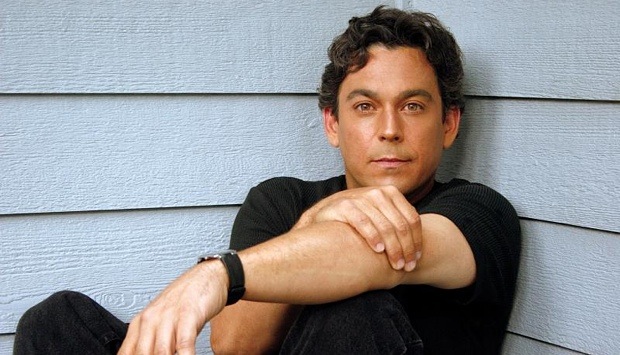
A man of extraordinary talent at the keyboard, he's held the piano chair in Branford Marsalis' band for some 11 years and also spent a long tenure with Michael Brecker. Both of those men have had a huge influence on Calderazzo, and he is unabashed about saying so. He carries lessons learned from those relationships. He also stays in touch with what fellow pianists are doing and with what's happening on the music scene. He's interested in probing music, not just playing it.
He's currently leading his own trio, while still being a vital cog in the Marsalis organization. In fact, 2011 saw the release of a duet record with Marsalis—Songs of Mirth and Melancholy (Marsalis Music)—and the recording of a new Marsalis quartet album to be released in 2012. It has no title yet, but Calderazzo is high on it.
Speaking in the fall of 2011, Calderazzo had just come off the European leg of a tour with his trio. He was about to set off again with his men—drummer Donald Edwards and bassist Orlando le Fleming—to Lebanon, Turkey, Norway and Italy. He was tired. Getting his own group out there requires a lot of energy. Traveling with Brecker or Marsalis is one thing, he notes. Negotiating his own trio around the globe is another. It isn't, he says, straightforward or glamorous. "I've been assured by everybody that no matter who you are, you've got to start somewhere," he quips. He looks forward to the trio performances, despite the rigor involved. He's glad to have his own group out there. Enjoying the performances makes it all worthwhile.
"I don't care how I feel, how tired I am, how far I traveled. I'll get up there and play," he says. "I don't look at my clock. I play. If I'm half dead, I'll play until it kills me. It could be a thousand people or one hundred people. It's the same to me. I hold a real high standard to my personal performance. I don't demand that out of my musicians because I know they're doing the best they can. Some shows are better than others."
Once thing is certain: His playing is always interesting, no matter the setting. He flies under the radar a bit in the jazz field, but to see him live—fingers flying, pushing the music, creating impressive sounds—is to know that he's one of those out there that is really doing it.
"I'm missing shows with Branford to pursue my own trio stuff, and he hasn't given me any grief," says the pianist. "He understands." Calderazzo is 46, Marsalis five years older. He calls Marsalis his best friend, a guy he's known since age 14. He was the best man at Calderazzo's wedding. "Branford and I are literally the odd couple. We are worlds apart in just about everything. He is completely well read, completely into politics. ... I'm not into politics at all. I do like history. He loves history. But Branford and I can talk for hours about life, about feelings, about relationships, about music—and just go on. And the thing that's really cool about Branford is he's an incredible listener. The other thing is I am a pain in the ass. I can be really difficult. Branford knows that about me. ... We just naturally like one another."
 Calderazzo notes, "I was really close to Michael [Brecker] also. Michael was a real hard-working guy. I learned a lot from both of these guys. The relationship I had with Michael was that of father and son. I lost my dad when I was 17, and I met Michael when I was 20. I was in his band when I was 21 or 22. I think I spoke to Michael almost every single day. I never went more than three days without speaking to Michael in the time that I knew him. I loved playing with him, but the relationship I had with him was very special."
 Brecker died in 2007, a death that affected many in the music world, as the great saxophonist had given the world so much fine music. "With any kind of tragedy, as we get older it chips away at you. Michael was a tough one," says Calderazzo. "It makes you think that maybe that shitty solo or when I turn the beat around on that blues really isn't important anymore. I'm a firm believer in the importance of the relationships that we build, both personally and musically. At the end of the day, that's really all this is about."
He says his relationship with Marsalis is one that works superbly from a musical standpoint. "After 11 years of playing with Branford, I'm still nervous to play with him. I'm comfortable, but ... And I had the same thing with Mike [Brecker]. Mike kept you on the top of your game. Whether you like the way he played or not—because I've met people who loved his playing and people who don't—but the one thing that's undeniable is his playing, his attack of the instrument, what he brought to the table. Night after night, Mike brought it. He would go to the sound checks and would sit at the venue and practice for hours. He's ready to go. Michael was a true professional. He played every performance like it was going to be his last.

"Branford's attitude is not that. It's a funny thing. My take on it is, no matter where it is, it's just another performance. The two of them are polar opposites, but it works for each one of them. It's very interesting. I've learned from both of them."
The duet record with Marsalis is one of quality, Calderazzo says, but oddly that might not be noticed by everyone. The music on it is mostly written by the two mates. The tempos are slow to medium. Marsalis' sound is typically rich, and he's always resourceful, very expressive. Bold or nuanced, brazen or thoughtful, he has the technique and artistic sensibility to cover it all. Calderazzo, for his part, shows many sides: stride-like moments on "One Way"; tender on "The Bard Lachrymose" and "Hope"; fleet and frisky on "Endymion." Throughout the disc, the conversations between the two merge in a manner that appears effortless. Each knows where the other is and where they're going. There's only one fast tune, the closer "Bri's Dance," where both are more playful.
"The thing that's cool about that tune is there are two chords to every measure. There are a lot of chord changes in that song," he explains. "It's like 'Giant Steps' with even more chords. At points, it sounds like it's free. What's cool about that is none of it's free. We don't go out of time. The time is constant: one, two, three four, one, two, three, four—with all those chords going by. But Branford and I are somewhere else. To me, that was very cool. I ran into [pianist] Phil Markowitz in Denmark, and we were hanging out listening to music. I played it for him. He said, 'You're playing that free?' I said no. I counted. I showed him where the time was, where the form was. He was, like, 'That's pretty cool.' It's very subtle. You would think we got 'out.' But we're so inside, we're free."
There are nine tunes on the album. "We probably didn't do more than 12 or 13 takes, total," says Calderazzo. That's how easy it is for these two partners to meld. But, "Musicians probably wouldn't like it because there's not enough flash. It's simple. It's melody driven. There's not enough slick shit on there for musicians to be wowed by. I love that about Branford. He doesn't make records for musicians. It's a documentation of whatever. ... My wife will listen to that record and love it. She'll put it on and say, 'I love this song. It's beautiful.' I have some friends that are musicians that like 'beautiful' music. They're, like, 'That duo shit with Branford is really nice.'"
 Retakes weren't usually necessary, and produced not much more than different music, not better. Calderazzo is comfortable with that approach.
 "The one place where my playing has really changed has been my attitude toward stuff. Once again, the difference between Mike and Branford: Mike would spend hours fixing stuff on his records, where Branford leaves all the mistakes on. I still don't know. I can go both ways," says Calderazzo. "I co-produced Two Blocks From the Edge (GRP, 2003) with Mike. I would have done anything for Michael at any time in my life. But I told Mike in jest, 'Don't ever ask me to do anything like this again with you.' Mike was a real studio musician. If he played a bad note, he fixed it. ... One thing I've learned is, if you have to do more than two or three takes, then you ain't getting it."
Recording the new Marsalis quartet record with bassist Eric Revis and new drummer Justin Faulkner was of one those record-in-the-moment projects. "Nobody really had music. We did a couple of new tunes, a tune of mine, a Monk tune we had been playing. I called [Marsalis] up and said, 'Hey man, do you have music?' He said, 'We got a few things. We'll just go in and do it.' I was, like, 'Dude!' Normally we have three days for recording, now we only had two. I'm, like, 'Branford, man ...'"
 Calderazzo says the resulting album "is really a good record." He adds, "Two days we went in and knocked it out. And it sounds great." He also has strong praise for the relatively new drummer, Faulker, who has been part of the band for several months now. Says Calderazzo, "Part of the jazz scene is: you have talent, but you don't have direction. Everybody is ... I don't know what the word is. People are striving so hard to be different. Or they're not complete. They haven't checked out enough jazz, so they're playing just enough to get by. This kid [Faulkner] came into this band with a certain kind of energy. Eric [Revis] has been so helpful. [Pianist] Orrin Evans has really been helpful in pointing this kid in the right direction. He's 20 years old, and he shows up and the shit that he can't do, we'll be, like, 'You need to check this out.' And he'll check it out, and he'll be playing it the next day. It's really amazing."
 "The way I like to play with my trio, I might play one tune. It might be fast one night, it might be a ballad another night, it might be a straight-eight tune. I might play a tune and it has 40 chord changes, but one night I might play all over the chords, the next night I might find a vamp and play on that. The guys gotta follow me. When Justin joined [Marsalis' band], I've said one thing to Justin: 'Don't get comfortable, don't find a part, don't play the same shit every night. I want you to change every day. Don't play anything the same. Ever.'"
Calderazzo says more young musicians could use some direction. "I respect and am aware of all the musicians that are out there today. I don't live in New York anymore, but I spend hours on YouTube and I know exactly what Gerald Clayton sounds like and Aaron Parks and Aaron Goldberg and Kevin Hays ... I'm still a student of all of this stuff and curious to see what's going on." While there are remarkable pianists out there, others have technical ability but are lacking something. "Quite frankly, a lot of it to me is a lot of talent, but not a lot of direction—a lot of mediocrity, a lot of guys that are more interested in being different than good.
"When I came up, the generation before me was Mulgrew Miller and Kenny Kirkland. The generation before that is Herbie Hancock, Chick Corea, Keith Jarrett and McCoy Tyner. Right? The kids coming up today aren't going back as far. They're going to people like Brad Mehldau, who I respect and think he's a fabulous pianist. But I travel around the world and all I see is a whole bunch of guys that are trying to sound like Brad Mehldau. The thing about that is Brad Mehldau, coming up, had checked out Wynton Kelly. ... Or people are just in love with Keith Jarrett, who I think is one of the greatest piano players in the history of music. They try and play like that, but meanwhile they miss out on the idea that Keith studied the tradition of jazz. Wayne Shorter is playing all this crazy shit now, but Wayne had transcribed Lester Young solos.
 "To me, there's somewhat of a musical disconnect. If he continues to grow, a guy that will really have the potential to be really special is Gerald Clayton, because his dad [bassist/composer/arranger John Clayton] steered him in a good direction. I was checking out videos recently. The kid is young and he can play the blues. He knows how to swing. He has information. He's checked out Oscar Peterson. He's also checked out Benny Green. He's checked out Monty [Alexander]. ... I told Gerald that also. The only problem Gerald is going to have is he's going to have to do a lot of this stuff on his own. That's with everybody that's come up. You know what I mean? He's really good.
 "But you know what's really good? Herbie's playing on Four n' More [by Miles Davis (Columbia, 1964)]. I'm guessing Herbie was 22. It's really amazing how good he fucking plays at 22 years old on that record. He took Bill Evans and George Shearing, maybe a little Nat King Cole. I know Herbie, and he was never a stride player, so he didn't go that route. But he checked out Debussy, Ravel, Mozart. He's extremely gifted. He's one of the few that God decides to put his finger on and say, 'You're going to be one of the chosen ones.' He's just a super talent. But his playing at 21, there's nobody who comes up that's close to that. So 'good' is really a relative term."
Further examining the youth movement, Calderazzo opines, "There's all this straight-eight music now, and a kind of harmony has taken over. You have guys that want to be different, so they write all these songs in odd meters, or they want to play standards, but they don't want to swing, so they play a standard in 7/4 instead of just playing it in 4/4. Which is fine. Who am I to tell people how they should play? But for my own thing, I have spent countless hours trying to comprehend how Herbie was able to play like that at that age. It's that good: the lines, the harmony, the comping—every aspect. So [nowadays] Blue Note Records will sign a guy and say he's the next genius? Come on.
center>

"Take somebody like Eldar, who's a hell of a pianist. But he's had to do all of this on his own. He didn't have an Art Blakey or an Elvin Jones or a Wynton Marsalis or a Joe Henderson or Freddie Hubbard or Woody Shaw. He didn't have anybody to say, 'Hey, kid, you don't have to play every fucking note on every solo.' He didn't have that lesson from one of the guys that made it. That's how I feel."
Calderazzo himself had a variety of influences while growing up in New Rochelle, New York, north of the Big Apple. He started studying piano at about the age of 7. At age 14, he was in a rock band led by his brother, Gene. "I was always the youngest in every group. This band I was in, I actually had to get a written note from my mother just to play in this bar. The guitarist went to Berklee and came back and was into jazz. Being that I was 14 and they were 18, they all went to Berklee, and I used to go visit them. That's where I met Branford. I met Walter Beasley and Donald Harrison. I met David Kikoski up there, Jeff Tain Watts. One of those guys told me to check out the Miles Davis groups and the John Coltrane groups. I went out and bought just about every Miles Davis record. Miles was a good one, because he always had a great group and he always had great musicians. So if you check out all of Miles' records, you get to check out Wynton Kelly, Red Garland, Bill Evans, Herbie Hancock, Chick Corea, Keith Jarrett."
From Miles, it was Coltrane and McCoy Tyner, who "was really an instant pull because it had that power." Calderazzo explains, "My favorite band was Led Zeppelin, because I loved powerful rock bands. So McCoy was cool—like Led Zeppelin, but jazz. Then we go backwards. It's Monk. I really liked Red Garland playing 'Billy Boy' on Milestones. So let me go buy a couple Red Garland records. Then it's Wynton Kelly, and somebody goes, 'Do you know this record?' And I go out and buy that record. I really liked Bill Evans. I loved—and still to today think it's as close to perfect as music can possibly get—a record called Circle in the Round (Columbia, 1979). It was 'Love For Sale.' It starts out with Bill playing an intro. It's Trane, Cannonball, Bill Evans and Miles. It is absolutely amazing. So I go out and buy Bill Evans albums. Live at the Village Vanguard, Everybody Digs Bills Evans (Riverside, 1958), you know."
 Still a teenager, Calderazzo was jamming with some heavy hitters at the age of 17. A few years later, he met Brecker at a clinic. Kenny Kirkland was Brecker's pianist, but he would leave for a gig with the rock star Sting. Kirkland's career would be somewhat intertwined with Calderazzo's, for a time. In 1987, at age 22, Calderazzo was on the road with the saxophonist. He played on 1988's Don't Try This at Home (Impulse), and his reputation grew. Brecker produced Calderazzo's first disc, In the Door (Blue Note, 1990), and played on it, as did Marsalis.
 "When I joined Mike's band. I didn't have any of his records. My musical influences were Miles and Herbie and Chick and Keith and McCoy and Sonny Rollins and Trane. I wasn't into the Brecker Brothers. I knew who they were. Mike wasn't really out playing straight-ahead until the late '80s. He was doing Steps Ahead, and that wasn't really a band I checked out," he recalls. "I was 22. I was still in and out of school and doing gigs and sitting in and running around to all the clubs in New York. I was doing duo gigs, and I put together a trio. I was doing that shit. Then I joined Mike's band. Kenny Kirkland stayed with Sting. It's funny, the two big gigs that I have were Kenny's. Kenny left Mike to play with Sting, and I got the gig. Mike decided to keep me. Then Kenny died and Branford called me. I loved Kenny. He was a great spirit."
The '90s saw more Calderazzo albums, while he continued to work with Brecker. He even was part of the funky Marsalis band, Buckshot Le Fonque, touring for a short while with the group. It wasn't the type of music he preferred, and he left the unit. It was 1998 when Marsalis' excellent pianist Kirkland died. Calderazzo was asked to step in, and has been there ever since. But he's continued to investigate jazz music and explore its possibilities. He's determined to keep growing.

"I joined Branford's band. He starts playing 'Mood Indigo' as an encore every night, and I never really checked out swing music. Now I'm out buying Duke Ellington records and transcribing those solos so I don't sound like a fool when I'm playing 'Mood Indigo' at a very slow tempo. I got into Nat 'King' Cole. I started getting into Jelly Roll Morton, trying to fill in the holes."
The pianist is still digging playing with Marsalis, but has enjoyed other sideman gigs with other top-notch jazz artists over the years. "It's been a neat thing for me as a sideman. I kind of changed both quartets that I was in. Mike [Brecker] played a lot of my music. Branford is playing my tunes. The communication relationship of what goes on has been developed, and Branford and I have a musical identity together, which is pretty neat.
"When I look back at what my career is, I did albums for Blue Note. My solo career could have been in a different place than it currently is, but I have no regrets and wouldn't change it, because of the music I've made with both Branford and Mike, and those personal relationships as well. It's been wonderful for me. All these years, I've been able to play music that I love playing, and I make a living. I own a house; I have a family. I made a career of playing whatever I want to play. It's pretty neat. I feel kind of lucky. I can bring in a tune to Branford Marsalis and he'll say, 'That's great. Let's record it.' That's pretty cool."
Between the Marsalis quartet and his own trio, the pianist has been booked solid. 2012 will see duo gigs with Marsalis, as well as quartet tours supporting the new recording. And there will be trio activity, including a live recording of his unit, that will likely be released. Calderazzo wants the trio to become well known, to stand out as one of the fine working trios on the scene.
He says, "Nobody knows who [Donald] Edwards is, and the guy is fucking great— not flashy, but a great musician. I met him when we needed a drummer to play with Branford one night. Eric [Revis] recommended him. Donald came and played great. I remember thinking it would be really fun to play with him in a trio.
"What I like about playing trio is: it's not a power trio. Everything I've been more known for doing is on the powerful side. Branford's band is still a hard hitting, pretty powerful group. My trio is very loose, very spontaneous. I'll play bebop tunes. I play 'Confirmation' every night. We do shit like that. I have a couple originals I like playing. I'll be on the road listening to Ahmad Jamal's trio and I'll come in and say, 'Let's play this like Ahmad's group.' That's what I do with the trio. It's fun. It's lighter. We can do gigs without any monitors, because Donald's dynamic range is huge. It's another musical outlet for me."
As for a possible trio album, he notes, "I've never put out a live record before, so part of me likes that. Part of me likes the idea that we're stretching and searching. ... I might look into editing some of it, I don't know. It's done. It's a question of putting it out."
Meanwhile, Calderazzo's strong chops and keen sense to explore night by night will be enhancing any setting where he might be found.
Selected Discography
Branford Marsalis/Joey Calderazzo, Songs of Mirth and Melancholy (Marsalis Music, 2011)
Joey Calderazzo, Amanecer (Marsalis Music, 2007)
Branford Marsalis, Braggtown (Columbia, 2006)
Joey Calderazzo, Haiku (Marsalis Music, 2004)
Branford Marsalis, Footsteps of Our Fathers (Columbia, 2002)
Joey Calderazzo, Joey Calderazzo (Columbia, 2000)
Michael Brecker, Two Blocks from the Edge (Impulse, 1998)
Joey Calderazzo, The Traveler (Blue Note, 1992)
Joey Calderazzo, To Know One (Blue Note, 1991)
Joey Calderazzo, In the Door (Blue Note, 1990)
Photo Credits
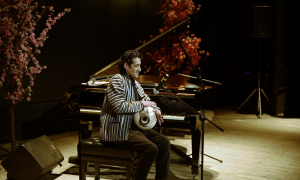
Pages 1, 5: Courtesy of Dog and Pony Industries
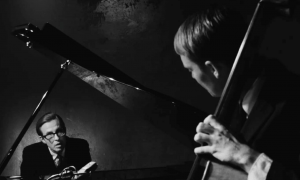
Page 2: Hans Speekenbrink
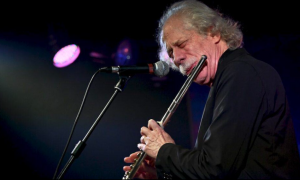
Page 3: Courtesy of North Sea Jazz Festival
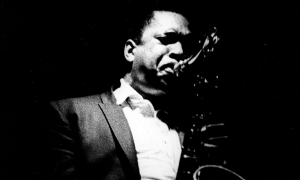
Page 4: Arkady Mitnik
About Joey Calderazzo

Tags
PREVIOUS / NEXT
Become a Sustaining Member

Since 1995, All About Jazz has championed jazz as an art form and supported the musicians who create it. Over three decades, it has grown into one of the world's leading jazz resources, serving hundreds of thousands of readers, musicians, presenters and industry professionals each month.
Help Build the Future of All About Jazz
Your support helps us continue building All About Jazz for the next generation—expanding our editorial coverage, preserving jazz history, developing new community features and creating better ways to discover the music and the people behind it.
Become a sustaining member for as little as $20 per year and you'll immediately enjoy an ad-free experience along with access to subscriber features and future articles for a full year.
Together, we're not simply sustaining All About Jazz—we're building its future. Thank you for being part of the journey.