Home » Jazz Articles » Interview » Gretchen Parlato: Quiet Revolutionary
Gretchen Parlato: Quiet Revolutionary


Parlato is no new kid on the block, having sung as a side-woman on nearly fifty recordings since moving to New York in 2003. Her unique voice has lent its magic to a surprising range of musical styles, from bebop to Brazilian music, and from pop to folk. Her first two albums sounded the arrival of a significant new singer who wasn't afraid to put lyrics to compositions by the likes of Shorter, Hancock and Davis. Parlato's third album as leader, The Lost and Found (Obliqsound Records, 2011) sees Parlato the songwriter and lyricist emerging more fully, and the results are transfixing. Intuitive musical collaborators, bassist Derek Hodge, drummer Kendrick Scott, pianist Taylor Eigsti, guitarist/vocalist Alan Hampton and tenor saxophonist Dayna Stephens play a wonderfully sympathetic supporting role, which encourages and inspires Parlato, though this is a hugely impressive collective performance.
Flattered by all the praise, Parlato humbly eschews comparison with the greats of the past; nevertheless, there is a sense that she already belongs in the pantheon of great jazz vocalists. In the long overdue DVD, Icons Among Us: Jazz In The Present Tense (IndiePix Films, 2009), trumpeter Terence Blanchard states: "History will tell a tale...there's a movement about of some young guys, that's the quietest revolution in jazz I've ever heard in my life."
Parlato is undoubtedly one of the most exciting talents to emerge in this incredible generation—this movement, of young talent which is defining and shaping modern jazz. Respectful of tradition, yet equally inspired by her contemporaries, Parlato is expanding the standards repertoire and pushing the expectations of what a jazz vocalist can do. She is, in her own way, a quiet revolutionary.
All About Jazz: The Lost and Found is a deep, beautiful album; you must be very satisfied with the way it's turned out.
Gretchen Parlato: As I've humbly said, I am satisfied [laughs]. I am very humble about it but I am very happy with the complete package. It does feel good.
AAJ: Is the title inspired by saxophonist Dayna Stephens' tune of the same name from his album The Timeless Now (CTA Records, 2007)

GP: Yeah, it did. The song already had that title, even as an instrumental piece and Dayna Stephens asked me to write lyrics. So, I thought of ideas that stemmed from this concept of the lost and found. In developing the lyrics I came to the realization that our existence is the acceptance of the opposition of the lost and found ,all the time; every day, every moment of our lives feeling good or feeling bad, light and dark or up and down. In the bigger picture sometimes you feel that everything is wonderful and then something tragic happens and there's no explanation for it. This is just life. I was thinking of how this concept develops in our everyday experience, but also in music.
AAJ: Is this also your experience making music?
GP: Yeah, absolutely. In music there is tension and release, the opposition of sound and space. It's very relevant with music and art in general.
AAJ: The Lost and Found marks something of a departure from your previous two albums in that you've emerged more as a songwriter; how does this album feel to you, compared to the others?
GP: There's a lot more of my own writing on this album so it ends up being much more personal than the first two. There's more of my own music and lyrics, so it feels a lot more revealing.
AAJ: You also co-produced this CD along with Robert Glasper; how challenging and how rewarding was this aspect of the making of The Lost and Found?
GP: Oh, very, very rewarding, and there was no challenge whatsoever; it was the smoothest running recording session you could ever imagine. That's because Robert and I have been friends ever since I moved to New York almost eight years ago. We have collaborated on music together and we have a very similar mindset on how we feel and think about music. Everybody in the band loves and respects him. There's a lot of admiration for him from the other musicians. He was able to come in as another ear for us and help us develop the cohesive sound of the band. He had great input and direction and gave great feedback. Robert is mostly known for his positive energy. He always makes you feel good, positive and inspired. And he'll make you laugh [laughs] and we all need that. When everyone has a positive attitude it makes the music that much better.
AAJ: Did you have a greater desire to be involved in the production this time because a lot more of the music was written by you?
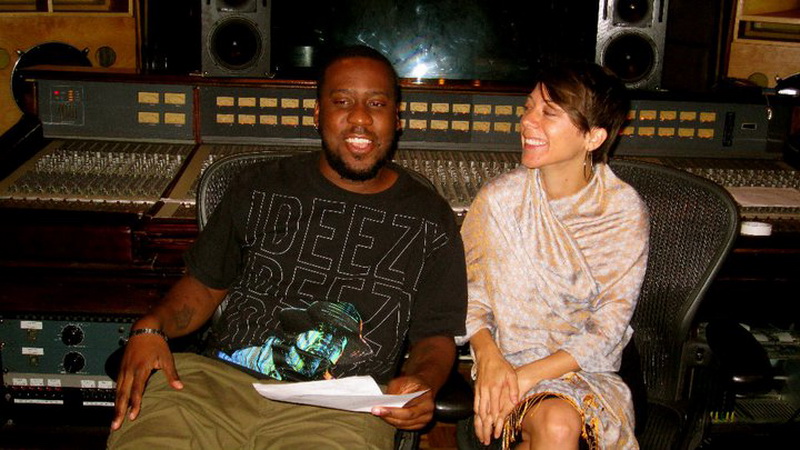
From left: Robert Glasper, Gretchen Parlato
GP: Yeah; I've only put out three albums and I've kind of played the producer role each time. Each album has been my own seed that's blossomed. I've always had help from people but the idea of being in control of a project as an artist is something that has been necessary for me so I've been lucky to have had that control from the beginning.
AAJ: Your lyrics on The Lost and Found are often quite poetic; are you inspired by any particular lyricists or songwriters in that regard?
GP: I have such wonderful peers who happen to be brilliant songwriters so I get inspired by other singers that I know and love who are around me; those would be Becca Stevens, Rebecca Martin and Alan Hampton. There are always the classics like Bob Dylan and Joni Mitchell, artists who know how to state something so profoundly and so eloquently. And sometimes lyrics that are a little less obvious; I like the intrigue of allowing the listener to think a little about a very personal line, you know, what do they even mean by that? [laughs] Knowing that there's something underneath the lyric, besides the obvious.
AAJ: One of the standout songs on a uniformly strong album is "Winter Wind"; it's a very good example of how music and lyrics go very much hand in hand. Could you tell us a little about this song?
GP: Yeah, thank you for that. I was inspired by a line that I saw in a Robert Frost poem. "He was a winter wind"—I took that and ran with the idea of using the imagery of the seasons and how that can connect with love. Beyond that, there's a deeper sense of accepting where you are in your life and it's about the fine line between holding on and letting go. Perhaps that's really what the song's about.
It was an idea on paper but I have to give the band a lot of credit for bringing that song to life. The wind effect, musically, has a lot to do with [drummer] Kendrick Scott, and how he shaped that song. Every song that I write on paper is very simple and when I bring it to the band that's where all of this magic happens and where the direction is realized. I love working with these musicians so much because they help me to realize each piece of music.
AAJ: Do the music or the lyrics come to your first?
GP: I usually hear music first and then the lyrics but with that one ["Winter Wind"] I saw this line and I just started singing. I gave myself the assignment of just singing, and recording myself singing "he was a winter wind," and kind of going from there and seeing where that would take me. The general theme developed with the lyrics at the same time but then the bridge of the song and the end of the song I pieced together lyrics that would complete the whole idea.
AAJ: You mentioned Kendrick Scott, and all the musicians bring a lot to The Lost and Found; let's start with Scott, what do you like about his playing?
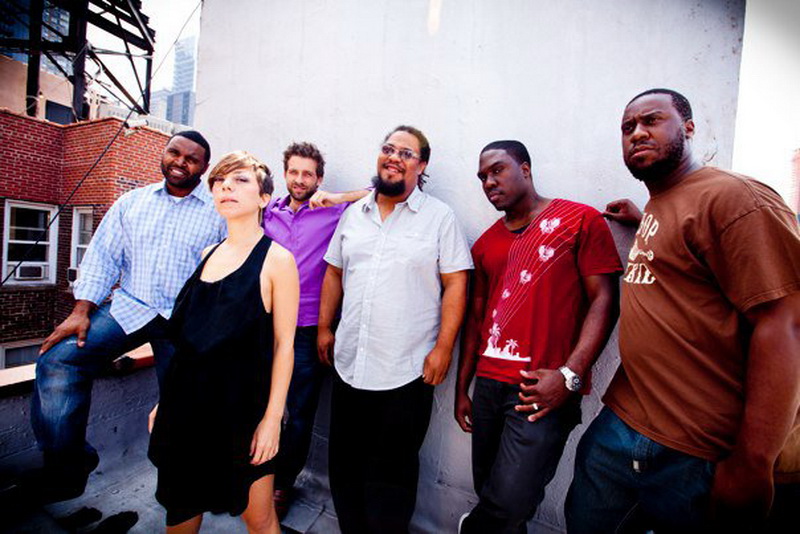
From left: Kendrick Scott, Gretchen Parlato, Taylor Eigsti Dayna Stephens, Derek Hodge, Robert Glasper
GP: He's one of my favorite drummers. What's so wonderful about him is the sound of his drums. A lot of that has to do with his detail, precision and tuning. Beyond that it's the textures and the sounds he's able to create from the drum set. Everything that he plays is really thoughtful. He's exciting to sing with because he'll give me the support I need but he always throws something new at me in a really good way. When we do live performance I'm always turning my head and smiling back at him because he'll create something that just snaps me into that moment. He's brilliant. He's a wonderful composer and visionary with his own projects and how he's hearing and feeling music. He was wonderful on the project, and he helped arranged the song "How We Love," which really pushed that song and took it to another level. He's a dear friend and really funny. The people in this group are some of the funniest people I know; it helps so much just to laugh with people and bond with them that way.
AAJ: You mentioned Alan Hampton before and you wrote wonderful lyrics for his music "Still"; that's such a great song and his voice is amazing.
GP: I know, thank you. I agree. He's really special and I can't tell you how excited I was to have him sing on my album. Not that many people know about his singing, yet. It was exciting for me to imagine that this might be the first time people hear how amazing he is as a singer and a songwriter.
AAJ: If Jack Johnson can sell gazillions of CDs then so can Alan Hampton, with a voice and music as good as this.
GP: Right, you never know. He's very capable and the sky's the limit for what he can do. He writes music all the time and he'll always bring me more profound songs. I say: "Oh, you'll never be able to top that one," but he does. There's a very heartfelt, very emotional quality to his singing that really hits you at your core immediately.
AAJ: Hampton has been your touring bassist for quite a while so why use Hodge on The Lost and Found? Was there any conflict for you personally in making that decision?
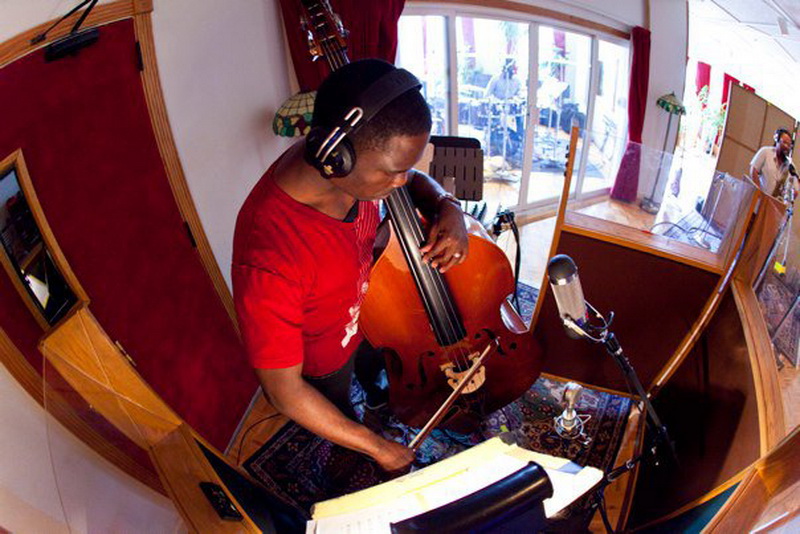
Derek Hodge
GP: Derek [Hodge] played on the previous album In a Dream, where we developed a wonderful rapport and I wanted to continue that on The Lost and Found. He's just a master on his instrument. He's so versatile and has so much to offer. For this project I wanted to feature Alan for his singing and songwriting, and I wanted to have Derek as a bassist. Derek had never heard Alan sing before and in the rehearsal when Alan came in to sing "Still," it was his first time. When Alan began singing Derek stopped, he just put the bass down. He was so blown away by Alan's singing. In that moment he was in the process of recording his own project and after that night he wrote a song for Alan and asked him to sing on his album. In the bigger picture, another door has opened, connecting Alan and Derek as collaborators. I think there's a reason for everything in life.
AAJ: Hopefully we'll be hearing a lot more of Alan Hampton, it seems that he's getting to be heard now. Coming back to Hodge, his bass intro to "Without a Sound" is tremendous; did you write that?
GP: That was written by Taylor Eigsti; he wrote the music and I wrote the lyrics. We were in rehearsal as a band, thinking of a way to perform that song. I was thinking, what if it's really minimal? Or what if we do this as a duet with voice and bass? I definitely wanted to do something that featured Derek. Derek had the idea of that figure, that's something he came up with and he ended up layering, I think it was three different bass tracks over each other to create what you hear. That's the magic of Derek. He's such a professional and so imaginative in creating a vibe and textures. He's a wonderful person to work with. Ultimately that track is just Derek, though Kendrick came in at the end with some mallets and brush on the snare.
AAJ: Taylor Eigsti brings a lot to this album and seems to be a very sympathetic, intuitive pianist; what's it like playing with Eigsti?
GP: Everything you've just described is a reflection of his musicality and it's also how he is as a person. He's an exquisite player. I love his mastery of acoustic and electric piano. There's a whole communication going on with himself, between those two instruments. Our musical relationship is so strong because we're like brother and sister. He's one of the sweetest, funniest people I know. He's somebody I talk to and see all the time as a friend and in our musical life as well. He's one of the most caring, thoughtful and considerate of people. That's who he is as a person and that's what he gives to the music.
These guys give me a beautiful, supportive bed to fall back on but at the same time in a very fun, exciting way they take the sheets off and just throw that bed out the window [laughs]. There's always something g new; it's like an adventure, and it's something very inspiring and challenging. They push the music to another level.
 AAJ: The personalities are keenly felt on the music throughout the album, for sure. On the first two albums you wrote lyrics to compositions by pianist/composer Herbie Hancock and saxophonist/composer Wayne Shorter and Miles Davis, and also Bill Evans; is it a special challenge to write lyrics to fit somebody else's instrumental music as opposed to lyrics for your own compositions, or is the process similar?
 GP: I started off writing lyrics to these preexisting melodies, and sometimes that was easier for me because there was already a shape to the song and a complete sound and my job was to add to the music already created. It's been another step for me to actually write music from the beginning with lyrics as well. Often the music comes first and the lyrics come later. That's been my method so far, though I always like to give myself a challenge—like writing the lyrics first, as if it were a poem, and then adding music. That's another approach. To me, it's all the same in the end whether it's my own song or whether it's a standard. It's always the same connection I have to the music and to the lyrics.
AAJ: You revisit Wayne Shorter's composition "Juju" on this album, though it's a different beast to "Juju/Footprints," which you recorded on your first album; tell us a little about this song and your collaboration with Dayna Stephens?
GP: Sure; the first time we played "Juju," it was as an introduction to "Footprints" so it was like a statement which led us into another track. What happened was, in my own gigs I realized I liked "Juju" on its own and I wanted to open up that piece and let it breathe. So we did in live shows, and when it came to recording this album it just seemed appropriate to add that to the repertoire. I wanted to add something so I asked Dayna if he wanted to come in and play. We have a very personal connection to that song because Dayna and I were in the Thelonious Monk Institute together and it was his idea back in the day to play that song for our ensemble. That led to me getting the assignment from [trumpeter] Terence Blanchard to write lyrics to "Juju," so I can thank Dayna a lot for bringing that song to my musical life.
To have Dayna play on it was very special. He's a monstrous talent and a teddy bear of a human being. He's such a kind soul. He's like an angel on earth; there's a quality he has which makes you think there's something much deeper and higher going on. We've known each other for so long and we played together every day in an ensemble for two years that we've definitely developed a musical communication and spirit together. It's kind of eerie how connected we are as musical minds and voices.
AAJ: You were the first vocalist ever to be admitted to the Thelonious Monk Institute; how did that feel to be the sole singer there, and do you know if any other singers have been admitted since?
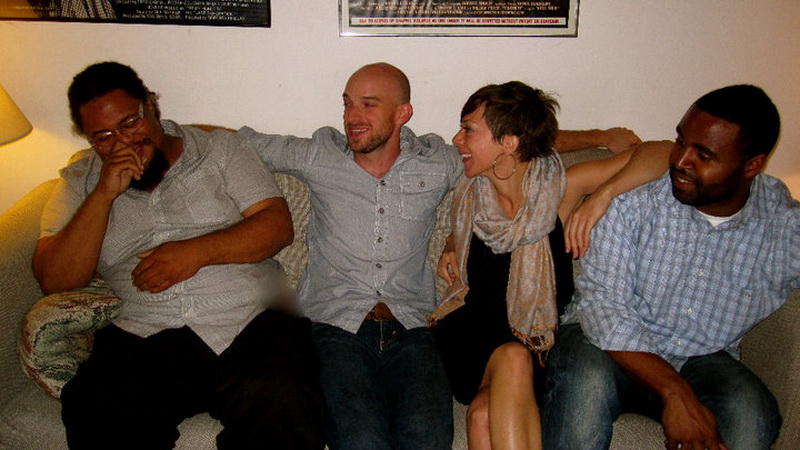
From left: Dayna Stephens, Alan Hampton, Gretchen Parlato, Kendrick Scott
GP: I was the first vocalist and then they had another singer, Johnaye Kendrick, who did the program a couple of years ago. So there's only been a couple. Because they hadn't had a singer I think we were all wondering how this was going to work. You know, how are we going to cater to the instrumentalist's mind and the vocalist's mind? What are we going to add or subtract to make this equation work? That whole program, whether you're an instrumentalist or a vocalist, becomes very revealing and transformative. It almost feels like you're in therapy, [laughs] a daily therapy, where you kind of break down before you break through. You end up being a much different person on the other side of it after the two years.
I was the only singer and the only female so there were different energies, but it was really just trying to figure how to speak the same musical language as everybody, and figuring out how to learn from each other and how to respect each other, and give and take. In the end we figured it out. With that ensemble it took some time to gel together, but you need to be a band very quickly and there was no leader in that band, which is why it took some time. But if you make it through the whole program, you 'll look back on it and realize that it was one of the most transformative experiences as a musician and as a human being. You do a lot of soul-searching in there, that's for sure.
AAJ: Coming back to The Lost and Found, another beautiful track is your interpretation of pianist Bill Evans "Blue in Green," which got its wings with Miles Davis on Kind of Blue (Columbia, 1959). You seem to share a lot of Davis' brittle lyricism in your singing, has he shaped your approach to music much?
GP: Oh yeah, absolutely. There are many hugely influential artists but he's definitely one of the most influential as far as his tone, his phrasing, his sense of space and when to lay out. He's the perfect example of every note serving a purpose. Nothing is ever throw-away, and less is more. There is a lot we can get from listening to and analyzing his music and his whole philosophy. It's really fascinating to me. Those lyrics are beautiful' they're written by Meredith d'Ambrosio. Her whole connection with "Blue in Green" is poignant, the emotion, the metaphors; the lyrics are really exquisite. I've heard other lyrics to that song but hers really spoke to me.
AAJ: You take a lot of inspiration from the jazz heavyweights we've already mentioned, and yet your music sounds very contemporary, and I don't just mean the Mary J. Blige number, but rather your approach to music in general. Is that fair to say?
GP: Absolutely. I think a lot of us in the jazz world in this day and age have the same mindset where we are influenced and have come up with the greats and are following in their footsteps but we are also listening to all kinds of music of different genres which also speaks to us. It's fun and challenging for us to think of opening up the repertoire of jazz. Songs like "All that I Can Say" or "Holding Back the Years" are the new standards, you could say. Jazz is a wonderful place to be, because there's room for forward thinkers like Robert Glasper and there's room for the traditionalists too. There's no reason to compare; there's space for all of that in jazz right now.
 AAJ: You have recorded a lot as a side-woman, and there are a couple of interesting collaborations of late. First up, your singing on saxophonist David Binney's Graylen Epicenter (Mythology Records, 2011); in a recent All About Jazz interview, Binney said he wanted to put the musicians on that record in a comfort zone where he knew they'd feel ok; did you feel like you were in a comfort zone or did you feel he really pushed you out there?
 GP: It makes me laugh if David Binney says that was a comfort zone, because when he gave me the music for this album there were times when I thought, "I don't know if I can do this." I was getting nervous and wondering if I could sing that but he was always "Yes, you can. I know you can do it." He was almost like a coach to me. And he was right. I ended up where I focused and worked really hard. What I love about his writing is that there's a level of intellect which is so advanced but then there's always something emotional about what he's saying. He never ignores the human element of music. I'm thankful that he asked me to be a part of that album.
It was not a comfort zone necessarily, though I will say the comfort lay in the fact that I am comfortable singing those horn-like parts. It was more of a challenge, to blend with the different horns. There's a different placement if I'm trying to blend with David Binney or blend with [trumpeter] Ambrose Akinmusire or [guitarist] Wayne Krantz. It's always really fun for me to get really analytical about where's the placement in the resonance and what syllable and vowels should I use. I hope people are aware of that album because I think it's really fantastic.
AAJ: Graylen Epicenter is one of the best jazz recordings of the last twenty years, at least.
GP: Yeah, I'm glad to hear that, because I agree and I just hope that everyone is aware of it.

AAJ: How difficult was it to maintain that ostinato on "All of Time," when you and Binney repeat that riff for two minutes over that incredible drum duet between Brian Blade and Dan Weiss?
GP: It's not. It ends up being very meditative. I ended up approaching it in the same way I would a meditation. I do yoga every day and I think it's the same if you're an athlete and go running, or if you're a swimmer, you end up having this focus where you zone out, you actually zone in. You do something repetitive and it takes you to another place. David is a fan of that and you can hear that in a lot of his writing. You feel kind of high from it [laughs]; a very natural high. It's not necessarily easy; it's like holding a challenging yoga pose. When my role is just to repeat something I get in a zone and listen to what's going on around me and how my part is fitting with everything else. When I was at UCLA, one of my favorite classes was percussion ensemble from Ghana. It was similar where my part was just to repeat, everyone's part really, a drum part, a shaker part or a bell part; you just zone out and let the music take you. It's fun.
AAJ: Your performance on "Home" is wonderful, and that's an obvious standout track on Graylen Epicenter but the other one, "Same Stare, Different Thought" is very notable in a different way. Binney credits you for that actually being on the album.
GP: That's cool. I remember that moment. He was like: "I don't know, we might not need it." It was a very selfish moment because I was like: "You know what? I have spent so long learning this that we are going to do this." I was insistent [laughs] and I was actually proud of myself for doing that work. I probably made it seem like "Let's just try it," but in my head I was "Oh, no, no, no, we're doing this! I'm not going home without doing this track." I'm really glad we did it and it was actually a lot quicker to record than we thought, because it was extremely difficult and detailed.
AAJ: You did the right thing to insist because it's another moment of magic on the album. You mentioned your percussion class at ULCA and you play percussion on the Paulihno Da Viola track, "Alo Alo"; you seem to have a special affinity with Brazilian music.
GP: I do. I fell in love with João Gilberto, my first Brazilian love, [laughs] when I was 13, and I came across the Stan Getz, João Gilberto, [Antonio Carlos] Jobim classic bossa nova album. I was so taken with the sound and the concept. It was so intimate, so powerful and so deceptively simple. It spoke to me because I think it was really my personality. When I was younger I was kind of quiet. I had a lot underneath but I was a little shy. I liked singing but belting out songs never felt very natural to me and maybe hearing someone like Joao Gilberto, I was really moved because here was somebody who...it was okay to be a little fragile and intimate, and move and affect people. I've always tried to incorporate a little bit of that in what I do.
AAJ: Another recent collaboration is with singer Becca Stevens, who you mentioned earlier, on her album Weightless (Sunnyside, 2011). You also sing in a trio with her and Rebecca Martin, called Girls Gone Mild; could you tell us about these collaborations?
 GP: Oh, sure. I had the wonderful opportunity of being introduced to Becca's music when I moved to New York and then getting to know her. Now we've become best friends. She's one of the closest people I have in my life. I'm just such a huge fan of her voice, her singing and her writing. I'm so grateful that she asked me to sing on her album. There's something very magical about blending with her. It's the same thing with Rebecca Martin. We were actually having a nice, relaxed, musical hang the three of us and we realized that it was a profoundly magical experience so we decided to collaborate. The name was originally Girls Gone Mild which was a comment that saxophonist Bill McHenry wrote under a photo of us hanging out in the backyard eating and drinking and there was a charm to that title but now the band's name is Tillery, which is named after a woman who was really influential to Becca.
 These are two hugely inspiring and influential women to me, as humans, and also as singers and songwriters. We do this project when we can. We have some performances coming up and some teaching we're going to do at Stanford Jazz workshop and we kind of take it as it comes. It's a really unique and very special group. It's similar to how I talked about my own band; when you have this deep love for the people that you play with the music ends up reflecting that. We either write music specifically for the three of us or we might do each other's repertoire, or covers. We have an unexplainable, magical energy and we hope to share that with other people.
AAJ: The tracks of Tillery on YouTube are amazing; the harmonies are reminiscent of Crosby, Stills and Nash at their best. Have you plans to record this trio?

GP: Oh, we're going to. There's lots to do with these women. It's a matter of time, but it'll happen. It's cool because it's fairly young in its concept and there's so much we can explore. When you find that connection with people you have to go with it. We're all in different decades of our lives; Becca's in her 20s, I'm in my 30s and Rebecca's in her 40s so there's a whole range of life experiences that each of us have and we absolutely adore and respect each other and support each other. It 's very healing for me to be around them and to sing with them. I have the feeling, and I hope listeners do too, that you're tapping into something much deeper, much higher.
Selected Discography
Gretchen Parlato, The Lost and Found (Obliqsound Records, 2011) David Binney, Graylen Epicenter (Mythology, 2011) Becca Stevens Band, Weightless (Sunnyside, 2011) Esperanza Spalding, Chamber Music Society (Heads Up/Concord, 2010) Mari Yamashita, Sunflower (Erato Music, 2010) Suresh Singaratnam Gretchen Parlato & Jamie Reynolds, That is You (Suresong Music, 2010) Gretchen Parlato, In a Dream (Obliqsound Records, 2009) Guilherme Vergueiro, Intemporal / Timeless, Vol.1 (Tratore, 2009) The Brother Thelonious Quintet, Brother Thelonious (Self Produced, 2009) Justin Vasquez, Triptych (Triptych Works, 2009) Kenny Barron, The Traveler (Sunnyside Records Records, 2008) Esperanza Spalding, Esperanza (Heads Up International, 2008) Massimo Biolcati, Persona (Obiqsound Records, 2008) Nick Vayenas, Synesthesia (World Culture Music, 2008) Hironobu Saito, The Rai, (Fresh Sound Records, 2008) Sean Jones, Kaleidoscope (Mack Avenue, 2007) Lionel Loueke, Virgin Forest (Obliqsound Records, 2007) Andy Milne / Gregoire Maret, Scenarios (Obliqsound Records, 2007) Kendrick Scott Oracle, The Source (World Culture Music, 2007) Francis Jacob, Side-by-Side (Self Produced, 2007) Hironobu Saito, The Sea( Fresh Sound Records, 2006) Gretchen Parlato, Gretchen Parlato (Self Produced, 2005) Terence Blanchard, Flow (Blue Note Records, 2005) Janek Gwizdala, Mystery To Me (Janel Gwilzalda, 2005) Guilherme Vergueiro, Encontro— Rio Bahia (Del Sol Records, 1997)
Photo Credits Page 1: Eva Elings Page 2, bottom: Joshua Semolik Page 2 (top), 3, 4: courtesy of Gretchen Parlato Page 6: Jonas Pryner Anderson
< Previous
The Lost and Found
Next >
Math or Magic
Comments

About Gretchen Parlato
Instrument: Vocals
Related Articles | Concerts | Albums | Photos | Similar ToTags
Gretchen Parlato
Interview
Ian Patterson
United States
Herbie Hancock
Wayne Shorter
frank sinatra
Billie Holiday
Miles Davis
Thelonious Monk
Kendrick Scott
Taylor Eigsti
Alan Hampton
Dayna Stephens
Terence Blanchard
Robert Glasper
Becca Stevens
Bob Dylan
Joni Mitchell
Bill Evans
Meredith Ambrosio
David Binney
Ambrose [Akinmusire]
Wayne [Krantz]
Brian Blade
Dan Weiss
Stan Getz
Joao Gilberto
Rebecca Martin
Bill McHenry
For the Love of Jazz
 All About Jazz has been a pillar of jazz since 1995, championing it as an art form and, more importantly, supporting the musicians who create it. Our enduring commitment has made "AAJ" one of the most culturally important websites of its kind, read by hundreds of thousands of fans, musicians and industry figures every month.
You Can Help
To expand our coverage even further and develop new means to foster jazz discovery and connectivity we need your help. You can become a sustaining member for a modest $20 and in return, we'll immediately hide those pesky ads plus provide access to future articles for a full year. This winning combination will vastly improve your AAJ experience and allow us to vigorously build on the pioneering work we first started in 1995. So enjoy an ad-free AAJ experience and help us remain a positive beacon for jazz by making a donation today.

Giveaway

Eligible winners: 15
Days remaining: 4
Days remaining: 4