Home » Jazz Articles » Interview » Anthony Branker: Jazz Dialogics
Anthony Branker: Jazz Dialogics
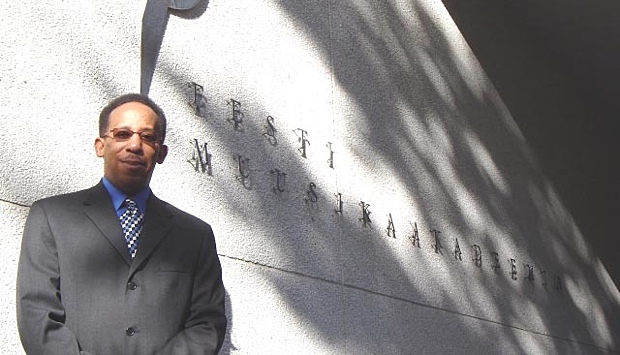

Never apologize for or deny any of those influences that have shaped you. If they are strong enough, and they are coming out in your playing and your writing, that's OK. That's what's gonna give you a chance to be unique and really share your voice.
Among his many accomplishments, Branker played a major role in organizing an active jazz program at Princeton. He has also founded and leads two jazz collectives—Anthony Branker & Ascent, whose recordings have received praise throughout the industry; and Anthony Branker & Word Play, which recently recorded its initial CD. For these groups of top-flank musicians, Branker crafts extended compositions that allow ample room for musical dialogue amongst the players. He guides his groups with his intentions, then stepping back to hear the results of their creativity. What ensues are rhythmic, stirring, and complex expressions of ideas and feelings, with coherence, meaning, and implication. In a word, they are beautiful, in a deep, aesthetic sense that leaves a lasting impression.
In a In a recent All About Jazz review of an April, 2011 performance by Word Play at the Paul Robeson Center for the Arts in Princeton, New Jersey, as much as the power of the music was clearly impressive—featuring saxophonist Ralph Bowen, bassist Kenny Davis, drummer Adam Cruz and special guest, pianist Jim Ridl—so, too, was it unusual to see Branker back off, after rehearsing the group and helping to establish the rhythm, rather than joining the ensemble as a player. While not uncommon with big bands, this strategy is rare in the quartet format.
All About Jazz: We'll start with the perennial desert island question: What are the recordings that you would bring to that desert island?
Anthony Branker: First of all, I love Woody Shaw. He was one of my big inspirations coming up as a trumpeter and composer. Mosaic Records came out with a box set a while ago that has the complete CBS recordings [ Complete CBS Studio Recordings of Woody Shaw, (1992)]. So that's definitely one.
AAJ: What is it about Shaw that appeals to you?
AB: There was something about his sound, the way that he created lines, his harmonic foundation. His use of wider intervals and the angularity of it. There was something so fresh and engaging about the way he played, coming out of the hard bop idiom, but influenced by freer approaches to improvisation and composition.
AAJ: Some more albums?
AB: Freddie Hubbard, The Body and the Soul (Blue Note, 1963). Wayne Shorter did a lot of the arranging on that, with a somewhat larger ensemble. Then there would have to be Art Blakey and the The Jazz Messengers' Ugetsu (Riverside, 1963). I discovered that record when I was about 19 or 20 years old. The Jazz Messengers were always an influence on me. Then there's a young vocalist, Gretchen Parlato, ho's done some work with Terence Blanchard, Herbie Hancock, and Wayne Shorter. On her debut recording, Gretchen Parlato (Self Produced, 2005), she has a wonderful sound, and sense of lyricism and musicality. Maybe not incredibly well known, but she's amazing. Pat Metheny's Still Life (Talking) (Nonesuch, 1987); there's so much about Pat's sound that I love, and the kinds of musical resources that he delves into, and that particular recording has a personal connection in that when my daughter Parris was born, back in 1994, that was one of the recordings that I always played around the house. And I remember just holding her in my arms and dancing, and singing some of the melody lines. She still remembers that recording, and at one point was able to sing some of the solos. Wayne Shorter—I love everything that Wayne has done. Speak No Evil (Blue Note, 1965) is probably the one I'd pull out at this point. Wayne's approach to composition has been a big influence on me as well.
AAJ: Do you have any interests in classical music?
AB: Yes. Bartók String Quartets. Everything by Stravinsky. I have wonderful boxed sets with Firebird and Petrouchka and so on. Again, I tend to gravitate towards performers, composers, and arrangers who have a unique approach or really value rhythm and lyricism. Those are what I embrace and are really important in my own approach to writing music.
Early Life and Musical Influences
AAJ: Let's go now to your early background and influences. You grew up in Piscataway and Plainfield, NJ. I believe that pianist Bill Evans grew up in that area.AB: Yes, in Plainfield.
AAJ: Did you come from a musical family?
AB: Well, at first I didn't think so, I had no idea. But in my twenties and thirties I did learn that there were a couple of Brankers in the music business. My uncle Rupert Branker was the music director and pianist with the Platters. My other uncle, Roy, was with the Copasetics, a fraternity of male musicians in Harlem organized after the death of William "Bojangles" Robinson, primarily to support dance. Billy Strayhorn was a member of that group, and my uncle Roy wrote some music with Strayhorn. Roy Branker was also in a trio called the Three Peppers. Another cousin, Nicholas Brancker, who spells his name slightly differently from mine, is from Barbados. He's a music producer and bassist who worked with Roberta Flack and also was nominated for a Grammy in the calypso category.
AAJ: So you only later learned that you come from a truly musical extended family.
AB: I didn't learn about Rupert until I was playing classical trumpet with organ at an event in Pennsylvania. Someone came up to me afterwards, and said, "Are you related to Rupert Branker? He was with the Platters." So I started doing some research, and sure enough, it was my uncle. It was very cool to find out about him in that way. I think he passed in 1961. I was born in 1958, so I didn't have actual contact with him. But it's a source of pride to be part of that lineage.
AAJ: What were your early musical influences?
AB: Well, my whole family is from Trinidad. I'm first generation American. So growing up, there was a lot of calypso, a lot of music of the islands I heard in the house. Also, a lot of popular music of that time period. On AM radio, I'm checking out the music of the Motown sound, Stevie Wonder, Aretha Franklin, Marvin Gaye. Some funk things, Parliament Funkadelic, James Brown. I started playing trumpet when I was 10 years old. In elementary school, I took lessons in school and played in the band. Maybe in middle school, I had my first experience of jazz, but the moment that jazz took hold of me was when I went to my first live concert, and that was not until I was about 14 or 15 years old, around 1973-1974. It was Maynard Ferguson's Big Band, just after they released the MF Horn—Vols. 4-5: Live at Jimmy's (Columbia, 1974), so the band was swingin' really hard. The concert was at a hotel in Somerset, NJ. I just remember sitting really close, and the spirit and the passion with which the band played, swingin' so hard, great soloists, playin' bop and hard bop. It was before the band's more commercial ventures like [the theme from 1975 film] Rocky, that came in around 1976 or '77 [on Chameleon (Columbia, 1977)]. It just took hold of me. And as a trumpet player, my mouth dropped when I heard Maynard doing what he's doing and playing in that stratosphere. And his showmanship. So after that concert, I really wanted to learn more about jazz and how to play this music. I wanted it to be part of my life.
So that's when I really started to study and work hard on the instrument. I had a chance to study with Donald "Doc" Reinhardt in Philadelphia and his pivot system approach to brass. Reinhardt was a trombonist involved in jazz and classical music and had a connection with the Curtis Institute. He looked at each brass player as unique, and would consider the specific physical features that you brought to the table. For example, if you had more of an overbite, there was a certain way he approached the exercises he created for you and how your air stream flowed. He had it broken down into types, and everything was individualized for that student. So it served me very well. I became really aware of my embouchure. My sound and range improved. My embouchure improved. I was playing lead a lot during that time period. A lot of the lead players in the industry went to Reinhardt, and it so happened the same friend who took me to hear Maynard took me to Philly, and we both studied with Doc Reinhardt for a couple of years.
This was when I really began to get into the music of some of those who really became idols: Miles Davis, Freddie Hubbard, and Woody Shaw, all around that same time period. I saw Art Blakey and the Jazz Messengers when I was in high school, and that was another one of those incredible experiences.
AAJ: I'm surprised you didn't mention Clifford Brown.
AB: Clifford was another one whose solos I tried to transcribe, and get into his sense of line development and articulation. In fact, when I was an undergraduate here at Princeton, he was one trumpeter I was focusing on, his beautiful lush sound.
AAJ: So it was in your late teens, and set on becoming a jazz trumpet player?
AB: At that point, I don't think I yet had professional aspirations. I was thinking about teaching math. I came to Princeton as a math major. But soon I was able to convince my parents that I loved math, but that music was taking a central part in my life. Music was always a passion, but there was a pragmatic part of me and my parents didn't see music as a very secure life. But at Princeton, I saw that there were many aspects of music that interested me: playing, teaching, composing, conducting, and doing research. And that was the path I decided to take and when I started taking jazz seriously as a player. I was around 20, going into my junior year.
AAJ: Did you play with any hot groups at that time?
AB: Mostly with other students, but some were rising stars. Guitarist Stanley Jordan was an undergraduate here. We played in a fusion band on campus called Timepiece. I also had to do a senior thesis project and mine was to produce a jazz recording. It was all my original compositions, and Stanley Jordan was on that.
AAJ: Did you perform with any working groups?
AB: Not until a bit later. For a number of years, I performed with a group called The Spirit of Life Ensemble, and we were the Monday night ensemble in residence at Sweet Basil in New York. It was great. We had Mark Gross and Talib Kibwe [T.K. Blue] on alto saxophones, Clifford Adams on trombone, Michael Cochrane on piano, Belden Bullock on bass, and Bryan Carrott who is a great vibraphonist. It was a wonderful ensemble. It was a great group. We were playing a lot of original music with an Afro-centric vibe. Caribbean, Latin, African foundation, but still some stuff that was swingin.' We did a lot of tours, and played the Pori Festival in Finland a number of times. We were in Paris, in Lithuania, Estonia (where I recently returned). It was a great experience to play with that ensemble.
Updating the Career
AAJ: Ivy League schools are certainly not known for their jazz programs, yet you were a student in one, and now you are a faculty member. And you seem to have played a major role in bringing the jazz component of the Music Department, at Princeton, from a dot on the map to a very significant enterprise, where people are coming to study and perform. And we hear about you guys more and more. How did all that happen?AB: When I came onboard to teach in 1989, we were not part of the Music Department, but under the Office of Student Life, and were literally improvising our studies. So when I got here as an instructor, I wanted to change the culture, and the way of thinking about jazz. I wanted both faculty and students to realize how important this tradition really was and to try to expose them to as great a variety of music as possible. So I started to reflect that in concert programming, in the guest artists that we would bring in, changing the rehearsal formats for the ensembles, creating small groups in addition to the ongoing big bands. So there were things I had in mind coming in, and I was fortunate to have several department chairs that were very supportive of our work.
It's been a slow progression, but we've finally hit our stride. A couple of years ago, we received a $4,000,000 gift from an alum, Anthony H.P. Lee [a 1979 Princeton graduate and mathematics major who is an investment banker in Australia], who actually graduated one year before me, and we were in the same "Introduction to Jazz" class taught by a graduate student. But we didn't know each other at all at the time. His support firmly institutionalized the jazz program here. So now I have help. I was able to share some of the small group load with saxophonist Ralph Bowen. Kenny Davis taught a jazz performance seminar. Laura Pelligrinelli, a jazz scholar who works for NPR, came in and taught the Evolution of Jazz Styles course this semester. We're getting students who really are interested in coming here, because there is a community. The students are really supportive of each other. There's a lot of talent. We're really blessed with the kind of students we're attracting.
But a propos of Ivy League schools falling short on jazz, that's not entirely true. I would be remiss if I didn't mention that Columbia University also has a wonderful program in place. Trombonist Chris Washburne, who is a professor there and Director of the Center for Ethnomusicology, is also head of their Jazz Studies Program. He is a wonderful force and does some tremendous things with the students there. I've had a chance to hear some of their groups, and they're fantastic. As a matter of fact, in December, we're doing a joint program at Princeton, in Richardson Auditorium, where both of our groups will be playing. So, jazz in the Ivy League is probably not the first thing that comes to people's minds, but some exciting things are happening. Cornell, Harvard, and other campuses are doing their thing as well.
Jazz Collectives and a Critical Life Event
AAJ: Let's talk about what you call your "Collectives."AB: The two working groups that I preside over, so to speak, would be Anthony Branker & Ascent; and the one that you recently reviewed in concert is called Anthony Branker & Word Play. Ascent put out its first release, Spirit Songs, in 2006 on Sons of Sound Records.
[But] I have to take a detour to tell you that around 1999, my life changed in a very profound way. At the end of a rehearsal on campus, I was sitting behind the drums, doing something with the bassist and pianist, and I somewhat lost consciousness. The students later told me that I stood up, muttered something, fell over on the drum set, and experienced a seizure. I was rushed to the hospital, where it was discovered that I had two brain aneurysms. Further testing showed that I had something called an AVM, or arteriovenous malformation. I had to take a leave from Princeton, where I was teaching part-time, and from Hunter College, where I was teaching fulltime.
AAJ: Guitarist Pat Martino also suffered an aneurysm and AVM, and the doctors told him the AVM had been there since his childhood. Did they tell you the same thing?
AB: Yes, the AVM is an entangled collection of blood vessels, which you could be born with and it would never manifest itself unless a precipitating event causes a seizure. So it was probably something I was born with, and through the years, despite playing music and sports, it never really manifested. And then I had this episode. So I took some time off, and had a number of surgeries, the last of which was a craniotomy, where they open the skull. My particular AVM was behind my left eye. After a period of recovery, I was back teaching in the spring semester.
AAJ: So, unlike Pat, you didn't suffer major memory loss.
AB: No, I was very fortunate and blessed that it caused less damage than I've heard about in others. But my trumpet playing went on the back burner. I decided my focus had to change, and a propos of what I was telling you about my groups, it became more towards composing, and I wanted to have some kind of group as a creative outlet for my writing. So I established the group Ascent, and the idea was to bring in musicians with diverse backgrounds and musical personalities, write for those musicians, and do various projects together. It would serve as a core group that would stay with me over time. Ascent has recorded three CDs.
AB: The newer group, Anthony Branker & Word Play, came about when I wanted to have a group of musicians that would allow me to explore another aspect of my composing, one that was grounded in free exploration and took more advantage of the notion of conversational interplay. All of that is part of the jazz tradition as well.
AAJ: The title, "Word Play," implies that you might include a vocalist.
AB: No, the title of our first album is Dialogic (Origin, 2011), and it really has to do with the notion of conversation and dialogue. The emphasis on dialogue comes from the Russian educator/philosopher/philologist Mikhail Bakhtin. It's about the fact that the "self" is always in relation to "other," and understanding that relationship, as it occurs in a one on one situation or group setting, and what happens when that becomes a main factor whether in a jazz group or in a classroom. So a lot of the research I've done recently has focused on this notion of dialogue. My composing is also exploring that notion of musical dialogue, the kind of dialogue and conversations the musicians have with each other in the group, the inner dialogues the musicians have within themselves, determining how their music will influence the soundscape, the dialogue they have with the tradition, always in contact with that tradition and the music that shaped who we are.
With Word Play, there are many influences. As you heard in the concert, the influences are eclectic in the styles I embrace in my composing. It's not just straight-ahead or coming out of Latin sensibilities, so the group had a chance to reflect on many different influences.
AAJ: Jazz is, in fact, a conversational form of music. Improvised music versus strictly composed music is like the difference between speech and writing in language. So with big bands, the charts are pretty much spelled out in detail, and a few solo improvs are built in. But in small groups, the guys do all kinds of fancy footwork on the spot, and you wonder how it gets in the mix. What is written in, what is discussed in advance, what is cued by the leader, what happens spontaneously in the moment? Now, I know that when you work with a group like Word Play, you're not just giving them some tunes to play. What are you composing on paper, and what are you leaving up to the musicians? If we looked at one of your charts, what would be there?
AB: You would see standard notation. I tend to move back and forth between things that are quite prescriptive and not so much so. For example, the composition "Ancestral Tales," that you heard at the concert, the lines the bassist had, the piano part, the melody, all of that was very well laid out to reflect changes in meters and keep shifting the listener's perception as to where is the grouping, where is the strong beat, what is the meter? So the musicians will play that exactly. But then in that piece, I will leave a space for improvisation based upon a specific bass line, but allowing the pianist to explore different kinds of harmonies, but listening to the bass line and listening to the soloists.
So it sometimes almost becomes an Ornette Coleman approach with his notion of "harmolodics," which has to do with the relationship between harmony, melody, and movement. Sometimes it's about letting what the soloist does with the melody dictate where the harmony is going. In some pieces, like "Skirting the Issue" and "Iggery-Poncheek," I'll have a very definite framework for the composition proper, but when we get into the improvisation, I may have a cell of a rhythmic idea or nothing at all. I may just say "NC," no chord and allow the musicians to really expand upon the resources they heard in the composition itself and use that as a starting off point. Let them take it wherever they want to, empowering them in that sort of way.
For the group Ascent, I've been more specific: these are the changes, these are the "feels," and so it's a different kind of ensemble and approach to composition. But now with Word Play, I'm trying to create a space that really values the notion of freedom and exploration, and just giving the musicians a chance, letting them know it's OK to take it where you think it should go. They may ask me questions, and I may say, "I don't know," which may make them wonder if I really know what I want, but I'm really backing off intentionally, as if to say "I don't want what I think to influence what you think. I want you to feel free to just try some things out, and let's see what happens." And in many cases, what they come up with is so much more hip and incredible than what I could have imagined.
And that's why I think it's important that composers really need to have a connection with the performers. Quite often depending on the genre of the music, the composer may think "This is the way I heard it, this is the way it needs to be played. End of discussion." The performer must respect the intentions of the composer, playing according to his or her intentions. So sometimes composers don't have that conversation with the player and say, "What do you think about this? Where do you hear this going?" Again, I think it's about dialogue, allowing the performers to contribute to the process.
AAJ: There's a sense in which every performance is unique, and that's what makes jazz a remarkable art form. On the other hand, there's the tradition and culture which provide guidelines and inspiration. What's interesting is that your way of composing sounds like it is for a specific group of musicians. Can your compositions then be used by another group, say in a another city or country? Can they take your written notations and use them for their own performances?
AB: Most definitely. And the same concept applies with whoever is playing. I want them to be able to infuse it with their own particular sensibility. It's comparable to Duke Ellington, who wrote with his musicians and their personalities in mind. He knew what Johnny Hodges, for example, was capable of doing. He knew the sound he was trying to get, and he wrote in such a way that he highlighted those aspects. He knew the capabilities of Cat Anderson, of Juan Tizol, of Paul Gonsalves. But Ellington's music is capable of performance by musicians all over the world, including those who may not have been the recipients of his compositional intention. And I see it the same way. I'm starting off with the musical personalities of musicians whom I know very well, know their work, have worked with them, but it's not so closed that other musicians won't be able to explore the same composition. They would, I hope, find different ways of interpreting and contributing to the flow of the composition.
AAJ: In contrast to Butch Morris and his idea of "conduction"—where he will direct a jazz ensemble with specialized movements that signal the musicians to do specific things at every moment—after you count off the rhythm, you back off and let the group take over. Yet there somehow seems to be a relationship in that you are both sort of the creator or deus ex machina, who is guiding the group as it performs while not actually being in the group as such.
AB: Well, Butch has created through the concept of conduction a very specific vocabulary of hand signals or other gestures to get the musicians to do what he needs them to do based on what he may be hearing in the moment or based on his conception of being a "conducting composer." That might be one way of describing what conduction is. For example, when I have led student groups here at Princeton, especially when we had our avant-garde ensemble, I utilized some of those techniques. Some conductors use notational devices like shapes on the paper, and that's what the musicians look at and interpret with the freedom to create around those symbols. So you can use non-traditional notation, hand signals, and so on. So I see Morris' approach to be a bit more hands-on in terms of what's happening in that moment, having some say in molding and shaping the flow in the moment. Whereas, what I try to do is empower the musicians to do that themselves. I trust them to hear and create and take the music to pla ces that work for this collection of musicians in that particular moment. Part of it too is that I'm working with a smaller ensemble. A lot of what Butch does is with larger groups. If I were doing music with a big band with a similar sensibility, I would probably be conducting them too.
Branker as Composer
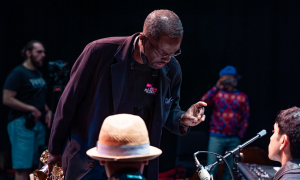
AAJ: There's an inner coherence with your groupsd that is uncommon for small jazz ensembles. Many just play the tune with choruses and variations without attention to the totality. By the way, do you use the standard AABA form?Anthony Branker conducting trumpeter Terence Blanchard and His Quintet Performing A Tale of God's Will (A Requiem for Katrina)
AB: I use a lot of different formal structures, and it's usually based on how the melody is naturally unfolding. In the [Paul Robeson Center] concert, there were some things in the AABA format; however, the lengths of the sections may not be a traditional 32-bar pop song form. Sometimes it's through-composed, with a sense that everything is sort of evolving, and I may not make reference to what came before, so it does have a sense of a free improvisation. The structures I use vary based on the tune. I don't create the structure first. I write and see where things go and then figure out the best way to add structure that is coherent for the listener and for the musician.
AAJ: There's a poster. in the lobby of the Music Department Building here, for a concert dedicated to Charles Mingus. Mingus did some quite intricate composing that might have represented a similar approach to yours, although of course his style was very different. Do you think there's a parallel there?
AB: Mingus is another influence on me as a writer in terms of the different kinds of resources that found their way into his music, whether of the church, the blues, bop, swing; and he also created structures that gave the musicians freedom to be themselves. And sometimes he taught the musicians the parts by first playing them himself as opposed to notation as such.
AAJ: When I listen to your music, varied ethnic associations come up for me: European, Caribbean, African, and so on. I know you recently spent time working in Estonia. Do you draw on diverse ethnic roots?
AB: I think it's all a part of who I am. It's all music, and one thing I tell my composition students is "Never apologize for or deny any of those influences that have shaped you in any way. If they are strong enough, and they are coming out in your playing and your writing, that's OK. That's what's gonna give you a chance to be unique and really share your voice." I've listened to and played Latin music, music of the Caribbean, calypso, and Soca music from Trinidad, which is a modernized combination of soul and calypso. It's all music that I've come to love, and, as I said earlier, it's rhythm that really drives me, and a lot of the music that I've embraced are styles that have very strong rhythmic identities. They're in there explicitly, or if the musicians are really listening, it may conjure up those influences for them as well. For example, my composition "Y Not" starts out with an African relationship between bass and drums, but there are parts where you hear our drummer, Adam Cruz, go into a New Orleans street beat. It's natural for that sort of thing to manifest itself, a logical extension of what's taking place.
AAJ: So much of music is based on the star system. We think in terms of the leader, the famous composer, the star, the personality, and the collective aspect of music making can get lost in the shuffle. The roots of jazz are in the collective, such as African tribal dance and New Orleans street bands. The music, however, comes from a group-as-a-whole place that's been influenced by other ensembles and traditions.
AB: I think the collective has always been there, but I think you're right. When you think of jazz, you think of the soloists who have helped create and shape the vocabulary of the music in different periods. When you listen to a soloist, it's possible to get drawn into that one person because he or she is telling a story. It almost seems like a monologue: here's someone saying what he has to say. But there's such a conversational dynamic that's taking place, even when the stars are improvising. And those conversations are being shaped by the interactions that are taking place in the group at any given moment. So, as you well know, the pianist may be playing something harmonically, and the soloist reacts to it at that moment. It may take them in a whole different direction. Rhythmically, there are things that are constantly inspiring the soloist, who in turn inspires the ensemble. So jazz has always been collaborative, collective, dialogic. Jazz musicians develop their identities as a result of the group, not in isolation. So, though it's easy to think, "yeah Dizzy was killin' and Monk was this," but they were also part of collectives that allowed them to play on the level that they played.
AAJ: The collective has always been there, but you're making it explicit.
AB: When you have a group of musicians who really understand it as a collective effort—not about "me"—and everyone listening to one another and shaping it, that's the ideal. There's always a collective conversation that's taking place.
Looking into the Future
AAJ: What are your thoughts about the future for yourself and the music? What do you have in mind down the pike?AB: I'm definitely going to continue with my collectives. I already have something in mind for a followup recording next year with Word Play, with the same players—Ralph Bowen, Jim Ridl, Kenny Davis, and Adam Cruz. I also want to continue to write for Ascent, which is a bit of a different vibe. In the Dance Music CD, there's a wonderful vocalist from Estonia, When I went there as a Fulbright Scholar, she was just entering the jazz program. Her name is Kadri Voorand, a great lyricist and composer, doing wonderful things and making a great presence in Europe. Her voice is central to the ensemble as well as the three horn voices that I use. So that's Ascent. I really want to explore that group.
I'm also working on some other compositional things. I have a short work for string quartet and am looking for a reading session for that work. I'm working on an octet that brings together classical and jazz influences. I wrote a book of five piano etudes that explore different aspects of dialogue and rhythm. There's supposed to be a premiere of that either at the end of May [2011] or, if not, maybe in the fall at Temple University. And I want to continue writing for piano. There are many things as a composer that I want to do. I want to write for big band more than I have in the past. But first and foremost, I want to explore Word Play, because there are some wonderful possibilities there.
AAJ: When you're sitting there listening to Word Play, after you've rehearsed them and all that, do you ever feeling like going in there and picking up a horn or telling them to do something different?
AB: Well, no, because I trust the musicians implicitly, and I just wanna see where they take it.
AAJ: It appears that you're able to let go of your ego, the "control freak" aspect, and just let it happen. That's very spiritual; it stands in contrast with, say Miles Davis, who was always shaping his groups.
AB: To a certain extent, but Miles also had an aspect to him where he left things very ambiguous and let the musicians figure it out. So he really empowered them. He wasn't one to say, "I need to hear this; I need to hear that. Give me that chord change again."
AAJ: Kind of Blue (Columbia, 1959), for example, was done in a very open way. Was Miles a role model for you?
AB: Yes, in many ways.
Spirituality, Family, and Life
AAJ: Speaking of spirituality, Coltrane once said, "Music is my spirit." Tell us about your own spiritual beliefs, practices, and so on.AB: My spirituality is at the center of who I am, not just as a person but as a musician. A number of the compositions I've done with Ascent do speak to that. There's a piece that I wrote for my dad. He was diagnosed with prostate cancer and given less than six months to live, which I just didn't believe—and he survived for nine years. I wrote a piece for him called "In God's Hands." It's on the Spirit Songs recording. He was a very spiritual person as well, and it was just this notion of trust in the Lord above. Put all your troubles in God's hands, and he will provide for you, he will give you that strength that you need to deal with any circumstance. I wrote a piece for my mom, "Imani" which means faith, and a piece on a recent recording called "Mysterious Ways." So my spirituality manifests itself in my compositions, in my inspiration.
I've mentioned in my liner notes that my daughter passed away at childbirth. I wrote a piece for her called "The Holy Innocent." Her name was Kassandra. At full term pregnancy, my wife and I were going to the hospital January 22nd 2001, we thought she was giving birth to a beautiful baby girl, and then she was still-born. When my other daughter, Parris was born, I wrote this piece for her called "Parris in April." I wanted to write something for Kassandra, but it had to be perfect and a real tribute to her, and I just couldn't do it. When I went to Estonia on the Fulbright in 2005, without my family, I had a lot of time to write. And the first piece I wrote was the one for Kassandra. It was an experience I haven't ever had before or after, where everything seemed to come out fully formed, the melody and chord changes were just so intuitive.
That was the first piece I wrote there, and I wrote a total of thirty-two on that trip. I recorded quite a few of them. And that was Kassandra from above saying, "Thank you so much Daddy. Let me talk to God to help you in this process." It opened the flood-gates for me; I know it was her and God that allowed me to write. I've always been a spiritual person. That's how my family is, as well. Spirituality and religion are two very different things entirely. Religion can be just for show: "Let's go to church so we can say we do."
About Anthony Branker

Tags
PREVIOUS / NEXT


Become a Sustaining Member

Since 1995, All About Jazz has championed jazz as an art form and supported the musicians who create it. Over three decades, it has grown into one of the world's leading jazz resources, serving hundreds of thousands of readers, musicians, presenters and industry professionals each month.
Help Build the Future of All About Jazz
Your support helps us continue building All About Jazz for the next generation—expanding our editorial coverage, preserving jazz history, developing new community features and creating better ways to discover the music and the people behind it.
Become a sustaining member for as little as $20 per year and you'll immediately enjoy an ad-free experience along with access to subscriber features and future articles for a full year.
Together, we're not simply sustaining All About Jazz—we're building its future. Thank you for being part of the journey.