Home » Jazz Articles » Live Review » Jazzahead 2011: April 28 - May 1, 2011
Jazzahead 2011: April 28 - May 1, 2011

Bremen, Germany
April 28-May 1, 2010
Jazz may be a marginalized genre with shrinking CD sales and, at least in North America, a painfully low profile in popular media, but just a few days at Jazzahead in Bremen, Germany, leave a much different impression. A trade show for all things jazz, Jazzahead is in its sixth year, and has become the annual focal point for the jazz industry in Europe. Make no mistake: on that continent jazz clearly is an industry, albeit one supported by people in all areas for whom it's clearly a passion; very few people get rich in jazz, after all. With over 80 booths representing every facet of the industry, which may not be as large as, say, the pop world, it's clearly a business that's big enough, despite the surprisingly personal nature of the goings-on at Jazzahead, where everybody either seems to know everybody—or is out to meet them—and new partnerships are struck at booths, over coffee or over drinks, anywhere and everywhere throughout the event's four-day run.
For the 2011 edition of Jazzahead, three floors of Bremen's massive Congress Center were devoted to a combination of booths (representing artists, labels, managers, jazz magazines, national jazz organizations and more); a number of meeting spaces for daytime programming, including seminars and opportunities for multi-national organizations like the European Jazz Network to bring everyone together under one roof; and performance spaces for artist showcases. Something like The Netherlands' Dutch Jazz & World Meeting, only much, much larger, both in scope and size.
Performances also took place at the nearby Kulturzentrum Shlachthof, a converted slaughterhouse that, five minutes' walk from the Congress Center, now sports its own good-sized performance space, a bar and restaurant. Shlachthof was, in fact, the place to hang in the evenings, a place where old friendships were revived, new relationships forged, and countless deals struck over many, many drinks, well into the wee hours of the morning. Themed evenings took place there each night, including an Overseas Night featuring Australia's Trichotomy, Canada's Rafael Zaldivar Trio and Indonesia's simakDialog; a German night with Philipp Van Ender and Transit Room; and a Turkish night, on the trade show's last evening, that demonstrated the rich variety to be found across continental Europe and beyond.
A little farther away, an ECM Night took place at Sendesaal Bremen, a building that used to house Radio Bremen's studios but which, since closing its doors in 2007, has been repurposed as a combination recording studio/performance hall seating 270 people; a smaller space for recording radio drama; a restaurant; and more. Two of ECM's up-and-comers—Swiss pianist Colin Vallon and Norwegian trumpeter Mathias Eick, both with 2011 releases—demonstrated that producer Manfred Eicher's instincts remain as acute as ever more than forty years after the label's inception, as he continues to find new talent from around the globe, giving it the international visibility it deserves.
Europe clearly has a more sizable jazz scene than most North American audiences know, with new traditions emerging from old, and sometimes coming from what might be considered the unlikeliest of places—though it's equally clear, at Jazzahead, that no place is truly unlikely when it comes to expanding jazz's already broad purview. As endless discussions about whether or not the music—with, at times, a tenuous connection to the American jazz tradition that started it all—is "real" jazz, Jazzahead proved that, despite the importance of that tradition, jazz has evolved into a global music, with a myriad of local cultures acting as springboards for exploration and cross-pollination that mirrors the genre's emergence at the turn of the 20th century.
The only problem with an event like this is that it's impossible to do it all. Meetings run overtime (but, usually, for all the right reasons); walking from one room to another means bumping into someone you've not seen for years or, even better, someone you've been dealing with via email and have never met face-to-face; and, walking through the large conference halls, a booth of interest seems to pop up everywhere you look. Stand in a space talking, and someone is sure to see your name tag and grab you to talk about their latest release, their festival, their label, or their publication.
But if it all sounds big and confusing, what's most surprising about Jazzahead is how well everything is laid out. A book that details every booth and every participant makes it easy to figure out what to do, though the real problem that emerges is choice. Attend a meeting of the JazzX initiative, which strives to break down barriers of language and geography, or catch a short set by Partisans? Check out a panel on Digital Promotion & Social Media, or find out what bassist Mats Eilertsen's quartet is up to? Hear peoples' opinions on New York versus European capitals as springboards for the new Swiss generation, or discover singer Mari Kvien Brunvoli?
Partisans
Ultimately, the best thing to do was try a little bit of both. And so, while the JazzX meeting, with attendees from across the continent—magazine editors, journalists, professors and bloggers—looked to hammer out some of the practical issues facing an initiative that hopes to provide the same content in a myriad of languages, it was necessary to step out a little early in order to catch at least a bit of Partisans' 30-minute set. Whatever regret there might have been for bailing on the meeting dissolved instantly, on entering Borgward Saal, where the British quartet was already half-way through its set, drawing largely from its most recent record, By Proxy (Babel, 2009).
Partisans' co-leaders—guitarist Phil Robson and saxophonist/bass clarinetist Julian Siegel, both leaders in their own right with tremendous recent releases including Six Strings & The Beat (Babel, 2008) and Urban Theme Park (Basho, 2011) respectively—were front and center, performing with the kind of energy that belied the unorthodox hour for their performance, but bassist Thaddeus Kelly and drummer Gene Calderazzo were just as essential and impressive, especially Calderazzo, who lit a fire under everything yet demonstrated no shortage of taste and restraint when necessary. It's no surprise that, while both Robson and Siegel use largely different personnel for their solo recordings, both continue to recruit Calderazzo as their drummer of choice.
In its brief set—and despite my catching only the final fifteen minutes—Partisans demonstrated everything that's great about a British scene that's currently experiencing a golden age as vibrant and innovative as the late-1960s, when so many of today's living icons first emerged. The group swung hard when it wanted, but its concepts of harmony and intricate melodic invention were as bleeding edge as it gets, and while the energy level was high, the contrasts—essential to building great tunes, great solos and great live performances—remained in full view throughout. Robson may largely adopt a warm, hollowbody-style tone, but he proved willing and capable of kicking in one of the ugliest fuzz tones heard in nearly half a century, as he did towards the end of the set—exactly what the music called for, as Kelly and Calderazzo turned up the fire in the engine room for some of the showcase's hottest moments. Siegel, no less incendiary, managed to weave spontaneous melodies whether it was over knotty guitar/bass counterpoint or thundering ostinati.
Hearing Partisans perform rendered a longtime wish a reality. It may have only been fifteen minutes in length, but as the first showcase caught on Jazzahead's first full day, it was a tremendous way to get started. The vibe may have been different a few hours later, when ECM Night took place at Sendesaal Bremen, a ten-minute cab ride away from Jazzahead Central, but it was no less revealing, and proved that power can come from many places...even silence.
Colin Vallon Trio
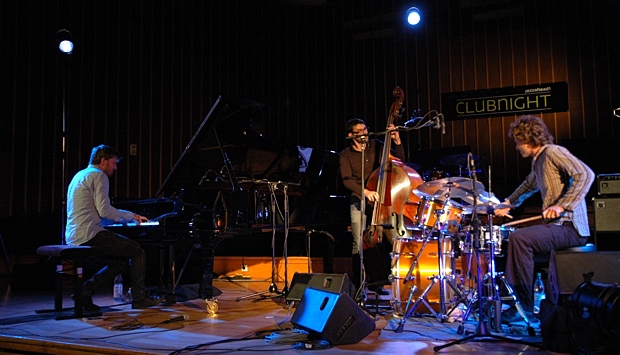
Featuring crystal clear sound, especially in the low end, the dual-purpose of the performance space/studio became obvious upon entering Sendesaal, with the space for musicians occupying nearly one half the room and the audience seating, the other. This generally disproportionate ratio was even more obvious when Swiss pianist Colin Vallon and his trio took to the stage with his trio, featuring bassist Patrice Moret and drummer Samuel Rohrer, the latter no stranger to fans of singer Susanne Abbuehl's April (ECM, 2001) and pianist (and fellow Abbuehl band mate) Wolfert Brederode's Currents (ECM, 2008). The trio was positioned near the front of the large stage with plenty of room for Mathias Eick's quintet, and still there was even more open space behind the trumpeter's setup.
Physical matters aside, when Vallon, Moret and Rohrer came onstage and took their places, the pianist sat at the piano stool, nearly completely still—and absolutely silent—bringing the audience to the same quiet, anticipatory state, a remarkable achievement from which other artists who have issues with ambient audience noise could learn a thing or two. Vallon managed to command complete silence and undivided attention in the most benign, non-confrontational fashion possible.
And Vallon's music required absolute attention, as the pianist began a set focusing heavily on material from Rruga (2011), his ECM debut (but third as a leader) for which each member had contributed compositions—a first for Vallon, who composed most of the music on Ailleurs (Hatology, 2006) and Les Ombres (Unit, 2004)—rendering the trio even more egalitarian. Rohrer's "Noreira" perfectly demonstrated the trio's strength—mining what, on the surface, appeared to be a relatively simple premise, but through a collective dynamic that organically ebbed and flowed, building this song (inspired by an ancient city in the eastern Alps) from gentle forward motion to more propulsive power and climax—curiously, almost imperceptibly, yet ultimately with an unshakable feeling of inevitability.
In addition to a conventional kit, Rohrer created near-orchestral breadth through use of his hands, cymbals placed on his drum skins, and bows on both his cymbals and the sides of his drums. He soloed rarely, but when he did it was filled with a tumult of ideas possessing internal logic all their own and never resorting to virtuosity for its own sake. The same could be said for Moret, who provided a strong anchor for the group—yet doing so almost invisibly—locking with Rohrer at times, elsewhere acting as a tension-building twister and shaker, but through Charlie Haden's elegance and spare simplicity.
In one of his soft-spoken introductions, Vallon praised the hall, saying, "The music kind of plays itself," as the pianist, too, avoided "look at me" pyrotechnics, commanding attention with an uncanny sense of restrained abandon. He employed a variety of preparations that, in one case, skewed his piano to make it sound ever-so-slightly out of tune, coupled with an unusual buzzing sound. Early in the set, the pianist appeared to be bowing his strings, creating a series of curious harmonics that were matched by Rohrer's bowed snare drum. Despite being capable of far-flung flights of freedom, and hints of jagged angularity, the surfaces remained largely rounded, and there was an intrinsic lyricism at the core. At a time when young piano trios seem to be emerging almost daily, Vallon—not exactly new, given he's been at this for nearly a decade—has carved out a unique space for himself, and with sympathetic partners in Moret and Rohrer (both have been a part of this trio for at least three years now), he's got a trio capable of exploring the spaces between the notes, the silence between the pulses, and a sonic landscape where the trio's instruments are clearly defined but pushed gently outside all perceived sonic or stylistic boxes.
Mathias Eick
Following Vallon's well-deserved encore and a short break, Mathias Eick delivered a potent set that, concentrating largely on Skala (ECM, 2011), but also featuring select tunes from his 2008 ECM debut, The Door, demonstrated just how far his quintet has come since its 2010 Natt Jazz performance in Bergen, where he premiered some of the music that would ultimately find its way to his latest recording.
The lineup for Jazzahead in Bremen was the same, with the exception of Torstein Lofthus replacing drummer Erland Dahlen, and also including keyboardist Andreas UIvo, electric bassist Audun Erlien and drummer Gard Nilssen. Lofthus—a drummer who can kick it hard with the aggressively metal-tinged Black Jazz of Shining, the Tony Williams Lifetime/Weather Report-informed fusion grooves of Elephant9 or the ambient-meets-anthemic sound of guitarist Eivind Aarset's Sonic Codex group—worked in uncanny synchronicity with Nilssen. The two drummers often complemented each other, like two friends finishing each other's sentences, occasionally locking into a unison that gave the second half of "Oslo" its driving power, with Erlien and Ulvo pushing a strong ostinato, over which Eick tastefully built layer-upon-layer of sound with his array of effects before returning to the song's memorable, melancholic theme.
Eick opened the set by running Skala's first four tunes in sequence, and while the quintet performed the material with more fire and abandon, it was much closer to the feel of the album than Eick's Mai Jazz 2008 show in Stavanger, where he turned the relatively subdued The Door (ECM, 2008) into a far more kick-ass affair. Still, despite the more electrified energy of Skala, it can't come close to the firepower of Eick's group in performance. Ulvo is a charter member of the quietly groundbreaking Eple Trio, as well as saxophonist Froy Aagre's quartet and, along with In The Country's Morten Qvenild and Splashgirl's Andreas Stensland Løwe, represents the next generation of Norwegian jazz pianists; astute listeners and mind-expanding sonic manipulators all, who bring a pop sensibility to an improvised music context.
A context that fits perfectly with Eick's emerging vision as a leader. As a charter member of the progressive-leaning Jaga Jazzist, Eick had already proven himself a masterful improviser with strong roots in the plaintive melancholy of Kenny Wheeler—while equally well-versed in the traditions of Clifford Brown and Miles Davis—on ECM recordings by guitarist Jacob Young and pianist/harpist Iro Haarla, but it's been in the emergence of his own recordings where he's managed to consolidate the broad musical interests that appear endemic to so many young Norwegian musicians. A pop sensibility colored his approach to singable melodies, while hints of European classicism imbued form and harmony—though hints of folk music could also be found, in particular on "Joni," which married Joni Mitchell's harmonic ambiguity with Wheeler's sense of yearning. Like fellow Norwegian trumpeters including Per Jorgensen, Arve Henriksen and Nils Petter Molvaer, Eick treats embouchure as a palette, rather than a definer of sonic specificity. But while he adopted a breathier tone at times, overall his sound was more burnished than that of Henriksen or Molvær, even leaning towards a sharp, piercing tone during some of his more energetic moments.
Nilssen—another broad player who ranges from the extreme, high volume freedom of Puma to the more controlled and acoustic environs of Zanussi Five—played a smaller kit than Lofthus, who favors a big bass drum over the smaller one usually found in jazz contexts. But while Nilssen may not have had Lofthus' oomph at the low end, he more than made up for it with the rest of the kit, as he locked in during the climactic peaks of "Oslo," only to pull back for the return to its lighter theme. Now in his forties, Erlien (another member of Aarset's Sonic Codex group), has been steadfast with his commitment to electric bass, and his ability to simultaneously act as harmonic anchor and thematic partner made him far more than "just" a rhythm section partner, as was also true of Nilssen and Lofthus. Yes, there were plenty of places in Eick's music where groove was paramount, but there was an inherent flexibility that transcended straight-ahead timekeeping. There may have been stronger roadmaps to follow in Eick's music (in contrast to the more sketch-driven music of Vallon's group) but Eick's remained a deeply interpretive unit, and one that continues to connect on deeper and deeper levels, the more time it works together.
Kari Ikonen & Karikko
With only two shows and a whole evening, the beauty of the ECM Night was that both groups got to perform full sets—unlike most performers at Jazzahead, who were restricted to 30-minute slots, meaning that every second counted. With a purpose of presenting as much music as possible, an audience that ranged from industry folks to fans were able to purchase tickets to attend the event and peruse no shortage of label booths selling their discographies, as well as a couple of vendors selling new and used CDs, vinyl and books. When he played in his native Finland at Tampere Jazz Happening 2010, Kari Ikonen was a member of saxophonist Markus Holkko's quartet, along with über-guitarist Raoul Bjorkenheim, it was far more visceral and freewheeling than his Jazzahead showcase with Karikko. But in many ways, the keyboardist's group—which already has one album out, 2008's Oceanophonic, with a follow-up imminent—delivered a more satisfying set, even if it was considerably shorter.
Ikonen's group included three other Finns—Ulf Krokfors (Iro Haarla, Krakatau), replacing Karikko's original bassist, Tony Elgland; drummer Mika Kallio, also a member of Holkko's quartet in Tampere; and flautist/saxophonist Sonny Heinilä, lesser-known, but truly Karriko's hidden treasure. The addition of French cellist Vincent Courtois (Louis Sclavis, Rabih Abou-Khalil) and Belgian trumpeter Laurent Blondiau, who replaced charter member, Norway's Gunnar Halle, turned Karikko into a multinational group, the perfect choice for Jazzahead. Considering the relative proximities of European Union countries (and its few remaining holdouts, like Norway) and their porous borders, there's far less cross-pollination amongst its musicians than people living in North America, with its greater distances and more tightly controlled borders, might expect. So it's encouraging to find groups like this, where the concept of boundaries simply doesn't exist, and each and every member of the group, in addition to the common musical language that links them together, brings the distinct culture of his own country to the mix.
The result, in the case of Ikonen and Karriko, is a blend of clear jazz roots—Oceanophonic has hints of Brazilian music, meshed with modal concerns and, at times, a clear sense of swing—with a variety of other interests, and a sonic palette that, considering the instrumentation, was surprisingly electric. In addition to Ikonen's synth and Fender Rhodes, Courtois' cello adopted, at times, a far more aggressive tone that was as much about amplification as it was the cellist's choice of hard-edged lines. Ikonen's choice of synth tones fell into the realm of "love it or hate it," but they were used relatively sparingly (and tastefully), never dominating, as the keyboardist proved as capable and comfortable on a grand piano as he was on anything of the plugged-in variety.
The trumpeter Blondiau was also a captivating player, bringing his broad résumé (Willie Nelson, Lee Konitz, Magik Malik Orchestra) to bear throughout the set. And the combined team of Krokfors and Kallio meant that groove was never an issue when warranted, but that freer concerns were possible, as the quintet moved into more liberated territory on occasion. But as strong as everyone in the group was—and as engaging as Ikonen's detailed writing was, much of it from the forthcoming album—it was Courtois and Heinilä who shone the brightest: Courtois for his stunning sense of invention, whether bowing his cello with near-reckless abandon, or delivering sharp pizzicato lines with lithe dexterity; and Heinilä for his flute work, which, despite its softer tone, was riveting throughout. The combination of cello, trumpet and flute was an unusual but inspired choice, and it gave Karikko a sound all its own.
Mats Eilertsen
Norwegian bassist Mats Eilertsen's discography as a leader may be small, but like Krokfors in Finland, his résumé as a band member is much larger, including high profile work on ECM recordings with Jacob Young, Wolfert Brederode, The Source, Thomas Strønen and, perhaps most visibly, with Tord Gustavsen on the pianist's Restored, Returned (2009), which was supported by some North American dates, including a stop at the 2010 Ottawa International Jazz Festival. But, over the course of the past few years, Eilertsen—no stranger, either, to more aggro free play with Crimetime Orchestra—has released a series of fine albums under his own name, the most recent being Elegy (Hubro, 2010), a trio date featuring Strønen and Dutch pianist Harmen Fraanje. For his Jazzahead 2011 showcase, the bassist reunited the group responsible for 2009's Radio Yonder (Hubro), and it was another case of a short set that did exactly what it was meant to do: generate interest from the familiar and unfamiliar alike.
The quartet—Eilertsen, saxophonist Tore Brunborg (Masqualero, Tord Gustavsen), guitarist Thomas Dahl (BMX, Dingobats) and drummer Olavi Louhivuori (Tomasz Stańko)—also appears on Eilertsen's forthcoming SkyDive (Hubro, 2011), due out later in the year, but there fleshed out to a quintet with the addition of Louhivuori's Stańko band mate and fellow Finn, pianist Alexi Tuomarila. Tuomarila was, in fact, at Jazzahead, playing with saxophonist Nicolas Kummert Voices earlier in the day, but Eilertsen chose to focus largely on the quartet and its repertoire from Radio Yonder for his showcase, playing only one new song from SkyDive.
Lyricism dominated the set, whether it was in a rubato tone poem or over a more propulsive groove. Brunborg's profile has been on the upswing the past year or so, also appearing in Ottawa last summer with Gustavsen and Eilertsen, after changing hats quickly from another festival date, just three days earlier, with ECM label mate Manu Katche, after appearing on the drummer's Third Round (2010). Brunborg also appeared on pianist Ketil Bjornstad's Remembrance (ECM, 2010), and his last record as a leader, the critically acclaimed Lucid Grey (DRAVLE, 2009), was a fine entry into saxophone trio territory. His attention to sound and economical approach can draw, perhaps, excessive comparisons to Jan Garbarek, but his sound is warmer, even though it possesses some of the same bite at times. And though his work with Gustavsen is intrinsically restrained, and he's not exactly an expressionistic player, in the context of Eilertsen's group he did let loose a little more, delivering some of the set's most exhilarating moments.
Louhivuori may be the youngster of the group, but he's already proven himself on an international stage, contributing both textural color and firepower in his work with Stańko, especially during the Polish trumpeter's show at the 2010 Ottawa Jazz Festival Improv Series. With Eilertsen, Louhivuori combined fervent forward motion with the kind of comfortable rubato playing that seems a particular purview of his neck of the woods, as he used his hands and mallets to broaden his timbral possibilities. Eilertsen, who also wrote all the material, combined robust tone and unshakable time with perfect choices and, on occasion, a real ability to make his bass sing in ways few can except, perhaps, Sweden's Anders Jormin.
But, as with most shows at Jazzahead, Eilertsen's group featured an artist who, with less international visibility, proved the hidden gem of the set. Dahl may not have the same presence outside Norway, but he's been a busy player at home since the early 1990s, first with KRØYT (an avant/electronica act with then-emerging singer Kristin Asbjørnsen, and a few years later, the more overtly jazz-centric and horn-driven Dingobats, which also featured Eilertsen in his formative years. In those early years, it was easy to hear the influence of Bill Frisell, but Dahl has since subsumed that and other influences, creating fine sonic backdrops ranging from picked arpeggios to broader, sustaining sonics. When given the opportunity, he also demonstrated an ability to patiently build solos from the ground up, most notably during the set's second piece where, innate melodism aside, a simmering sense of tension built almost relentlessly, pushing towards a release that never came.
The quartet also took the opportunity to expand on the relative brevity of the album tracks, stretching the songs so far as to only permit three songs during its 30-minute slot. But half an hour was all that was necessary to capture what Eilertsen and his group was about. With SkyDive set for release in the fall, here's hoping Eilertsen gets to take his group on the road, especially the quintet version with Tuomarila, and with some North American dates to give it the broader exposure it deserves. Fans of Eilertsen's ECM collaborations will, no doubt, be rewarded when given the chance to hear this increasingly ubiquitous bassist's personal take on Nordic lyricism.
Jazzahead Ends
As the final full day of Jazzahead drew to a close, many of the participants congregated at Shlachthof for Turkish Night, featuring four groups including Baba Zula, who brought the country's musical tradition into the 21st century by marrying saz and darbuka with programmed beats. But, as is often the case with these kinds of events, it was hard to make it to the performance space, as there was someone to speak to at every turn. It's the peril of a trade show of the size and scope of Jazzahead, that the sheer number of people who come together can actually become an impediment. But wandering through the Conference Center on the morning of May 1, as people packed up their booths—some nursing happily acquired hangovers, most at least dealing with three nights of very little sleep and plenty of activity—it became increasingly clear just how important an event like Jazzahead has become.
Jazz may be a marginalized genre, after all, where dedicated people work long hours to spread the word in some way, shape or form, whether it's making music, facilitating the music, promoting performances or writing about it. But what emerges, after spending three days in Bremen, is the tremendous sense of community that brings everyone together. No matter where you went—even back at the Maritim Hotel, one of two hotels used by Jazzahead for the majority of its invitees—it was impossible not to run into people one had met over the course of the weekend, people who might have been acquaintances walking into the event (if even that), but who left as friends. And though Jazzahead is now a full week in the past, communication continues, and the relationships forged and/or strengthened have already begun to shape into concrete plans that, if nothing else more accomplished (and plenty was), would make Jazzahead a smashing success.
Photo Credit: John Kelman
< Previous
Tarkovsky Quartet
Comments
About Partisans
Instrument: Band / ensemble / orchestra
Related Articles | Concerts | Albums | Photos | Similar ToTags
Partisans
Live Reviews
John Kelman
Germany
Bremen
Colin Vallon
Mathias Eick
Manfred Eicher
Mats Eilertsen
Phil Robson
Julian Siegel
Susanne Abbuehl
Wolfert Brederode
Charlie Haden
Shining
Tony Williams
Weather Report
Elephant9
Eivind Aarset
Eple Trio
Frøy Aagre
In the Country
Splashgirl
Andreas Stensland Løwe
Jaga Jazzist
Kenny Wheeler
Clifford Brown
Miles Davis
Jacob Young
Iro Haarla
Joni Mitchell
Per Jørgensen
Arve Henriksen
Nils Petter Molvær
Kari Ikonen
Raul Björkenheim
Vincent Courtois
Louis Sclavis
Rabih Abou-Khalil
Willie Nelson
Lee Konitz
The Source
Thomas Strønen
Tord Gustavsen
Tore Brunborg
tomasz stanko
Nicolas Kummert
Manu Katche
Ketil Bjørnstad
Jan Garbarek
Anders Jormin
Kristin Asbjørnsen
Bill Frisell
For the Love of Jazz
 All About Jazz has been a pillar of jazz since 1995, championing it as an art form and, more importantly, supporting the musicians who create it. Our enduring commitment has made "AAJ" one of the most culturally important websites of its kind, read by hundreds of thousands of fans, musicians and industry figures every month.
You Can Help
To expand our coverage even further and develop new means to foster jazz discovery and connectivity we need your help. You can become a sustaining member for a modest $20 and in return, we'll immediately hide those pesky ads plus provide access to future articles for a full year. This winning combination will vastly improve your AAJ experience and allow us to vigorously build on the pioneering work we first started in 1995. So enjoy an ad-free AAJ experience and help us remain a positive beacon for jazz by making a donation today.Near


Giveaway

Eligible winners: 2
Days remaining: 1
Days remaining: 1



