Home » Jazz Articles » Interview » Bill Frisell: The ECM Years
Bill Frisell: The ECM Years

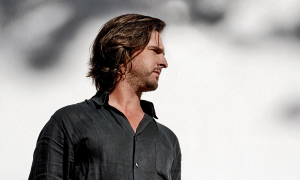
Courtesy Robyn Stoutenburg / ECM Records

This kind of music wasn't being represented anywhere. For them to present it in such a high-class way—their covers looked different, the vinyl thicker, and they were all consistently so good sounding—ECM went into this really uncharted area.
"I went to Berklee in 1971, for one semester, and I didn't like it," Frisell recalls, in a 2001 interview that is now seeing the light of day for the first time. "I went back to Colorado, where I grew up, and sorta hung around there for awhile. Then I went back in 1975, and I took to it more; I was more ready or something. But I stayed there for two years and majored in arranging; I wanted to play guitar, but I thought I could get more information to apply to it doing it that way, rather than taking guitar lessons. I had the basic playing guitar thing together, and I was trying to get as much theoretical info as I could. Herb Pomeroy was one of the best teachers I ever had—I got so much from him—but also, there was Mike Gibbs.
"So I took all of his classes and all of Herb's," Frisell continues. "Mike Gibbs had a relationship with Gary Burton, and a lot of people that were on ECM were associated with Mike, for whom he had written music. So, after I got out of Berklee, I went and lived in Belgium for a year, and this is where I started to write my own music, and tried to find my own voice. Soon after I got to Belgium, in 1978, I get a call from Mike Gibbs, who had a tour of England with his own big band, and his regular guitarist, Philip Catherine, wasn't able to do the tour. I had played in Mike's band at school, so I knew the music, so he called me and asked me if I could do his tour. There were a lot of British musicians in the band, like [drummer] John Marshall and [trumpeter] Kenny Wheeler and [saxophonist] Charlie Mariano. Eberhard Weber was playing bass, so I was kind of thrown in with a lot of the guys I had been listening to already.
 "It was just an incredible opportunity for me to be able to play with all these guys," Frisell concludes. "So, during that tour, there was a little area every night where Mike Gibbs let Eberhard and me play some free improv, and it really felt great; it felt like we were connecting—there'd be moments where it lifted off, with just two of us playing. This was in October or something, of 1978, and Eberhard had this recording coming up with Gary Burton that was going to be Fluid Rustle. Man, I couldn't believe it; I had done a couple little recordings in Belgium, but nothing that was a big recording. That was how I met Manfred Eicher, ECM label head/producer] the first time, and I think I was so terrified of the whole thing, I didn't know what I was doing. Even traveling and staying in the hotel, I didn't know what to do; I didn't even know how you checked into a hotel or anything. And I wasn't able to get much going; I was pretty inhibited during that recording."
 Listening back to Fluid Rustle, it's clear that Frisell's performance on his first major recording was marred by a certain tentativeness. Still, what's most remarkable about the record—one that, over time, has emerged as one of Weber's most memorable recordings—is its sublime combination of vibes, guitar and voice, soaring to dramatic peaks while remaining filled with the subtlety, nuance and transparency that had become touchstones for ECM. That Frisell was young and green, among a group of far more seasoned players, was largely obvious only to the guitarist. "I didn't think I had made any kind of impression at all on Manfred," Frisell says. "He was just trying to get me to do something, you know, and he tried to get more sound. I was too freaked out to do anything. I don't think I ruined the record or anything, but I don't think I made a very big splash with anybody. So, I stayed in Belgium for a little while longer and I stayed in contact with Eberhard, and then I moved to New York; that would be 1979."
 And that seemed to be it, as far as recording for ECM went: one record, and a feeling that he'd not made any kind of impression. "I was struggling along; nothing was happening," says Frisell. "I was playing weddings, and jam sessions with guys I knew from Boston. Every once in a while, through Mike Gibbs, there was a gig. There I met other ECM people—Bob Moses the drummer and [bassist] Steve Swallow. So I start to do a few things—like, Bob would call for gigs, and then I met [saxophonists] Julius Hemphill and Jim Pepper, and other people I later played with more; but there were a couple years where things were discouraging. But at the same time, I was getting a little stronger with my own voice, so somewhere in there, a lot of things happened at once. I made this solo tape—just a little cassette that was myself, overdubbed—and, without thinking anything would come of it, I sent it to Eberhard and Manfred, and so that went off into the mail.
 "But then I got a call, one of the most important calls I ever got, at the lowest point of my career," Frisell continues. "[Drummer] Paul Motian called, another ECM person. I was rehearsing with Paul, and I sent this tape off, and that tape kinda got Eberhard more fired up about me; it kinda rekindled his interest in me. And he called me to do some duet gigs in Europe—again, totally improvised stuff—and I went over there. And this was when I was also playing with Paul: we played six or seven gigs—the quintet with [saxophonists] Billy Drewes and Joe Lovano, and [bassist] Ed Schuller—and did the album Psalm (ECM, 1982). That was, for me, the beginning of how Manfred and I connected.
"For me, Paul is one of the most important relationships I've ever had," Frisell continues. "He's not like my father, but almost. He's the guy, for me, where I get to do everything; he let me feel as if I was coming up with the stuff. It wouldn't have happened if it wasn't for him. We're still playing, and it feels like the first time we've played every time we play. I can't say enough about him.
"So I spent almost nine or ten months rehearsing with Paul before we ever did a gig; we did this in early in '81," says Frisell. "I did the duo concerts with Eberhard, and then I get a call from [bassist] Arild Andersen, out of the blue, because Manfred, through Eberhard, was told to check me out again. Arild had this gig in Molde at the end of the summer, and Manfred said [to Andersen], 'You should check out this guy Bill Frisell.' So, out of the blue, Arild called me. So, I went there in August of '81, and when I get to Arild's, my mind was being slowly blown, because I was playing with Paul, and then Arild called, and I go do that!
"Then I get to Arild's house, and we rehearsed a little bit, and he liked it; it was good," Frisell concludes. "Then the phone rang, and it was Manfred, to whom I hadn't talked to in three years. Manfred talked to Arild, asked how it was going, and he said, 'It's going great.' So Manfred gets on the phone and asks for me to do a solo recording, and I thought, 'Jesus Christ, this is insane.' There were so many things happening suddenly. That was August, and a couple months later we did a long European tour with Paul, when we recorded Psalm at the end, and before that tour, Eberhard had talked to [saxophonist] Jan Garbarek about me. So it was December, 1981 that I recorded Psalm with Paul. Then I flew from Munich to Stuttgart to Oslo, and met Jan and recorded Paths, Prints (ECM, 1982). And, at that point, things were clicking with Manfred; he was excited about my playing. My confidence level was going up and I was playing strong then."
 After the tentativeness of Fluid Rustle, the release of Psalm, Paths, Prints, Weber's Later That Evening and Andersen's Molde Concert (ECM), all within months of each other in 1982, was as strong a quadruple punch as any guitarist has made in the past three decades. All became classic albums for their leaders, and Frisell's idiosyncratic, texturally expansive playing was the common thread that united them all. By this time, it was clear that Frisell could take any context and make it his own, with a distinctive harmonic language capable of reinventing anything he touched into something unmistakable, unfailingly recognizable as his.
 The logical next step was to record his debut as a leader, but things didn't go exactly as planned. "My confidence was going up, but I'd never played alone before—and still, to this day, playing by myself is very hard for me," Frisell reveals. "Music, for me, is about the chemical reaction that happens between people, the give and take. Most of the music I play has to do with the relationship between the people, and I don't know if I was ready for that [a solo recording].
"It started out being a solo record," says Frisell, "and then Arild was on there; and, maybe that was the beginning of me not seeing eye to eye with Manfred. There were things I started to do—I used a lot of overdubs—and Manfred wasn't able to follow through with the ideas. I didn't have enough confidence or strength to let me finish what I was doing, so there were a number of pieces where he didn't like the direction they were going. Manfred wanted spontaneous solo performance, like what Keith Jarrett does. I wasn't really mature enough—or didn't have the strength—to do that, and I wanted to do something else with some pieces prepared that had overdubs. So some of those got on there, like the tune 'In Line' [which would become the title track to Frisell's 1983 debut as a leader].
"Basically, Manfred would lose patience pretty quickly when I did those pieces," Frisell continues. "He wanted spontaneous performance. I gave up on a lot of my original ideas, and then I only had a couple days to do the recording, and this is pretty devastating to me. I'm only in there a couple days, and I remember we ate lunch and he said, 'You're not ready for this yet.' And I was really disappointed; I felt as if I'd failed, that I wasn't strong enough for it in the first place, and he was seeing it going one way and I wasn't strong enough to push through with my original ideas. Basically, he knew I'd been playing with Arild, and he thought, 'Maybe if you had Arild come in, that would balance it out.' So, a few months later, I came back to do a few songs with Arild, and that balanced out the whole thing. There was a bit of solo stuff and a bit of that, but it was a really difficult record for me—that thing about a mental state: if you start getting into doubting yourself and you're all alone, you're in deep trouble. I remember being in there and being panicked and terrified, and Manfred wasn't liking what I was doing; it was a horrible feeling."
Still, it was clearly good enough for Eicher to release, and, as a first effort from this emerging guitarist, there were no obvious signs of the trials and tribulations that took place during its recording. For Frisell, it was a milestone, to be sure, and one that was certainly received well enough by critics and a growing legion of fans. But, ultimately, it was just one more important event during a very hectic time of emergence. "I finally finished it, and I was playing gigs with Jan and Paul," Frisell recalls. "We had done Psalm, and were getting towards my first little conflict with Manfred. I don't remember when, but I was really committed to play with Paul's band. I felt like, for whatever all else, that was really where I was really expressing the full range of what I wanted to do. I felt connected to it. It was really important to me, even though it was a struggle in the beginning—he didn't get paid a lot of money—but, at the same time, I was playing with Jan Garbarek. It was a time when Jan was doing pretty good; he was doing higher-profile gigs.
 "I was having a great time with him, but there was this weird conflict," Frisell continues." I had a tour with Paul, and then, without asking me or anything, ECM scheduled a tour for Jan at the same time and then announced it. But no one asked me if I was free: 'Oh, Jan has a tour at such and such a time,' and I said, 'But I have a tour with Paul then,' and they said, 'Well we've already set this up, and Jan's gigs are much bigger than Paul's.' And it was, like, 'Wait a minute.' And then it was a real bad scene for me; that's when I left Jan's band and had to make the choice, and there was also a lot of pressure from Manfred. Everyone wanted me to play with Jan. I should have played with Jan [from a business perspective], but personally I couldn't leave Paul. There was a little period where I was on the shit list, where nothing happened. After all that first batch of records, with Jan and Arild, Paul, Eberhard, and mine—it was a lot of stuff, and then I had this little conflict. So nothing happened for a while. Then Paul started recording solo for Soul Note, and Manfred's right-hand man [Thomas Stöwsand] left ECM at that time. He left the company and started his own booking agency—which, all the work I do in Europe, I still do with him [though Stöwsand has, sadly, passed on since this interview, in 2006].
  "So, there was a little period of tension," Frisell concludes, "but out of the blue, Manfred called back and said, 'What are you doing?' like nothing happened, and, 'What do you want to do?' He suggested doing a record with Kenny Wheeler, and he suggested Al Foster to play drums. It was right around when Charles "Cow Cow" Davenport started to play again, and I was really into Al Foster. I had this idea to have Jerome Harris play bass and Bob "Saloon" Stewart play tuba, and I was really getting fired up. It was a dream band, and that's what became Rambler (ECM, 1984)—except for Al. He was excited to do it, and we had mutual friends—guys that were playing with Miles, like Mike Stern—so I was able to call him up and ask him to do it; but then, literally a week before the recording [he had to pull out]. I thought, 'What am I gonna do?' At this time, Paul [Motian] was really committed to not playing with anyone else; anytime people called him, he'd say, 'No, I'm committed to my own band.' So, I called Paul to confide in him, and he said, 'I'll play." I was ecstatic, because at that time he wasn't doing anything. No matter who called, he said he would not do it because of his own band and music. And he bailed me out. That's how that record came about, and, in a way, it was really my first. It was a burst of my own stuff."
 How Rambler might have sounded with Foster, we'll never know; but with Motian, Frisell had a built-in chemistry, and Rambler was ultimately even better received than In Line (ECM, 1983), with three compositions that would feature time and again in performance (and on record) for years to come: "When We Go," "Resistor" and, especially, the lyrical "Strange Meeting." That Frisell's reputation was on a rapid ascendancy, by this time, didn't stop the guitarist from appreciating the opportunities ECM provided, and how that label was changing the face of jazz. "The first ECMs I heard were Chick Corea's Piano Improvisations Vol. 1 (1970) and Vol. 2 (1972)," Frisell recalls. "There was an area at that time, this blank area, where this kind of music was happening, and it wasn't being put out or represented anywhere. And for them [ECM] to go into a neglected area and present it in such a high-class way from the very beginning—their covers looked different, the vinyl looked thicker, and they were all consistently so good sound-wise ... that's not to say there wasn't good music around, but ECM went into this really uncharted area.
"ECM made the standard higher," Frisell continues. "Bob Hurwitz [now the head of Nonesuch] worked for ECM at the time, and has since done his own thing, but with ECM, there's a certain period where they really upped the standard, stayed consistent, and stayed with a real clear vision of what the music was to be. Anything that's good, it's gonna hold up. You go through different phases of fashion, but if you do it right and good and true, it's gonna do that. ECM did that."
It was at that time that Motian reduced his working quintet of Psalm to a trio that has, in the ensuing quarter century, reshaped the concept of interactive, spontaneous small ensembles by eliminating the bass—a rare and daring move for an ensemble led by a drummer. Sure, there were bass-less ensembles, but not ones where there was another instrument to which it was normally so tightly tied. But with Motian's approach to the kit, turning more textural than temporal, it was no surprise, then, that the equally texture-minded Frisell was such a strong fit for the drummer. It was the formation of this trio that would, in its own way, reshape the direction of jazz and improvised music to come, even as it remained closely aligned with the tradition from which it emerged. "So, Paul started his trio with [myself and] Joe Lovano, and [we did] the album It Should've Happened a Long Time Ago (1985), and there was this period where things were going good," says Frisell.
"There were two dates with Paul Bley [1986's Fragments and 1988's The Paul Bley Quartet]. He's another one of my heroes, who I've been listening to forever—even before ECM. He's a giant historical figure, and to play with him was another dream come true. I think it was a suggestion, from Manfred, for that band [which also included Motian and British saxophonist John Surman]. That first record [Fragments] was the very first time we ever played together, and then, during that year, we did a long European tour, went to Martinique, and played a bunch of gigs that year, and that was the last time we played. The second record [1988's The Paul Bley Quartet] was totally improvised; we never said a word, we just played. Every night, we didn't know what was going to happen. Paul's looking into the whole history; he's taking it about as far as it can—you look at Bud Powell, Thelonious Monk, Bill Evans and then Paul Bley. I see Paul Bley as setting the stage for Keith Jarrett."
So, it was another busy year—that also included the start of Bass Desires, bassist Marc Johnson's supergroup with Frisell, another guitarist who'd also arrived by this time, John Scofield, and ex-Weather Report drummer Peter Erskine—but most important was Frisell's continued work as a leader. His next record, 1988's Lookout for Hope, was the guitarist's first recording with a permanent band that would continue on, in one shape or another, for nearly the next decade. "We played for maybe a year or so, and we'd been trying to get it together," Frisell recalls. "It was great. It was an important moment for me, really, when I finally felt ready to have my own band—and I had my best friends. I knew [bassist] Kermit Driscoll back from Berklee, and the record with Chet Baker [Chet Baker & Steve Houben (52e Rue Est, 1980)] was with Kermit. I met him back in 1975 with [pianist] Emil Viklicky. I also met [cellist] Hank Roberts at Berklee. So, now I'm starting to do my own thing, and it was interesting how it happened. Lee Townsend had taken over Bob Hurwitz's job at ECM, and every now and then, when Manfred was too busy, he'd let him produce a record, including mine. So that was the beginning of my relationship with Lee, and it goes on to this day—he manages me as well. It was engineered by James Farber, who also did Rambler, and that was one of the first times I worked with him. Manfred normally had [engineer] Jan Erik [Kongshaug], but he couldn't come, so that was the first time James did something with Manfred."
Lookout for Hope represented another watershed for Frisell. In fact, while he only released three albums as a leader, each one represented a significant milestone: In Line, his first record as a leader; Rambler, his first to work with a group; and Lookout for Hope, his first with the group that he'd continue with until 1991's Where in the World? (Nonesuch, 1991). While Roberts would move on to other things (but return later as a member of Frisell's current 858 Quartet), Frisell, Driscoll and drummer Joey Baron continued touring for another four years, in groups varying from trio to sextet. Its last gig was at the 1995 Festival International de Musique Actuelle Victoriaville, a performance—complete with the films—of Music For The Films Of Buster Keaton: Go West and Music For The Films Of Buster Keaton: The High Sign/One Week, both released by Nonesuch the same year.
 The release of Lookout for Hope, however, represented another parting of ways for Frisell and ECM. "The best way to describe it," says Frisell, "is that there were a number of issues: I was doing more and more things with more people, and I was moving a little faster than Manfred was able to record. So I became frustrated with recording the quartet; we were ready to record that first record before that [March, 1987], and we had to keep waiting. Finally he was ready, and he let Lee do it. And I was ready to do something else after that, and he started postponing again, and I was really frustrated not being able to do it. There's a moment when it feels right to do something, and I didn't want to miss those moments; with Nonesuch, I've been able to record when I've wanted, and that's been the most luxurious thing. Usually when I have a project that feels right, they just say, 'Go ahead and do it.'"
 Frisell was caught in the ECM cycle that sometimes meant two or three years went by between recordings—necessitated by the label's steadfast insistence on remaining small and keeping the quality up—and as he became involved in more and more projects, that kind of delay simply became untenable. It's interesting to note that now, a decade after this interview took place, Frisell has left Nonesuch and signed with Savoy Jazz for a similar reason, only the timeframe has shrunk even further, with the guitarist currently involved in so many different projects that releasing one album per year isn't enough to keep up with his prodigious output. But despite scheduling issues necessitating his departure from not one, but two labels, Frisell is ever grateful for the opportunities and exposure that ECM provided so early in his career.
"I know how lucky I am," Frisell says. "It was basically like when I left my parents. I loved my parents and they supported me, but there was a time when I had to reject my parents, go out on my own and grow up. And leaving ECM had that feeling. It had been a huge presence even before I started recording for the label—those records [on ECM] were a big influence, from the time when I first heard them around 1969 or '70, like the Jarrett recordings; it was a big thing for me. And to be involved with the label ... but I felt like it was time—that I needed to find my own thing. I needed to get away from it, and Manfred has such a strong presence there; he did every recording in his way. I wanted to be able to not record in just two days, and I wanted to play with people he didn't like. It's the same feeling when a kid leaves home. I could've just stayed there and done whatever Manfred thought I should do, but I really felt like I needed to be on my own to find my own voice."
 Even at the time of this interview, in the fall of 2001—and today, still, 10 years later—the spirit of ECM loomed large over Frisell's career, but so, too, did the elements he rejected. "I still related to the spontaneous part of ECM," Frisell recalls, "so leaving it was one of the hardest things, and it was really weird—and I don't know what Manfred thinks—but it was coincidental that Lee Townsend quit on the same day. I wrote a letter to Manfred, saying I wanted to leave, and one of the hardest things was that I was just developing this relationship with Lee, but I sent the letter anyway. And then I called Lee at the office, and said, 'I've got to tell you, I'm gonna leave.' There was just this dead silence, and he said, 'I have to call you back.' And he called back and said, 'You're not gonna believe this, but I just sent a letter to Manfred.' So Manfred gets these on the same day, and thought it was some kind of conspiracy, but it was a complete coincidence. So Lee leaves and immediately talks to me about being my manager, and it seemed perfect. It's weird, because Hans Wendell also quit around that time; Lee was my manager, and Hans continued to work for my publishing, and then Bob Hurwitz was there [at Nonesuch], so there were still people from ECM working with me."
 But Frisell's never one to burn bridges, and it became clear, not long after, that his ongoing relationship with Eicher may have been severed, but that didn't preclude the two from working together again. "I thought, after that, 'Well Manfred is never gonna talk to me again,'" says Frisell. "But then I get this call to do this Gavin Bryars record [Requiem (1991)]. I thought, 'Is this for real?' I thought Manfred was so pissed, but I was so happy to go do that—he was so cool, and it felt good. Gavin's someone who I more recently became aware of. I met him when he played a piece that he wrote from one of my tunes ["Sub Rosa," based on In Line's "Throughout," released on 1994's Vita Nova]—an amazing thing, an abstraction of what I had played. I said, 'Wow.' It made me think it was what I wished I could do in my own writing. It was my very first meeting with him, in a restaurant with a bunch of people, and he gave me a walkman and said, 'Check this out,' and he really freaked me out. It was great to work with him; there's been something else in the works, and I'm hoping we'll do more stuff. "
More years passed, but in 1996, Frisell got another call from Eicher, this time to record trumpeter Kenny Wheeler's Angel Song (1997). "That was a fantastic record," Frisell enthuses."That's one of my favorite things I've ever done. Working with Kenny—that's getting into someone who I listened to a lot before I got to play with him. Kenny did that record with Keith [Jarrett] and Dave [Holland], Gnu High (1976); that's one of those classic records—unbelievably great. And then I also heard him with Anthony Braxton, with Dave Holland and [drummer] Barry Altschul; it was the early '70s, and already he was a total individual. I've never heard anyone else play that way, writing those tunes for Gnu High ... and yet he's so humble, just quietly working away on his stuff."
Perhaps it was Wheeler's introspective nature that dovetailed perfectly with Frisell's own humble personality, but the trumpeter also considers Angel Song—an intimate chamber album also featuring Holland and saxophonist Lee Konitz—to be a special album among his many recordings. It was also Frisell's first encounter with Holland, whom he'd go on to record with, releasing Bill Frisell with Dave Holland and Elvin Jones (Nonesuch) shortly before this interview took place. "Talk about a big person," Frisell says of Holland. "Hearing him with Miles [Davis]—when I really got deep into jazz music, it was when he played with Miles. That's as big a thing as could be—someone that was in that world, and then, after he left Miles, those first [Chick] Corea CDs, like Circle: Paris Concert (ECM, 1972) and the stuff with Sam Rivers. Aside from his amazing musicianship, I also looked to him as a kind of inspiration—someone who stayed true to what he believed in. I remember him being totally committed to Sam Rivers. He could've gone any way, but he said, 'I'm going to do this thing.' He was strong and determined, staying true to what he believed in. He's one of those guys we need more of."
Frisell hasn't recorded any more sessions for ECM since Angel Song, but he never considers any doors to be permanently closed. "I hope things are at a point where I can still do special things, like Angel Song, with Manfred. What makes ECM still one of the most amazing labels is how he's managed to survive; when you look at all the little companies that came along, for his label to make it through 30 [now over 40] years, it's amazing."
 From green Berklee grad to musical innovator and touchstone for so many aspiring guitarists—despite amassing a large discography as a leader at the time of this interview, and an even larger one as a guest—Frisell has remained humble and grateful for the opportunities that have come his way in the past 30-plus years, playing with so many of the musical heroes significant to him as he was coming up. "Paul Motian was someone who gave me a chance to be myself early on," says Frisell, "and Eberhard, he was one of those guys that heard something in what I was doing and let it come out, at the very beginning, before I even recorded. I'm so grateful to him for that. He's really the one that told Manfred, 'Listen to him'; he had that tape, and he said, 'You've gotta check this guy out.' Musically, he's one of those guys who are complete individuals; he's got his own sound and he's written some beautiful music. Just that as a model—it's somehow rarer and rarer to get these guys who don't sound like anyone else in jazz, and Eberhard created this whole context in both his playing and his writing.
 "I could say some of the same things about Jan [Garbarek]," Frisell continues. "To play sax and have your own sound—how many thousands of sax players really have their own thing? There's so much that he did—he goes back to the very beginning of ECM: those records he did with [guitarist] Terje Rypdal, Arild and [drummer] Jon Christensen. It's unbelievable; it's like being taken into some other plane. It was new, and Jan's another one of those guys. For Manfred to bring some of those guys like Eberhard and Jan to the world—I don't know if they'd have been known outside Europe, were it not for ECM. And Arild gave me my first chance. He called me up out of the blue; he hadn't heard a note I'd played, and yet he was one of those sweet, good people, who made me feel safe, at home and comfortable to be myself."
Finally, while he's left working with him behind, Frisell has plenty of good things to say about engineer Jan Erik Kongshaug, who has collaborated with Eicher on so many classic ECM recordings. "He's amazing," Frisell claims. "He's so transparent that you hardly even know he's there. Everything seems to be ready to go—you never have to think about where the mic is, or are they ready. He's like this invisible force, and, for me, that's the coolest thing. As an engineer, there's this transparency with him; you can get away from thinking about it being recorded. He's not always saying, 'Can you do this or that?'; you just start playing, and he's always ready. He's always out of the way; sometimes you don't even have to use headphones. He's super quiet, and it's good that they have him and Manfred—they don't say anything, they just know what they want. I love the guy."
So much has happened with Frisell since this interview took place: 15 recordings as a leader/co-leader and far more as a guest, ranging from Norah Jones to Robin Holcomb, Jim Hall to Dave Douglas, Cuong Vu to Jack DeJohnette, and David Sylvian to Lucinda Williams. Nothing seems out of reach for this quietly intrepid guitarist, who's in a position, now, to play with almost anyone he pleases, despite remaining somehow in awe of that very fact. And, of course, with Paul Motian returning to the label in 2004, after a lengthy hiatus, Frisell's name is, once more, appearing on recordings with the ECM imprint. It's hard to say where he'd be today, were it not for that one session in 1979, that began to put him on the map and, more importantly, connected him with so many people—musicians, producers, managers and more—many with whom he continues to work to this day. But there's little doubt that, without the opportunities that arose from the 17 sessions he did for ECM over the course of two decades, he'd not be where he is today.
< Previous
Ascension
Next >
Urban Theme Park
Comments

About Bill Frisell
Instrument: Guitar, electric
Related Articles | Concerts | Albums | Photos | Similar ToTags
Bill Frisell
Interview
John Kelman
ECM Records
United States
Eberhard Weber
Gary Burton
norma winstone
Herb Pomeroy
Mike Gibbs
Philip Catherine
John Marshall
Kenny Wheeler
Charlie Mariano
Manfred [Eicher
Bob Moses
Steve Swallow
Julius Hemphill
Jim Pepper
Paul Motian
joe lovano
Ed Schuller
Arild Andersen
Jan Garbarek
Keith Jarrett
Miles [Davis]
Jerome Harris
Bob Stewart
Mike Stern
Chick Corea
Paul Bley
John Surman
Bud Powell
Thelonious Monk
Bill Evans
Marc Johnson
John Scofield
Weather Report
Peter Erskine
Kermit Driscoll
Chet Baker
Emil Viklicky
Hank Roberts
Joey Baron
Gavin Bryars
anthony braxton
Barry Altschul
Lee Konitz
Sam Rivers
Terje Rypdal
Jon Christensen
Norah Jones
Robin Holcomb
Jim Hall
Dave Douglas
Cuong Vu
Jack DeJohnette
David Sylvian
Concerts
May
15
Wed
For the Love of Jazz
 All About Jazz has been a pillar of jazz since 1995, championing it as an art form and, more importantly, supporting the musicians who create it. Our enduring commitment has made "AAJ" one of the most culturally important websites of its kind, read by hundreds of thousands of fans, musicians and industry figures every month.
You Can Help
To expand our coverage even further and develop new means to foster jazz discovery and connectivity we need your help. You can become a sustaining member for a modest $20 and in return, we'll immediately hide those pesky ads plus provide access to future articles for a full year. This winning combination will vastly improve your AAJ experience and allow us to vigorously build on the pioneering work we first started in 1995. So enjoy an ad-free AAJ experience and help us remain a positive beacon for jazz by making a donation today.

Giveaway

Eligible winners: 15
Days remaining: 4
Days remaining: 4