Home » Jazz Articles » Live Review » Jeff Kaiser / Kronomorphic / Keneally-Minnemann-Beller: ...
Jeff Kaiser / Kronomorphic / Keneally-Minnemann-Beller: San Diego, March 11, 2011
Porter's Pub, UCSD
San Diego, CA
March 11, 2011
The Friday, March 11 show at Porter's Pub, organized by UCSD promoter Brian Ross, was a wild, kaleidoscopic affair. Featuring two Southern California-based creative improvising exponents with a rock-fusion headliner represented a certain degree of risk: would the headliner's fans tolerate the opening acts? Conversely, would the jazz crowd stick around for the main attraction?
Well, it all seemed to work out in the end. There was a definite less-than-attentive vibe going on during the first two sets, but it was somewhat mitigated by the wild applause given up to the efforts of Jeff Kaiser and Kronomorphic who are both associated with UCSD's terrific music department. The bulk of the boisterous crowd, though, were obviously waiting for Mike Keneally.
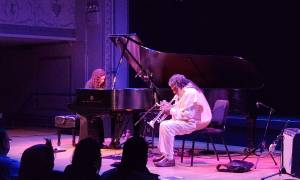
Jeff Kaiser : Solo Trumpet and Laptop
Jeff Kaiser is dedicated to extending the tradition established by John Coltrane,and Miles Davis, expanded by Lester Bowie, and the Association for the Advancement of Creative Musicians (AACM). He is also a veteran of the L.A. free jazz community, particularly associating with players like Vinny Golia, Alex Cline, and Michael Vlatkovich.
Kaiser, who is also a guitarist, initially became fascinated with electronics through the influence of players like Robert Fripp, Jimi Hendrix and eventually, Nels Cline and G.E. Stinson. At one point, he carried around 150 pounds worth of effects pedals, which, he ultimately replaced with a laptop.
Kaiser plays a custom-made, four-valve trumpet, which means that whatever note he's playing, depressing the 4th valve drops that note by a quarter-tone, allowing him to play all sorts of microtonal scales. With a microphone plugged into his laptop, Kaiser interacted with his customized version of MaxMSP software, which not only modified his sound in myriad ways, but also spatialized it in the room with a kind of surround sound. He used four different pedals, assignable to any aspect of the software, to improvise with sound and space.
Sitting down, Kaiser's short set began with him looping his muted trumpet and adding new parts to the loops until he created an ethereal, trumpet choir of sorts. This went on for several minutes, establishing a dreamlike and hypnotic reverie that's subtle beauty had the crowd leaning forward in their seats. Suddenly, all hell broke loose, and the first three rows recoiled in response to the sonic assault that exploded out of the speakers.
For the next 15 minutes, Kaiser kidnapped the audience for a manic, hallucinogenic joyride through time, space and tonal distortions. He took some of the extended techniques of Lester Bowie and Bill Dixon, and stretched them past the breaking point. He would bend a note, transpose it to an impossible octave, and then send it spinning around the room like a remote-control airplane with a glass-pack muffler attached. He'd sample a phrase and distort it beyond recognition, causing it to ricochet around the space in pink and white noise reiterations. Kaiser's set was unbelievably creative, but extremely hard to follow.
Kronomorphic
Kronomorphic is an ensemble co-led by UCSD professor and saxophonist David Borgo and Los Angeles drummer Paul Pellegrin. The two met while both were enrolled in UCLA's Ethnomusicology department. Part of the aesthetic driving their ensemble music is the use of African-derived, or inspired, polyrhythms that incorporate multiple interlocking meters like 5/3/4 and 7/5/3. These grooves are worked out on the drum kit, and then arranged in melodic and modal terms, and expanded for improvisation.
That's where the rest of this highly creative ensemble comes in. The extremely difficult assignment of anchoring these metrically subdivided repetitions into relatable grooves fell to veteran San Diego bassist Gunnar Biggs, who navigated passages in 11 or 9 as if he'd been doing it all of his life. The inventive Paul "Junior" Garrison, whose stated mission is to "sound like anything other than a guitar," was given the role of color commentator.
Garrison successfully carried out said mission. Throughout the set, he created loops, sampled, then manipulated the samples, and used dozens of pedals to build walls of sound that disappeared as quickly as they arrived.
Sharing the frontline with Borgo was the creative chromatic harmonica virtuoso Bill Barrett, a veteran of electric bassist Steuart Liebeg's ensembles. The combination of Borgo and Barrett was sublime on the spooky Kronomorphic melodies, and his solos were mindboggling.
Holding everything together was percussionist extraordinaire Nathan Hubbard, on vibraphone. Playing a role similar to Bobby Hutcherson's epic work with free jazz icon Eric Dolphy, Hubbard at times set up the melody with neat, ascending melodic repetitions, and other times established the modal centers with haunting two mallet intervals. As a soloist, he was fascinating, and, in the ensembles, he was essential.
The set began with "Tehauntepec" from Kronomorphic's latest release, Micro Temporal Infundibula (pfMENTUM, 2010). The piece evoked coastal Mexican marimba ensembles being led into an entirely new 10-beat meter territory. Borgo and Barrett played the repeating haunting motif until Barrett broke loose with a solo that sounded like the result of a Toots Thielemans, Pauline Oliveros tryst.
They followed up with "Perambulate," which featured a killer bass ostinato from Biggs, set in a 3-against-4 groove with an aching melody that spilled into evocative solos from Barrett and Hubbard. Borgo took the final solo, on soprano, and he demonstrated a fascinating style that had echoes of Steve Lacy, Wayne Shorter and Dave Liebman (with whom he's studied).
Kronomorphic is one of those groups that are doing something entirely new. Its take on interlocking metric groove's layered with memorable melodies and virtuosic outward-bounding soloing, was nothing short of astounding. Fresh and innovative, Kronomorphic delivers.
Mike Keneally/Marco Minnemann/Bryan Beller
Mike Keneally, who was one of the late Frank Zappa's "stunt" guitarists, is an eclectic virtuoso of the highest order. He can and does play in a dizzying amount of stylistic genres. He also sings and plays keyboards, and has written and recorded songs with XTC's Andy Partridge. On the other side of things, he released an Albert Ayler tribute record with Vinny Golia. In other words, the guy's all over the place.
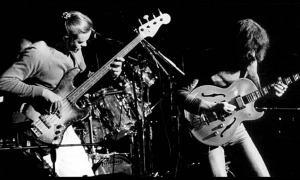
This concert concentrated on his wide-ranging hard rock trio that tours under the moniker of KMB. Most of the compositions were actually written by the German born (now San Diego resident) drummer, Marco Minnemann, who seemed to be coming out of a Billy Cobham-meets-Stewart Copland bag. Minnemann's playing was always clear, precise, and very busy. KMB was just coming off a European tour, so its interplay was rock-solid.
It would be tempting to refer to Keneally as a fusion guitarist, but for this gig, he mostly eschewed the jazz elements that are part of his background. One thing for sure, though, KMB's brand of rock was full of wicked, intricate components and this band could start, stop and turn on a dime.
Keneally has an intensely devoted, almost rabid, fan base who came from far and near to hear their man. There were also two dedicated, professionally equipped videographers set up in various locations to document the concert. At least one of them tries to film 85 -95% of every stateside Keneally gig. They have fans in Europe doing the same thing.
The Keneally trio's set began with the multifaceted opus, "Skunk" which actually sounded like three or four different pieces spliced together. In this respect there was a definite link to guitarist Bill Frisell's trio with Joey Baron and Kermit Driscoll, back in the 1980s. Like Frisell's unit, KMB could shift from one groove to another radically different mood instantaneously. "Skunk" even had a section that morphed into a "jazz-cocktail" minor chord vamp, complete with walking bass line, before shifting again into the hard rock dynamic.
Keneally showed some admirable chops throughout the evening, playing a song with enough chord changes in it to have given Joe Pass carpal tunnel syndrome. The guitarist announced another piece as being in the "circus-metal" genre. This one actually sounded more like demented skating rink music for troubled teens.
Keneally brought up David Borgo to sit in on a totally free improvised piece, and it was another interesting bit of genre-smashing. Bryan Beller got a single solo, (which was excellent), featuring his heavily processed wah-wah and phase -shifted bass in a dreamy, slurred-note soliloquy.
Minnemann took two full-length drum solos that sparked guttural howls of "yeah" and piercing whistles from his fans in the audience. Both solos were chockfull of chops and technical, almost military precision. It's easy to see why he sells a lot of drum instructional videos and books.
Keneally also sang several tunes and it was there where his connection to the late Frank Zappa was most obvious. Like Zappa, his lyrics tend to favor some rather silly subjects, like his "Cow-ology" suite. Unfortunately, the P.A. system didn't really allow the words to come out very clearly, so some of the jokes were lost into the noisy atmosphere.
Keneally is a hard-working musician. His two sets at Porter's Pub demonstrated a clear desire to give his audience what they came for—and their wildly enthusiastic response indicated that his efforts paid off.
Tags
Mike Keneally
Live Reviews
Robert Bush
United States
Jeff Kaiser
John Coltrane
Miles Davis
Lester Bowie
Vinny Golia
Alex Cline
Michael Vlatkovich
Jimi Hendrix
Nels Cline
G.E. Stinson
Bill Dixon
David Borgo
Gunnar Biggs
Bobby Hutcherson
Eric Dolphy
Toots Thielemans
Pauline Oliveros
Steve Lacy
Wayne Shorter
Dave Liebman
Frank Zappa
Albert Ayler
Billy Cobham
Bill Frisell
Joey Baron
Kermit Driscoll
Joe Pass

PREVIOUS / NEXT

Support All About Jazz
 All About Jazz has been a pillar of jazz since 1995, championing it as an art form and, more importantly, supporting the musicians who make it. Our enduring commitment has made "AAJ" one of the most culturally important websites of its kind, read by hundreds of thousands of fans, musicians and industry figures every month.