Home » Jazz Articles » Live Review » KSDS Jazz 88 Ocean Beach Music and Arts Festival
KSDS Jazz 88 Ocean Beach Music and Arts Festival

Winston's, Hodad's Stage, The Harp
Ocean Beach, CA
September 11, 2010
Perfect day for a party: the sun shone bright in a cloudless sky, it's heat mitigated by a cool ocean breeze. After a one year hiatus due to the terrible economy of 2009, the KSDS Ocean Beach Music and Arts Festival has re-emerged in 2010 with an imperative commitment to a larger, more diverse and ambitious event. This years festival included 7 venues, and 26 acts, a large row of tents with various arts and crafts, and beer gardens from local breweries. The venue furthest from the actual ocean was only two blocks away.
The free-spirited and casual beach community of "OB," (that's what the locals call it), provided a perfect locale for a festive atmosphere. There was, however an acknowledgment of the date's significance—the festival began with a moment of silence in remembrance of those who lost their lives in the terrorist attacks on September 11, 2001. After that, it was full on party mode till the last strands of music wafted into the darkening skies at the edge of night.
KSDS, the area's only full-spectrum jazz radio station, partnered with the Ocean Beach Mainstreet Association in assuming the risk of this production. In these days of ever declining ticket sales and dwindling discretionary spending—the risk was palpable. In the end, 3,000 tickets were sold—which was precisely the number hoped for—documenting "That San Diego will support an event like ours... so, look forward to a similar Festival in 2011 and beyond" said KSDS station manager Mark DeBoskey. So kudos to the radio station and their partners for taking the chance to fund such a musically diverse undertaking.
There was something for almost everyone at this year's festival: blues, funk, New- Orleans style, Big Band, and lots of straight up jazz. As in most multi-artist festivals, the pressing issue was making decisions on who to see.
 Geoffrey Keezer Trio at Winstons
 The OB nightclub Winston's was packed solid for pianist Geoffrey Keezer's set. Keezer, at age 39 is already a veteran musician with tons of top-flight experience. He burst on to the scene in 1989, with the legendary Art Blakey's Jazz Messengers as a teenager. Since then he's worked and recorded with Ray Brown as well as Christian McBride to name just a few. Keezer is an amazing pianist. What sets him apart is his complete mastery of rhythm. All sorts of rhythms. Obviously, working with Blakey and Brown gave him plenty of experience with swing, but that's just the tip of Keezer's iceberg. He's also mastered several forms of South American folkloric rhythms and he loves to "rock out" as well. He is so metrically precise it's as if one was witnessing Max Roach or Elvin Jones soloing on the piano instead of the drums.
Keezer appeared with his working trio: Los Angeles based double-bass virtuoso Hamilton Price and San Diego drum master Duncan Moore who has appeared on hundreds of recordings and played with a virtual "who's who" of local, national and international musicians. The concert started when Keezer closed his eyes and began hammering a minor chord vamp that at times recalled 20th Century piano preludes or middle-eastern "trance music." After several mesmerizing minutes, the first oblique strains of "My Favorite Things" began to assert them selves. By then Price had entered the fray with huge, growling whole notes and deep ostinatos while Moore was laying down some serious ride cymbal statements. Keezer took a long, organic solo that built to a frenzied crescendo—then dropped to a very quiet dynamic to allow Price's solo to be better absorbed. Price has a huge, woody sound and he knows how to use it. His solo, full of slurs and double stops never lost sight of where the "meat" was, in terms of the bottom end. The spirit of John Coltrane had entered the building, and Keezer, who hadn't even planned on playing "My favorite Things" beforehand, wisely recognized what he had set in motion, and followed with a medley of Coltrane's minor blues compositions: "Equinox" and "Mr. P.C."
Keezer set the stage for these interpretations with another long, hypnotic unaccompanied piano intro. This time, he reached inside the lid, muting the strings with one hand while he spun out long strands of rapid, swirling runs—achieving a koto- like effect. Suddenly he was injecting "blue-notes" into the framework and soon after, began the trademark bass riff of "Equinox." Before he played it through even once, Price was with him note for note, and Moore had begun an Elvin-like assault on the skins of his drums. "Equinox" became an intense "swing-fest" with a groove so strong it was impossible to ignore. Like dropping the needle on a "Best Of Coltrane" record the band instantly morphed into the double-timed "Mr. P.C." where the swing intensity ratcheted up to an almost unbearable sense of ecstasy. When the Coltrane medley finally wound down, the audience erupted into a full minute of riotous applause.
The three tunes had taken up almost an hour. Keezer finished his set with the only original of the performance (indeed the only tune planned in advance) another strong waltz, "Point Alexander Moon." It fit rather nicely with the more 'Trane-centric' pieces and finally showcased Keezer the composer. Keezer is a pianist to watch. He is a man of the moment in the highest sense. He comes with a blank slate and creates masterful abstractions that are undeniably grounded "in-the-tradition." He also conveys a sense of joy in his inventions that is so obvious that even the casual listener '"gets it.'" If the festival ended on his last note—it would have been worth the price of admission. Fortunately, the festival was just getting started.
Ernie Watts Quartet at the Hodad's Stage
Ernie Watts is one of the most versatile saxophonists in history and has straddled two seemingly separate careers for ages. On one hand he's got the whole studio sideman thing going. He's played on thousands of sessions with everyone from Carole King to Frank Zappa. He has toured with Oliver Nelson and the Rolling Stones. On the other side: his work as a highly disciplined and creative keeper of the post-John Coltrane flame; both in his work with his own quartet and with bassist Charlie Haden's Quartet West.
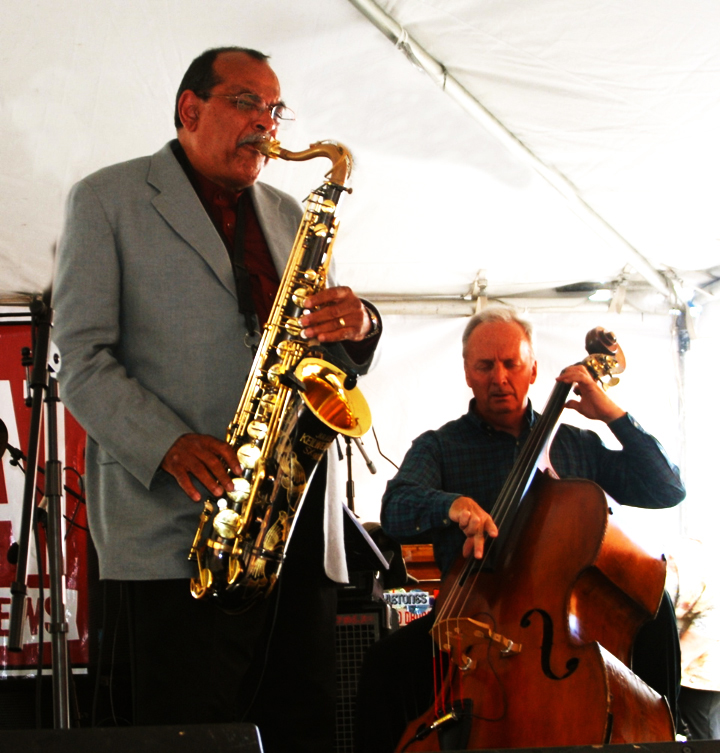
On this performance, he was assisted by his extremely tight, veteran working group. On piano was the able Andy Langham, who is able to evoke the spirit of McCoy Tyner, while maintaining his own identity; on bass: Bruce Lett—who was very strong and meaty with his support, and finally Bob Leatherbarrow on drums who knows how to mix things up, constantly upping the ante when Watts was soloing.
The concert began with "To The Point" an intricate, modern tune stylistically set somewhere between hard-bop and free-bop. After the knotty head, (which featured some intense trading of "fours" with Leatherbarrow), Watts took flight with a keening, swirling tenor solo, building to a climax with altisimo register squealing. At this point the piano and bass dropped out so that Watts and Leatherbarrow could engage in some feverish tenor/drum dialogue a la 'Trane and Elvin.' By the time the tune ended—Watts "owned" the audience.
After such an impressive, volcanic beginning, Watts showed a completely different (yet no less profound) side of himself. He picked up an end-blown wooden flute, and after a captivating solo cadenza, launched into his original, "Spirit Song" which may have been the highlight of the festival. "Spirit Song" captured the whole gamut of human emotions, from somber to joyful. Watts' work with the wooden, reverb-drenched flute was incredible: it soared, it cried out, he caressed it gently and teased bent notes that drifted into the heavens. Next, Watts shifted gears dramatically again with an amazing arrangement of the Dizzy Gillespie be-bop classic, "Shaw 'Nuff." This extremely up-tempo treatment featured long, spirited baroque exchanges between Langham (who might not be a household name—but is a remarkable pianist nonetheless) and Watts. It sounded like Bach on steroids. They then seamlessly "shape-shifted" into the jagged, intricate unison head, making the sixty year old tune sound as relevant as tomorrow. Thus far, every single Watts performance had brought the house down. Boisterous applause and catcalls followed every song. The tall tenor man chose his own "Reaching Up" a fast Latin-tinged tune from his album of the same name Reaching Up (JVC, 1994) as his last piece. A final round of inspired solos from all, especially Leatherbarrow, who's taut drum explosions were written into the tune, (The album version featured Jack DeJohnette). Watts graciously accepted the long, spirited ovation he received, re-introducing the members of his quartet, and afterward chatted with audience members and signed autographs.
E.S.P. at The Harp
E.S.P. is an excellent San Diego collective who gather to explore the music of Miles Davis. As implied in the name, most (but not all) of their repertoire culls from various albums by the famous mid-sixties quintet. All of the members lead, or are featured in other bands in the area. They've been doing this for over thirty years. The group consists of Mitch Manker: trumpet; Bob Campbell: saxophone; Lynn Willard: piano; Gary Nieves: drums; and the newest member, Rob Thorsen:double bass.

Their set at local nightclub The Harp, began with a rendition of the seldom performed, "In A Silent Way" by Weather Report founder Joe Zawinul. An inspired, "out-of-the-box" choice as hardly anyone covers this tune. That they were able to do so faithfully—while still injecting their individual personalities was a portent of things to come. Next up was "Code Blue" an original by tenor saxophonist Bob Campbell. This piece seemed more drawn from Miles' '80s ensembles as it had a serious, funk element to it. Following was the Ron Carter penned sixties classic "81." Here, and elsewhere, bassist Thorsen played an amazing approximation of Carter's muse without ever aping him. This was true of all the members of the quintet. As a repertory band, there's an expectation of some approximation of the original recordings—yet at the same time you want to hear the musicians play themselves. This, E.S.P. accomplishes admirably. Next, the band performed their namesake, "E.S.P." with a startling alacrity. Even the often taciturn Davis might have smiled at this one. Trumpeter Manker has that "broken-note" Miles trick down, as well as some audibly apparent Don Cherry and Freddie Hubbard moves. Tenor man Campbell utilized some of Wayne Shorter's oblique phrasing, but did so in an entirely original way. Miles Davis' music from any period is well worth investigating, hat's off to E.S.P. for doing it with such integrity.
The Cannonball-Coltrane Project with Luther Hughes at The Harp
As the sky darkened the final performance of the day belonged to the Cannonball-Coltrane Project. Bassist Luther Hughes put this band together with the idea of paying tribute to the live session, Cannonball Adderley Quintet In Chicago that Coltrane and Adderley recorded for the Mercury label in 1959. They play tunes off that disc as well as originals set in that style.

The members of this repertory group are all based in the Los Angeles area save tenor player Glenn Cashman, who works out of New York. The rest of the members are leader/bassist: Luther Hughes; alto saxophonist: Bruce Babad; pianist: Ed Czach; and, drummer: Paul Kreibich. They are all long time professional musician/jazz educators working in jazz programs at Cal State Fullerton, Fullerton College and Colgate University.
They began their set with a spirited, bluesy take on Nat Adderley's "Work Song." Cashman took the first solo—his sound is strong in all registers and his tone owes more to Dexter Gordon than Coltrane. Alto player Babad followed with a flutter-tongued trill that was reflective of his aesthetic. He raced up the neck of his horn to some well-timed altisimo register squeals. Pianist Czach and bassist Hughes contributed excellent solos "in-the-tradition." Hughes has a big, thick sound— sort of a hybrid of Paul Chambers and Jimmy Garrison. Up next was a modal tune written by the drummer, Kreibich, called "Subai, Subai." This one featured a smart, electric piano solo by Czach which had a good blend of single-note runs,octaves and chordal punctuations. One of the highlights of their set was Babad's homage to McCoy Tyner, titled, "Saphire." This one featured Babad insinuating some grainy distortion in his solo that was quite "free" and quite welcome. All in all, the Cannonball-Coltrane Project served to remind us of some of the most vital—yet often overlooked music recorded in that period of jazz history.
Scheduling conflicts prevented catching many of the festival's other excellent acts that day such as: former James Brown sideman Maceo Parker; eight-string guitar virtuoso Charlie Hunter; Texas blues-woman Marcia Ball; local stars trumpeter Gilbert Castellanos, pianist Mike Wofford, flautist Holly Hoffman, the San Diego State All Star Big Band with Bobby Shew and the Martin Luther King Youth Choir. There was indeed something for everyone. Many folks chose to attend an entirely different set of acts, and were no doubt equally satisfied.
This year's festival was an exceptional collection of diverse musical talent, gathered to perform right on the beach. Hard to beat a location like that. For KSDS, the Ocean Beach Mainstreet Association and San Diego music fans—it was a huge success. Certainly, there were a few issues to improve upon—they need to provide acoustic pianos for the venues that lacked them—that's a must. Judging from the enthusiasm displayed, there are thousands of attendees already dreaming of next years event.
Photo Credits
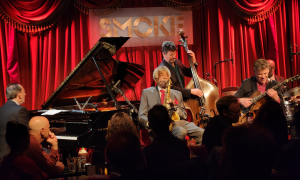
Page 1, crowd: Michael Rovatsos
All Other Photos: Michael Oletta
< Previous
John Abercrombie / John Menegon / Che...
Next >
Quiz
Comments
Tags
Jazz 88 Ocean Beach Music & Art Festival
Live Reviews
Robert Bush
United States
Geoffrey Keezer
Art Blakey
Ray Brown
Christian McBride
Max Roach
Elvin Jones
Hamilton Price
Duncan Moore
John Coltrane
ernie watts
Frank Zappa
Oliver Nelson
Charlie Haden
McCoy Tyner
Dizzy Gillespie
Jack DeJohnette
Miles Davis
Rob Thorsen
Joe Zawinul
Ron Carter
Don Cherry
Freddie Hubbard
Wayne Shorter
Luther Hughes
Nat Adderley
Dexter Gordon
Paul Chambers
Jimmy Garrison
James Brown
Maceo Parker
Charlie Hunter
marcia ball
Gilbert Castellanos
Mike Wofford
Bobby Shew
For the Love of Jazz
 All About Jazz has been a pillar of jazz since 1995, championing it as an art form and, more importantly, supporting the musicians who create it. Our enduring commitment has made "AAJ" one of the most culturally important websites of its kind, read by hundreds of thousands of fans, musicians and industry figures every month.
You Can Help
To expand our coverage even further and develop new means to foster jazz discovery and connectivity we need your help. You can become a sustaining member for a modest $20 and in return, we'll immediately hide those pesky ads plus provide access to future articles for a full year. This winning combination will vastly improve your AAJ experience and allow us to vigorously build on the pioneering work we first started in 1995. So enjoy an ad-free AAJ experience and help us remain a positive beacon for jazz by making a donation today.

Giveaway

Eligible winners: 15
Days remaining: 4
Days remaining: 4