Home » Jazz Articles » Live Review » Copenhagen Jazz Festival 2010
Copenhagen Jazz Festival 2010

Various Venues
Copenhagen, Denmark
July 2-11, 2010
With the current crisis of the major record labels and the folding of venues all over the world, it could be argued that jazz, as an art form, has entered the age of survival where it is simply a basic matter of keeping the music alive, rather than trying to let it flourish and expand. However, there are also signs that the so- called crisis of the music business is the fuel that has fed the fire of a whole new wave of musicians and entrepreneurs who are re-thinking how jazz should be communicated and distributed to an audience. What drives them is their passion. They're not in it for the money, but for the love of the music.
The new entrepreneurial spirit of jazz was strongly felt at the Copenhagen Jazz Festival 2010 where a host of groundbreaking initiatives showed that jazz is not only able to survive, but also has the potential to regain its position as the popular music of our times, and this is no coincidence: It is hard to find a musical genre that is more balanced when it comes to giving a proper reflection of society. No other genre is able to reference and embrace its own historicity in the same way, while still being open to the post-modern permutations of genres. While classical music is about the past and pop music about the present, jazz music is about both: It is the music of then and now. Thus, the whole continuum of music history was reflected and transgressed at the festival, where everything from traditional Dixieland and mainstream swing to fiery avant-garde and genre-bending grooves echoed throughout the city.
The Music of the City and the City of Music
It must be emphasized that attending Copenhagen Jazz Festival isn't just a matter of hearing music, but also, in a way, a state of mind. Much has been said about the fairytale-like nature of the city where bicycles, rather than cars, are preferred, and green areas provide welcome hideouts for star-crossed lovers. However, what is most fascinating about the city is that, like New York, it has its own rhythm and its own beat, pulsating throughout the city.

The rhythm of Copenhagen isn't the hectic sounds of modernity or the nostalgic musings of yesteryear. Like jazz itself, it is something in-between. It is a sensual kind of swing that oozes out of every pore of its body. Jazz is literally everywhere: From remixing-sessions done at the top of the buildings to the soft hum of an old Chet Baker-record, heard late night at the harbor, and the joyful licks of skilled amateurs on the street corners, music isn't only played in venues, it embodies the city. Copenhagen is one big scene where one is just as likely to experience jazz in the zoo or the local mall as in the historical and beautiful surroundings of venues like the recently resurrected Jazzhus Montmartre.

As usual with the festival, the abundance of offers is a positive problem. To choose one good gig at any given day of the festival is the same as missing minimum five. However, staying for a long period in the city allows for a rich sample of the festival's luxurious program and it was also the case this time where the ticket included legends like singer/songwriter Caetano Veloso, pianists Herbie Hancock, Martial Solal and Kenny Barron, but, perhaps more interestingly, also modern groundbreakers like saxophonists Mark Turner and Joshua Redman, pianists Jason Moran and Vijay Iyer and avant-garde icons like pianist Marilyn Crispell, and saxophonist John Tchicai, not to mention a talented pool of Danish jazz musicians in trans-national collaborations, including the young pianist Rasmus Ehlers playing with saxophonist George Garzone, French guitarist Marc Ducret's new ensemble featuring drummer Peter Bruun and trumpeter Kasper Tranberg and last, but not least, the massive undertaking of saxophonist Benjamin Koppel who, together with pianist Kenny Werner hosted a star-studded mini-festival in the suburb of Valby, bringing in such heavyweights as drummer Al Foster, saxophonists Chris Potter and Bobby Watson, guitarist John Abercrombie and bassist Scott Colley.
The Shape of Jazz to Come
While the festival featured many established names, part of the fascination of attending a musical event like the one in Copenhagen is that it offers a singular opportunity to access the future voices of jazz, especially the many talented musicians emerging from the reputable Rhythmic Music Conservatory of Copenhagen (RMC). This year, a lot of the musical talent gathered around the venue Huset i Magstræde where it was possible to experience the lyrical post-bop musings of Lars Fiil Quartet, the bouncing world-rhythms of Girls in Airports and the wild punk-jazz of Magnus Fra Gaarden (Magnus from the Farm) who thrilled their audience by dressing up as animals and delivering a stellar stage-performance.

Two of the most pacesetting Danish jazz-labels, ILK and Barefoot Records, were also highly profiled at the festival. Barefoot Records held a series of concerts at the intimate music store Jazzkælderen. Here, the pianist Karen Bach and her trio premiered promising material from her self-published album Secret Rooms, a fine example of the new Danish melancholy. A more violent take on the piano was given by Morten Pedersen whose trio, The Mighty Mouse, gave an intense concert where explosions of chords gave way to atmospheric explorations of texture, with Norwegian drummer Håkon Berre making all sorts of sounds emerge from his kit. While the wild music of The Mighty Mouse might by perceived as difficult and hard to understand, it was intuitively appreciated by two kids who marvelled at the music, taking it in while lying on floor. The older audience was also open to the sounds, and a distinguished gentleman spontaneously bought the band a beer after a highlight of tight musical improvisation.

The special atmosphere at Jazzkælderen isn't a new invention. Last year, Barefoot Records also hosted a series of concerts at the store, but unfortunately this year's event will be the last as the store is now closing down. However, the musicians are taking matters into their own hands and are opening stores themselves. At Krystalgade, the label-collective ILK presented a series of intimate living room concerts where the audience literally was able to breathe musicians like drummer Kresten Osgood and bassist Thomas Morgan in the neck. The concerts were held as showcases with free admission and the possibility to buy records at special price.
There was also another strong commercial and artistic initiative during the festival, taken by a collective of ten young Danish jazz musicians who has opened their own store: Homemade Records. The idea is that the store will only sell music by the participating musicians and thus offer a small but exclusive oeuvre to the quality-seeking customer. To whet the appetite of a future audience, the musicians held a number of concerts. Young pianist August Rosenbaum played with his Beholder-project and in a duo with the eminent Thomas Morgan, who was very prolific during the festival, and there was also a chance to hear the fine band of guitarist Per Lyhne Løkkegaard, Petrus Kapell, whose album, A Call for Silence (Your Favourite Jazz, 2010) blends pop, country, rock and jazz into a wonderful eclectic stew.
Your Favourite Jazz is a high profile Danish jazz label run by the pianist Lars Winther. Besides Petrus Kapell, one of the latest signings on the label is the percussion wunderkind Emil de Waal whose music merges playful electronica and jazzy rhythms. The latest offering from de Waal is called Elguitar & Saxofon (Electric Guitar & Saxophone) and introduces the curious combination of de Waal in the company of three guitarists who also play the saxophone. The result is finely woven carpet of electronic and acoustic rhythms interspersed with delicate horn lines and catchy riffs. De Waal played with his project at Studenterhuset and live his compositions got a rough and edgier sound, shunning the more sophisticated vibe of the record. Tracks like the bouncing "Börsa" and the electronic afrobeat of "Birba" became vehicles for the energetic interplay of the saxophonists and guitarists, who were driven forward by the restless rhythms of de Waal. The playful nature of the concert was underlined when it ended with a completely improvised composition where the jam-band nature of the live-experience became fully unfolded.
Playfulness was also the keyword for the performance by Jörg Brinkmann Trio at Vor Frue Plads. The sympathetic Germans, who has released an album on the prestigious Act-label simply titled Ha! (Act, 2008), plays a unique kind of vibrant chamber-jazz where cellist and leader Brinkmann both embraces the romantic nature of his instrument and uses it as solid groove machine. Every composition is turned around and deconstructed, changing from wistful and elegiac moments to highly energetic grooves and tongue in cheek-waltzes. At the end of the concert, the audience was completely won over and promised to attend the next concert of the trio.

A more meditative approach to the future sound of jazz than the outgoing Emil de Waal and Jörg Brinkmann Trio was given by the British Portico Quartet, who built their concert around the critically acclaimed albums Knee Deep in the North Sea (Vortex, 2007) and Isla (Real World, 2009). As good as their debut is, it is the follow-up, Isla, which has defined and perfected the unique sound of the quartet. Carried by the florescent and electronically manipulated saxophone lines of Jack Wylie, the tight but yet elastic rhythm section of drummer Duncan Milo and bassist Milo Fitzpatrick and the signature sound of Nick Mulvey's hang drums, whose ethereal, ringing sound adds a flowing counterpoint to the groovy pulse of the rhythm section, the four musicians gave stunning interpretations of tracks like "Dawn Patrol," conjuring images of lonely birds flying in mountain mist, and the dynamic "Clipper," with Wyllie's saxophone singing over Fitzpatrick's funky bass patterns. While the compositions gave room to make the individuals shine, the aesthetic of the band is more songlike in its nature, with sophisticated structures emerging out of melodic motifs and rhythms. Portico Quartet has transferred the complex nature of jazz into the tight structures of pop, adding a feel of atmosphere from unknown movie soundtracks. Live, they gave a performance which fully justified the praise that has been heaped on them.
Well-tempered Jazz Pianos
As well as enjoying the future sounds of jazz, the festival also gave a special opportunity to hear some of the past, present and upcoming stars on the piano. The Jazzhus Montmartre had booked two living legends for several dates: Martial Solal and Kenny Barron, and both delivered the goods. Solal played two dates at Montmartre where he played in a duo constellation with Danish bassist Mads Vinding. Without any unnecessary talk, the pianist engaged in a musical conversation, deconstructing standards while wearing a quiet smile. Like Art Tatum, Solal is sometimes too much of a virtuoso for his own good, but it is hard not to be impressed by his technical skills and knotty sense of swing.
Kenny Barron, on the other hand, brought a more straight-ahead approach to jazz piano, playing with his quartet, including masterful tenor saxophonist David Sanchez. During the three dates he played at Montmartre, Barron spoiled the audience with a mixture of self-penned tunes, standards and newer original material. One of the highlights of the engagement was a smoking version of Tommy Flanagan's "Freight Trane" where Barron showed his ability to stretch a tune with emphatic elegance. The response from the audience was also overwhelming; smiling faces all around.
When it comes to attracting a mainstream audience, Vijay Iyer has been known to be notoriously difficult to comprehend, but his album, Historicity, with its more groove-oriented compositions and inclusion of popular songs, has opened the gates towards a wider audience, and the concert Iyer played at Copenhagen Jazzhouse also showed an inclusive pianist, whose advanced harmonies never lost track of the basic, earthy groove. Iyer, who has an encyclopaedic knowledge of music history, also served up a slice of jazz history when he played a stride version of "Darn That Dream," making a graceful translation from the past to present.
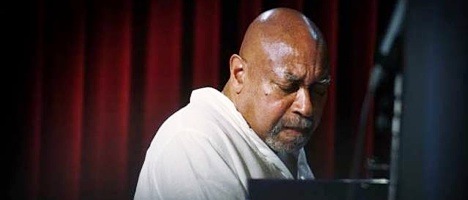
While Iyer has finally emerged from the avant-garde shadows into the limelight, it was also possible to hear a pianist who has long time ago received his breakthrough, but yet hasn't received the full critical acclaim he deserves: Kenny Werner. Together with saxophonist Benjamin Koppel, Werner arranged a mini-festival in the suburb of Valby where he and Koppel played in a number of all-star constellations. Among the highlights of the many sessions there was played was a band consisting of Werner and Koppel with bassist Scott Colley, drummer Al Foster and guitarist John Abercrombie.
The sound of this all-star group was simply wonderful as the musicians navigated through a program of melodic material, including Koppel's groovy "Hammond Street" and Werner's "Untitled Lament" where the pianist showed a sense of deep lyricism comparable to Keith Jarrett, developing melodic motifs like pearls on a string that resembled carefully constructed songs within the larger compositional framework. Werner's playing throughout the many sessions was continuously awe-inspiring and close to transcendence.

In many ways, Søren Bebe might be seen as a student of Werner. He certainly belongs to the tradition of lyrical pianists that goes from Erroll Garner and Bill Evans through Keith Jarrett. What Bebe adds to the lyrical tradition of the piano is a sense of folk-like simplicity, with mourning melodies blossoming like shy night-flowers. His trio with versatile drummer Anders Mogensen and electric bassist Niels Ryde is capable of the kind of close interaction that spawns magic moments. For the concert at the intimate Spanish bookstore Rayuela, situated in the charming quarters of Nørrebro, the trio went well beyond the melancholic mood that characterises their latest offering, From Out Here (Your Favourite Jazz) and stretched across a wide repertoire, sporting some solid blues-based workouts. Still, the highlights, and what Bebe does best, were the ballads where his lyrical playing really shone, especially in the reading of Ryde's "Heimat" and in his own "Song for Andrea" and "Song for Sophie."
Saxophone Bonanza
Piano-lovers were not alone in being treated to a feast of outmost musical excellence, connoisseurs of the saxophone also had the possibility to enjoy some of the instrument's most idiosyncratic and elegant practitioners. While Joe Lovano played with the grand backing of The Danish Radio Big Band, some of the festival's greatest moments arose in more humble, chamber-like settings. The trio Fly, with bassist FLY, drummer Jeff Ballard and saxophonist Mark Turner, have become one of the most interesting explorers of the saxophone- trio format. Their name is particularly well-chosen, because while the group certainly swings, it does so in a light, almost featherweight way, where the instruments seem to blend into each other. They play upon the pulse, instead of the beat, transferring the principles of Claude Debussy's impressionism to jazz. The concert at Copenhagen Jazzhouse showed a group at the height of their powers, with especially Turner sculpting each phrase into a work of art as the group explored the material from their ECM-album Sky & Country, peppered with a selection of standards and other favourites.

Joshua Redman, another young tenor saxophonist, whose profile has risen in the later years, played a stunning set at the Jazzhouse, introducing his double quartet to an enthusiastic Danish audience. Redman took the bulk of his material from the album Compass (Nonesuch, 2009) and while bassist Reuben Rogers and drummer Gregory Hutchinson, who play on that album, also played at that concert, FLY (bass) and Brian Blade (drums) were replaced by Bill Stewart (drums) and Matt Penman (bass). This replacement gave an interesting change in the dynamics of the group, with Stewart adding a more hard-hitting, funky feel to the proceedings. Redman-compositions like "Identity Thief" and "Hutchhiker's Guide" were captivating studies in harmony and groove, but it was when the group played Gil Evans' "Barracudas (General Assembly)," in the Wayne Shorter-inspired version found on Etcetera (Blue Note, 1965), and Redman called in Mark Turner as a guest star that the concert changed from being excellent to becoming purely sublime. Here, the two saxophonists acknowledged the debt to the classic Blue Note hard bop recordings of the sixties, while adding a whole new sensibility to the tune, their fiery lines cascading like cathedrals into the air. Both Redman and Turner showed that they have become style-icons in their own right, stepping out of the shadows of their predecessors.
For a brief moment, the unification of Joshua Redman and Mark Turner gave the blueprint for a dream blowing session. However, the idea of an all-star saxophone meeting was fully realised at Prøvehallen in Valby where saxophonist Benjamin Koppel and pianist Kenny Werner had invited Chris Potter and Bobby Watson to a steaming symposium of sax playing.
Supported by Pierre Boussaguet on bass and Alex Riel on drums, the group delivered a spirited program of original tunes, each of the saxophonists contributing material, but it wasn't really about the songs, but rather about the blowing itself and the group managed to convey an atmosphere of virtuosic relaxation with solid grooves and surprising licks. The only downside was that, at times, the passing of the solo duty seemed a bit formulaic. The concert didn't turn out to be a revelation like Koppel's and Werner's line-up with John Abercrombie, Scott Colley and Al Foster. It wasn't art for the ages, but three saxophone masters engaging in some serious fun.

Avant-garde Encounters
Fun isn't usually a word associated with the avant-garde and while the concerts held at the beautiful Statens Museum for Kunst (National Gallery of Denmark) didn't convey fun in the rigid sense of the word, they surely showed musicians engaged in the joyful art of tight musical communication and, another thing, which didn't make them less attractive for the Danish as well as the foreign audience: They were completely free of charge.

Like his cousin, drummer Kresten Osgood, pianist Soren Kjaergaard is always involved in a lot of projects during the festival. At Statens Museum for Kunst he played in an exciting new trio with saxophonist Torben Snekkestad and drummer Thomas Strønen called The Living Room. Together the three muscians formed a rich tapestry of sound that took advantage of silence and space. Kjærgaard used a wide variety of effects, ranging from intense outbursts and semi-classical ornaments to strange sounds coming from his prepared piano, while Snekkestad's saxophone kept drifting in and out, sometimes crying, other times merely whispering. Using all aspects of his drumkit, Thomas Strönen wasn't so much a timekeeper in the traditional sense, but rather another colorist, using a broad spectrum of sources to make the drums chime, screech and scream. Fragments of melodies surfaced throughout the concert, but it was more about the process of playing instead of resorting to instantly recognizeable melodic patterns. What emerged, then, was a cool abstract lyricism that revealed the Nordic heritage of the players while also putting the music into a larger framework of modern composition practised by the likes of John Cage and Morton Feldman.

A far more passionate approach to the avant-garde-aesthetic than the cool lyricism of The Living Room was given by the constellation of pianist Marilyn Crispell, saxophonist Lotte Anker and bassist Jöelle Léandre. Especially Léandre caressed and attacked her bass, moaning and chanting in controlled excess while Anker's saxophone lines punctuated and supported the rhythms and sounds made by Léandre and Crispell. Crispell was definitely the most subdued of the three, more impressionistic than expressionistic in her playing. Together the three musicians achieved a perfect balance between cold and hot, improvisation and composition.
A decidedly more melodic excursion into avant-garde territory was given by Danish guitarist Hasse Poulsen who, together with his group Das Kapital, consisting of saxophonist Daniel Erdmann and drummer Edward Perraud, explored the oddball repertoire of Austrian composer Hanns Eisler whose strange mix of cabaret, folklore, marching music and socialist aesthetics received a deadpan-treatment by the improvising iconoclasts.
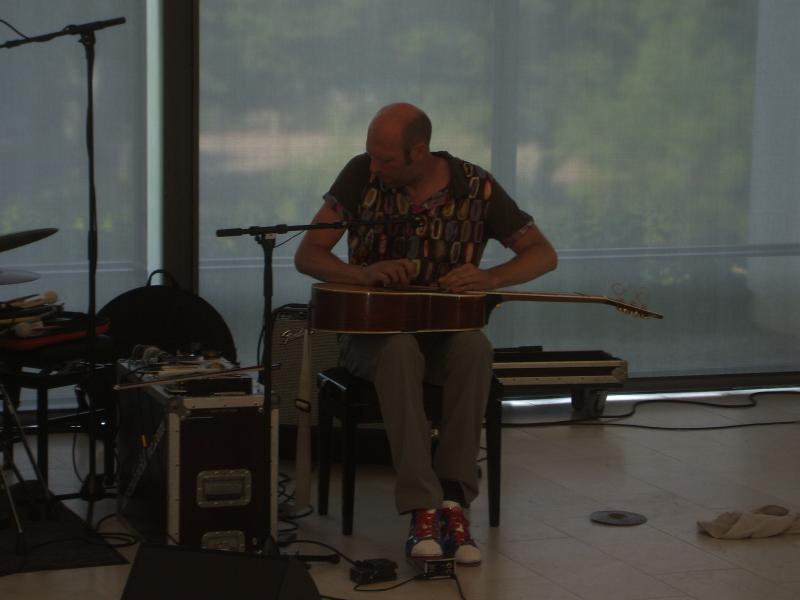
In the optics of Das Kapital, the song "Ohne kapitalisten gehts besser" ("Without capitalists it will be better") was transformed into a surreal waltz with Erdmann's dry saxophone and Poulsen's guitar pyrotechnics. Elsewhere, the haunting "An den deutchen mond" ("To the german moon") gave a fine example of the group's ability to delve into more lyrical territory without ironic distance. Hasse Poulsen is known as a guitarist in the tradition of Derek Bailey and while he certainly showed aspects of his less than orthodox way of getting sound out of the guitar, for most of the time his effects were surprisingly straight, using catchy riffs, fingerpicking, power chords and chucking rhythms as his vehicles. The result was an engaging, but also challenging concert which found beauty in the strangest of material. Eisler may be a novelty today, but in Das Kapital the best aspects of his music lives on.
Hasse Poulsen is a Danish avant-garde guitarist who has moved to France. With Marc Ducret it is the other way around: He is a French avant- garde guitarist who has moved to Denmark, more specifically Copenhagen. For his concert at Vor Frue Plads, Ducret revealed his new ensemble with Danish trumpeter Kasper Tranberg and drummer Peter Bruun and French trombonist Mathias Mahler and saxophonist Fred Gestard. The highlight of the set was a suite called "Real thing" where Ducret merged the sounds of New Orleans jazz, Frank Zappa and free improvisation, constantly pressing his musicians into more wild territory. Moving around in athletic poses with his guitar, Ducret could be heard saying: "more, more" in a passage where the band worked itself up in a hectic frenzy of distorted hornlines and chaotic rhythms. It was a wild, sensual dance Ducret presented that it will be thrilling to hear on record.

Guitarist Scott DuBois also presented a dance in the shape of his latest work, the album Black Hawk Dance (Sunnyside, 2010). It's an album whose dark lyricism deserves a wide audience and live DuBois made a convincing case as he unfolded his complex compositions with the help of the fluid rhythms of Thomas Morgan, whose bass lines seem to fly around like a moth searching for light, and the more direct melodic approach of saxophonist Gebhard Ullmann, who also played the bass clarinet. It was a joy to behold the tight interplay of the group in the epic title track, with Kresten Osgood's tribal drumming and a repeated guitar pattern building up into a grand climax. DuBois showed himself as an elegant and empathic stylist who was able to take full advantage of the rich palette of sounds his group provided, creating a lush fresco of melodic soundscapes.
Balladeering: A Modern Masterpiece
While the festival featured an abundance of great guitarists, including John Abercrombie, Hasse Poulsen, Marc Ducret and Scott DuBois, there was especially one guitar meeting that stuck out: Danish guitarist Jakob Bro playing with Bill Frisell in a live performance of Bro's masterpiece Balladeering (Loveland Records, 2009). It's an album that in 2009 was chosen as the best Danish record of the year by the magazine Jazz Special and it has justifiably been praised by critics all around the country.
In the world of rock and pop it has become quite common to celebrate a groundbreaking album by performing it live in its enterity. This trend has also reached the jazz world and at Copenhagen Jazz Festival 2009 it was Danish trumpeter Palle Mikkelborg's homage to Miles Davis: Aura (Columbia, 1989) that received a grand work-performance. However, with Jakob Bro it is special case since the record is only a year old and yet it already merits the treatment of a classic. Part of the success of the album is due to the fact that it enlists an absolute who's who in modern jazz: drummer Paul Motian, bassist Ben Street, guitarist Bill Frisell and last, but not least, Lee Konitz on saxophone. The process of recording was documented by filmmaker Sune Blicher in his documentary: Weightless: A Recording Session. Here, acting as the fly on the wall, one could follow the close musical communication that resulted in the album.
The evening begun with a screening of the movie and it certainly set the right mood for the concert, but it also raised the question whether a re-working of the album could be successful. It was certain that Bro couldn't use the exact same line-up of the album and yet he surprised everybody by bringing in Bill Frisell, who had played earlier on with his trio at the scene in Det Kongelige Danske Haveselskab. Besides Bro and Frisell, whose telephatic interaction became the backbone of the concert, the band was completed by Bro's trio of drummer Jakob Høyer and bassist Anders Christensen, supported by the horns of Chris Cheek and George Garzone.
As it turned out, it became a magical concert where the material gained new nuances and shone as bright as on the record. After a promising start with a shimmering version of "Weightless," the opener on the album, Chris Cheek got the impossible assignment of following Lee Konitz' sublime opening line on "Evening Song" and while he got off to a somehow anonymous start, he slowly worked himself into the material and created a solo of great beauty and as the evening unfolded he played himself completely out of Konitz shadow. Adding to to the palette of sound was also the inclusion of tenor saxophonist George Garzone, who joined the group on "Greenland," and continued to play an important role for the rest of the evening, bringing a burning tone to complement the more subdued passion of Cheek. Later on, Garzone would let himself completely go for a moment of total catharsis when he played with pianist Rasmus Ehlers and his trio at Cafe Blågårds Apotek, but in this context he limited himself in a constructive way, letting the anguish and pain out in brief strokes.
Creating the perfect framework around the saxophonists and guitarists were Christensen and Høyer whose elegant work secured the ambient feel that let the rich textures come to the fore. After a perfect conclusion, with Bro and Frisell playing in a duo on "Starting Point," the band was brought together for an extra, a speciel treat that was a performance of the track, "Hamsun," that didn't make it to the final cut of the album. It says something of the strength of Balladeering that a song like this was left out because it didn't fit into the work as a whole. Here, however, it was allowed to put the beauty of the album into relief and support the claim that Bro has created a modern masterpiece that can be seen as a high watermark in Danish jazz.
Songs of Love and Life
The festival offered the chance to hear some of the finest instrumentalists in jazz, but there was also an opportunity to encounter the strength of the human voice in different contexts, ranging from electronic soundscapes and a classic quartet setting to intimate chamber pop.
Danish-Swedish Nuaia offered a haunting experience in the surroundings of Københavns Hovedbibliotek, a library in the heart of Copenhagen. Here, the three-piece combined electronically modulated sounds from keyboard and guitar with rattling percussion and the rich voice of the wonderful Sofie Norling, one of the greatest vocal talents on the Swedish scene. On compositions like the crystalline "I Run" and "Igloo," bell-like sounds, electronic glitches and spheric guitar wrapped itself around the expressive voice of the singer who delved deep into themes of pain and regret.

A more smooth approach to jazz singing was given by Gretchen Parlato, whose natural virtousity has been compared to the sweet sounds of a saxophone. On her rendedition of Herbie Hancock's "Butterfly," the singer used her hands to give a percussive effect while her voice dripped like honey from a tree. Mixing self-penned tunes with lesser known originals, like a convincing reading of Thelonious Monk's "Ugly Beauty," Parlato avoided the trap of doing overdone standard interpretations and her band of pianist Taylor Eigsti, bassist Alan Hampton and Mark Guiliana did a perfect job, accompanying her in a solid, swinging style.

Tight accompaniment also characterised the small chamber-like group that singer Martha Wainwright brought with her for a concert in Det Kongelige Teater (The Royal Theatre) where the program consisted of songs made famous by the French chanteuse Edith Piaf. While not a jazz singer in the classic sense, Wainwright has the most important ability of any singer, whether in jazz or popular song, she is able to dramatise and interpret lyrics, making even the most banal and outrageous love stories seem convincing. Adding a touch of humor and existential sensibility, Wainwright cut to the heart of the matter of Piaf's oeuvre, catching the tragic vulnerability that lies in the cabaret genre in general and specifically in the type of tales favored by Piaf. Using a minimal setting with piano, bass and guitar and the powerful register of the singer's voice, an almost otherworldly beauty was created in a time bubble somewhere between past, present and future.
Like Martha Wainwright's meeting with Edith Piaf, what characterized this year's Copenhagen Jazz Festival, as whole, was that it understood to embrace all aspects of musical time, making a festival for all ages, young and old. Jazz was seen with all its many possibilities, the music of then and now, a life-affirming force permeating throughout the city of Copenhagen and spilling over its borders.
The echo of the rhythms of Copenhagen Jazz Festival 2010 will continue to resonate until next year where, once again, another celebration will take place of one of the world's greatest art forms.
Photo Credits
Front cover: Morten Langkilde
Page 1: Jonas Pryner
Page 1: Jakob Baekgaard
Page 2: Jonas Pryner
Page 2: Jakob Baekgaard
Page 3: Jakob Baekgaard
Page 4: Jonas Pryner
Page 4: Jakob Baekgaard
Page 5: Jakob Baekgaard
Page 6: Jakob Baekgaard
Page 7: Jakob Baekgaard
Page 7: Jonas Pryner
< Previous
Directions
Next >
Local HAT
Comments
Tags
Copenhagen Jazz Festival
Live Reviews
Jakob Baekgaard
Denmark
Copenhagen
Chet Baker
Caetano Veloso
Herbie Hancock
Martial Solal
Kenny Barron
Mark Turner
Joshua Redman
jason moran
Vijay Iyer
Marilyn Crispell
John Tchicai
Rasmus Ehlers
George Garzone
Benjamin Koppel
Kenny Werner
Al Foster
Chris Potter
Bobby Watson
John Abercrombie
Scott Colley
August Rosenbaum
Lars Winther
Emil de Waal
Mads Vinding
Art Tatum
David Sanchez
Tommy Flanagan
Keith Jarrett
Søren Bebe
Erroll Garner
Bill Evans
joe lovano
Larry Grenadier
Jeff Ballard
Reuben Rogers
Gregory Hutchinson
Brian Blade
Bill Stewart
Matt Penman
Alex Riel
Søren Kjærgaard
Torben Snekkestad
Thomas Stronen
John Cage
Morton Feldman
Lotte Anker
Derek Bailey
Marc Ducret
Frank Zappa
Scott Dubois
Gebhard Ullmann
Jakob Bro
Bill Frisell
Palle Mikkelborg
Miles Davis
Paul Motian
Ben Street
Lee Konitz
Anders Christensen
Chris Cheek
George Garzone
Gretchen Parlato
Herbie Hancock
Thelonious Monk
Taylor Eigsti
Mark Guiliana
Edith Piaf
For the Love of Jazz
 All About Jazz has been a pillar of jazz since 1995, championing it as an art form and, more importantly, supporting the musicians who create it. Our enduring commitment has made "AAJ" one of the most culturally important websites of its kind, read by hundreds of thousands of fans, musicians and industry figures every month.
You Can Help
To expand our coverage even further and develop new means to foster jazz discovery and connectivity we need your help. You can become a sustaining member for a modest $20 and in return, we'll immediately hide those pesky ads plus provide access to future articles for a full year. This winning combination will vastly improve your AAJ experience and allow us to vigorously build on the pioneering work we first started in 1995. So enjoy an ad-free AAJ experience and help us remain a positive beacon for jazz by making a donation today.Near


Giveaway

Eligible winners: 15
Days remaining: 4
Days remaining: 4