Home » Jazz Articles » Live Review » Norwegian Road Trip, Part 1: Kongsberg Jazz, July 7-8, 2010
Norwegian Road Trip, Part 1: Kongsberg Jazz, July 7-8, 2010


[Editors Note: From July 6 to July 26, 2010, All About Jazz Managing Editor John Kelman will travel throughout Norway to cover both the Kongsberg Jazz Festival (also participating in Silver City Sounds) and Molde Jazz. He'll also spend a week between the two famous festivals in Oslo, where he'll check out the scene, talk to musicians and labels, and visit the legendary Rainbow Studio for a look around and an interview with engineer Jan Erik Kongshaug, who has participated in hundreds of ECM recordings. He'll publish every second or third day, so be sure to follow him as he goes from the east coast to the west, in search of Norwegian artists known and unknown].
Walking out of the train station, after a 16 hours air/train trip, from Ottawa, Canada, the first view of Kongsberg, Norway was a particularly welcoming one.

The Kongsberg Jazz Festival is in its 47th year, and like Molde Jazz (celebrating its 50th anniversary in 2010), which inspired it so many years ago, it's hard imagine how the country's second largest jazz festival packs seventy events into four days in a town of less than 25,000 people. But this is Norway, a country that is currently experiencing "festival inflation," according to Kongsberg Jazz Festival Manager manager, Pål Fidjestøl. There may be plenty of challenges facing a festival where attendance, in the tens of thousands, well exceeds the town's population, but Kongsberg has, for nearly five decades, met those challenges, creating a festival where—with its emphasis on Norwegian artists but with a handful of American artists including saxophonist David Murray, guitarist Bill Frisell, pianist McCoy Tyner, and instrumental experimental group Tortoise—a once silver mining town becomes, for a brief time, a music mecca of the highest order.
Kongsberg is but the first destination in a three-week Norwegian Road Trip that will also see visits to Oslo and Molde. During that time, there'll be plenty of coverage of the Norwegian music scene, but also plenty of time to have a look at a country that, with only 4.5 million inhabitants, is on the cutting edge of music and may well have more musicians per capita than any other country.

Kongsberg may be small, but like other Norwegian towns of its size, its commitment to culture remains a wonder to North American visitors, where a town the same size would be lucky to have a movie theater. Kongsberg has that, of course, but it also has a wealth of spaces that the jazz festival can use as performance venues. "We have fourteen venues," says Fidjestøl, "all of them have very unique characteristics that tell something about Kongsberg or the festival. Our main arena was designed by Snoarc , the very famous Norwegian architect who designed the Ground Zero Memorial in the US and the Bibliotheca Alexandrina in Egypt. They did the Norwegian opera and they also designed our new venue, that's four years old this year that we call the Tubaloon. Under the roof it can seat about 1,500 people, but we use it mostly for standing room shows, and can hold 5,000 people. And that's the main arena, and then we have a wide array of small, intimate and unique settings, like the old museum, we call it the Silver Melting Cabin. When they had the silver mines they took the silver to the city in this melting hut and they made silver bars there. So that's the actual room where they have the concerts, you can see the ovens where they melted the silver, and there's lots of history in the walls. It's a great arena to have concerts, and we also have picture gallery, and the oldest wooden building in Norway is where have the Avanthaugen concert on the Saturday. So all these are unique buildings that add to the experience and to the atmosphere, of course."
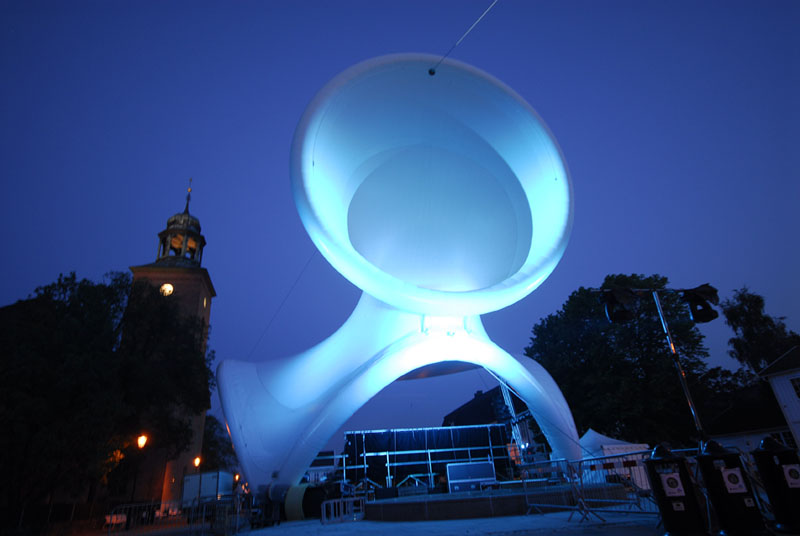 Tubaloon
 A daytime event that's similar to JazzNorway in a Nutshell (that takes place in May each year), called Silver City Sounds, brings together a group of people from Norway and abroad to create a forum for information exchange, unique music events and more. "The song by Sonny Rollins, he called it 'Silver City' as an homage to our festival and to our city," Fidjestøl explains. "That was when fame broke for the Kongsberg Jazz Festival in the early '70s, and Jazz Times had this front page, 'Where is Sonny Rollins?,' he was disappearing for two or three weeks, nobody knew where he was. And then in the next issue, Kongsberg put an ad saying 'He's Here.' He lived here after one of his periods of heroin use—he lived here in a small cabin in the woods for a couple of months one time, leading up to the festival—and that's when eyes opened about our festival."
Like many festivals, Kongsberg offers a combination of free and ticketed performances, also offering day passes and, relatively recently, a full festival pass for 2,000 NOK (a little over 300 USD). "The free program assembles about 30,000 people each day," Fidjestøl says. "For a city that is inhabited by close to 25,000, that's more than the number of people living here." A recent survey conducted by the festival indicated that, as Fidjestøl continues, "about 40 percent are locals, from the city of Kongsberg, then there's a good percentage of people from the areas near Kongsberg, but we also found that 13 percent of people come from abroad or from the other side of Norway [the west coast]." And so, a combination of people driving to and from Kongsberg and folks staying either at a campground along the river that runs through Kongsberg, or its two major hotels—which provide accommodations for festival goers and artists—converge on Kongsberg during week 27 of each year, turning the normally quiet town into an active and vibrant music mecca.
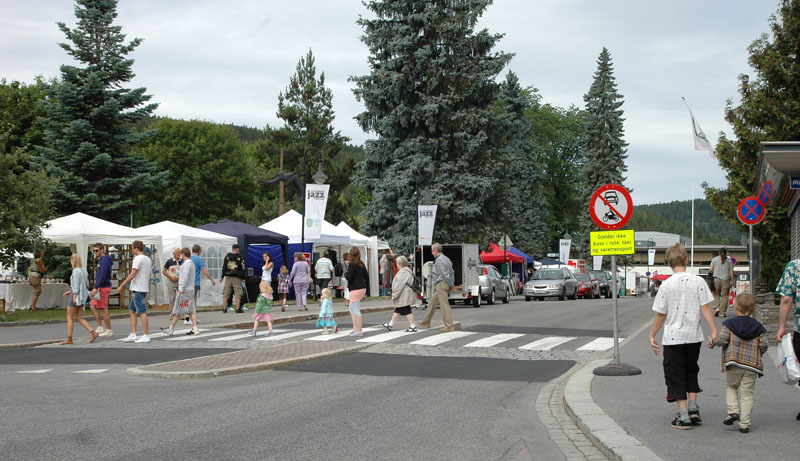
"The main headache is hotel capacity," says Fidjestøl, "but we have a lot of artists staying in Drammen, about 30 kilometers towards Oslo; also, some artists stay in Oslo, which we often suggest for those that will be here for several days." Given the proximity, and the way that Norway's population is spread around the country, it means that there are plenty of options, even for a small town like Kongsberg, allowing it to sustain a tremendous festival that, this year, will feature Norwegian artists including Shining, pianist Ketil Bjornstad and cellist Svante Henryson, guitarist Knut Reiersrud, poet Jan Erik Vold (in a unique concert with bassist Arild Andersen and Bill Frisell), singer Solveig Slettahjell and her Slow Motion Orchestra, and progressive jazz group Jaga Jazzist.
Chapter Index
- July 7: Silver City Sounds Begins
- July 7: Shining
- July 8: Zanussi Five
- July 8: Intro Jazz: Årets Unge Jazzmusikere 2010
- July 8: Ketil Bjørnstad and Svante Henryson
- July 8: Röyksopp
July 7: Silver City Sounds Begins
Meeting the rest of the delegates at the Kongsberg Rail Station for a drive to Storaas, where Silver City Sounds is being hosted, it became apparent just how far Norway is extending its reach to recruit new advocates of the music. Promoters from Italy, record label and club owners from England, festival directors from Germany, journalists from Canada...the list goes on. Some have attended SCS before, and are meeting up again with old friends; others may be new to SCS, now in its third year, but have encountered participants during travels elsewhere; and some are new to the country, the people, and the music. That everyone is a passionate music lover is a given; that they're fascinated by the Norwegian scene also a certainty.
After a brief chance to check in to the old hotel, and grab a bite to eat and a drink, everyone was invited to a room where five tables seated all the delegates. In a version of speed dating, SCS and Music Export Norway Project Manager Øyvind Skjerven Larsen kept delegates on track—each table, seating five or six people, had ten minutes for its participants to introduce themselves to one another. A clap of Larsen's hands and it was time to move on to the next table and do it over again. After five sessions, almost everyone had the chance to briefly meet, an informal way of kick-starting relationships that will, no doubt, grow over the coming days.
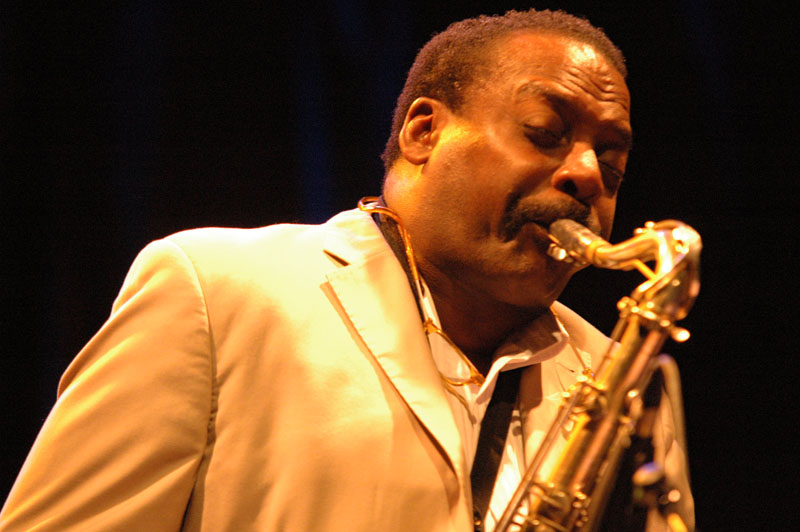 David Murray
Then it was back in the bus to Kongsberg, for the first evening of the festival. An early show at Kongsberg Kino—a small multiplex cinema—brought saxophonist David Murray from the US to play with Lonely Woman, a Norwegian quintet led by bassist Tina Asmundsen. Also featuring woodwind multi-instrumentalist Vidar Johansen, trumpeter Roy Nikolaisen, pianist Rune Klakegg and drummer Svein "Chriko" Christiansen, the group proved that the mainstream jazz tradition remains alive and well in Norway, as the quintet plus Murray swung its way through an opening original that swung hard and provided plenty of solo opportunity for all. Unfortunately, while the group played credibly—and Murray, with characteristic fire—it was a safe performance. Perhaps there needs to be advocates of the tradition in Norway, but in the case of Lonely Woman and its relatively sparsely attended set, there appeared to be a big difference between playing the notes and truly meaning them.
July 7: Shining
Black Jazz may mean one thing to most traditional jazzers, but to Norway's Shining—and the packed house of fans at its 11:00PM show at Energimølla, an old red brick building that's been converted into a two-tiered performance space—it means something else entirely. Led by guitarist/vocalist/saxophonist Jørgen Munkeby and also including powerhouse drummer Torstein Lofthus—now going only by their last names—Shining began life as an edgy, rock-inflected but still clearly jazz band, but has gradually moved away from its clearer roots towards a kind of high octane, metallicized hybrid, loaded with growling vocals, thundering bass, even more powerful drums and relentlessly screaming guitars.
 From left: Hermansen, Kreken, Moen, Munkeby, Lofthus
With Black Jazz (Indie Recordings, 2010)—also the name of its latest CD—Shining's definition of a term so closely associated with an African-American tradition and redefined it in a Norwegian context. Norway, after all, has some of the world's biggest metal fans and a huge death metal scene, so it was remarkable (but not necessarily surprising) to see, in a crowd of predominantly young faces, no shortage of gray hairs and no hairs. Metal, at least in North America, tends to largely attract teenage males, but in Kongsberg there were also plenty of women to be found amongst a demographic ranging from late teens to fifties and sixties, all of them pumping their arms enthusiastically when Munkeby encouraged them during the set's one cover, the extreme version of King Crimson's iconic "21st Century Schizoid Man," that closes the Black Jazz album.
Shining hit the stage running and didn't slow down for its entire set—an hour, plus another ten minutes or so for an encore; short, perhaps, but so exciting and energizing that, by its end, the audience was as sated as the group. The music came almost entirely from Black Jazz, and while the album captures much of the group's energy, it's still best experienced live. With swirling, blue-tinged lighting, nuclear blasts of blinding light, and the occasional strobe lighting, Shining's show was as exciting to watch as it was to hear. There was plenty of rock-posturing, but make no mistake: as much as Shining has morphed into a progressive metal band whose only relationship to jazz now rests with Munkeby's improvisational acumen (especially on saxophone) this is no "three-chord wonder" music; instead, with constant twists and turns, shifting meters and complex arrangements, this was music for which most musicians would have required charts to navigate.
 Kreken
Not Shining, however—and, of course, having a set of music stands onstage would have been antithetical to the show's fundamental spirit. As unfailingly tight as the group was in delivering its knotty, head-banging message, it performed with sheer and unfettered abandon. The activity on stage rarely let up, with guitarist Hermansen affording Munkeby the freedom to switch to saxophone and EVI (electronic valve instrument, a MIDI-d wind instrument) without losing the crunching guitar that so defines the group's sound. And when the two played together, bolstered by bassist Kreken during passages of almost impossibly fast riffs, played in unison—and made all the more astounding for their shifting bar lines—it elevated the show even further, turning up the heat in a room that as already hot and sweaty.
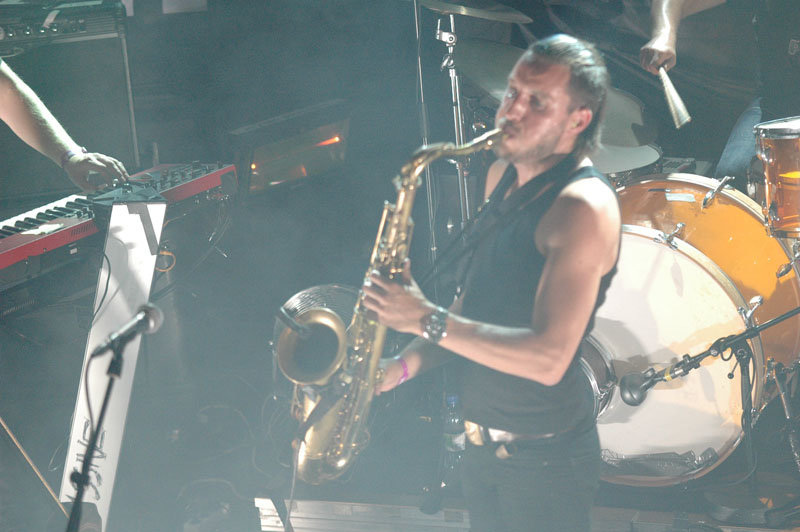 Munkeby
It's hard to know what King Crimson co-founder/guitarist Robert Fripp would think of Shining's version of "21st Century Schizoid Man," but with Munkeby's screaming saxophone, Lofthus' turbulent drums, Moen's industrial keyboards, and ear-crunching guitar and bass from Hermansen and Kreken respectively, it far more viscerally reflected the paranoid intent of the original, first heard on Crimson's groundbreaking debut, In the Court of the Crimson King (DGM Live, 1969). Munkeby wailed on tenor with a screaming, cathartic energy that suggested how the late Albert Ayler might have sounded, had he grown up in a different time, a different place and a different culture. It was one of many moments that proved Shining remains, at its core, a jazz group, albeit one that has, over the years and through the course of albums including Grindston (Rune Grammofon, 2007) and In the Kingdom of Kitch You Will Be a Monster (Rune Grammofon, 2005), dispensed with virtually every last scrap of orthodoxy.
 July 8: Zanussi Five
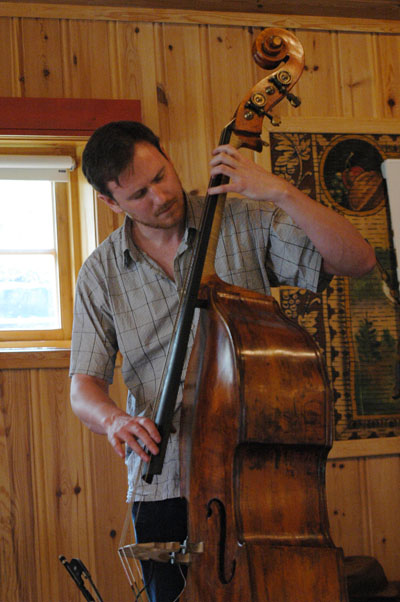
Each day, Silver City Sounds programs a morning event, ranging from speeches to interviews to live performances. For its second day, following breakfast and more opportunities to become acquainted with its participants, SCS hosted a performance by bassist Per Zanussi and his group, Per Zanussi Five. Originally intended to be an outdoor performance, a little morning rain pushed the show indoors, but in many ways it was just as well, as this was an all-acoustic performance that benefitted, sonically, from being in a smaller, more intimate space.
Zanussi first hit the radar as the bassist for Wibutee—a group that, in the early part of the millennium, also provided a springboard for saxophonist Håkon Kornstad. But while Kornstad continues to mine the nexus where technology and music meet, Zanussi has gone all-acoustic since forming Zanussi Five and releasing its self-titled debut in 2005 on the Swedish Moserobie label. While the lineup is different and there's a greater edge, Zanussi's closest frame of reference is legendary bassist Dave Holland and his work of the past decade, in particular the way that Zanussi Five grooves, even when the players are heading towards more extreme territory.
With drummer Gard Nilssen—surely one of the hardest working drummers in Norway—Zanussi has shaped a chordless band that still possessed, with three horns (baritone/alto saxophonist Eirik Hegdal, tenor/soprano saxophonist Jørgen Mathisen and alto/sopranino saxophonist Rolf-Erik Nystrøm), enough linear voices to layer harmony, whether it was over the irregular-metered, riff-driven groove "The Afreet"—with Zanussi and Gard drive a gradually intensifying, mid-tempo pulse that built to a potent climax—or other material where the writing was almost classical in its detailed voicings—though forward motion was rarely far away.
 From left: Gard Nilssen, Per Zanussi, Eirik Hegdal Jørgen Mathisen, Rolf-Erik Nystrøm
A collective of superlative soloists, most of whom also have albums out under their own name, Zanussi Five worked its way through a handful of tunes culled largely from the group's latest CD, Ghost Dance (Moserobie, 2010). Performing with a combination of simmering heat and boiling over intensity, Zanussi Five's short set provided a terrific sampling of what was to come later in the day, when the group played a full set at the Kongsberg Jazz Festival.
A generous buffet-style lunch followed, and then it was on the bus to return to Kongsberg for the second day of the festival and 15 shows to choose from, ranging from electronica to middle eastern-centric folk music, free bop, intimate duos and more.
July 8: Intro Jazz: Årets Unge Jazzmusikere 2010
In a time when support for jazz and other music is dwindling, Norway stands as one of the most supportive countries in the world with a remarkable number of organizations formed to foster a strong local scene, as well as getting the word out to the world. With hundreds of festivals each year, the smaller network of jazz festivals is also connected, with individual festivals working in conjunction with each other on specific projects.
One such project is Årets Unge Jazzmusikere, where eight promising young groups are given the opportunity to perform in front of an audience at the Kongsberg Jazz Festival. Four finalists are chosen to move on to Molde Jazz, a little over a week later. The winner is awarded a package worth several hundred thousand Kroners, to facilitate touring, recording and other activities. It's this kind of support for younger jazz artists—support which, in fact, starts early on with music programs in grade school, moves on to some of the most creative degree programs at universities like Trondheim, and ultimately to contests such as this and a budget for overall arts support—that has positioned Norway as one of the world's most forward-reaching music communities.
 Two performances on the second day of Kongsberg Jazz Festival demonstrated just how broad the scope of these young artists is. A duo featuring guitarist Per Arne Ferne and pianist Per Gunnar Juliusson delivered a 45-minute set of intimate writing and gentle improvisational acumen. In some ways related aesthetically to 1970s ECM albums like guitarists Ralph Towner and John Abercrombie's Sargasso Sea (1976) and Towner's duet disc with vibraphonist Gary Burton, Matchbook (1975), as well as some of the pastoral ambience of saxophonist Jan Garbarek's disc with pianist Art Lande, Red Lanta (1977).
Ferne, whose debut album with the Flux quintet—Peninsulator (Jazzaway, 2010)—is an exciting combination of fervent energy and more angular free play, performed here with considerably more restraint and an inherent lyricism. With a deep hollow body guitar, his tone was warm and clean, not unlike Jim Hall, whose economical approach was a clear touchstone for the young guitarist, along with established players like Pat Metheny and Kurt Rosenwinkel. Juliusson also played with an admirably spare approach, and the two musicians interacted on a level surprisingly deep for players of such a young age.
Cinnamon ReSource was an altogether different beast; a sextet featuring trumpeter Marius Gjersø, tenor saxophonist Svein Magnus Furu, keyboardist Øystein Skar, guitarist Kim Johannesen, bassist Sebastian Haugen and drummer Jakop Janssønn. In contrast to Ferner/Juliusson's distinct songs, Cinnamon ReSource performed one long, continuous set that moved from piece to piece, with intriguing segues in between.
An additional differentiator was the group's use of electronics. Skar's synths were no surprise, nor were Johannesen's array of effects pedals; but both Furu and Gjersø integrated effects processors into their individual sounds, creating loops and altered sonics to give the group a broad aural landscape.
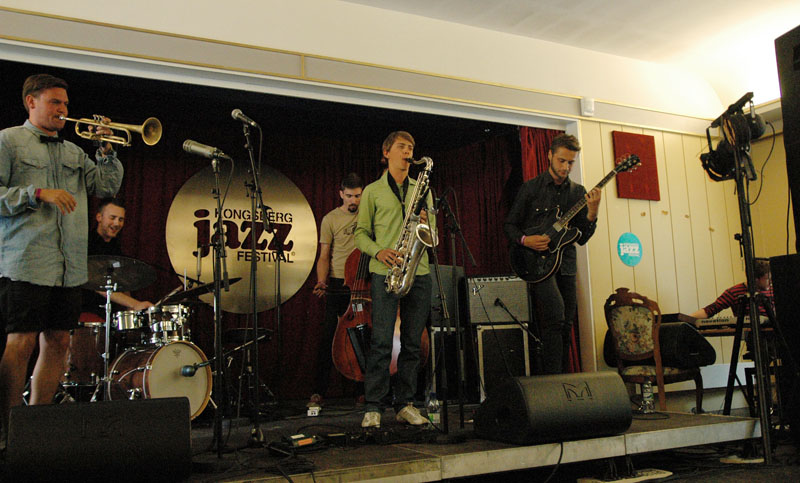 From left: Marius Gjersø, Jakop Janssøn, Sebatian Haugen Svein Magnus Furu, Kim Johannesen, Øystein Skar
The music ranged from ethereal interludes to more propulsive, backbeat-driven songs featuring strong themes and a certain pop-like sensibility. Johannesen was particularly impressive; a player with no shortage of ideas, and an ability to create a seamless foundation—alongside Skar—when the horns took the lead, but also delivering one of the set's most compelling solos early on, where he combined rapid runs with brief dissonances.
When the set was over, the four finalists were announced. Along with other groups, including the duo motsol, Steiner Aadnekvam Quintet, and Fairfist, Fenner/Juiliusson will be heading to Molde. It's unfortunate that Cinnamon ReSource didn't make it, but hopefully the group will continue, as there was plenty of promise in its performance.
July 8: Ketil Bjørnstad and Svante Henryson
If pianist Ketil Bjørnstad had only released his acclaimed series of ECM recordings, beginning with Water Stories (1993) and winding through a series of duo, trio and quartet albums that culminated with this year's Remembrance (2010), that would have been enough to cement his reputation as a compelling, neoclassical composer with an improvisational bent and strong poetic aesthetic. But Bjørnstad has been around much longer than most people in North America are aware, with a four-decade, multi-disciplinary career that, in addition to other non-ECM albums like Grace (Universal Music Norway, 2004) and Before the Light (Universal Music Norway, 2002), has seen the pianist release a number of novels and books of poetry.
 Ketil Bjørnstad
 Nearing 60, Bjørnstad continues at a pace that would put many younger musicians to shame. With a new album in the can, but being held for release in early 2011 to allow Remembrance sufficient time to reach its audience, Bjørnstad delivered his first live performance of this new material at Kongsberg. If this charming duet show with Svante Henryson was any indication, Bjørnstad's forthcoming recording with the Swedish cellist is going to be another high point in a career filled with milestones.
Bjørnstad and Henryson have been performing together for a number of years, and their shared chemistry was in plain sight throughout their hour-long set, where the music was richly composed, but still filled with opportunity for subtle interpretation and brief, lyrical soloing. Bjørnstad's seemingly effortless playing was all about touch, whether it was the delicate, whisper-like approach to the opening "Night," or a more powerful force on the more dynamic "Tidal Waves." In many ways, his music was hypnotic, creating a context for the mind to wander, evoking strong cinematic imagery. Not exactly lulling, but rather more trance-inducing, Bjørnstad's particular ability to surround his vividly thematic, classically oriented pianism with contexts ranging from gentle electronic to edgy electric guitars, has created a personal oeuvre. His particular empathy with Henryson—especially on the more rubato compositions, where the delicate balance between an almost physical feeling of falling into a theme was carefully maintained by both players—actually surpasses earlier collaborations with American cellist David Darling.
Darling was (and remains) a fine cellist, with a series of strong albums for ECM, but Henryson's understated passion created a dramatic undercurrent to Bjørnstad that made their performance a transcendent experience. His arco was a times warm, at other times delicate and gossamer-like, while his pizzicato was surprisingly robust—or, at least, surprising to those who didn't catch his performances at Molde Jazz 2009 with singer Kristin Asbjornsen, or at the festival's "Break of Day" performance, with trumpeter/Artist in Residence Arve Henriksen, keyboardist Jon Balke and percussionist Terje Isungset. But here, in intimate duet with Bjørnstad, Henryson was featured to a far greater extent, his mid-set solo performance a beautiful combination of subtle virtuosic technique and lyrical intent.
 Svante Henryson
Henryson appears to have emerged out of nowhere the past couple years, but continued associations with artists like Bjørnstad, and especially their forthcoming ECM disc, will surely achieve greater visibility, and bring him the attention he so richly deserves. As for Bjørnstad, this new album promises to be a career highpoint, one which will surpass his last piano/cello duet disc, Epigraphs (ECM, 2000). It was no surprise when, at the end of the performance, the audience not only demanded an encore, but gave Bjørnstad and Henryson a standing ovation, a rarity in Norway and a refreshing change from North American audiences who dispense them with generally less discretion. It was a well-deserved and apt ending to a show that was largely gentle, occasionally majestic and always elegant —more space and calm than density and power.
July 8: Röyksopp
It's difficult to imagine any way to link Bjørnstad and Henryson's sublime duo performance with the techno beats and electronica of Röyksopp, defined by the group at its website as "a two-headed Norwegian monster, dealing within the realm of contemporary electronic music." But with guest singer Anneli Drecker—the voice of Bjørnstad's Grace and
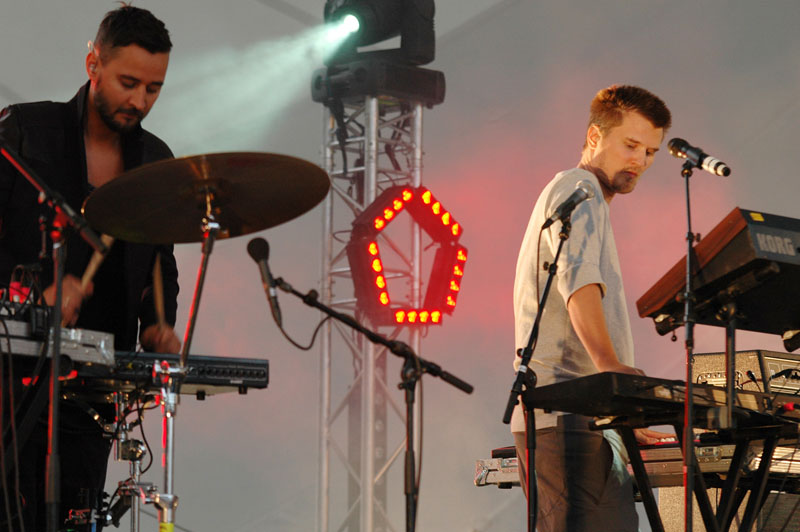 From left: Svein Berge, Torbjørn Brundtland
Performing at Kongsberg's Tubaloon—a large outdoor venue uniquely designed by Snoarc— Röyksopp was definitely pop spectacle; but as is the case with most jazz festivals, stepping outside even the broadest purview works by drawing people who might otherwise not come, or satisfying the happy truth that many fervent jazz fans are also passionate about all kinds of music, making some additional extracurricular programming enriching to the overall festival experience.
The crowd of a few thousand people began lining up well in advance of Tubaloon opening around 8:15PM for the 9:00PM show. There was a vibe of anticipation, made even stronger by the group's delayed entrance, about twenty minutes late. But all was forgiven when the duo of singer/keyboardist Torbjørn Brundtland and keyboardist/percussionist Svein Berge hit the stage, fleshed out by a guitarist and, in particular, a bassist whose charismatic stage presence pushed the energy level even higher.

Emerging from the innovated Trømso scene in 2001 with Melody A.M. (Wall of Sound), nearly a decade later the Norwegian Grammy Award-winning Röyksopp drew from its catalog, also including material from its forthcoming Senior, due for release in the fall of 2010. It was a party atmosphere, with fervent fans pushed up against the barrier at the front of the stage, others dancing throughout the packed crowd behind them, and even more mulling around the back of the venue. And with performances by Tortoise and Jaga Jazzist to follow at Tubaloon over the next couple days, the party vibe is sure to continue.
Visit Shining, Zanussi Five, Ketil Bjørnstad, Svante Henryson, Röyksopp and Kongsberg Jazz Festival on the web.
Coming up in Part Two of Norwegian Road Trip 2010: Kongsberg Jazz Festival with Bill Frisell's Beautiful Dreamers, Tortoise, Jan Erik Vold/Arild Andersen/Bill Frisell, Kornstad/Hollenbeck/Sverrison and Jaga Jazzist, and Silver City Sounds wraps up with a presentation about Oslo's Henie Onstad Arts Centre, and a public interview with saxophonist Hakon Kornstad and Jaga Jazzist's Martin Horntveth.
Photo Credits
Page 1, Tubaloon: NorwayFestivals.com
All Other Photos: John Kelman
Part 1 | Part 2 | Part 3 | Part 4 | Part 5 | Part 6 | Part 7
Tags
Kongsberg Jazz Festival
Live Reviews
John Kelman
David Murray
Bill Frisell
McCoy Tyner
Tortoise
Sonny Rollins
Ketil Bjørnstad
Arild Andersen
Jaga Jazzist
Robert Fripp
Albert Ayler
Dave Holland
Ralph Towner
John Abercrombie
Gary Burton
Jan Garbarek
Art Lande
Jim Hall
pat metheny
Kurt Rosenwinkel
David Darling
Arve Henriksen
Jon Balke
Terje Isungset
Hakon Kornstad
PREVIOUS / NEXT

Support All About Jazz
 All About Jazz has been a pillar of jazz since 1995, championing it as an art form and, more importantly, supporting the musicians who make it. Our enduring commitment has made "AAJ" one of the most culturally important websites of its kind, read by hundreds of thousands of fans, musicians and industry figures every month.