Home » Jazz Articles » Interview » Frank Glover: Going A Different Way
Frank Glover: Going A Different Way

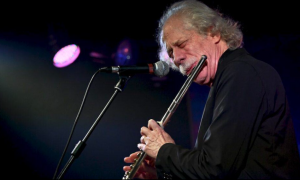
 Intelligent and outspoken, Frank Glover began playing clarinet when he was eleven years old. On entering college, he trained for nearly two years at Indiana University before striking out on his own; upon the independent release of Politico in 2004, he was signed by Owl Studios and the album was re-released under that label in 2009. Initially training as a classical clarinetist who also plays saxophone, the music of John Coltrane grabbed him; he experienced a musical epiphany as a result. An institution in Indianapolis, Glover has a long history enveloped in a diverse range of musical styles. Abacus (Owl Studios, 2010), a journey across many colors and spaces, demonstrates the range that is possible when a composer of Glover's imagination takes a jazz quartet and weaves it seamlessly within the workings of a classical orchestra.
All About Jazz: Your music has a film noir sort of impression and feel to it. Can you tell me about the making of Abacus?
Frank Glover: The last person to really change the way clarinet was heard was Eddie Daniels. He has a very pretty sound, a very feminine sound. I wanted to make a really ballsy clarinet record—hard harmonies and dark sounds. I'm a big James Bond fan; I like all those film noir, guy kinds of movies. But I didn't have any specific idea of where I wanted to go with it; I just write what I write, because of the things I've listened to—and the music that I want to hear. Since I can only play one note at a time, I can't hear my music played with many instruments, but I hear an orchestra in my head. I just hear some big orchestral chords; Abacus just has some huge chords in it.
This is a real orchestral record from end to end. It has separate tracks, but I was asked to do that for the radio; it's really a three-part concerto for orchestra. That's why Politico was so hard to write, I was hearing orchestra, and I was thinking, "I've got to make a quartet record." I just can't write a pure jazz record anymore, that's not the music that comes out of me. The standard is really high now—Wayne Shorter and other people who write for orchestra—Abacus is not just a '50s Blue Note Record—it's influenced by Igor Stravinsky, Astor Piazzolla, composers like that.
AAJ: Which tracks correlate to which parts?
FG: "Two Shades of Green," "Lost Sumino" and "Domino" are the first part. I actually found scraps of the first two pieces at the bottom of my closet. I almost threw them away, but after playing with them a bit, I realized that they could work as part of the first movement. "Ballerina" is the middle part, and "Lighthouse" to "Robot" is the third movement. It goes from a really classical string line with "Two Shades of Green" to completely rocking out. "Robot" is just completely bashing, the orchestra is just screaming loud. I think this sounds very African; it has a lot of marimba and vibraphone in it. I wrote "Lighthouse" for Jack [Helsley, acoustic and bass guitar], and I wrote "Ballerina" for Zach [Lapidus, keyboards]. "Lost Sumino" was written for someone I lost who was important in my life.
AAJ: What was the inspiration for calling it Abacus?
FG: I think because I had a lot of marimba in it, and marimba reminds me of wood and, of course, an abacus is made of wood. It has that kind of resonant sound that wood has when you use it. What do you call someone who sees colors when they listen to music? A synesthetic? I'm not quite that, but almost. Music possesses colors for me; I have some of that in me. I think it would be interesting—I'm also an abstract painter—to see if there is a general set of mathematical rules documenting how colors move from dark to light or from bright to brighter. I'm not sure where I want to go with that, but it's reflected in my music, I think.
AAJ: Who are the people that influenced you?
FG: I heard Coltrane and I quit college, it was his spirit that drew me in to jazz. I then started taking lessons from Harry Miedema at Indiana University; he was the musical director for the O'Jays. I did summer sessions with Robert Marcellus, who was the principal clarinetist for the Cleveland Orchestra for 20 years. Shortly after that, I started driving to New York to take lessons from various guys; Eddie Daniels, Joe Lovano, Lee Konitz. Pete Fountain is another influence, a clarinetist from New Orleans, my grandfather had a collection of his albums. Dave Liebman, he was another teacher of mine for a little while. He's a real colorful saxophonist; he's one of most colorful players I know.
AAJ: I know you have some issues with the current state of the music industry. What do you see as a possible solution? FG: It's kind of disconcerting in a way, you get halfway through your life and you discover that what you do has no value to society whatsoever. None, actually—if you were a janitor it would be more useful. So you basically have to beg to live as a working musician. I'm just an artist, everything outside that world I know very little about. The only choice we have is to try and carve out your own little tiny piece of happiness and that's all there is. I could be a symphony musician, go play with a symphony, but that's not what I do. I've done that—it's OK. Or go in a studio and play some BS music for people. It's OK, I've done that, but it's not who I am. I guess we're required to be more than we are. But you don't get paid for inspiring people in this culture—you don't even get paid for winning a Grammy Award.
I can write some Kenny G BS, maybe people can make money and sell it, but I wouldn't want to put my name on it. And this is happening everywhere. So you have to just carve out your own little niche, which is cool. Which is what I've done, but when it works its way down to club owners canceling you, and that's where I'm at, then you're talking about a major part of your income disappearing.
AAJ: What would you like to do from here?
FG: I'm sure that whatever happens will happen for the good; and I'm not ready to quit, I'd like to be able to continue to make records. I like having a project to work on, but these are too expensive to make. I may write a record at home on the synthesizer. I could re-release my older material, but I'd rather write new music. I have at least three or four more records in me. Oh, I'm sure that Owl wants me to tour; it would be great to have just a little more justification for doing what I do. But I'm happy to just be making records; this record is special for me. I like building things, designing them and putting them together. I like to do things around the house, I like interior design and building bathrooms, creating things—it's not unlike music, really. I'm a very slow but careful writer; I try to blend each sound as a completely new sound. Frank Glover conducting during the Abacus sessions
AAJ: So what is music, then? Why do you do it? What does it give you that makes you want to keep doing what you do?
FG: I can create new things that I've never heard before and that nobody else has heard before. It's hidden in the universe, you find it, you don't make it. Others think you make it, but you don't, you discover it, if you're lucky. I find them on the keyboard; then I just work it and work it until I can't work it anymore. You know it's done when nothing can be added to it. Nothing can be taken away from it to make it better. You can take away from it and make it cleaner, but I'm not like a Hemingway writer, I'm not a lean writer, I love color. I'm more like a Charles Frazier writer.
I have textural ideas that I hear and make notes from. Sometime I hear things in movies and I'll write down the time and what movie it's in. There's some great movie music out there. There's a million dollar chord in King Kong (2005) at 42:40 that is spectacular. There's a nice score to The Lord of the Rings (2001-2003). Troy (2004), Babel (2006) and the The Road to Perdition (2002) are all good. I've loved the movies since I was very young. There's just so much more music to be made.
Abacus isn't a pure jazz record, there's real classical composition on this one; Bach to Stravinsky and beyond, Toru Takemitsu. And when you add improvisation on top of that and it becomes something different, it requires a lot of specialized disciplines to pull it off. I almost made the whole record without "Ballerina," the whole second movement, because I didn't think it fit. Then someone told me they thought it fit, that you could tell that it was all written by one person, it flows, so I decided to keep it in there. But "Ballerina" is very different from the rest.
AAJ: Tell me about your composing process. Do you sit down with a piece of paper, a clarinet and a piano?
FG: Abacus was all written with pencil and paper and keyboard. When I am composing, I am that thing within music. I don't have to have it, I feel like I am it. People look at it like it's something separate from themselves—I need an hour of exercise, I need time to do this or that. When you're in the right place, you realize that you are it. The trick is to be able to stay in that place as long as you can, I mean literally, during the day, because it makes you happy. It helps me solve problems that I otherwise wouldn't be able to solve.
AAJ: Does the solution to a problem come up after you've written the music?
FG: No, it comes from within the process of creating. If you never get to the place where you realize life can be so beautiful, then you never realize what a mess you've got on your hands when you're in it. There's no contrast, life is not a fantasy, it's real. I just think that if people can get to a place where art is, if they can discover that place that they can actually live in, maybe for only three seconds, for example, this time, in an art gallery...then maybe next time you go, you realize that you were there for three whole minutes, and in that moment, nobody could touch you. You feel like you're in bed with the artist for a second.
Like when I listen to Barber's "Adagio for Strings," every time I hear it, it makes me cry. That's the real power of music. Joseph Campbell calls it aesthetic arrest; it's the best definition of art I've ever heard. It's aesthetic; it's beyond what you can say, you can decide how it feels to you, that's about all you can describe, the rest of it is magic. In that place there are no boundaries...when I start playing, that shift happens to me automatically. I can get in that space usually within a matter of seconds; the aural stuff is a little quicker than the visual for me, it gets me there a little faster. But if that's not magic, then what is?
AAJ: Other cultures, particularly the Hindu, think that music is the door to the divine.
FG: But that's what different between our musical culture and that one. You have to put some time in, you have to relax. You can't have all these bills to pay, all these cell phones, all these messages, all this crap you've got to do. You have to put all that aside, you've got to slow down to get to that place. And within this culture, that's a hard thing to do.
Selected Discography
Frank Glover, Abacus (Owl Studios, 2010)
Frank Glover, Politico (Owl Studios, 2004)
Photo Credit
Page 1: Courtesy of Owl Studios
Page 2: Courtesy of Frank Glover
About Frank Glover

Tags
PREVIOUS / NEXT
Become a Sustaining Member

Since 1995, All About Jazz has championed jazz as an art form and supported the musicians who create it. Over three decades, it has grown into one of the world's leading jazz resources, serving hundreds of thousands of readers, musicians, presenters and industry professionals each month.
Help Build the Future of All About Jazz
Your support helps us continue building All About Jazz for the next generation—expanding our editorial coverage, preserving jazz history, developing new community features and creating better ways to discover the music and the people behind it.
Become a sustaining member for as little as $20 per year and you'll immediately enjoy an ad-free experience along with access to subscriber features and future articles for a full year.
Together, we're not simply sustaining All About Jazz—we're building its future. Thank you for being part of the journey.