Home » Jazz Articles » Interview » Nik Turner: Bringing the Music to the People
Nik Turner: Bringing the Music to the People


Independent of his work with Hawkwind, Turner has an extensive performance history with his own bands such as Sphynx, Inner City Unit and Space Ritual, and has performed and recorded with such artists as Farflung, the Stranglers, and Sting.
All About Jazz: What influenced you to start playing music?
Nik Turner: I grew up on jazz. Rather, my mother played the piano. She played sort of the stride piano. One of my uncles played clarinet, although I never really heard him very much. One of the first records I bought was "12th Street Rag" by Pee Wee Hunt. I was sort of subjected to a lot of jazz—Billie Holiday and stuff like that. My aunt used to sing like Billie Holiday [laughs]. We used to take turns at Christmas. I remember singing some sort of songs when I was about six. I grew up in a jazzy sort of environment. My mother liked jazz. She was a fan of Oscar Peterson and Jelly Roll Morton and Fats Waller, people like that.
For myself, I was very interested in the clarinet at first. There was a guy called Sid Phillips who was a British jazz clarinetist, and I seem to remember hearing him. I really got into traditional jazz, what they call Dixieland jazz. One of my first influences regarding the saxophone was hearing Earl Bostic playing "Flamingo." I heard it in a jukebox. I used to hang out in a sort of juke joint on my way home from school and they used to have all of the latest records in there. This is like in the '50s, probably about 1956 or '55. I thought it was fantastic. It just really made an impression on me.
Around that time, I can't remember exactly when, I got into Charlie Parker and John Coltrane and Stan Getz. I got interested then in learning to play, initially, the clarinet. I liked traditional jazz a lot. Friends of mine played in trad jazz bands and I used to listen to it a lot. It was quite popular in Britain at the time. There was a guy living up the street from me who was a band master for the Marine band. He taught woodwind instruments and I got a clarinet and had some lessons from him when I was about 17. I used to go to him every week and I learned a few scales. He showed me how to read music a bit.
Having been influenced as well listening to saxophone a lot, I really wanted to get a saxophone. Initially I bought a tenor sax from him, and he said, "Well, if you learn to play the saxophone you must continue to play your clarinet." I said, "Okay," but of course I didn't [laughter]. As soon as I got the saxophone I sort of abandoned the clarinet and got into listening to Art Blakey. I mean, John Coltrane I listened to then, but he was a bit beyond me, at that point. I listened to Charlie Parker. I learned a few Charlie Parker tunes.
Shortly after that I got an alto saxophone. I traded my tenor in for an alto. There was a local band that played around that played a lot of Charlie Parker, Thelonious Monk, quite a lot of that sort of thing—a lot of different bands, Modern Jazz Quartet. But I liked them. I listened to Charles Mingus, and I just listened to a lot of that stuff. There were a lot of jazz musicians around at that time. Modern jazz was becoming quite popular in Britain. This was probably in the late '50s.
 At the same time I was listening to rock and roll as well. You know, the Coasters and "Yakkety Yak" and old stuff like that, all the sax parts on those records were played by jazz people, even Bill Haley. I bought a Bill Haley record and [tenor saxophonist] Rudy Pompilli is actually a jazz player, I discovered later.
I was interested in Paul Desmond with Dave Brubeck and I listened to Sonny Stitt. I used to see concerts and ended up going to see Miles Davis. I had been going to trad jazz clubs in London seeing Cy Laurie and Ken Collier. I hung out with, like, Bohemian people at the time. I was very young and they were sort of giving me my musical education. Then skiffle hit Britain and I was hanging out in these little skiffle bars in London. And then I got involved and interested in the modern jazz idiom, listening to John Coltrane then and sort of finding it very difficult and thinking, "Wow, I'd really like to play like that but it's quite hard [laughs]. "
I practiced a bit for quite a while and I learned a few tunes, and never played in a band though, really. I started getting into playing "Intersection" with a band very briefly with my music teacher, then I sort of gave up playing for some time. In about 1968, I went to Berlin and met all of these free jazz musicians that hung out in the Blue Note. I think that's where Eric Dolphy and John Coltrane had played, and I think some of these people had played with them. They turned me on to the fact that you didn't have to be technical to express yourself. I realized then I'd met some guys who played in a band and talked about getting involved in a band with them, and then it just sort of struck me that I could play free jazz in a rock band. That's how I became involved in Hawkwind.
Prior to that I'd played in a couple of bands. When in a college band, my brother played the trumpet. He was at Art College studying architecture. I was in college studying engineering at the same time, and I played in a band with him. We did a couple of gigs. He played trumpet, he had a trombone player, there was a bassist and a drummer. We did a couple of gigs just playing four or five numbers. We were playing stuff like "Foggy Day In London Town" and "My Funny Valentine."
I listened to a lot of Gerry Mulligan and then my brother turned me on to Miles Davis with Milestones (Columbia, 1958). I bought a Cannonball Adderley record, Something Else (Blue Note, 1958)," and I thought I really was into jazz. I read a lot about it and listened to it a lot, and I really found it very exciting but quite difficult to play.
While I was in Holland I was road managing for a black guy who did a James Brown look-alike act—or sound-alike or stage act. I was his road manager and we used to hang out all night in bars in Amsterdam with all of these black guys on the run from the Army [laughter] listening to all this old jazz. He turned me on to John Coltrane's Olé Coltrane (Atlantic, 1961). He was writing a book about black hip-speak at that time.
This was probably about 1967. Psychedelia was happening and everybody was taking LSD and stuff like that. I later discovered John Coltrane took LSD as well. And then I got involved with these free jazz people in Berlin in 1968, I think it was. I listened to Jimi Hendrix when I was in Amsterdam and I thought that was really cool music. I think it was quite influential to me. Miles Davis playing his wah-wah, as well.
I got quite influenced by those things and got involved in this band Hawkwind. The guys in the band were all friends of mine, I had met them in Amsterdam. They had played in a band—I was working on a rock and roll circus as a roustabout and a barman. I wasn't playing music at the time but these guys played in one of the bands that featured there. I eventually got this band together with them, a guy called Dave Brock and another one called Mick Slattery. Incidentally, I work with Mick Slattery still today.
We got this band together, I was going to be their road manager. I happened to have my saxophone in my van, in my car, and brought it into rehearsal and banged away at it playing all of this sort of expressionist music that I learned about in Berlin, and then I was invited to be involved in the band.
They didn't have a name at the time, but we later called ourselves Hawkwind as a result of my hawking—clearing my nasal passages, and my wind—my sort of volume of flatulence [laughs], you might call it. So, we were Hawkwind, then, and I was playing free jazz in a rock band. Then my friend Robert Calvert got involved in the band and we turned into a space rock band. He was a poet, a space poet.  And all of this time I had been listening. I listened to jazz all of that time. It was the main music I listened to, really, so I was always interested in jazz. But while I was in Hawkwind—I was in the band for about nine or ten years—I didn't really practice very much because I found I could get away with just, the band, the blending of guitar keys, and I think they even tuned down sometimes.
So I was actually playing in the key of C on my alto and then I was playing in the key of F on my tenor, and so it was quite simple stuff. You know, they were playing in E flat, so it was sort of quite easy for me to play that stuff. It was only when I left the band, I realized how inadequate my playing was, and determined to improve my technique because I was embarrassed to find that I couldn't play with other musicians who didn't play in E or A [laughs]. I was playing in E and A quite a lot in Hawkwind, as well as E flat and A flat.
 And then I worked on my technique and got a bit frustrated with my playing. I went to Egypt for a time, at one point, in 1976 or '77, did some recorded flute music inside the Great Pyramid, then I came back to Britain. I was sitting in the king's chamber and it had fantastic awesome sound, and I was just doodling around thinking about the Egyptian gods.
I came back to Britain and I had a recording deal to fulfill. I had left Hawkwind at this time. I got bored with it, really. I had a recording contract to fulfill and talked my record company into letting me make an album out of this music that I'd recorded in the Great Pyramid. They went with that, and it was produced by Steve Hillage. It was a real cult album.
I was musically progressing, I guess, all the time, playing with different people, some very competent people—Mike Howlett the bassist, and Steve Broughton the drummer, Steve Hillage the guitarist, and other people as well. I got a band called Sphynx, which we performed at all the festivals around Britain.
We had this sort of mystical show. It was choreographed by my friend Barney Bubbles who we have recently done a memorial benefit concert for. He died in 1983, I think. We did this really wacky, wild show, appearing in the middle of the night [laughs] and doing this mystical thing.
And then that developed into a band called Inner City Unit playing satirical, sort of political hard-edged punk music, but very musical. It's all very musically constructed but very free as well. I was playing really wild saxophone in that sort of context and had quite a lot of success with that band.
And then out of that developed another band. My interest in jazz had always been going on. I'd started playing with some guys in the band which I formed called Nik Turner's Fantastic all Stars. I had moved to the country by this time. When I was in London I had Inner City Unit and I recorded an album and a couple of singles on my own label, Riddle Records—riddle of the sphynx, you know, riddled with bullet holes, it became a bit of an ambiguous sort of thing—and moved to Wales and formed a band called Nik Turner's Fantastic All Stars.
I found a keyboard player that had used to play with the Small Faces and he'd played with various people. I think he had played with Roy Orbison or somebody like that, or Ray Charles or someone. He had this sort of very vague background. He did a lot of work with Grace Jones and Marianne Faithful. His name was Mike Vaughan- Jones.
We formed this band playing all this stuff that we had in common, things like "Watermelon Man" and a lot of other bits and pieces of stuff, and we developed a repertoire. He played Hammond organ so he had all of this Jack McDuff and Jimmy McGriff stuff that we played together. I learned songs from him, he learned a lot of stuff from me. We played a bit of Ray Charles sort of stuff. We played just stuff that we liked, you know, getting into playing Art Blakey, Lee Morgan playing "Sidewinder," and just stuff that we liked, common ground that we found. Had a bassist and drummer who had been playing rock and roll previously and now were learning to play this sort of neo-jazz stuff that we were playing and I was learning to improvise.
 I got bored with my musical technique and I had a music lesson from a guy called Alan Holmes. He played baritone saxophone for the Kinks, but he was also the woodwind correspondent for a magazine called International Musician. He got together a sort of round table of all these jazz musicians and people that were in London. I was, at that time, doing a tour with a punk band called Sham 69 with my band, Inner City Unit, supporting them, and I played on several of Sham 69's albums and singles.
At this time I was offered deals by Rosetti Music to buy Yanagisawa saxophones cheaply, and at the same time this guy Alan Holmes gave me a music lesson, which was like, normally he would charge 25 pounds for it and he gave me a free lesson and said, "Go away and learn it and come back in six months time." [laughs] Well, I learned the lesson but I never went back, in fact. I developed in my own way with a few books that he'd sort of directed me towards like "Patterns For Jazz" by Jerry Coker, and a lot of play-along stuff—these sort of Jamey Abersold's "music minus one" stuff—and I started getting into all sorts of developments where I could see going in the direction that I liked.
I was listening to a lot of jazz. I was listening to a lot of Miles Davis, a lot of Dizzy Gillespie and Charlie Parker, and a lot of trumpet players, Freddie Hubbard, a lot of Art Blakey stuff, sort of developing in that direction and aspiring to play jazz, really. What I was trying to do was play what I termed as "accessible jazz," so it wasn't intellectual. It was the sort of jazz that I imagined jazz stemmed from originally, which was people like having a party, like the black slaves having a party and playing their music, which was derived a lot from African music.
We were playing jazz, and jazzing was fucking, at that time. That's how it was originally supposed to be. It was party music and people had a party and fucked each other [laughs] and played a lot of music and had a good time. This is what jazz was to me. It wasn't this intellectual thing that people put on a pedestal.
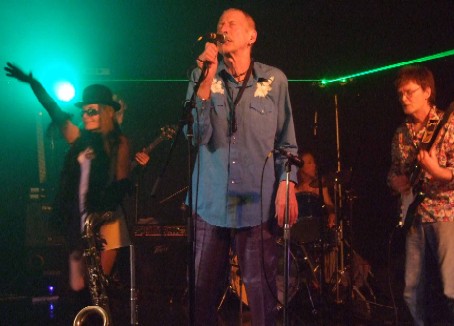
I was trying to play accessible jazz that would touch people, they could understand it, that had a good beat so you could do what you liked on top of a good beat and people got off on the beat and I could sort of meander around playing my jazz [laughs]. That's what I developed in the band called Nik Turner's Fantastic All Stars.
I then got a trumpet player in the band who had been trained at the Royal College of Music. His name was Rick Walsh. We were then playing a lot of his repertoire. He'd worked on the ships, he'd worked on the cruise liners. He'd played with all of these Las Vegas jazz artists like Lena Horne and Sarah Vaughan. He was a really good trumpet player. He died recently from cancer, unfortunately. He taught me a lot. We worked on a lot of stuff. We played all sorts of duets and harmony stuff. I could develop with him.
That band then developed into the band I'm currently working with which is the Nik Turner Band, where we play a lot of sort of Maceo Parker, The Meters, a lot of different stuff, really. We play a lot of the jazz repertoire, "Sidewinder," Miles Davis's "So What," quite a lot of other stuff, some original material as well, sort of funk, just a lot of fun, good time music, and we play parties. We have a wide repertoire of material.
I also play in another band currently of all ex-members of Hawkwind, this band called Space Ritual, and we're playing a lot of new material most of which I wrote. I'm also playing in the Inner City Unit band. I'm still playing with that band and it's still playing quite a wide repertoire of interesting satirical high energy upbeat rock and roll background music.
I did an album with Barney Bubbles called Imperial Pompadours at one point, which was a lot of really wacky rock and roll and I've gotten a lot of that into my repertoire, like "There's A Fungus Among Us," or "See You Soon, Baboon," and "Little Black Egg," and a lot of rather obscure rock and roll stuff, all of it just good time, good fun music, really. So, I'm doing quite a lot of gigs.
I did a gig the other day which I actually organized the whole thing. It was in London. It was a memorial benefit concert for Barney Bubbles featuring, actually, myself playing in three of the bands. I played in this other band which I've got together called the Hawklords which was a spinoff from Hawkwind that had been going in the sort of '80s very briefly. I played in that band, I played in my band Inner City Unit, and I played in the Imperial Pompadours. It was actually very successful and very exciting, and very interesting. I'm doing gigs currently with all of those bands as well as the Nik Turner Band playing sort of funky, sort of jumpy rock and roll and jazz, Latin jazz [laughs].
As well as these things, I go busking sometimes on the street playing anything people want to hear. I go sort of regularly to the Brecon Jazz Festival and go busking there, although sometimes I have played there with my band. That's a festival in West Wales. I was there in the summer playing anything people wanted to hear. You know, people would throw numbers at me, "Oh, play 'The A-Train,'" or "Play 'Little Sunflower,'" or "Take Five [laughs]."
So that's sort of been a bit of a parted history of my musical experiences.
AAJ: Do you think you are going to continue to record and perform new music?
 NT: Yeah, I think so. That's what I do, you know. I like it. I get off on it. I find it's a privilege and a pleasure, and I find a great deal of satisfaction in touching people musically and turning people on and raising their spirits and trying to raise their consciousness and making people have a good time and helping them to have a good time and having a good time myself. It's what I do [laughter]. I'm working on some recordings at the moment with two or three of the bands I'm in.
AAJ: Do you think you have stayed close to your roots?
NT: I think so, yeah. I play music from the heart, really. I play music I enjoy and every gig is the best gig I have ever done. I'm not a superficial person. I just enjoy playing and I find it is a privilege to actually play to people that enjoy what I am doing. It's a gift. I think it's a wonderful thing.
AAJ: What kinds of things do you do to stay creative?
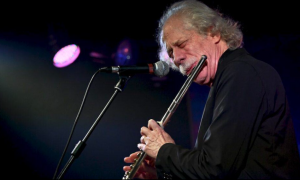
 Nik Turner Onstage with Spaceseed
NT: I find the most creative things are the jazz-funk sort of things, really. With the other bands, one tends to play in guitar keys rather a lot, and I find it is difficult to play in guitar keys. The configuration of the fingering is actually quite difficult. I'm playing in F sharp or I'm playing in C sharp or I'm playing in B. You know, those keys are not really that easy to play. I prefer to play in F and E flat, B flat, D flat, and I play in those keys in the sort of funky Latin jazz medium. I'm sure they are much more interesting keys to play in because you have more freedom and you can express yourself.
I mean, I see music as a language and I practice every day now. I have been practicing for quite awhile and I find you have to learn the language, you have to learn the vocabulary in order to express yourself, and I find that the vocabulary is achieved by practice and developing one's technique to be able to play anything in any key, and just play what you feel like playing, and just feel it.
AAJ: How do you feel about where you are now as an artist?
NT: Well, I'm just me, you know. I listen to John Coltrane and I think, "Wow, What fantastic technique!" But then, he used to practice for 12 hours a day. I don't practice for 12 hours a day, but I find, for myself, I'm quite happy with where I am. I'm quite happy with the development I'm making. I am developing and I aspire to improve my technique to be able to express myself better. I'm not really an ambitious person, I'm just quite a hard worker and I try to develop my musical technique for my own satisfaction, and I find it's a personal thing, really. So I'm quite happy with how I am and what I'm doing.
I went busking in Mexico City. I've played with bands all over the world, you know. I've got backing bands all over the place. I've got about three or four backing bands in America. I've played in Seattle a few times. I had some guys from some famous bands coming down to see me while I was there. I've got backing bands in Sweden, Finland, Germany.
One of the bands I was with in Finland, a band called Five Fifteen, they told me they had a gig in Mexico playing in a progressive rock festival, and I said I'd like to go there, and they said, "Well, you can come with us if you get us a gig in America." So I got them a gig in L.A. with a band that I play with there sometimes, a band called Farflung. They're from L.A.. Pressurehed, as well, they're called—a guy called Tommy Grenas.
I arranged the gig with him, with me sort of headlining with his band at Spaceland, and I arranged for this band Five Fifteen to be special guests there, and Five Fifteen took me to Mexicali where there was a progressive rock festival. I played with them there, and after we had done our act and we stole the show, I got a bit bored and ended up busking in the lobby, sort of entertaining all the girlies in the lobby while all the guys in the heavy metal and progressive rock festival hall were playing air guitars. Subsequently, I was invited to go back and play at the festival just doing my busking act.
I took a bit of time out. I booked a ticket for three or four weeks so that I could go to Mexico City, and there I met a lot of jazz musicians. There was one guy called McGough, he was one of the top jazz guys in Mexico City, and I played with him, and I met a couple of other guys. I was staying in Garibaldi, which is a red light district area. I was living in a brothel playing Mariachi music every night with these Mariachi players and doing three gigs a day with this keyboard player who I met, with all of these really beautiful Mexican girl singers playing all of this really romantic Mexican music that I never heard before.
 The guy was saying, "Oh, this key, this one's in F, one-two-three-four," bang! And I'm playing the intro, and the girl sings, then I do a solo, and then he says, "Oh, it finishes in a minute. Yeah, one- two-three, stop!" [Laughs] And it was going on like this, I was doing three gigs a day with this guy in all of these sort of seedy cantinas, transvestite strip joints and extremely up-market hotel lounges [laughter], and then playing Mariachi music all night with all these really top players.
They are all playing this sort of concert orchestra and the Philharmonic, and stuff like that. They are all playing Mariachi music, and busking as well. They all wanted to hear "The Pink Panther." "Play el toco 'Pantera Rosa,'" they all say [laughter], and I was playing all my bossa novas, you know, "Girl From Ipanema," and all that stuff.
Because I've got a lot of play-along records, I learned a lot of stuff like that. I've got all of these Charlie Parker records that I do play-alongs to. You know, I'm teaching myself, really, and I'm learning. I give music lessons to people that want to learn to play like me. When I was in London playing in Hawkwind in the early days, I used to go to the music shops and one of the guys said, "Oh, you can have anything you want cheap, if you want." And I'd say, "Oh, why is that?" This is about 1973 or '74, and he said, "Well, 90 percent of the people that come in the shop who want to play the saxophone say they want to play like you." [Laughter] And I thought, "Wow, that's very flattering." But I didn't think I was very good, even then [laughs].
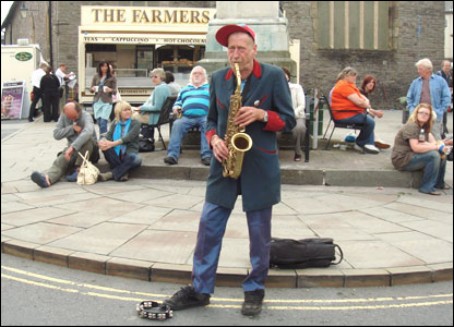 Busking at the Brecon Jazz Festival
I go busking in Cardiff as well, sometimes, when I'm not doing anything else. I just like to take the music to the people, really, and I find it actually great fun to be busking and for nobody to know who I am. Then I make quite a lot of money at it and get a really good response, and I get all the girlies dancing.
I'll go on a Saturday night down one of the streets and everybody's out clubbing, and all the girls come to me and say, "Wow, this is much better than the disco." I'm playing the alto saxophone with a tambourine on my foot keeping time and playing all these sort of bossa novas. If I play "Sway," I get all the girls completely besotted with it, and they're all doing this really sexual dancing. It's a real turn-on [laughter].
Yeah, I do like playing. I do music workshops at kids' festivals and stuff like that. I do music workshops all over the place. I just try to make music fun for people, and I get people that have never played in front of other people and I get them up and running and give them confidence.
I think that my attitude towards playing music is to enjoy yourself and don't give a fuck [laughter]. That's what I say to people, you know. Come on. And if people have got the balls to come onstage with me, then they are very welcome to. I just like to encourage people and give them confidence and show them that everybody is different. We're all at different stages of musical, spiritual, and intellectual development, and nobody is better than anybody else. We're all different.
That's why I like to listen to John Coltrane and Charlie Parker. I find them inspirational, but I don't want to be them. I just want to be me, you know, enjoying music, really, and I want to turn everyone else on to enjoying music and playing it and listening to it.
I felt very sorry for people that can only play music by reading. And I try to tell people throw away the reading books. Start again. Learn your scales. Start from scratch. Just learn basics and just practice and practice. And enjoy it.
AAJ: I've found, just myself, from playing, that one of the best things that you can do is to just play as though you have never, ever picked up the instrument before, and just sit down and play like you are playing for your very first time.
NT: Yeah, you've just got to play for the enjoyment and not worry about what other people think. One of my kids plays drums, and he listens to Stanton Moore. Do you know Stanton Moore? Really complicated New Orleans shuffle stuff. He's learned all of that sort of thing. He played percussion with me at the gig I did the other day. He's very good. He's really cool.
AAJ: I saw a video of the Barney Bubbles tribute. It looked like the gig went really well.
NT: Yeah. There's stuff on YouTube, I think.
AAJ: I saw something at your website—I think it was "Watching the Grass Grow."
 NT: Oh, okay. Cool! [laughs] That's Inner City Unit stuff. I'm doing that with the Space Ritual as well. I mean, I just drag my songs into all of the bands sometimes. But then I'll work out a repertoire of material quite often just based on what turns people on, really. I've got stuff on my site where I'm just playing "Tequila" or something like that [laughs]. Solo sort of stuff. I used to do that a lot. At the end of the gig, all of the band would want to stop playing and the audience wants more. I just get everybody clapping and play "In The Mood," or "The Pink Panther," or "Tequila," or "Sway," or any of these old tunes, and just give people a nice time.
AAJ: You said that you're really influenced by free-form jazz. Have you ever gone out and gigged playing free jazz? You were saying that you were really influenced by that early on.
NT: I've done that as well, yeah. I've done free jazz sometimes. I did a gig recently at Cheltenham University playing free jazz. It was great. I've got videos of it. I don't think there was any of that on YouTube. Maybe there was at that time. There was a guy called Chris Cundy who organized it. It might be on his site. I think he might have a Website. I'm up to anything, really. I just enjoy playing music. I play with The Damned sometimes, and other bands. I just sort of fit into any sort of genre.
AAJ: It's interesting because a lot of times guys will get together and just play, like from the Manhattan scene or the Seattle scene, and maybe they'll never even have played together before.
NT: Really?
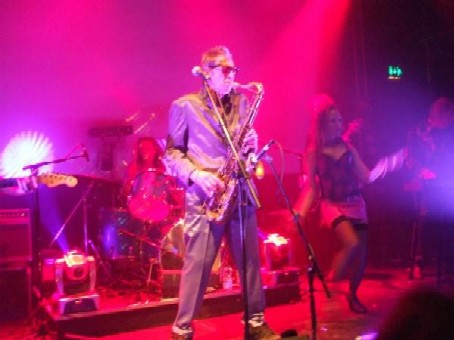
About Nik Turner

Tags
PREVIOUS / NEXT


Become a Sustaining Member

Since 1995, All About Jazz has championed jazz as an art form and supported the musicians who create it. Over three decades, it has grown into one of the world's leading jazz resources, serving hundreds of thousands of readers, musicians, presenters and industry professionals each month.
Help Build the Future of All About Jazz
Your support helps us continue building All About Jazz for the next generation—expanding our editorial coverage, preserving jazz history, developing new community features and creating better ways to discover the music and the people behind it.
Become a sustaining member for as little as $20 per year and you'll immediately enjoy an ad-free experience along with access to subscriber features and future articles for a full year.
Together, we're not simply sustaining All About Jazz—we're building its future. Thank you for being part of the journey.