Home » Jazz Articles » Live Review » ECM at 40: Enjoy Jazz Festival: Days 3-6, October 22-25, 2009
ECM at 40: Enjoy Jazz Festival: Days 3-6, October 22-25, 2009
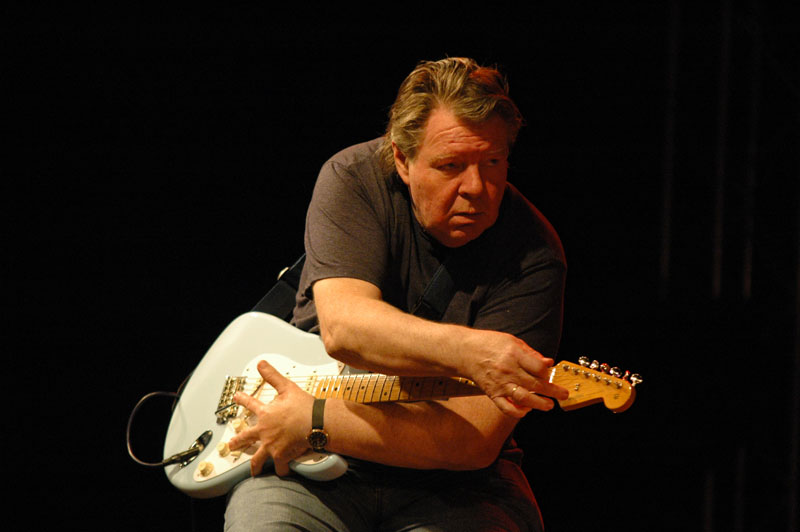

ECM at 40. It's hard to believe that a record label responsible for stretching the boundaries of modern music has survived the various crises that have threatened and, in some cases, decimated so many others. With Enjoy Jazz's "The Blue Sound: 40 Years of ECM" festival-within-a-festival, it's as good a time as any to take stock of where the label has been, where it is, and where's it's going.
In a press conference that took place prior to the first evening's concerts, label head/producer Manfred Eicher spoke of how the label has, indeed, survived such perceived crises as the oil crisis in the late 1970s which, as he dryly put it, "resulted in vinyl as thin as pizza crust." Just as much a threat was the industry's move to CD format, forcing the label to rethink its design approach to accommodate a smaller footprint. And as music seems, at the same time, to be moving away from hard media to digital downloads and returning to vinyl, ECM continues to stand strong with the vision that has not only made it a remarkable innovator, but a rare survivor. There simply is no other independent label in jazz and beyond that has remained so for so long, and it's Eicher's singular vision of sonic transparency and musical cross-pollination that, as he explained, is all about instinct—the intuition that has kept the label at the forefront of modern music—no longer jazz, no longer classical, but simply music.
Eicher talked about the increasingly blurred line between the label's regular series (once considered the "jazz" side) and the New Series line (the "classical" side), and how musicians are surprisingly well-informed about music beyond their apparent purview. He talked of attending a Radiohead concert and being invited backstage, where he ended up in a discussion about Beethoven with the group's bassist, Colin Greenwood. "It was a surprise," Eicher said," but then again it shouldn't have been." It was a sentiment mirrored by Wolfgang Sandner—a respected German journalist who is co-curating the ECM festival with Enjoy Jazz Festival director Rainer Kern and journalist Hans-Jürgen Linke—who talked of how classical composer György Ligeti was informed by jazz, and how violinist Thomas Zehetmair, scheduled for a duo performance with violist Ruth Killius later that evening, takes considerable improvisational liberties with the music of Paganini on his most recent recording, Paganini: 24 Capricci (ECM, 2009).
The theme of the day-long ECM symposium scheduled for Saturday, October 24, was "ECM Music and the Transatlantic Music Dialogue," with speakers from North America (this writer), Germany, England and Italy. With Eicher participating in a closing panel discussion, plenty of the debate and discussion going on at the Festival Café— where fans, musicians, ECM staff and journalists could meet and interact throughout the festival's four days—was brought into sharp focus, with plenty of fresh perspectives. But around all the talk was something even more important, more elemental: the music itself, with a selection of eleven ECM artists representing a true cross-section of the label's unfettered approach to music without borders.
Chapter Index
- John Abercrombie Quartet
- Thomas Zehetmair / Ruth Killius
- Egberto Gismonti / Alexandre Gismonti
- Keller Quartett
- Terje Rypdal / Miroslav Vitous / Gerald Cleaver
- The Blue Moment Symposium
- Dino Saluzzi / Anja Lechner
- Louis Sclavis Quintet
- Alexei Lubimov Trio
- Anouar Brahem Quartet
- Enrico Rava New York Days
- "The Blue Sound" Wrap-Up
- Thomas Zehetmair / Ruth Killius
John Abercrombie Quartet
At the conclusion of John Abercrombie's performance, the opening show of "The Blue Sound," the guitarist said to his audience, "Thank you...and thank you Manfred"—a sentiment that was echoed by many other artists throughout the festival's four days. It was also a particularly meaningful comment, coming from one of the label's longest-standing artists, first appearing in 1973 on saxophonist Dave Liebman's classic Lookout Farm, and releasing his own Timeless—an early classic for both Abercrombie and the label—in 1974.
Closing in on a decade together, Abercrombie's current quartet has the distinction of being his longest- lasting ensemble (recording-wise, at least), though there has been one personnel change on Wait Till You See Her (ECM, 2009), its most recent release, with bassist Thomas Morgan replacing Marc Johnson. Morgan's woodier, more muscular sound has changed the complexion of the group, though it's still a compelling synchronicity of Abercrombie's varied interests, most notably a chamber jazz sound due, in no small part, to the encyclopedic classicism that imbues violinist Mark Feldman's vivid improvisations.
Opening with Abercombie briefly alone, the group's empathic free play was established from the get-go on "Line-Up," one of five tunes taken from Wait Till You See Her. With Morgan's right hand skittering up and down his bass between notes, as if to find exactly the right spot to achieve the desired tone, he proved as strong a fit live as he was on the album, the perfect replacement in a group where, even in the presence of delineated solos, the interaction between the players was both acute and astute.
Drummer Joey Baron—who, according to Abercrombie in a 2004 AAJ interview, actually ended up in the group almost by accident—has become, over the last 30 years, one of modern jazz's most intuitive drummers and the perfect foil for Abercrombie. With eyes constantly darting around the stage, Baron went beyond conventional picking up of a phrase from Abercrombie, seeming at times to complete the guitarist's ideas even as Abercrombie was already moving ahead to the next one.
With respect to transcendence, watching Abercrombie—whether soloing along or in tandem with others—revealed a guitarist who has gone beyond matters of technique and theory. So absolutely comfortable with his instrument, he always manages to avoid signature phrases that often define most guitarists—even the best ones- -by creating a sound and approach that's unassuming yet and absolutely fresh and distinctive, as was also heard at the guitarist's 2007 Montreal Jazz Festival performance.
Abercrombie introduced most of the 85-minute set's music with his characteristically dry sense of humor. Referring to his elegant "Anniversary Waltz," he said: "This song was written for my wife. She got me a present for our anniversary and I didn't buy her anything, so I said to her, 'What can I do? I'm not worthy.' She said, 'Write me a song,' and so I did. When Feldman left the stage for the aptly titled and amiably swinging "Trio," the guitarist explained, "It's like a marriage; guys come and go...have affairs with other bands and then come back...it makes the marriage stronger...I really don't know what I'm talking about." With a comfortable vibe coming from the stage—jokes going on between band members throughout the set, with Baron his usual smiling self—the music was deep, but it was also effortlessly playful, at times even mischievous.
Rarely going too far back in his catalogue, Abercrombie did pull out the indigo ballad "Spring Song," from Open Land (ECM, 1999), the guitarist's first encounter with Feldman. As the tune progressed, however, it took on greater power, with Baron as elastic as ever, Morgan an unshakable anchor and the entire group responding to each other at the drop of a hat. Feldman's solos were amongst the most overtly virtuosic, as he effortlessly ran the gamut from rapid cross-string bowing to high register harmonics, always with an emphatic focus on construction that said all it needed to say, and nothing more; his solo on Wait Till You See Her's "Sad Song" brief, but absolutely perfect.
A short but equally ideal encore was the quartet's version of Ornette Coleman's often covered "Round Trip," from its The Third Quartet (ECM, 2007), a song that clarified the lyrical beauty of Coleman's writing. It may be a largely "time, no changes" tune, but the free jazz icon's memorable melody acted as a guiding beacon throughout that provided a firm context for the group's collective, swinging interplay. A terrific ending to an outstanding performance from an artist who continues to find new, personal ways to mine the realm of chamber jazz with elegance, understatement and, at times, considerable power.
Thomas Zehetmair / Ruth Killius
With Feldman's inherent classicism a significant link, violin virtuoso Thomas Zehetmair and violist Ruth Killius delivered an all-acoustic performance (no microphones, no PA system) that spanned four centuries and four countries, from Wolfgang Amadeus Mozart (Germany) and Niccolò Paganini (Italy) to Heinz Holliger (Switzerland), Bohuslav Martinů (Czechoslovakia) and Giacanto Scelsi (Italy).
It was no coincidence that the duo opened with Mozart's graceful yet majestic "Duo G-Due KV 423," since Mannheim was a place the prolific and mercurial composer spent considerable time—quite possibly in Mannheim Castle itself, the home of "The Blue Sound" festival. The duo's remarkable performance made great use of the large, acoustically resonant Hall of Knights to create a sound much fuller than might be expected from simply a violin and viola. Both players possessed the dynamics and profound sense of nuance to do more than just bring the music to life, creating a visible sense of interaction that, despite the more scripted music, mirrored Abercrombie's performance in the Castle's auditorium.
Zehetmair left the stage to Killius, who took the performance to a more modern place with Scelsi's "Manto 3," a challenging but deeply moving piece written for viola and female voice. Known for working around a single pitch with microtonal variations and drama created through use of timbre and dynamics, it was brief but powerful piece, as Killius sang in a deep voice that, even without knowing the words, felt like an outpouring of rage and grief, her viola creating the key context around which her singing orbited and intersected.
Holliger's "Drei Skizzen für Violine und Viola"—written specifically for Zehetmair and Killius—remained in avant territory, the first of its miniature movements a confluence of harmonics; more color and texture than melody. The second movement was paradoxically fuller in harmony yet sonically more hollow, the result of a device fitted on the bridges of both instruments to mute the complexion. The final movement was one of contrapuntal complexity, as viola and violin moved at times in parallel, elsewhere seemingly inexorably interlocked.
An aspect to the performance that was most remarkable was how a simple musical dyad could create so much harmonic implication. Zehetmair's solo performance of three miniatures from Paganini: 24 Capricci were sequenced to create a miniature narrative within the context of the entire concert. Zehetmair's stunning virtuosity was, perhaps, at its most visible here as his dyadic implications were executed with rare precision and articulation, a true marvel of a performance that brought music written nearly 200 years ago into the 21st century.
Martinů's "Drei Madrigale," a relatively contemporary suite of three pieces that, nevertheless, brought the concert full circle with more accessible and, again, slightly majestic melodies, brought the concert to a close. The appreciative and fully attentive audience demanded—and received—a well-deserved encore written by British composer Peter Maxwell Davies. With a strong mix of music from centuries past and contemporary chamber jazz, "The Blue Sound: 40 Years of ECM" got off to a fine start, auguring well for the three days to follow.
Egberto Gismonti / Alexandre Gismonti
As empathic as band members can become, especially after years of working together, the familial bond is inevitably a stronger one. Rare but not completely uncommon, it's possible to find examples in jazz where siblings work together to great effect. The Heath Brothers is one such example; in the case of The Moutin Reunion Quartet the bond is even tighter, with twin brothers François and Louise Moutin demonstrating an even deeper connection—one equally shared by twin brothers Alex Cline and Nels Cline on the now relatively rare occasions when they work together. Rarer still is the opportunity to see father and son work together. Argentinean bandoneonist Dino Saluzzi's group, responsible for Juan Condori (ECM, 2006), brings brothers and sons together, but larger group settings are rarely as intimate as the most exposed of musical settings, the duo. And so, Enjoy Jazz's appearance by the highly influential Brazilian composer/pianist/guitarist Egberto Gismonti and his son, guitarist Alexandre, was a performance that demonstrated just how acute the connection between father and son can be, especially when translated into music.
"There are probably some fathers and mothers here," Egberto said partway through the performance, "You guys know..." What mothers and fathers knew was just as clear to those without children, as the connection between Egberto and his son was palpable, as he encourage Alexandre with looks that can only be described as full of love and pride. The same was returned by Alexandre though, in response to his father's comments to the audience, he smiled and said, "I don't know...I only know the son part."
The two Gismontis have been playing together since Alexandre was in his early teens, though they've only begun recording together, with their Enjoy Jazz performance culled largely from Saudações (ECM, 2009). Ranging from extended pieces to relative miniatures, the elder Gismonti played a custom-built 14-string guitar with nylon strings, while the son played a standard classical guitar. Egberto's instrument, extending the range far below a normal guitar, allowed him to approach the instrument pianistically at times. A rawer player in contrast to Alexandre's more polished performance, the two guitarists were miked, but the beauty of the room and the soundman responsible for all the performances at Mannheim Castle was that the amplification was minimal, just enough to fill the rather large room with a capacity of approximately 400, while allowing for the kind of delicate nuance that so defined the performance.
The first hour or so was comprised largely of duets, though Alexandre did recreate his tender and lyrical solo version of his father's enduring "Palhaço" from Saudações. While the elder Gismonti is, perhaps, the more distinctive player at this point in time, Alexandre is already more than delivering on a certain promise. Prodigious skill may have underlain the set, but it was a combination of Gismonti's distinctive writing and the remarkable interplay between the two instruments—fixed in structure but free in interpretation—that defined the set. The two created a hypnotic interlocking of minimalistic, repetitive finger-picked patterns, in particular on the opening "Zig Zag," where Egberto constantly egged Alexandre on with the slightest of visual gestures, while Alexandre responded in a way that suggested there was another dialogue going on in addition to the music itself. Solos were traded freely, with only the slightest of nods to cue into new compositional constructs.
When Alexandre left the stage, Egberto moved over to piano—completely unmiked, yet filling the room with sound where, with an enraptured audience, it was so quiet that the slightest touch could be heard. Three songs, including his enduring "Frevo," demonstrated Gismonti's improvisational prowess, stretching the music freely while maintaining an unfailing musical eye on the definitive melodies. As with his guitar playing, he's an unbridled player whose music comes more from the rainforests than the cities of Brazil, playful yet emotionally exposed.
Alexandre returned for a duet with his father, who remained on piano, for two encores that began brightly, but ended on a more subdued note. As powerful as the musical performance was, just as potent was the clear devotion, pride and love that flowed like an undercurrent throughout the set.
Keller Quartett
With amplified performances taking place in the Castle's auditorium—a part of the University that uses much of Mannheim Castle—acoustic performances took place in the Castle's Hall of Knights, a remarkable room filled with 17th century paintings and sculptures—a room whose beauty adds its own personality to the music being performed within.
"The Blue Sound" provided a broad cross-section of the artists and musical styles that have contributed to ECMs broader aesthetic. As much as it would be impossible to imagine a celebration without Thomas Zehetmair, any festival paying tribute to ECM would be lacking without the presence of Keller Quartett, truly one of the world's most impressive string quartets, whose discography on ECM goes as far back as Bach and as recent as György Kurtág and Alexander Knaifel. For its Enjoy Jazz performance, the Quartett—violinists András Keller and János Pilz, violist Zoltán Gál and cellist Judit Szabó delivered a set focusing on the contemporary, with interpretations of György Ligeti's "Streichtquartett Nr. 1: Métamorphoses Nocturnes," Kurtág's "Officium breve in memoriam Andreæ Szervànsky op.28" and Béla Bartók's "Streichquartett Nr. 5."
A challenging set, but one that was profoundly evocative, it drew an inexorable link to the jazz world and co-curator Wolfgang Sandner's comment of the previous day concerning Ligeti's jazz proclivities. The composer's string quartet may have been unequivocally classical in tone and development, with impressive markers definitive of his groundbreaking innovations; but so, too, were voicings that spoke more of jazz's own sophisticated harmonies. An often dark and occasionally dramatic composition, it was still curiously accessible; even when the strings continued to ascend through upper register harmonics, converging in delicate yet tension-building microtonal harmonics, it was less outré than, say, the celestial "Lux Aeterna" or "Atmospheres," two Ligeti compositions made famous by film director Stanley Kubrick when he used them in his seminal 2001: A Space Odyssey (1968). There were, in fact, passages of deeper beauty.
Kurtág's "Officium breve," heard on Keller Quartett's Musik für Streichinstrumente (ECM, 1996), demonstrated the greater meaning that silence can bring, and highlighted Keller Quartett's outstanding dynamic range to create a reading that, in many ways, demonstrated the vast difference between hearing this music on record and in performance. ECM has always aimed—and successfully achieved—a distinctive sonic transparency, where every nuance, every detail is absolutely clear. It's original aim was to bring the kind of pristine clarity, so often heard in classical recordings, to the jazz world of the early 1970s where relatively little attention was paid, as even milestone albums like Miles Davis' Bitches Brew (Columbia, 1969) were murky recordings where it was impossible to hear with anything resembling pellucidity.
No less modern than Ligeti, there was a more prevalent folkloric element to "Officium breve," and voicings that were of a more oblique nature. Every member of Keller Quartett is a virtuoso, with András Keller, in particular, participating on a number of other ECM titles, including Béla Bartók's 44 Duos for Two Violins (2002), and the expressive qualities of the individual players brought a different kind of light to the piece, especially in a room where the softest phrase could be heard throughout. ECM's recording of the piece has its own soundscape, with a different kind of intimacy that draws in the ear when Szabo begins her long, languid glissandi beneath the piercing violin harmonics near the piece's half-way point. In the Hall of Knights, while the elemental nature of the music was retained, the natural reverb of the room created a different kind of immediacy, even as the thirteen-minute piece reached its zenith, before ending with an almost painful beauty, mournful and reflective.
Of his six renowned string quartets, Bartók's 23-minut "Streichquartett Nr. 5" is, perhaps, one of the lesser recorded outside those projects that cover the entire series. Even more redolent of the traditional music of his native Hungary than the Romanian Kurtág, it was a powerful closer to this hour-long performance. "Finale,"the closing section of this five-moment suite, "was a propulsive and definitive ending to a performance that, in its own way, stretched the boundaries of classical music by, at least in parts, blurring the increasingly fuzzy line between ECM's regular and new series recordings.
Terje Rypdal / Miroslav Vitous / Gerald Cleaver
No ECM festival would be complete without representing the music of Norway, which has been such a large part of the label's focus, nor would it be comprehensive without the kind of international collaboration that has also been a label touchstone.
Norwegian guitarist Terje Rypdal has, as an ECM artist since nearly the very beginning— first appearing on the label's seventh album, Jan Garbarek's early classic, Afric Pepperbird (1971), and releasing his own eponymous debut the same year—defined a sound that has come to be called, for better or worse, right or wrong, "Nordic Cool." Heavily influenced by rock guitarists like Jimi Hendrix, Rypdal has nevertheless evolved his own sound that is also informed by early work with George Russell, the creator of the Lydian Chromatic Concept of Tonal Organization (1968). Miles Davis has also figured in the guitarist's career, but throughout, his playing has been an unmistakable combination of raw energy, a restraint rare for electric guitarists, and a sound that manages to evoke images of vast, barren landscapes. Also a modernistic classical composer, he's further blurred the lines between musical genres on albums like Whenever I Seem to Be Far Away (1974) and If Mountains Could Sing (1995).
Czech double-bassist Miroslav Vitous, as co-founder of the seminal fusion group Weather Report, has pushed his own boundaries. While not as prolific as Rypdal, he's recorded a number of outstanding records for ECM, including First Meeting (1980), the first of three albums with his early-1980s quartet with saxophonist John Surman, drummer Jon Christensen and either pianist Kenny Kirkland or John Taylor. In the 1980s he created what has since become one of the de facto standards in orchestral samples, and has used them to great effect on more recent albums including Universal Syncopations II (2007) and Remembering Weather Report (2009), an album that pays tribute to the more improv-heavy days of early Weather Report in spirit, if not in letter.
The two musicians collaborated with American drummer Jack DeJohnette on two albums— Terje Rypdal / Miroslav Vitous / Jack DeJohnette (1978) and the 1981 follow-up, To Be Continued. While this trio, focusing on written material by Rypdal and Vitous, dissolved shortly after the second album, the guitarist and bassist came together occasionally over the years, including a tour with Indian percussionist Trilok Gurtu in the mid-1990s. For their reunion performance at Enjoy Jazz, Rypdal and Vitous recruited American drummer Gerald Cleaver, who was an important part both Universal Syncopations II and Remembering Weather Report. The rapport he shared with Vitous was on a deep level, and while he possessed no shortage of kinetic power when needed, he was also capable of the kind of texture and color that made this improv-heavy trio such a treat.
The late night performance was not without its problems. Vitous, using a keyboard to trigger a variety of samples throughout the show, sometimes seemed as though he was losing focus by having to disturb his playing to activate the samples. And, equally, it often felt—even when playing material that was clearly Rypdal's—that he was the focal point, when the trio should have been more egalitarian.
That said, his sound—and in particular his signature arco tone—was as compelling as ever, and he remains a virtuosic player capable of providing some rhythmic foundation while engaging in trialogue with Rypdal and Cleaver, even if the conversation was, at times, one-sided.
Rypdal, on the other hand, was there with ears wide open, as he both responded to and provided his own cues in a series of pieces that were based around pulse-driven free play. In recent times, including the performance of a new extended piece, "Crimescene," with the Bergen Big Band in Bergen this past May (recorded for his next album), he's been playing better than he has some time, quite possibly better than he ever has, with a combination of trenchant lyricism, surging, sustaining notes and chords, and Hendrixian whammy bar swoops that, despite the reference, remain wholly his own.
Cleaver, too, was keeping his eye on the ball, intuitive and fully engaged. Creating a tumultuous undercurrent that possessed pulse but, at the same time, was open-ended and filled with greater implication, he also demonstrated a broader purview than usual by playing glockenspiel and tympani. And while groove—at least by more conventional definition—was a rare commodity during this ninety-minute performance, when he did lock in with Vitous, it created a terrific sense of release from much of the tension built throughout the show. It may have been a show of mixed results, but the beauty of this kind of experimentation is that it's risk without necessarily (or always) total success. The journey is often as important as the destination, and for Rypdal, Vitous and Cleaver, it was one well worth taking.
The Blue Moment Symposium
An important part of "The Blue Sound" festival was a full-day international symposium held at the university in Mannheim Castle, featuring eight lecturers from a variety of countries and with a multitude of perspectives, and a final panel discussion that included Manfred Eicher. With Enjoy Jazz a festival largely in German, English and German translations were available for attendees, sp they could understand the lectures, regardless of the language.
Perhaps most surprising about the Symposium—though, given the broad scope of ECM, perhaps not so surprising at all—was how little overlap there was between lecturers. Süddeutsche Zeitung editor Thomas Steinfeld opened the day with a lecture that was only partly serious on the subject of "nothing," though not in reference to the old Seinfeld television show, but more philosophically. ECM CDs begin with five seconds of silence, and Steinfield explored the significance of this unusual marker. French critic, philosopher and curator Daniel Soutif spoke of the emergence of jazz in Europe, setting the context for how American jazz found its way across the ocean and, in the 1960s, became part of a movement that was as much sociological as it was artistic. This writer spoke about how ECM recontextualized American jazz within a broader musical spectrum, and how label loyalty evolved through the expectation that new recordings would be anything but similar to what had come before.
Oldenberg professor of media, Susanne Binas-Preisendörfer, spoke about music industry trends, while Hannover professor of trumpet, Herbert Hellhund, discussed the importance of the north in ECM's overall aesthetic, and the label's commitment to incorporating the cultural traditions from countries around the globe into the overall purview of improvised music. BBC Radio's Fiona Talkington delivered a particularly compelling lecture that drew a line from ECM's regular series to New, using Terje Rypdal as the initial touchstone, but ultimately leading from his memorable "Return of Per Ulv," from If Mountains Could Sing, forward to his own Lux Aeterna (2002) and Knaefel's 2000 same-titled composition and album (performed by cellist brothers Patrick and Thomas Demenga). From there, Talkington drew a line back to Schumann and, ultimately, Bach, and in a brief twenty minutes of speech and sound samples, vividly made the same point that Eicher made two days prior at the press conference.
From there, Italian writer Francesco Martinelli demonstrated the confluence of Euro-American traditions, dating as far back as the 1930s, when ((Sidney Bechet)) referenced music from an Italian opera in one of his solos. That cross-pollination has existed all along was Martinelli's theory, and it was proven even further as he came to Italian clarinetist/composer Giovanni Trovesi, whose Profumo di Violetta (ECM, 2009), brought the stylistic blurring of opera and improvised music to the Northern Italian provincial banda. "The Blue Sound" co-curator, Wolfgang Sandner, stepped in at the last minute for the unavailable Richard Williams, and closed the lecture segment of the day with discussion of Keith Jarrett, in particular, his highly successful Köln Concert (1976), and how the pianist constantly creates something from nothing.
Ending with a panel discussion involving this writer, Fiona Talkington, Daniel Soutif and Manfred Eicher, questions from the audience were taken, as well as driven by co-curator Hans-Jürgen Linke. It was a fitting close to a day filled with new ideas and intriguing consolidations—all of which are planned to be published in a book in 2010, to celebrate ECM's 40th Anniversary.
Dino Saluzzi / Anja Lechner
When it was released in 2007, Ojos Negros—the sublime duo recording by Argentinean bandoneonist Dino Saluzzi and German cellist Anja Lechner—was critically acclaimed for its marriage of Saluzzi's South American folk tradition and Astor Piazzolla-informed tango, with Lechner's inherent classicism; yet another example of ECM and its artists blurring or, in some cases, entirely erasing anything that would prevent a fertile cross-pollination of musical ideas.
Of course Saluzzi is no stranger to the classical world, having released the second of two albums, both called Kultrum (1998), where the bandoneonist collaborated with the German-based Rosamunde Quartett—his first encounter, in fact, with Lechner, a member of Rosamunde. While her early career was largely focused on classical concerns, Lechner was also interested in improvised music and, as a result of Kultrum, the music of South America. Lechner began touring with Saluzzi as a duo some years ago, so Ojos Negros was no singular event; instead, it was the culmination of much work together—work that has continued since the album's release, and demonstrated palpable growth in the duo's all-acoustic performance in the resonant Hall of Knights, the ideal venue for yet another ECM group that values space and the decay of notes, and eschews conventional virtuosity for more lyrical concers.
If Ojos Negros was an album where the improvisation was more in the area of interpretation rather than overt creation of, for example, new melodies based on the structure of the writing, Saluzzi and Lechner's performance demonstrates a duo that may still work within the confines of the written page, but takes considerably more risk and liberty than it did when the album was recorded three years ago.
Saluzzi appeared to be almost in a state of transcendence, eyes open but seeing something beyond what was in the literal world. Lechner was, perhaps, more grounded but no less engaged, as the two wound their way through a 75-minute set culled, in part, from Ojos Negros. Tender melodies intertwining with temporal elasticity, and a sound that filled the room with warmth, as the two connected through nearly constant eye contact—that is, when Saluzzi wasn't looking somewhere else that nobody else could see.
Near the end of the duo's moving performance, Saluzzi spoke clearly from the heart when he said: "Manfred Eicher is a part of my heart, because he's a part of my history" As the weekend continued to move forward, there was much praise for Eicher who, according to trumpeter Enrico Rava in public after the final performance on Sunday, October 25, spoke of how, "sometimes you come to the studio and you don't know what to do; Manfred Eicher can help you find what to do." It became abundantly clear that Eicher—distanced completely from the kind of record creation where the producer has little artistic involvement—is invariably the added member of the ensemble, an active artistic participant whose suggestions are sometimes subtle, other times definitive.
Louis Sclavis Quintet
In a time where mentoring—teaching the art of improvisation through experience rather than a textbook—is in increasing danger of extinction, it's always a pleasure to find established artists who are committed to passing along their own histories to younger players. American trumpeter Terence Blanchard is one such artist; Polish trumpeter (and ECM recording artist) Tomasz Stańkois another. French saxophonist/clarinetist Louis Sclavis is yet another and, by bringing all but one member of the young group that recorded his latest album, Lost on the Way (2009), he demonstrated the real value of music's oral tradition.
Opening with the first track off Lost on the Way, Sclavis' new quintet brought back guitarist Maxime Delpierre from his previous release, the equally fine L'imparfait des langues (2007). Looking like he's barely out of his teens, Delpierre played with a curious approach that was, in part, influenced by Bill Frisell at his most angular, but also by the more overdriven agro of Radiohead. As the only chordal accompanist in the group, he was an idiosyncratic player, ideal to support Sclavis' serpentine lines and remarkable solos, as well as some outstanding features for saxophonist Matthieu Metzger, who matched Sclavis for energy, imagination and sheer endurance during some of the set's more electrifying moments.
Like Delpierre, electric bassist Oliver Lété looked as though he'd be more at home in a rock band, and certainly some of the fire he brought to the group came from that space; Sclavis has, in fact, evolved a sound, in recent years, that appeals to fans of some of progressive rock's more compositionally ambitious groups, but his language is far deeper, his improvisational acumen far more acute. There were relative miniatures like "Bain D'or," with drummer Eric Groleau's mallet-driven pulse and a lithely melody that snaked in and around Delpierre's arpeggiated guitar and Lété's equally contrapuntal lines. The group occasionally coalesced around a unison phrase that acted as a rallying point and setup for Lété's oddly shaped solo.
Capable of powerful forward motion, Groleau—replacing Lost on the Way's François Merville—was a knotty player ideal for Sclavis' compositional twists and turns, and while he soloed rarely, a clearly unique approach that utilizes dark cymbals to color the more indigo shades of tunes like the temporally fixed but seemingly elastic "Le Sommeil Des Sirénes."
"Un Vent Noir" took the group into near-rock territory, with Delpierre's hypnotic strumming, Lét's persistent strumming and Sclavis—who played most of the set on bass clarinet—layering sinewy lines over the lengthy intro vamp, ultimately resolving into an attractive, mixed-meter melody. As much as Sclavis brought years of experience to his younger players, so, too, did they return the favor by providing the reedman with a context to allow the continued evolution his distinctive, modern-edged approach. It made for a thrilling performance that was one of the highlights of "The Blue Sound" festival.
Alexei Lubimov Trio
For the final performance to focus on ECM's New Series line, the last day of "The Blue Sound" began with a late morning performance by pianist Alexei Lubimov, violinist Alexander Trostiansky and clarinetist Kyrill Rybakov. It was the perfect combination of elegant simplicity, bold drama and instrumental virtuosity that brought deeper meaning to a repertoire that included pieces by Galina Ustwolskaja, Valentin Silvestrov, Meyer Kupferman, Igor Stravinsky and, perhaps ECM's most renowned composer, Arvo Pärt. Given Pärt's proclivity for larger orchestral/choral works, with the focus of this festival on smaller chamber ensembles, it was an opportunity to experience two of Pärt's most beautiful compositions—"'Spiegel in Spiegel' für Klarinette und Klavier," and the sublime "Für Alina," both from the Estonian composer's Alina (1999), but "'Spiegel in Spiegel" also on this trio's more recent Misterioso, from which the Utwolskaja and Silvestrov were also culled.
It was an intriguing way to start a Sunday morning, with Ustwolskaja's "trio für Violine, Klarinette und Klavier" a somewhat moody but appealing piece that highlighted the sensitivity of the trio to the finer details of the music. Beginning with Rybakov's obliquely lyrical melody, Lubmiov entered with emphasis on the lower register of the piano which, in the larger expanse of the Hall of Knights, sounded immense without being overwhelming. The piece gradually became more abstruse, a darkly evocative piece that, over the course of fifteen minutes, waxed and waned with unpredictability, for those unfamiliar with the composition.
Pärt's "Spiegel in Spiegel," driven by Lubimov's gentle piano arpeggios that, with additional notes gradually introduced above and below them, created unexpected and gorgeously simple harmony with Rybakov, whose melody created a lulling sense of tranquility. Both players demonstrated an acutely sensitive touch, with Lubimov's nuances creating a soft sense of power as the piece ebbed and flowed over the course of eight minutes. It was a fitting segue into the final piece of the performance's first half, Silvestrov's "Post Scriptum, für Violine und Klavier," where an initial sense of folkloric simplicity was gradually absorbed into an underlying tension, filled with implication.
The second half began with Kupferman's "Moonflowers, Baby, für Kalrinette solo," a spare entry by Rybakov that set the context for the second set, a piece that required the utmost control and nuance to perform, as the clarinetist gradually evolved a melody that was so compelling on its own that accompaniment simply wasn't necessary. Rybakov then left the stage, as Lubimov began a solo piano segment with Ustwolskaja's "Sonate f&252;r Klavier, leading into Silvestrov's "Zwei Postluden für Klavier," a piece dedicated to Pärt but which was ultimately the most boldly dramatic of the set, creating a powerful tension that was then released to great effect with Lubmivo's spare, spacious "Für Alina," where stasis created a calming effect and rapt attention from the audience.
Ending with Stravinsky's "Suite aus 'L'Histoire du soldat,'" the trio brought the transcendence back to earth with a brighter, more majestic closer, one movement of which was repeated as the encore; with a program this intense and this expansive, it's no surprise the trio didn't have any additional material to play. Still, the audience clearly didn't want the performance to end but, as ever, all good things must.
About Enrico Rava

Tags
PREVIOUS / NEXT

Become a Sustaining Member

Since 1995, All About Jazz has championed jazz as an art form and supported the musicians who create it. Over three decades, it has grown into one of the world's leading jazz resources, serving hundreds of thousands of readers, musicians, presenters and industry professionals each month.
Help Build the Future of All About Jazz
Your support helps us continue building All About Jazz for the next generation—expanding our editorial coverage, preserving jazz history, developing new community features and creating better ways to discover the music and the people behind it.
Become a sustaining member for as little as $20 per year and you'll immediately enjoy an ad-free experience along with access to subscriber features and future articles for a full year.
Together, we're not simply sustaining All About Jazz—we're building its future. Thank you for being part of the journey.