Home » Jazz Articles » Interview » Gary Smulyan: Low Man Aims High
Gary Smulyan: Low Man Aims High

The apprentice system is largely gone, there is no opportunity for young musicians to play with people who are better than them. That's how the continuum happens. Jazz is largely a mentor-student music.
—Gary Smulyan

To be fair, Smulyan has his own voice, but he cites Charlie Parker as one of his earliest, most important, and enduring influences. And in these later years, Phil Woods also falls into that category. That one of today's most notable baritone sax players doesn't cite Gerry Mulligan or Harry Carney as his main influences might seem like an enigma, but the solution presents an interesting tale.
Smulyan started playing music at the age of eight, and by high school was already playing "in a pretty sad-sounding garage band." At the age of 13, he confesses, "I didn't even know what jazz was," until he was flipping through radio stations and came across the legendary Ed Beach's radio show, Just Jazz, on WRVR. What got Smulyan's attention was Fats Waller playing "African Ripples." "I'd never heard anything like that before," and the sound was life-changing.
"A total accident," he says, "but life-defining."
A knowledgeable radio personality, Beach became a focal point for the young Smulyan as he was growing-up, learning music and learning about music. Beach was famous for devoting as much as a week to certain artists. "I was riveted, he gave so much information. When I heard Fats, that was really it." Smulyan started playing in stage band in high school, where he met Joe Dixon, who had a youth ensemble and he coached the group.
So, Smulyan would be a jazzman.
But first, he'd be a jazzboy, or at least a jazz adolescent. At the age of 16, visitors to Sonny's Place, a jazz club in Seaford, NY, could find him sitting-in with the legends of the day: Zoot Sims, Lee Konitz, Jimmy Knepper, Ray Nance, }}Chet Baker}}. While it's tempting to say, "and the rest is history," we're not quite there yet. He's still an alto player, at this stage of his life.
Smulyan started meeting and working with other younger musicians who were passionate about this music, including the brothers Glen and Billy Drewes (the latter currently a fellow reedman with Smulyan in the Vanguard Jazz Orchestra), Kenny Werner, and more. And the journey began.
If Smulyan's musical epiphany is clearly engrained, his instrumental conversion is equally memorable, and equally serendipitous. Everybody has their favorite big band, and intelligent jazz fanatics can be passionate about their own choices. But one thing seems certain: there's a debt of gratitude owed to Woody Herman, who was perhaps singly responsible for converting Gary Smulyan from an alto saxophonist to one of today's leading exponents of the baritone.
At the age of 22, Smulyan was a member of the Long Island Jazz Quintet, when he got the call that would eventually change his professional life. Bruce Johnstone had left Woody Herman's band, and Smulyan was invited to join the band, whose reed section featured three tenors and a baritone.
Right: no alto.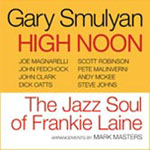 "I had never played the baritone, and had no desire to do so. I was into players like Gene Quill, Phil Woods, Cannonball Adderley and the like. But this was a real opportunity." So, he bought a Yamaha baritone sax with a stock mouthpiece, and joined the Thundering Herd on May 25, 1978. He remembers the day as if it were as important as, say, his wife's birthday (which, in fact, it is). He stayed with the band two years, to the day.
"At first, I didn't play like a baritone player, I played like an alto player." Conceptually, he explains, a baritone requires clearer articulation because of the instrument's low range. "Otherwise, it could sound like mush, a sonic blur," he quips. Plus, the larger horn requires more air, meaning harder work during the training-up period.
All that being said, "Woody didn't fire me, he saw something in my playing that must have convinced him I would be right for the band." Smulyan delivered on Woody's vision: "I discovered that the baritone was my true voice, waiting to be discovered."
Of this, he drew a life lesson for other possible musicians. "You have to be ready for anything because your life can change with one phone call. Don't be afraid to go for it. I had no idea where this would go," but over the next two years, he made a name for himself. "I was convinced that I would be fine, because I passed Woody's test."
Turns out they were both right. Leaving the Herman band, Smulyan was able to stay in New York and find meaningful work with the likes of the Mingus Big Band and also the Smithsonian Jazz Masterworks Orchestra. Having established himself in the toughest of markets, he got to share the stage and the recording studio with an amazing array of luminaries including trumpeters Freddie Hubbard and Dizzy Gillespie, saxophonist Stan Getz, pianist Chick Corea, timbales king Tito Puente, and R&B/Blues and soul icons Ray Charles, B.B. King and Diana Ross. Shaping an impressive range of repertoire and style, the chops that he developed brought him work and contributed to his longevity, for which he is eternally grateful.
Smulyan feels fortunate to be able to be playing and touring regularly in this day and age. He is on the road with different bands and configurations, plus recording and teaching projects of his own. And, he maintains a deep commitment to jazz education. "I was fortunate to play with and be taught by great musicians on Long Island, people like Billy Mitchell and Dave Burns; Joe Dixon was also a mentor." They imparted "practical information that I still need today to be successful, in both business and music." And now, he is giving back, helping to nurture the next generation of jazz players.
Ever grateful to have had that kind of exposure as a younger, aspiring musician, "I feel obligated to help younger musicians. The apprentice system is largely gone; there is no opportunity for young musicians to play with people who are better than them. That's how the continuum happens. Jazz is largely mentor-student music."
Thus, during the school year, you're likely to find Smulyan teaching at Amherst (MA) College, where he is professor of saxophone. He is also Artistic Director at Berkshire Hills Music Academy in nearby South Hadley, a two-year post secondary music school for 18-to-30 year-olds with developmental disabilities. He finds teaching very rewarding, not just a form of giveback for the influences of his early years. An ensemble of Berkshire Hills graduates makes up a performance troop that tours. Smulyan conducts ability/awareness workshops that sometimes serve to recruit students to the school. He also coaches with repertoire, and holds daily rehearsals.
Education is more than a day job for Smulyan, and accessibility is a critical part of his persona. The two characteristics suggest an attitude that may well be responsible for his success today. He harkens back to one of his current and long-standing idols, Phil Woods. "You've got to be approachable. Phil was my idol. I first met him at the Jazz Museum in New York. I sat down and hung out with him, I was on cloud nine for a month. As things got better for me, I remembered that. Any time I can be around young musicians who are serious about playing, I feel it is my job to be accessible and supportive."
Noting that many other successful jazz musicians also teach in some way or form, Smulyan says "it is a calling that we have, a desire. Especially if I meet a young musician who has the same kind of passion that I had when I was young. I was helped out, and I need to do that now."
 He may or may not lead some other youngster to the baritone. After all, his two major influences are Charlie Parker and Pepper Adams, and "I still listen to Bird almost every day." Compositionally, he conjures Mulligan, whom he considers a genius, adding "I like his writing more than his playing." On the performing side, "Pepper Adams epitomized post-bop modern baritone sax playing. He was a great improviser. And stylistically, it's a school that I find more attractive." Although he doesn't necessarily emulate Harry Carney, he is quick to say that "Without Carney, there wouldn't be any of us. He had the most beautiful sound on the baritone that I've ever heard."
His list of awards and accolades is long and varied. The baritone saxophonist is a four-time winner of the Down Beat Critic's and Readers' Polls and a multiple winner of numerous other official and casual polls, including the Jazz Journalists Award for Baritone Saxophonist of the Year. He is a seven-time Grammy award winner for his work with B.B. King, Joe Lovano, Dave Holland, the Vanguard Jazz Orchestra and others. In 1995, WBGO, the all-jazz, Newark, N.J.-based NPR station voted Smulyan's Saxophone Mosaic (Criss Cross, 1994) as one of the best 25 CDs of 1995; two years later the Boston Globe selected Gary Smulyan with Strings(Criss Cross, 1997) as one of the 10 best jazz CDs of 1997. While he does not covet nor brag about individual awards, and seems awkward talking about them, he is proud of the accomplishments that they signify, especially the recorded works that the Grammys exemplify. "It's not the awards so much as the recordings that are associated with them. It was fantastic to be associated with those projects."
Perhaps ironically, his most recent album is an instrumental appreciation of singer Frankie Laine's repertoire. A longtime fan, Smulyan says that Laine had "a sensibility that many other pop singers didn't have. A more soulful concept." Laine was also a prolific composer, and wrote the lyrics to "What Am I Here For" and "We'll Be Together Again," the latter being the closing number on the recording, High Noon: The Jazz Soul of Frankie Laine (Reservoir, 2009). Except for the title tune, all the selections were composed by or were collaborations of Laine.
How did this recording come about? After some four years of discussion, the west coast composer/arranger/conductor Mark Masters worked with Smulyan on the project. There was little material extant, and Masters managed to find several lead sheets through the Smithsonian, and the two decided on which numbers to use. They performed the work with a nonet at Claremont McKenna College in California, and Smulyan took the idea to Mark Feldman, a producer at Reservoir Records. Feldman gave the recording project the green light, to the delight of fans and reviewers.
The results apparently pleased the two main collaborators, too, as Smulyan coninues his quest to call additional attention to Masters' work. In fact, he expects his next project to also involve Masters, who cut his teeth as an intern in Stan Kenton's office.
The music that touches Gary Smulyan was written by other jazz masters (sorry), most especially Billy Strayhorn, Bill Evans, and Thad Jones. With a nod to current composers, Kenny Wheeler is one of his all-time favorites.
But he returns to the subject of Mark Masters. Besides collaborating on High Noon, Smulyan enjoyed working with Masters on a Gary McFarland project, presenting the late composer's work in concert (also at Claremont McKenna College), featuring Steve Kuhn, Milcho Leviev and others, with Masters as arranger and conductor. Another Masters master, in Smulyan's eyes, was a Clifford Brown recording that was orchestrated for six trumpets. "Mark deserves wider recognition, people need to know who he is, they need to know his work. He is an amazing musician."
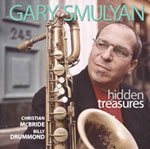
While big-band fans are most familiar with Smulyan's work with the Vanguard Jazz Orchestra, Woody Herman, John Fedchock, the Mingus Big Band and others of that ilk, and while his High Noon and Dave Holland work is with mid-sized ensembles, his favorite configuration is actually a piano-less trio of baritone saxophone, bass, drums, which, he says, gives the greatest freedom. A recorded example of that setup is Hidden Treasures (Reservoir, 2006), with Christian McBride on bass and drummer Billy Drummond. It features songs written by jazz composers based on standards. With the freedom to improvise, the tunes had "hidden harmonies." That's the hidden part; the tunes themselves were treasures, in Smulyan's eyes. But, "many hadn't been recorded in a long time." The material includes Phil Woods' "House of Chan," based on the changes of "Alone Together." He recently finished a gig with this configuration at the Kitano Hotel in New York.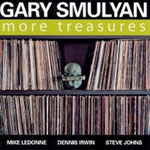 The 2006 album was so well-received that Reservoir followed it in 2007 with More Treasures.
And, while this small-group configuration may be his favorite setting, his favorite gig is still the Vanguard Jazz Orchestra, which performs weekly on Mondays at the Manhattan night spot. "Walking down those stairs, I can still feel Sonny Rollins, Bill Evans, John Coltrane. Their spirit is still hovering around that room. I still get that feeling."
In the aggregate, Smulyan may spend four-to-six months a year on the road, and in mid-August (2009) was headed for a five-concert whirlwind tour of Russia. His group for the tour includes trumpeter Alex Sipiagin and a Russian rhythm section. Stops include Siberia, Krasnodar, Kazan, Yaroslavl and Moscow. "Russians are passionate about music," and he expects knowledgeable, enthusiastic audiences.
Upon returning from Russia, this Labor Day weekend will find him at the Chicago Jazz Festival with the Dave Holland big band. The next day, he appears with both Holland's octet and the Vanguard Jazz Orchestra at the Tanglewood Jazz Festival in the Berkshire hills of western Massachusetts. Later this fall, his travels will include an October visit to the Pacific Northwest, where he will be artist-in-residence at some high schools in the Seattle area. Returning closer to home, he will play the Blue Note with Jon Faddis, and then go on a five-city European tour with the nonet of fellow Herman alumnus Joe Lovano. Then back home as a guest artist with the U.S. Air Force's big band, the Airmen of Note in the Washington area. The Jazz Cruise with Ken Peplowski takes him to sea.
That's a lot of work, he admits, returning to another familiar refrain: "I feel blessed to be able to play the baritone at this time."
Recent weeks have seen various articles about the future of jazz, and not all of them very optimistic. Terry Teachout's Wall Street Journal piece, asking "Can Jazz Be Saved," comes to mind. Smulyan has a more positive outlook, arguably because he is out there, performing for and talking with audiences about the music.
The Newport Jazz Festival issued a press release noting the increasing crowds for its 55th rendition, and while producer George Wein saw fit to broaden the talent perspective, to the extent of including rapper Mos Def, this doesn't bother Smulyan. "George Wein is trying to present authentic jazz at his festivals. At these day-long events, people will hear some great music. But these are challenging times to be one hundred percent purist," he avers. "Everything is a crossover, anyway. Frankie Laine. Coldplay, you name it. The categories are blurred."
Smulyan says he has first-hand evidence that encourages his optimism. "I travel all over the world, and I see young musicians really passionate about the music. This music will go on forever. It will not pass away into nothing."
To support this view, he offers that Mondays at the Vanguard are packed. In fact, "everywhere I play is packed. As long as the audiences are there, and young musicians are compelled to succeed and play, this music will be here. There will always be doomsayers. Judging by studying, jam sessions, musicians playing on a high and deep level, I don't see much to worry about."
Selected Discography
Gary Smulyan, High Noon: The Jazz Soul of Frankie Laine (Reservoir, 2009)
Gary Smulyan, More Treasures (Reservoir, 2007)
John Fedchock, Up and Running (Reservoir, 2007)
Gary Smulyan, Hidden Treasurers (Reservoir, 2006)
Gary Smulyan, Real Deal (Reservoir, 2003)
Dave Holland Big Band, What Goes Around (ECM Records, 2002)
Dizzy Gillespie Alumni All Stars, Things to Come (Telarc, 2002)
Tom Harrell, Art of Rhythm (RCA, 1998)
Conrad Herwig, Latin Side of John Coltrane (Astor Place Records, 1996)
Benny Green, The Place To Be (Blue Note, 1994)
Woody Herman, Woody and Friends at the Monterey Jazz Festival (Concord, 1979)
Photo Credits
All Photos: Hans Speekenbrink
< Previous
Crystal Silence: The ECM Recordings 1...
Next >
Snapshot
Comments

About Gary Smulyan
Instrument: Saxophone, baritone
Related Articles | Concerts | Albums | Photos | Similar ToTags
For the Love of Jazz
 All About Jazz has been a pillar of jazz since 1995, championing it as an art form and, more importantly, supporting the musicians who create it. Our enduring commitment has made "AAJ" one of the most culturally important websites of its kind, read by hundreds of thousands of fans, musicians and industry figures every month.
You Can Help
To expand our coverage even further and develop new means to foster jazz discovery and connectivity we need your help. You can become a sustaining member for a modest $20 and in return, we'll immediately hide those pesky ads plus provide access to future articles for a full year. This winning combination will vastly improve your AAJ experience and allow us to vigorously build on the pioneering work we first started in 1995. So enjoy an ad-free AAJ experience and help us remain a positive beacon for jazz by making a donation today.

Giveaway

Days remaining: 4