Home » Jazz Articles » Live Review » Burton Greene and Perry Robinson at the Zeitgeist Galler...
Burton Greene and Perry Robinson at the Zeitgeist Gallery, Boston, MA

Outpost 128 / Zeitgeist Gallery
Boston, Massachusetts
April 11, 2009
Pianist Burton Greene and clarinetist Perry Robinson have known each other for two generations' worth of years. They first played together at Greene's loft in New York in 1965 in a trio, which included Joel Friedman on cello. The two were together in Greene's quartet, Klez-Edge, a recording for Tzadik, and will play again soon in another recording called Two Voices in the Desert. As a preview of their new record, the pair convened for a special event at the Zeitgeist Gallery in Boston on April 11.
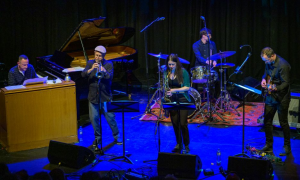
The Zeitgeist Gallery is a small, dimly lit room created for an intimate audience. The piano is a shiny black upright; art adorns the walls, and oriental rugs partially cover the floor. All of the folding chairs provided for the audience were filled to hear these two musicians, who are as close as brothers and whose music emanates from a space that is genuine, profoundly spiritual, joyful and often playful.

Greene arranged three pieces by his friend Syl Rollig for this performance, all of which the pianist allowed to glisten with a feminine lightness. The music began with one of the composer's dance melodies, which Greene named after her: "Syl's Frailech." The word "frailech" is Yiddish for happiness. The music adopted that character in an energized, rhythmic, harmonic unison between the piano and the clarinet. The chordal phrasings within the body of the piece ascended and descended the scale on the piano. The clarinet's line took shape in glissandos, often piercing the air with ringing high notes but moving quickly to a series of delicate, slurred low tones. The piano yielded to the clarinet by subduing its volume, and the clarinet yielded to the piano for the same purpose. The two instruments were dancing, one bowing to the other, as if inviting it to take its own shining steps. In contrast, in the second set the two played "Bertie's Frailech," written by Greene, which was more intense, full of repetitions and less of a frolic.
Greene's affinity for setting out melodic structure with chords to be upended by detailed treble phrasings was complemented by Robinson's songlike fluidity on the clarinet. The latter's single notes were rarely a part of his playing except when he had reached the limit for which he was striving during a musical stretch, or when the piano's process demanded a syncopated complementary presence. The two intersected in synchrony multiple times; in fact, that synchrony signified their sterling compatibility.
Greene moved in and out of the middle of the keyboard repeatedly, slightly shifting the point at which he would land, only to spread out again to the bass and treble; then he might hammer one note in any range with his index finger. His hands might syncopate in parallel, then the method would change as the left reached over the right. His broad approach generated strong chordal statements that would collapse into incandescent treble tremolos. Often the flood of music would break for a split second and proceed to build up again to yet another plateau of resolution, one of which served as a tight, clear and neat ending for the piece.
Greene's extraordinary sensitivity to a colorful dynamic and tempo is affecting, evoking in the listener the same kind of feelings that went into the composing, as in Rollig's "Song for My Friend Burton" and Greene's "Lamentation," which he dedicated to his poet friend, the late Greg Foster.
 Robinson achieves nothing but perfection on his clarinet, his playing an extension of his being. He improvised on the level field the piano provided for him, moving off on his own for brief amounts of time. The ringing that he can create moving from tone to tone is stunning: that sound propelled him to fly through the aural space with ease without becoming caught up in ungrounded sounds. The manner in which he plays his instrument can be seen in the brightness of his eyes, in his agility with his horn, in the way his smile beams when a piece has finished.
Greene counted out "One, two, three" and looked to Robinson before each composition was played. The one spontaneous improvisation of the performance started with Robinson saying: "Hit it!" And off the two went on "The Pussy Cat Went Meow," the music and the subject matter coalescing to a point where Greene actually clawed at the keys of the piano.
The culmination of the night was their performance from Greene's "Desert Suite," "Desert Wanderers," followed by John Zorn's "Eitan." Nothing other than an expression of a tale of wandering came forth from the music; it evoked the sense of walking over distances and occasionally coming upon oases where birds or water might break the monotony of skimming the surface of sand. "Desert Wanderers" metaphorically raised the question of what we, as human beings, are searching for, if anything at all.
The piece commenced with ominous bass chords on the piano and peaked frequently as Robinson blew a whistle or fluttered on his wooden flute or claimed arpeggios and glissandos on his clarinet. As soon as the piece had climaxed, the music would break and then build again...harmonies were re-discovered, and everything would resume from the minutest treble tremolo on the piano to only the air that was pressed through the clarinet reed. Sliding into "Eitan" was immediate. At one point, Greene slipped a piece of paper into the piano so that the hammers hit the paper while meeting the strings of the sounding board. An almost electronic sound ensued. The composition created a vast space which seemed complex yet developed organically from a simple theme.
This was not epic or overblown music, the effusions of high romanticism. Rather, every note, every gesture, every compositional concept was proportioned to common humanity. Nothing that was attempted required gargantuan efforts. Such intimacy embeds awareness in the listener, embraces the listener and invites the listener into a world of consciousness that can be habitually visited. All that is required is open-mindedness and the watchful, playful acceptance of the inner child.
Photo credit
Lyn Horton
< Previous
River of Time
Next >
Beaty Brothers Band
Comments

Tags
For the Love of Jazz
 All About Jazz has been a pillar of jazz since 1995, championing it as an art form and, more importantly, supporting the musicians who create it. Our enduring commitment has made "AAJ" one of the most culturally important websites of its kind, read by hundreds of thousands of fans, musicians and industry figures every month.
You Can Help
To expand our coverage even further and develop new means to foster jazz discovery and connectivity we need your help. You can become a sustaining member for a modest $20 and in return, we'll immediately hide those pesky ads plus provide access to future articles for a full year. This winning combination will vastly improve your AAJ experience and allow us to vigorously build on the pioneering work we first started in 1995. So enjoy an ad-free AAJ experience and help us remain a positive beacon for jazz by making a donation today.Near


Giveaway

Days remaining: 19