Home » Jazz Articles » Book Review » In Search of Buddy Bolden: First Man Of Jazz
In Search of Buddy Bolden: First Man Of Jazz

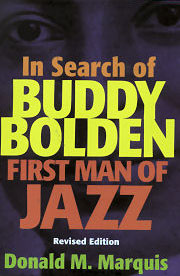 Donald M. Marquis
 In Search Of Buddy Bolden: First Man Of Jazz
Louisiana University Press
256 pages
ISBN: 0-8071-3093-1
When In Search of Buddy Bolden first came out in 1978, it was a landmark work filled with a staggering amount of research on the legendary trumpeter. Bolden was greatly admired by musicians who fervently stole his licks and a legendary figure in turn of the century New Orleans, but he gave no interviews and never made a recording. Thus false stories circulated around the trumpeter, many of which were then assumed to be accurate. Donald Marquis spent fifteen years uncovering the truth through interviews, courthouse documents, and dogged detective work. His book is now available in a revised 2005 edition that is still required reading for all jazz listeners.
Instead of a straightforward biography, In Search of Buddy Bolden approaches its subject by focusing on pieces of a puzzle to create a picture (albeit one where a few pieces are still missing.) There is a chapter on the places Bolden played, one on his music, and one on his sidemen and contemporaries. Through the extensive background information, Marquis uncovers several new insights while laying to rest several old myths (such as the widely held belief that Bolden was a barber.)
However, what emerges even more prominently than the portrait of the musician is the aura of New Orleans at the turn of the century. Populated by brothels, bars, and churches that turned into dance halls after Sunday morning, New Orleans is depicted in fine detail with period photographs. Although its impossible to read the description without thinking of the recent tragedy that beset the city, New Orleans is portrayed as a jubilant place filled with spontaneous parades and celebrations and, most importantly, the development of a unique style of playing that became jazz.
The 2005 edition of the book corrects some errors in the previous version while adding a small epilogue that highlights some recent developments. Bolden now has a street named after him in New Orleans, and new evidence suggests that there may have once been a cylinder of Bolden playing his music, but it was accidentally destroyed. There are also some new psychological theories that help explain the causes of the mental illness that forced Bolden into an institution for the last two decades of his life.
Like many musicians, Bolden was a gifted innovator who changed the course of music, yet met with tragedy and died in obscurity. In Search of Buddy Bolden remains the definitive look at a legendary figure, largely readable yet bulked out with primary sources for those who care to dig deeper. Often considered one of the greatest jazz biographies, this book paints a picture of a terrific performer who set a city on fire with his playing. Sadly, all of us only have the work of Marquis to help us picture who he was and what his music might have been like.
< Previous
File 0899-1
Next >
Deviations
Comments
Tags
For the Love of Jazz
 All About Jazz has been a pillar of jazz since 1995, championing it as an art form and, more importantly, supporting the musicians who create it. Our enduring commitment has made "AAJ" one of the most culturally important websites of its kind, read by hundreds of thousands of fans, musicians and industry figures every month.
You Can Help
To expand our coverage even further and develop new means to foster jazz discovery and connectivity we need your help. You can become a sustaining member for a modest $20 and in return, we'll immediately hide those pesky ads plus provide access to future articles for a full year. This winning combination will vastly improve your AAJ experience and allow us to vigorously build on the pioneering work we first started in 1995. So enjoy an ad-free AAJ experience and help us remain a positive beacon for jazz by making a donation today.

Giveaway

Days remaining: 4