Home » Jazz Articles » Book Review » Jazz-Rock Fusion: The People, The Music
Jazz-Rock Fusion: The People, The Music

 Julie Coryell
Jazz-Rock Fusion: The People, The Music
Hal Leonard
1979 Preface by Ramsey Lewis
2000 edition with new preface by Julie Coryell
"Jazz-rock fusion . It's a tag, a label from the 1970s that can still provoke impassioned arguments from all sides—pro, con and every stop in between. Not to mention the way the debate was, for a long time, stoked by a mostly critic-enflamed controversy about how to define it in the first place. But one thing that (nearly) everybody could agree on was that, however you define it and regardless of what you might think of it, jazz-rock fusion was launched deep into the mainstream by Miles Davis, with his end-of-the-sixties In A Silent Way and Bitches Brew—two recordings that electrified both the jazz and the rock worlds. From there, the arguments tended to blossom into adulation of Miles' sheer prophetic genius and innovative redefinition of the genre (from jazz-rock fusion proponents), or vilification of his cynical sellout and lazy capitulation to an anti-music trend-du-jour that threatened to kill off jazz forever (from jazz-rock fusion detractors)—and veer away from any reasoned discourse about where the music came from in the first place.
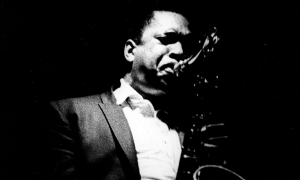
For myself, the term was alternately meaningless or an exciting bridge between the hard-rock rhythms of Jimi Hendrix and Carlos Santana, and the bop iconoclasm of Bird, Mingus, Trane and, of course, Miles. It gave people like me—bred on rock-and-roll and its wicked offspring, rock—a way into the dense, complex, demanding hard bop and post-bop of these jazz pioneers. Just as there was no way to ignore Hendrix, or force-fit his music into an elevator's Muzak soundtrack, so too was there no way to relegate Bitches Brew or Coltrane's A Love Supreme to the background. You had to listen to Hendrix, you had to pay attention to what his music was saying; you couldn't listen to Santana without joining in, whether in dance or by turning the table into a room-sized percussion instrument. And you had to listen to Miles, Mingus, Trane and others with the same intensity, the same engagement, the same passion.
From my first exposure to In A Silent Way (I think I bought it within days of its release), it immediately became the #1 title on my list of indispensable desert-island recordings—sharing that #1 spot with A Love Supreme. To this day, more than a third of a century later, those two are still a dead tie for top of the list. I loved it that I could load up the turntable with Hendrix's Axis: Bold As Love, Mingus's Pithecanthropus Erectus, A Love Supreme, In A Silent Way, and top it all off with Hendrix again, with Electric Ladyland. I could spend an entire 1969 afternoon in my dorm room, listening to this sumptuous feast, and never feel a jarring change of the pace or intensity from one record to the next. Call it whatever you want—but for me, even the label "rock was already essentially meaningless, as it was for many of us who matured during the era of psychedelic experimentation with various combinations of soul, pop, folk, blues, R&B, and you-name-it. And I knew, even at the fresh young age of 18, that the word "jazz hardly sufficed to comfortably encompass the likes of both "A Love Supreme and "Take the 'A' Train ; or Mingus's "The Black Saint and The Sinner Lady and anything by Louis Armstrong. No wonder Wynton Marsalis and Stanley Crouch are still having apoplectic fits about it all.
[For those younger than 35 or 40, a turntable would be one of those pre-modern, gear-driven clunker machines that played scratchy, hissing, popping, skipping, unreasonable facsimiles of ancient music while we hauled our hand-woven woolen underwear down to the river to wash them on the rocks, keeping one eye alert to the threat of hungry saber-toothed tigers.]
So why is it, then, that when Mingus recorded and performed any of his many versions of "Better Git Hit in Yo' Soul , it wasn't branded "jazz-gospel fusion ? Why wasn't Monk labeled a "jazz-stride fusion artist? And why weren't any of Ellington's compositions termed "jazz-classical fusion ? For that matter, why is it only rock that had to be "fused ?
One possible answer that comes to mind is the word "fusion itself. It implies some kind of post-Atomic Age technology, and thus the whole label might just be an unavoidable product of its time; if it had happened just 10 years earlier, maybe it would have been called something else entirely. Another factor, also sociological, might be the rock business's near-total hegemony over the music world as the 1960s morphed into the '70s; the pinning of a rock-centric label on Miles Davis—a jazz giant—might be nothing less than rock's expression of its own cultural power at the time.
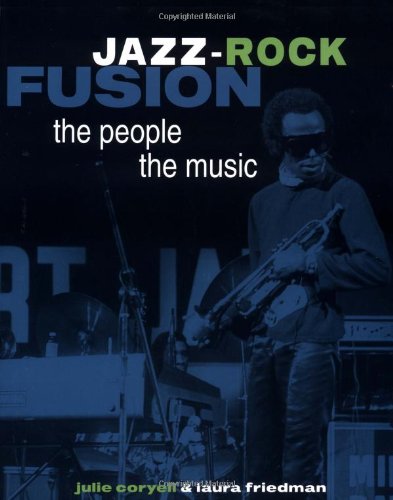
All of which brings us to Julie Coryell's Jazz-Rock Fusion: The People, The Music (Hal Leonard Corp., 1979, with preface by Ramsey Lewis; new edition with preface by Julie Coryell, 2000). I originally picked up the book in hopes of getting some insights into the earliest years of this music that would come to be known by the high-tech label, jazz-rock fusion. The book consists almost entirely of interviews and conversations that Ms. Coryell held with some of the pre-eminent names in jazz in the 1970s—a decade that many have written off as being a musical wasteland for both jazz and rock; at the same time, a decade during which Coryell could find herself talking to a huge range of creative, productive musicians. From Larry Coryell to Herbie Hancock, from Steve Gadd to Pat Metheny, John McLaughlin to Jaco Pastorius, Ron Carter to Jean-Luc Ponty, Al DiMeola to the Brecker brothers, Gary Burton, and even Miles Davis himself.
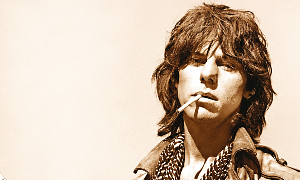
I always knew that In A Silent Way and Bitches Brew were far from the first forays into jazz-rock fusion (let's call it simply JRF, okay?). They hadn't popped up from a vacuum—nothing ever does (with the possible exception of George Bush's electoral victories—but that's a story for an entirely different place). It's clear that Miles was responding to, and adding to, a musical movement that had been percolating for a few years in the compositions and performances of many smaller, less-well known (and some never-to-be-known) bands in little, out-of-the-way venues, and especially in clubs that had primarily been known up to then for their steady menu of rock acts. Most of these performers and their bands just don't show up in the historical records now—but one group in particular regularly shows up as being "one of the first, if not the first group of professional musicians to actually perform and record a new kind of music that even they knew was ahead of its time. The band was called The Free Spirits, and was formed by Larry Coryell (guitar and sitar), Jim Pepper (tenor sax and flute), Bob Moses (drums), Chip Baker (guitar), and Chris Hill (electric bass). The Free Spirits recorded and released their only album as a group, Out of Sight and Sound, on the ABC Paramount label in 1966, some 3-4 years before Miles's own ground-breaking recordings.
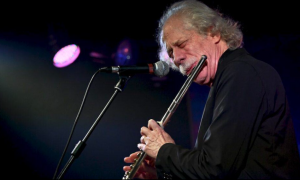
I've been researching saxophonist Jim Pepper's music (visit website) in an attempt to learn how it became a model and stepping-stone for musicians of all stripes, and found it interesting that he had been one of the first real pioneers in JRF. Pepper's parents were Kaw and Creek Indians; his father and grandfather were singers in the Native American Church's Peyote tradition. Pepper learned the chants of his father and grandfather from the time he was no more than three years old, as he recalls. As a teenager, he picked up the saxophone and began learning R&B songs from the radio. It was from these radio shows that he picked up the occasional piece by Coltrane, Sonny Rollins and others. He eventually began to apply what he learned about jazz to new arrangements of some of the Peyote chants he had been hearing and singing since childhood. The first real result of this integration of musical forms was the song "Witchi Tai To , which so captured the imagination of musicians and fans around the world, that it became a crossover Top 40 hit for him—and a favorite to be covered by artists as disparate as Brewer & Shipley, Harper's Bizarre, Jan Garbarek, Oregon, and countless others around the world representing a wide range of musical styles. I wanted to be able to better trace how Pepper came to be one of the first definers of the JRF idiom, and where his musical evolution took him from there. A book—by a Coryell, no less—with interviews of many of the people associated with JRF, seemed a good place to start.
There's a ton of wonderful information contained in Coryell's conversations—but I have to say that the title of the book may be a little misleading. This is not so much a book about JRF and the musicians who made it, as it is a book about a decidedly fruitful and creatively fertile decade or so in which popular music was rapidly evolving. And it's a book about many of the musicians who, in one way or another were associated with, or saw themselves a part of, that phenomenon. Coryell herself addresses the dichotomy between the book's title and the fact that so many of those interviewed for the book have never been thought of as being of the JRF persuasion. In her introduction to the original 1979 edition of the book, she notes that ..." although we call this work Jazz-Rock Fusion, we wish to emphasize that not everyone included in it plays a 'style' of music that can... be labeled either jazz, rock, or fusion. The title, therefore, is only to identify a period in the history of music and not the music itself. I'm not sure I buy that as a defining paradigm—by her reasoning, virtually anything happening in the world of music during this "period in the history of music could be called JRF. But at the same time, I'm willing to accept her thesis as a starting point, since it would be a waste of time and energy to devise a universally acceptable definition of JRF, and then to impose that definition on those few hand-picked musicians who might happen to fit that artifically invented definition most closely.
In his preface to the 1979 edition, Ramsey Lewis puts this question into a somewhat different historical context. "Jazz has been and always will be a changing and enduring art... , he says. And who can argue with that? (okay, Wynton and Stanley—we know how you feel about jazz changing over time). But then, when he tells us that "It is obvious that the birthplace of fusion music was in Chicago , you want to ask: "Obvious? To whom? Chicago? Huh? . He goes on to give a shout-out to his own group as being a birth-mother to the fusion phenomenon: "It was during the early sixties that the Lewis Trio (El Dee Young, bass; Red Holt, drums) were unknowingly setting the stage for things to come... El Dee, Red, and myself at that time did not consider what we were doing to be terribly new. Without knowing it, we combined into an approach some of the music we had always been exposed to: black church music, rhythm and blues (melodic repetitive rhythms), and jazz. Because of my classical training... we also showed the influence of European harmonies, musical devices, and theories... From musicians and critics alike, there were shouts of foul play... " There are countless musicians and groups who could say the same thing—combining European melodies and harmonies with African and Black American rhythms and styles has always been a central hallmark of jazz, since its very beginnings.
In Lewis's defense, however, he does cite other early innovators and influences, including Ahmad Jamal and Eddie Harris, but especially Miles Davis: "It was not until the late sixties when Miles Davis gave his stamp of approval by incorporating some of these ideas into his albums that musicians accepted that rock rhythms and influences other than the traditional ones could be integrated with jazz." He underscores the depth of Miles's role in this music, indeed in the whole generation of musicians who grew up with it and who grew out of it, when he asks us to ponder "exactly how many people in this book have at one time or another been directly or indirectly under the influence of Miles Davis."
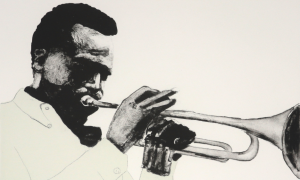
Acknowledging the central role that Miles played in the promulgation of JRF, Coryell gives him by far the most space in the book—a full eight pages, uninterrupted by questions, excerpted from several conversations she had with him. Interestingly enough, he says nothing here about JRF—what he thought of it, where he thought or hoped it might go, his own take on the part he played in the fusion movement, what he thought of audience and critical reactions to In A Silent Way and Bitches Brew (many die-hard jazz critics especially lambasted him as a sellout when Bitches Brew became a Grammy winner). It would have been a nice element in a book ostensibly about the era that he, perhaps more than anyone, ushered in.
[For an interesting side trip, check out Coryell's portrait of Miles, which accompanies the excerpts from their conversations. She paints a picture seemingly at complete odds with the typical, stereotyped image of Miles as a nasty, brutish, arrogant, and confrontational beast of a man who, oddly enough, composed and played some unbelievably beautiful music. In her estimation, "Miles is a teacher. He always has been... He is an extraordinarily kind and compassionate man... very patient, very amusing when he wants to be... serious when he needs to be... Most of all, he is a lot of fun to be with."]
In fact, very few of the interviews in Jazz-Rock Fusion even contain an explicit reference to JRF—and of those musicians who do talk about it, some are downright disdainful of it. Here's what John McLaughlin (ironically, someone who is almost always credited with being one of the most influential and groundbreaking of the early "mainstream" fusion artists) says: "How do I feel about jazz-rock? Boring! It bores me to tears; it just doesn't go anywhere... I never listen to it, never. I don't want to hear it." Or percussionist Lenny White, who says that, "The art is subservient to the business. You're thought of as a commodity... That's the name of the game... That's part of the reason why you have the jazz-rock fusion music, whatever you want to call it."
As if to underscore White's observations, there's Ms. Coryell's comments on the commercial aspects of the concept of "fusion—as seen by the music business, as opposed to that of the musicians. In her introduction she speaks of the record companies, ..." where new 'fusion' divisions are being created for the purpose of seeking out and developing new talent to satisfy the growing market. Once again, the old story of supply and demand threatens the vitality and innovativeness of the scene... " However, all is not lost, she reassures, because "what keeps it human is the music—and the musician."
But there are others, with an openness that truly makes one nostalgic for an era during which virtually anything was possible, when the horizons of creativity stretched out as far as you had the courage (and talent) to take them. Guitarist John Abercrombie says it well: "Two guitarists that were very important in shaping a new direction for jazz guitarists were Gabor Szabo and Larry Coryell. They brought to jazz music other influences, like rock 'n' roll, country, and folk, that gave the music a more impressionistic quality. It made me realize that there are many ways to play music and it is up to each individual to channel his or her own personal experiences and influences into a way of playing that will suit their needs and reflect their ideas and feelings... "
What's even more valuable about what some of the musicians have to say in this collection, is their perceptions of what was happening to (and with) the music in the 1960s and '70s. Michael Gibbs, composer and musician from Zimbabwe, talks about how counter-productive a label like JRF is, how it not only doesn't describe the music, but actually constrains where you can go ultimately with the music—a testament to the power of labels. "I think to label a particular music 'fusion music' is to limit the music. There's a lot of jazz-rock fusion at the moment, and as long as that music is labeled that way, it always remains two musics and the fusions don't have room to take place." Gibbs goes on to trash the whole concept of calling just one kind of music a "fusion , when music by its very nature has always been a fusion of different cultural and artistic elements: "There is a fusion going on every time somebody writes music... It's not just a fusion between jazz and classical, or jazz and rock; there are all sorts of elements going in, all sorts of inspiration and influences which come out in the composer as one thing."
Of particular interest are those who were quite aware that they were creating some new kind of music. When Larry Coryell talks about what The Free Spirits were doing, and how audiences perceived it, he recalls that "We felt that we would be ten years ahead of our time if we made the music we wanted... what later became known as jazz-rock. Nobody understood it. As a matter of fact, the Free Spirits album was appreciated more in Europe, especially Denmark, than it was [in the U.S.]." And as Abercrombie recalls: "My first real involvement with jazz-rock music came... in 1968-1969 when I was asked to join a newly formed band called Dreams which included, at that time, Randy and Michael Brecker, Billy Cobham, and Barry Rogers. It was my first experience playing a sophisticated type of rock in which I found myself, with my knowledge of jazz phrasing and use of electronics, attempting to fuse the two into some kind of sensible-sounding music." I think it's important to note how Abercrombie refers to the sophistication of rock, and how they were trying to "fuse that with jazz to create "some kind of sensible-sounding music. He makes it sound serious—dead serious, or to borrow the title of Valerie Wilmer's book about the so-called Free Jazz movement of the same period, "as serious as your life."
Some of the musicians talk about the process they went through, without pinning labels on it. Drummer Will Lee recounts making a living as a rock-and-roll musician while studying jazz in school: "Somehow it made complete sense as the perfect fusion... I was so involved with jazz and so involved with rock, the two just met each other." Percussionist Narada Michael Walden cites long-time jazz drummer Louis Hayes as one of his earliest influences and inspirations, while placing Jimi Hendrix's drummer, Mitch Mitchell, on the same stage, ..." because he had that freedom and strength, and yet he had that rock thing."
Ms. Coryell took the occasion of the re-publication of her book in 2000 to look back over the 20+ years that had passed since she first collected these conversations. What had happened to this JRF thing over that time? Was it worth all the noise and debate? Was it a dead-end? Was it a portal to something new? In her preface to the new edition, she notes: "There were critics who contended that the musicians had sold out by combining the elements of rock and jazz to form the musical hybrid which came to be known as fusion, but I do not agree. The intention wasn't to make commercial music, but to express what was felt and experienced intrinsically by those who had the opportunity to do it. The music is classic, it has withstood the test of time. The heyday of the fusion movement is over, but the music inspired a generation of musicians."
Ramsey Lewis, in his preface to the original edition, less than 10 years after Miles rocked the jazz world and jazzed up the rock world with In A Silent Way and Bitches Brew, reminds us finally that "Nothing is permanent, however. Even now, as this book is being published, the stage is being set for the next period. When and how it began, and what it will be called, we won't know until we look back at it."
There are many more musicians and groups who could have—perhaps should have—been included in the book. But Coryell has assembled an impressive range of instrumentalists, styles, and perspectives in her book. Maybe some of the missing names weren't available for her, maybe they didn't have anything publishable to say at the time, maybe some of them didn't care to talk or she didn't care to talk to them. She only mentions one gap, in her introduction: "It is regrettable," she says, "that we were not able to include the group the Crusaders, who were forerunners in the crossover movement. The Crusaders, originally known as the Jazz Crusaders, dropped the word Jazz from their name, a move which altered not only their image and music, but their record sales, where a substantial increase was experienced." But from my standpoint, what's really missing is contributions from people like drummer Bob Moses or saxophonist Jim Pepper, to name just a couple from the very earliest days of this enigmatic new movement. Moses has done a tremendous amount for the development of modern music, stretching its boundaries in both sound and meaning. And of course, there's the ground that Pepper opened up with his fusion—if we can use that word here—of Native American music and jazz; there's a whole new generation of jazz, rock, blues and even traditional Native American musicians and singers who name Pepper as a key influence. No matter—there's more than enough here for anyone interested in the serious music scene of the 1970s; combine this book with Wilmer's As Serious As Your Life, and you'll never again think of the 1970s as a musical wasteland.
Readers will find much in Coryell's Jazz-Rock Fusion to chuckle at, much to argue with, many occasions on which to say "Wow, I never thought of it that way , and much to learn. Laura Friedman's photos of the musicians, accompanying each interview, are excellent portraits of a very influential generation of jazz musicians—ranging from the impeccably stylish David Liebman and Gato Barbieri (who must have consulted with each other about their clothing before the photos were taken!), Richard Tee looking like Little Richard caught in mid-shout, a supremely relaxed-looking Keith Jarrett, ecstatic George Duke, Joe Beck looking quintessentially 1970s-ish, Carla Bley caught in a downpour, and a host of leather-jacketed style mavens. One of my favorites is the photo of sweatshirted Jaco Pastorius—maybe because it's a poignant reminder of just how young he was when he died, while still being the oft-acknowledged touchstone for so many jazz and rock bass guitarists who followed him (Pastorius eschews the whole JRF tag, by the way, preferring instead to call his music "punk jazz—now there's a concept that young jazz musicians might want to pursue, if they think there's any need to inject some life into the music!).
Play some of the music while you're reading the book. And never forget: the 1970s were not the doldrums of modern music, they were not a field lying fallow. Some of the most innovative music has come from the foundations laid down during that time; certainly some of the most adventurous—and yes, some of the worst crap, too. But whether it all ultimately went anywhere, or accomplished anything, may still be up to another generation or two to answer.
*** Want to talk about this article? Join the "Jazz-Rock Fusion: Pro-fusion or Con-fusion?" bulletin board under "General Music Discussion."
About Larry Coryell

Tags
PREVIOUS / NEXT
Become a Sustaining Member

Since 1995, All About Jazz has championed jazz as an art form and supported the musicians who create it. Over three decades, it has grown into one of the world's leading jazz resources, serving hundreds of thousands of readers, musicians, presenters and industry professionals each month.
Help Build the Future of All About Jazz
Your support helps us continue building All About Jazz for the next generation—expanding our editorial coverage, preserving jazz history, developing new community features and creating better ways to discover the music and the people behind it.
Become a sustaining member for as little as $20 per year and you'll immediately enjoy an ad-free experience along with access to subscriber features and future articles for a full year.
Together, we're not simply sustaining All About Jazz—we're building its future. Thank you for being part of the journey.