My House Concert Story
Where's The Gig - AFM Local 6 Musicians Union
Jon Hammond: “Where’s The Gig?”
by Alex Walsh
"Every time I see a musician walking down the street I say, ‘Hey, where’s the gig?’ Because it doesn’t matter what kind of music you play, if you’re carrying an
instrument–going to a rehearsal, or coming back from a repair shop, whatever it is–we all need our gigs. And that’s what the union is all about. Hopefully, we can all
keep working and be supportive of everybody’s gigs. There’s room for everybody."
“Every time I see a musician walking down the street I say, ‘Hey, where’s the gig?’ Because it doesn’t matter what kind of music you play, if you’re carrying an
instrument–going to a rehearsal, or coming back from a repair shop, whatever it is–we all need our gigs. And that’s what the union is all about. Hopefully, we can all
keep working and be supportive of everybody’s gigs. There’s room for everybody.”
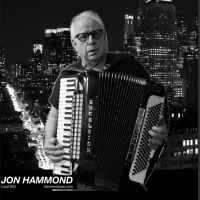
Jon Hammond is a musician, composer, bandleader, publisher, journalist, TV show host, radio DJ, and multi-media entrepreneur. He currently travels the world, playing
gigs and attending trade shows.
THE EARLY YEARS
Jon Hammond was born in Chicago in 1953. His father was a doctor and his mother was a housewife. They both played the piano. In 1957, his parents moved Jon and
his four sisters to Berkeley, CA, where his father worked in a hospital as head of the emergency room. When he was nine, Jon started accordion lessons. “In those days,
they had studios where parents would drop their kids off after school for tap dancing and accordion lessons. There were accordion bands and they would compete
against each other.”
Jon played his first gig at a senior citizens luncheon when he was eleven. Not only did he get a free lunch but he was paid $25 –a lot of money in those days. Jon says
his father was supportive, but did not want him to pursue a music career. “He told me that music was a great hobby. He got me a wonderful professional accordion for
my Bar Mitzvah, directly from John Molinari, one of the greatest accordionists who ever lived. It was a Guilietti Professional Tone Chamber accordion. That’s the
accordion I won Jr. Jazz Champion on in 1966.”
In high school, Jon attended a private boys school in San Francisco. He was a class clown, and when it got to the point where he was going to be expelled, Jon took his
accordion and ran away from home. He immersed himself in the San Francisco music scene and started playing organ in several bands. By 1971 he was in a four piece
rock group called Hades which shared a rehearsal space with Quicksilver Messenger Service. “I was friends with their manager, Ron Polte, who also managed guitarist
John Cipollina. We got to open for his band, Copperhead.”
Jon in the early 70s
Jon in the early 70s
Jon continued to play gigs in the Bay Area in different configurations, including a few gigs with a young Eddie Money. By this time Jon had become frustrated with the
Bay Area scene. One night while playing a biker bar he got into a fight and his band didn’t come to his defense. “That was the last straw. I was angry and I said I wasn’t
coming back.”
Jon moved to Boston in 1973 to attend the Berklee School of Music. He also got a gig playing in Boston’s Combat Zone backing up burlesque shows. When Jon saw one
of his idols, pianist Keith Jarrett play in New York he told him he was going to Berklee and asked him for advice. “Keith looked me right in the eye and said ‘Berklee can
be very dangerous for your music.’ It was like he popped this huge bubble. Years later I came to understand what he was talking about. You have to learn the
fundamentals, but the music itself comes from a much deeper place. They can’t teach that, you have to find it yourself.”
When Jon’s teachers began sitting in on his gigs in Boston, he questioned why he was in school if the teachers were coming to play with him. He quit school, moved to
Cape Cod and started playing with bandleader Lou Colombo. “He did all the private parties for Tip O’Neill. We played what they used to call the business man’s beat.
On the gig it was forbidden to swing. It was like swing cut in half. So if you tried to go with the four, Lou would say, ‘Don’t swing it, don’t swing it.’ He pounded it into my
head night after night.”
LATE RENT
In 1981 Jon took a trip to Paris where he broke through his writers block and wrote some of his best music. He returned to New York with his new tunes and started a
production company with the idea of getting a record deal for a friend that had played on a #1 hit record. After months of pounding the pavement with no results, Jon
realized he had better work on his own music before his money ran out. He took the last of his savings, including his upcoming rent money, and went into the studio to
record what came to be known as “The Late Rent Sessions”.
The session had Todd Anderson on tenor sax, Barry Finnerty on guitar, Stephen Ferrone on drums, and Jon on B3. They recorded at Intergalactic, the last studio that
John Lennon recorded in. Jon had no luck getting a record deal for his new project, but he did get gigs in New York with his band Jon Hammond and the Late Rent
Session Men.
Jon-at-NAMM
Jon Hammond Band Onstage at NAMM, 2014: Joe Berger, Dom Famularo, Alex Budman, Koei Tanaka, Jon Hammond
In 1982, Jon found out about public access television and the idea that anyone could produce a show and get it on TV. He started broadcasting on Manhattan’s public
station in 1984. “I decided I was going to produce a radio show on TV. The first episodes showed just my tapping foot and my voice. It was a gimmick. We had graphics
that were synchronized to go with the music. It worked out well. People dug it.” Within a few weeks, Jon was interviewed and featured in Billboard Magazine. The Jon
Hammond Show was considered an alternative to the clips on Cable TV. “MTV was still in its infancy. We had a concept that was revolutionary. My phone started
ringing and we were the hot kids on the block.”
LIVING ABROAD
Jon continued to play gigs in New York and produce his TV show. In 1987, he went to his first trade show (NAMM) where he was introduced to Mr. Julio Guilietti, the
man who built his accordion. He then began traveling to trade shows and making contacts with musicians and companies around the world, including Hammond Suzuki.
“They gave me the Hammond XB-2, the first really powerful portable Hammond organ. Glenn Derringer, one of my all-time heroes, presented it to me. I got one of the
first. Paul Shaffer from the Letterman Show got the other. At the time there was only one EXP-100 expression pedal–we had to share the pedal. I used the pedal for my
gigs and when Paul needed it I would bring it over to him at 30 Rockefeller Center on my bicycle.”
In the early 90s, when his New York gigs began drying up, Jon was encouraged to go to Germany. “It was a hard time. My father had just died and there were very few
gigs. I got the XB-2 organ right when I needed it, so I decided to take a chance. I bought a roundtrip ticket to Frankfurt with an open return. I went with 50 bucks and
stayed for a year. When I came back, I had 100 bucks.”
Jon stayed at a friend’s house and played a borrowed accordion on the street until he could get a band together. “I played on the street until my fingers turned blue and
would collect enough money to get some fish soup. After about two weeks I got a call—I had put a band together and had 3 gigs coming up. A TV show had heard my
story and wanted to do a story on me. At the first gig 19 people came; the second only 15 people came. Then I got the little spot on TV. When I came to the third gig
people were lined up down the street. When I walked up I thought they were having an art exhibit. When they said, ‘No, they’re waiting for you.’ I choked up, I couldn’t
even talk. So I’ve been playing there every year since. The people in Germany really saved my musical career at a time when very few things were happening for me in
New York or San Francisco. I have a really good following in Europe. I keep busy as a musician in the States, playing hospitals and assisted living places, but my band
dates I pretty much play overseas.”
Jon’s Late Rent Sessions was eventually released on a German label and received modest airplay. During the 90s he travelled back and forth to Europe, spending a year
playing gigs in Paris, and eventually settling in Hamburg. Since then he has released two more albums and has played gigs in Moscow, Shanghai, and Australia. With
the help of the internet, Jon is able to produce his TV show anywhere.
PRESENT DAY
In the mid-2000s Jon produced Hammondcast, a radio program for CBS that aired in San Francisco at four in the morning and was rebroadcast before Oakland A’s
games. “When the baseball games played in the afternoon, my show would play for about 20 minutes and then it was pre-empted. I had a lot of fun with that.” His
guests included Danny Glover, Barry Melton from Country Joe & the Fish, and many local people. “It took me awhile to figure out that I had permission to broadcast
anything I wanted. I could play the London Philharmonic or Stevie Wonder. My tag line was ‘Hello, Hello, Hello! Wake up or go back to sleep…’”
Today, Jon continues to visit tradeshows and is determined to keep doing everything he does as long as he can. “I made a pact with my longtime co-producer, guitarist
Joe Berger, that we are going to go to these trade shows until we are little old men with canes.”
Jon has released four CDs

 About Me