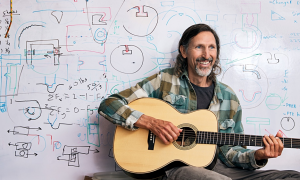
The younger half brother of folk musician Pete Seeger and part of a renowned musical family, Seeger dedicated his life to documenting, teaching and keeping alive traditional music of the American South. The interwoven strands of Anglo American ballads from the Appalachian hills and hollers, the blues laments of black people in the rural South and the gospel sounds of both black and white churches made up what he called the “true vine" of American music.
A singer and an instrumentalist, he was once described as a “one-man folk festival." He played banjo, fiddle, guitar, autoharp, Jew's-harp, quills, dulcimer, mandolin and harmonica, and recorded extensively on Folkways Records and Smithsonian Folkways Recordings. He made a number of recordings in the 1950s and 1960s as a member of the folk revival ensemble the New Lost City Ramblers with John Cohen and Tom Paley.
Seeger influenced a number of musicians, including the young Bob Dylan. “Sometimes you know things have to change. . . . Somebody holds the mirror up, unlocks the door and your head has to go into a different place," Dylan wrote in his 2004 memoir, “Chronicles: Volume One." “Mike Seeger had that effect on me."
Michael Seeger was born Aug. 15, 1933, in New York. His father, Charles Seeger, was an ethnomusicologist who once headed the folklore and ethnomusicology department at UCLA; his mother, Ruth Crawford Seeger, was a noted composer and folk song collector.
In 1935, the family moved to the Washington, D.C., area when Charles Seeger took a position with the Works Progress Administration in the Roosevelt administration.
“Exciting people were always dropping in," Mike Seeger's sister Peggy, who also became a prominent folk singer, told Folkways Magazine. “Leadbelly, Woody Guthrie, John Jacob Niles, Bess Hawes, Henry and Sidney Cowell, John and Alan Lomax, Lee Hays, composers and writers . . . and, of course, beloved Pete."
At age 18, Seeger began teaching himself to play stringed instruments. At about 20, he began collecting songs on a tape recorder from traditional musicians.