Home » Jazz Musicians » James Carter
James Carter
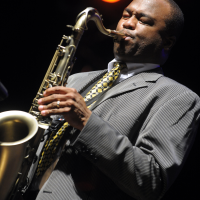
Sometimes it takes an extraordinary talent to inspire an unprecedented piece of music. For Puerto Rican-born composer Roberto Sierra, the epiphany struck in the midst of a tenor saxophone solo by James Carter, who was appearing as the featured soloist with legendary soprano Kathleen Battle. Long fascinated by the horn, Sierra immediately realized he had encountered a master capable of playing anything he could imagine. Working closely with Carter over several months, he composed a four-part concerto that seamlessly integrates the forms and harmonic language of contemporary classical music, Latin rhythms, and jazz’s improvisational imperative. Documented on Carter’s 13th release and his second for Universal, Concerto for Saxophones and Orchestra is a singular work that stands alone in the jazz and classical canons, half belonging to each world. In a fascinating collaboration that neither could have foreseen, one of classical music’s most widely respected composers has given this era’s most prodigious saxophonist the role of a lifetime.
“What immediately struck me was that he played with total command and mastery of the instrument,” says Sierra, a professor of composition at Cornell University. “James is the Paganini of the saxophone. He and the instrument are one. To me that was amazing, right from the start.”
Carter premiered the concerto with his hometown Detroit Symphony Orchestra in October 2002, a performance that elicited such a rapturous response that he and the orchestra reprised the last movement as an encore. As the Detroit News music critic reported, “In your lifetime, did you ever witness such a thing—the reprise of a new work, on the spot? Neither did I, until Thursday night, when Carter and conductor Neeme Jarvi finally gave in to a storm that showed no signs of abating and recapped the last long stretch of Roberto Sierra’s brilliant ‘Concerto for Saxophones.’”
Written for soprano and tenor saxophones, Concerto for Saxophones and Orchestra and “Caribbean Rhapsody” (the CD title track) don’t just represent a new musical synthesis, they embody a state-of-the-art open-source collaboration in which Carter and Sierra worked through the piece’s details together, a process that continued up until they recorded the piece last year in Poland with a world-class orchestra under the direction of Costa Rican-raised conductor Giancarlo Guerrero (music director of the Nashville Symphony). For Carter, the premiere was just the beginning of an ongoing process exploring the emotional nuances and melodic contours of Sierra’s breathtakingly intricate work.
“Roberto said, ‘Let me know if something’s not happening. It’s your piece to deal with,’” recalls Carter, 42. “He’s not a stick- in-the-mud composer, pulling out his hair saying ‘You’re not playing it right!’ It continues to grow. I started thinking of the tenor and soprano as male and female roles, giving them a little more personality and incorporating some elements of the written material in the cadenza, which gave it more cohesion. There’s so much to draw from in the piece.”
Read moreTags
Jazzkaar Festival 2025

by Nenad Georgievski
Jazzkaar Von Krahl/Fotografiska Tallinn, Estonia April 20-April 26, 2025 When arriving in Tallinn, Estonia, the city reveals its quiet, timeless beauty--a place where medieval charm and modern energy coexist. It is a city where old-world atmosphere meets cutting-edge innovation, recognized as one of the most tech-savvy capitals in Europe. Despite its digital edge, Tallinn maintains a deep connection to its traditions, reflected in its rich cultural life and the numerous museums that populate the city. ...
Continue Reading...Ivo Perelman: Reed Rapture in Brooklyn

by Jeff Schwartz
Is this album fundamentally unreviewable? Are there jazz fans who do not immediately know if they need an 11-hour collection of 103 improvised duets between Ivo Perelman and a dozen saxophonists and clarinetists? It is at least describable. Perelman is faithful to his tenor, while his partners bring examples of nearly every type of saxophone, from soprillo to contrabass, as well as most of the clarinet family. Although all tracks are free improvisations, the default mode is ...
Continue Reading...Steve Turre: Generations

by Dave Linn
Generations is a wonderful exploration of the bop and post-bop era. Steve Turre both looks back to his roots while encouraging the next generation of musicians to find their voice. It's a position he's eminently qualified for, considering the artists he has played with and his tenure as a long-time jazz educator. Trombone players have a unique place in the sound created in a small jazz band. Their parts helped blend and define any given melody. On this ...
Continue Reading...Reed Rapture With James Carter And More

by Bob Osborne
On this show we continue a deep dive into Ivo Perelman's Reed Rapture In Brooklyn this time focusing on his partnership with James Carter. As well as other music from Carter we also have tracks from new releases from Relojeros ya no quedan, Josh Sinton's Predicate band, and Nosoy Trio.Playlist Show Intro 00:00 Ivo Perelman and James Carter “One" from Reed Rapture In Brooklyn (Mahalaka) 00:53 James Carter “I Can't Get Started" from Live At Baker's Keyboard Lounge ...
Continue Reading...Ivo Perelman: Reed Rapture in Brooklyn
by Mark Corroto
"Let's play two," the famous line by the Cubs Hall-of-Fame baseball player Ernie Banks in 1969, uttered when the temperature in Chicago had reached 105 degrees (40.5 celsius) and his teammates were exhausted, might find its analogy with this massive undertaking from saxophonist Ivo Perelman. At eleven hours in length though, the two games Banks cited are not single games, but more like two double-headers here. Like the baseball infielder, Perelman has limitless energy and a never-ending appetite for creativity, ...
Continue Reading...Reed Rapture In Brooklyn: A Box Set Of Woodwind Duets With Ivo Perelman
by Hrayr Attarian
One of the 20th century's musical geniuses, saxophonist Charlie Parker said “Music is your own experience, your thoughts, your wisdom. If you don't live it, it won't come out of your horn. They teach you that music has boundaries. But, man, there's no boundary line to art." This statement on unbridled creativity applies perfectly to saxophonist Ivo Perelman's oeuvre. Perelman, however, is not just a saxophonist. Although the tenor is one of his favorite tools of expression, he is an ...
Continue Reading...James Carter, Milt Jackson, Logan Richardson and More
by Joe Dimino
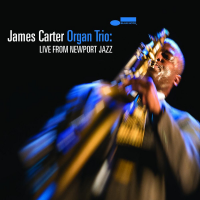
This week we open with a live cut from Newport Jazz recorded by James Carter and his Organ Trio. From there, we do what Neon Jazz is known for .. doing interviews and probing into the life of today's jazz musician, as we profile Kit Downes and hear new music from Kansas City-native Logan Richardson. Then, we look back to the music of Milt Jackson and into the right now with Todd Marcus. Playlist James Carter Organ Trio ...
Continue Reading...Jazz Musician of the Day: James Carter
Source:
Michael Ricci
All About Jazz is celebrating James Carter's birthday today!
Sometimes it takes an extraordinary talent to inspire an unprecedented piece of music. For Puerto Rican-born composer Roberto Sierra, the epiphany struck in the midst of a tenor saxophone solo by James Carter, who was appearing as the featured soloist with legendary soprano Kathleen Battle. Long fascinated by the horn, Sierra immediately realized he had encountered a master capable of playing anything he could imagine. Working closely with Carter over several ...
read more
Jazz Musician of the Day: James Carter
Source:
Michael Ricci
All About Jazz is celebrating James Carter's birthday today!
Sometimes it takes an extraordinary talent to inspire an unprecedented piece of music. For Puerto Rican-born composer Roberto Sierra, the epiphany struck in the midst of a tenor saxophone solo by James Carter, who was appearing as the featured soloist with legendary soprano Kathleen Battle. Long fascinated by the horn, Sierra immediately realized he had encountered a master capable of playing anything he could imagine. Working closely with Carter over several ...
read more
Jazz Musician of the Day: James Carter
Source:
Michael Ricci
All About Jazz is celebrating James Carter's birthday today!
Sometimes it takes an extraordinary talent to inspire an unprecedented piece of music. For Puerto Rican-born composer Roberto Sierra, the epiphany struck in the midst of a tenor saxophone solo by James Carter, who was appearing as the featured soloist with legendary soprano Kathleen Battle. Long fascinated by the horn, Sierra immediately realized he had encountered a master capable of playing anything he could imagine. Working closely with Carter over several ...
read more
Jazz Musician of the Day: James Carter
Source:
Michael Ricci
All About Jazz is celebrating James Carter's birthday today!
Sometimes it takes an extraordinary talent to inspire an unprecedented piece of music. For Puerto Rican-born composer Roberto Sierra, the epiphany struck in the midst of a tenor saxophone solo by James Carter, who was appearing as the featured soloist with legendary soprano Kathleen Battle. Long fascinated by the horn, Sierra immediately realized he had encountered a master capable of playing anything he could imagine. Working closely with Carter over several ...
read more
Jazz Musician of the Day: James Carter
Source:
Michael Ricci
All About Jazz is celebrating James Carter's birthday today!
Sometimes it takes an extraordinary talent to inspire an unprecedented piece of music. For Puerto Rican-born composer Roberto Sierra, the epiphany struck in the midst of a tenor saxophone solo by James Carter, who was appearing as the featured soloist with legendary soprano Kathleen Battle. Long fascinated by the horn, Sierra immediately realized he had encountered a master capable of playing anything he could imagine... Read more.
Place our Musician of ...
read more
Jazz Musician of the Day: James Carter
Source:
Michael Ricci
All About Jazz is celebrating James Carter's birthday today!
Sometimes it takes an extraordinary talent to inspire an unprecedented piece of music. For Puerto Rican-born composer Roberto Sierra, the epiphany struck in the midst of a tenor saxophone solo by James Carter, who was appearing as the featured soloist with legendary soprano Kathleen Battle. Long fascinated by the horn, Sierra immediately realized he had encountered a master capable of playing anything he could imagine... Read more.
Place our Musician of ...
read more
Jazz Musician of the Day: James Carter
Source:
Michael Ricci
All About Jazz is celebrating James Carter's birthday today!
Sometimes it takes an extraordinary talent to inspire an unprecedented piece of music. For Puerto Rican-born composer Roberto Sierra, the epiphany struck in the midst of a tenor saxophone solo by James Carter, who was appearing as the featured soloist with legendary soprano Kathleen Battle. Long fascinated by the horn, Sierra immediately realized he had encountered a master capable of playing anything he could imagine... Read more.
Place our Musician of ...
read more
Jazz this week: James Carter Organ Trio, Gary Peacock, Spektral Quartet, and more
Source:
St. Louis Jazz Notes by Dean Minderman
As March comes into St. Louis in mostly lamb-like fashion, the first week of the new month offers several intriguing jazz and creative music headliners on local stages, plus an assortment of performances from local musicians in a variety of styles, and a rare chance to see a film scored by Miles Davis on the big screen. Let's go to the highlights... Wednesday, March 2 Saxophonist James Carter returns with his organ trio for the first of four nights at ...
read more
StLJN Saturday Video Showcase: James Carter's Organ Trio and more
Source:
St. Louis Jazz Notes by Dean Minderman
This week, let's check out some videos featuring the versatile saxophonist James Carter, who will be back in St. Louis with his organ trio to perform starting Wednesday, March 2 through Saturday, March 5 at Jazz at the Bistro. Carter, who was here most recently in 2013 for a week with organist Dr. Lonnie Smith at the Bistro, concentrates mostly on tenor and soprano saxophones, but also plays alto and baritone saxophones, flute, bass clarinet, and pretty much any other ...
read more
Jazz Musician of the Day: James Carter
Source:
Michael Ricci
All About Jazz is celebrating James Carter's birthday today!
Sometimes it takes an extraordinary talent to inspire an unprecedented piece of music. For Puerto Rican-born composer Roberto Sierra, the epiphany struck in the midst of a tenor saxophone solo by James Carter, who was appearing as the featured soloist with legendary soprano Kathleen Battle. Long fascinated by the horn, Sierra immediately realized he had encountered a master capable of playing anything he could imagine... Read more.
Place our Musician of ...
read more

Carl Bartlett, Jr.
saxophone
Aaron Quarterman, Jr.
saxophone, tenor
CHYKE MARTINS
saxophone
Jackson Cotugno
saxophone, tenor
Oscar Laven
saxophone, tenorSam Vaulina
saxophone, baritonePhotos
Music



Videos
Similar

Miles Davis
trumpet
John Coltrane
saxophone
Roy Hargrove
trumpet
Wynton Marsalis
trumpet
Dizzy Gillespie
trumpet
Sonny Rollins
saxophone
Kenny Garrett
saxophone
Wayne Shorter
saxophone
Chris Potter
saxophone, tenor
Joe Lovano
saxophone
Cannonball Adderley
saxophone
Joshua Redman
saxophone
Rahsaan Roland Kirk
woodwinds
Johnny Griffin
saxophone, tenor
Branford Marsalis
saxophone
Greg Osby
saxophone, alto
David Murray
saxophone, tenor
Cyrus Chestnut
piano
Dewey Redman
saxophone, tenor
Walt Weiskopf
saxophone
James Carter
Instrument: Saxophone
Born: January 3, 1969