Home » Jazz Musicians » Sonny Sharrock
Sonny Sharrock
The career of the late Sonny Sharrock is unique in modern jazz. He first aspired as a doo-wop singer, determined to take music as his vocation after listening to Miles Davis' "Kind of Blue." Aspired to play saxophone but instead took up guitar in his early 20's due to asthmatic conditions, nonetheless he emulated his guitar styling after the energy players such as Coltrane and Pharaoh Sanders. He appeared as a cameo in Mile Davis' "Jack Johnson" album and Wayne Shorter's "Super Nova" album as well. His most notable appearance was his duel with Sanders on "Taulid" and "Izipho Zam." His primal tone with gusto was indeed a one-of-a-kind. Although his didn't employ massive distortion to create the full-on blast, Sharrock's buzz saw lines with slamming dissonant chords were definite a character in the late '60s free jazz scene.
After playing free jazz with Pharoah Sanders, while he was playing funk-jazz with Herbie Mann, guitarist Warren "Sonny" Sharrock recorded three albums with his wife Linda Sharrock's wordless vocals: “Black Woman,” ( 1969), featuring the first version of his signature tune “Blind Willy,” “Monkey-Pockie-Boo,” (1970), possibly his most personal album; and Paradise (1975), introducing electronic keyboards in the sound of the couple and emphasizing Linda's vocal workouts, an avant-funk experiment that predated the new wave of rock music. The background of his guitar playing was fundamentally the blues, but at the same time he displayed a loud, aggressive, feedback-laden, quasi heavy-metal technique.
For six years Sharrock did not make a single record. It was bassist Bill Laswell, a protagonist of the new wave, who rediscovered him for Material's “Memory Serves.” (1981) “Dance with Me Montana,” (1982), not released until 1986, contained embryonic versions of his classics.
Laswell also organized Last Exit, an avant-funk quartet with Sharrock, German saxophonist Peter Brotzmann and drummer Ronald Shannon Jackson that played virulent jazz- rock, influenced by both the brutal edge of punk-rock and the cerebral stance of the new wave. Laswell was the brain, but Sharrock was the epitome: Last Exit played the kind of loud, savage jazz-rock and free jazz that Sharrock had pioneered. The catch, of course, was that Laswell had put together four mad improvisers, ranging from the cacophonic Brotzmann to the hysterical Sharrock to Laswell's dub bass. “Last Exit,” (1986) was a set of totally improvised jams, with frantic peaks, but pale in comparison with the live “Koln.” (1986) The other Last Exit live recording, “The Noise of Trouble,” (1986) was a humbler study in contrasts.
Read moreTags
Ignition of the Ages: Sonny Sharrock’s Seismic Siege of the Detroit State Theatre
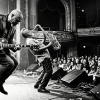
by Dave Kaufman
Sonny Sharrock was a singular force in music, a brilliant and volcanic guitarist who bridged the jagged divide between the visceral power of Jimi Hendrix and the spiritual depth of John Coltrane. In 1991, he released his masterpiece, “Ask the Ages," a record that remains a high-water mark of modern jazz. Tragically, it would serve as his final statement; Sharrock passed away just a few years after its release, leaving behind a profound “what-if" in the history of the genre. ...
Continue ReadingString Players: Sonny Sharrock to Charles Mingus

by Jerome Wilson
This show. from September 15, 2020, focuses on string players, mostly guitarists but bassists, cellists and a harp player are also thrown into the mix. Specific musicians heard include Sonny Sharrock. Lonnie Johnson. Tomeka Reid, Charles Mingus, and Brandee Younger. Playlist Henry Threadgill Sextett “I Can't Wait Till I Get Home" from The Complete Novus & Columbia Recordings of Henry Threadgill & Air (Mosaic) 00:00 Joel Harrison “Stratusphunk" from Mother Stump (Cuneiform) 1:00 Stephan Crump/Mary Halvorson “Turns to ...
Continue ReadingSteve Marcus, Miroslav Vitous, Sonny Sharrock, Daniel Humair: Green Line

by Joshua Weiner
Several decades into the jazz reissue boom, first on CD and now increasingly on vinyl, one might imagine the bottom of the barrel is being scraped, and that any newly rediscovered obscurities might at this point have been best left alone. Yet so vast are the archives of recorded jazz that diamonds remain in the mine, exemplified by Green Line, a beautiful document of a single session in Tokyo on September 11, 1970, credited jointly to saxophonist Steve Marcus, bassist ...
Continue ReadingAlbum Review
Don Cherry: Where Is Brooklyn? & Eternal Rhythm - Revisited

by Stefano Merighi
Nel percorso artistico di molti, è decisivo il rapporto tra emancipazione ed auto-affermazione. Il jazz moderno è spesso testimone di una dialettica feconda tra individualismo e trama collettiva, ma è dirimente il tema dell'originalità. “Se sei come tutti gli altri, a che serve il jazz?," diceva spesso Monk. E un vero “percorso," costellato da innumerevoli stazioni, è stato quello di Don Cherry, mai del tutto soddisfatto delle sue conquiste, costantemente messe in discussione. Ammesso e non concesso che Cherry sia ...
Continue ReadingThe Electric Years Box Set

by Mike Jurkovic
In a year that has brought us a true bounty of previously unheard majesty including Evenings at the Village Gate: John Coltrane with Eric Dolphy (Impulse!), and Bill Evans; Treasures: Solo, Trio & Orchestra Recordings from Denmark (1965-1969), (Elemental Music) it is only fitting that Miles Davis get his due. And in a very, very big way. Seared into modern memory, modern art, the music presented on the gloriously massive, eleven LP set Miles Davis: The Electric Years ...
Continue ReadingSummer Of Soul (...Or, When The Revolution Could Not Be Televised)

by Ian Patterson
Various Artists Summer Of Soul (...Or, When The Revolution Could Not Be Televised) Onyx Collective/Searchlight Pictures 2021 One of the most thought-provoking moments in Ahmir 'Questlove' Thompson's documentary on the 1969 Harlem Cultural Festival comes from a festival attendee, looking back from the distant perspective of half a century. “I had never seen so many black people before," he recalls, still awestruck, all these years later, at the memory of 50,000 black people gathered ...
Continue ReadingSonny Sharrock: Ask the Ages

by Chris M. Slawecki
In 1994, guitarist Sonny Sharrock died from a sudden heart attack at age 53, leaving behind a body of cutting-edge jazz guitar compositions and recordings that still sounds ahead of its time.Ask the Ages (1991, Island), Sharrock's last official release, literally was one for the ages, recorded with an amazing quartet which teamed the guitarist with bassist Charnett Moffett and two powerhouse musicians greatly influenced by the sturm und drang of John Coltrane, drummer Elvin Jones and reedman ...
Continue ReadingNick Storring
various
Hans Tammen
band / ensemble / orchestra
Mike Lorenz
guitar
John Shannon
guitar
Philip Yaeger
trombone
Vic Dillahay
guitar
Aaron Summerfield
guitar
Jay Sanders
guitar
Max Kutner
guitar

Phil Dawson
guitar, electricPhotos
Music
Similar

Pat Metheny
guitar
Anthony Braxton
woodwinds
Eric Dolphy
woodwinds
Ornette Coleman
saxophone, alto
Cecil Taylor
piano
Alice Coltrane
piano
Albert Ayler
saxophone, tenor
Nels Cline
guitar
Archie Shepp
saxophone, tenor
Marc Ribot
guitar
Pharoah Sanders
saxophone, tenor
Derek Bailey
guitar
Art Ensemble Of Chicago
band / ensemble / orchestra
Julius Hemphill
saxophone, alto
James Blood Ulmer
guitar
Grachan Moncur III
trombone
Byard Lancaster
saxophone
Eugene Chadbourne
guitar

Otomo Yoshihide
turntable
Sonny Sharrock
Instrument: Guitar, electric
Born: August 27, 1940
Died: 1994