Home » Jazz Articles » Interview » Dewey Redman: The Sound of a Giant
Dewey Redman: The Sound of a Giant
If you got the technique and I got a good sound, I?ll beat you every time. You can play a thousand notes and I can play one note and wipe you out.
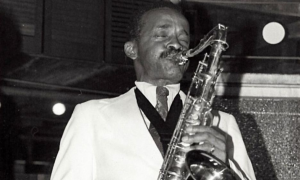
 Dewey Redman has been on the scene for a long time, adding his musicianship to diverse musical settings with a long list of great jazz artists, and pursing his own challenging projects. It seems that each path he has taken, he has done so in a manner that speaks to who he is: straightforward and genuine.
Whether it's stomping out blues or bop, playing free with Ornette Coleman and Don Cherry, spicing up the work of Pat Metheny or Keith Jarrett, or performing in larger groups like Charlie Haden's Liberation Orchestra, this Texas tenor is always up to the task. He adds his sound, which can both warm and excite any setting. He has something to say.
One of the last of his generation of outstanding tenor saxophonists, Redman is still playing great and is still adventurous. But it gets kinda weird sometimes, because in today's mass media-fed society, many people only know him as Joshua Redman's father. Often, he's kind of taken for granted in the jazz community. But it doesn't dissuade him. The accolades would be nice, of course. But the artist keeps on moving, and creating and is grateful for the things that have come his way.
Diagnosed six years ago with prostate cancer, the Fort Worth native — transplanted to New York City since 1967 — was able to beat it and go on. He has also been able to stay afloat in the very unstable world of the jazz music business, which has been unkind to many in the past and is in a period that has just about everyone shaking their heads and shaking the bushes for gigs and recording opportunities.
"I'm lucky to be here. You know what I mean? At this point, I'm 72 and a lot of my colleagues didn't make it," he says. "To think that the great John Coltrane, who I knew personally when I lived in San Francisco — I used to have conferences with him whenever he came to San Francisco — he passed at 41, which is a terrible tragedy."
"I'm a survivor," he says.
Along the way, he has amassed a great track record. His work with boyhood friend Ornette is well known. The controversial art produced in the 1960s by that aggregation of musicians is more accepted today, but they had to survive the slings of many arrows at the time. In doing so, Redman put his stamp on some important music of the time. He has also played with Old and New Dreams, made up of Coleman band mates Cherry, Haden and Ed Blackwell, and led his own groups. He's performed with other illustrious musicians in his long career, and doesn't show any signs of stopping. The distinct sound of his horn will be heard for some time to come, it appears. And that's a good thing.
Like so many of his generation, an identifiable sound has always been important to Redman. "I can't be critical of other musicians or other saxophonists. But back then, you could listen to Coleman Hawkins and tell that it was Coleman Hawkins, and Lester Young and it was Lester Young. The same with John Coltrane and Sonny Rollins. You could tell the difference. Today, we're in the post-Coltrane era where a lot of saxophonists are still in the Coltrane genre," he says. "It's not only saxophones, it's like that in other areas. For example, female singers. I guess I'm getting old. Back then, I could tell the difference between Dinah Washington and Carmen McRae. And Sarah Vaughan and whoever. But today, they all sound the same to me. I can't tell one from the other. Times change. That was then and this is now."
What doesn't change is Redman's approach to his instrument, and his open-minded approach to his art.
"In my world, that's the first thing I reach for is the sound. Technique is Ok, but if you got the technique and I got a good sound, I'll beat you every time. You can play a thousand notes and I can play one note and wipe you out. That's what I reach for is a sound."
He's a self-taught player who "learned by trial and error and watching other saxophone players do what I do and asking them questions. That's the best lessons in the world." Those lessons, he says, will soon be published in an instructional book. And through it all, whether it be blues, bop, free or pop, Redman has a simple — even if somewhat self-effacing — way of categorizing himself: "I think of myself as a country boy from Texas trying to make it in the big city."
"If you listen to my records, I'm not just in one dimension or one style. I play some blues, which is from Texas. I play ballads. Some avant-garde. I like all of the above. If I played in one style all night it would bore me."
Redman's first job after college and a stint in the Army was as a schoolteacher, and he planned to keep it that way. But music began to have a stronger pull and led him on a path.
"My folks had an old record player and the used to play Duke Ellington and all that. I always liked music, so at the age of 13 I decided I wanted to play." His parents did not play instruments, but Redman surmises that he had a musical link in the family.
"As far as I know I had an uncle, but I can't prove it, whose name was Don Redman [one of the first great jazz arrangers and a pivotal figure in the development of the Big Band style]. He was a great bandleader, saxophonist and composer in the 20s and 30s. I never got a chance to meet him. I wasn't aware that he was my uncle, so to speak, until I saw a picture of him and he looked just like my father. And he was short in stature and my father was short in stature. But he passed a couple years before I came to New York in 1967. The only thing I know is that he looks just like my father. They were born in the same place, Piedmont, West Virginia. So I think there's a connection there. I can't prove it, but I think that he's my uncle."
His parents were supportive of his musical efforts and were willing to buy an instrument to get Dewey started. "It took me a long time to decide. I didn't want to play the trombone, because I didn't like the way it functioned. I didn't want to play the piano, it had so many keys. I didn't want to play the violin. So I decided what I really wanted to play was the trumpet, because it had three keys. I figured I could work that out. I went to this music teacher and I said, 'My mother wants to buy me an instrument, but I want to know if you?ll give me lessons.' He said, 'Yes. What do you want to play?' I said I want to play the trumpet. He said, 'No you can't play the trumpet because your lips are too big.' [laughter] I was embarrassed. I went home and told my mother.
"Then he said what I need to play is the clarinet. But the deal was he needed clarinets in his church band. My first gig was the church band and nobody wanted to play the clarinet because it squeaked. So I started on clarinet. Ever since then, every time I meet a trumpet player the first thing I look at is his lips," he says with a laugh.
Things worked out with the instrument, as Redman played in high school and went on to Prairie View A&M University in Texas and started playing in the its jazz band. He had been playing a bit of alto sax, but it was then he turned to the tenor for good. "I'm really a late bloomer, unlike Ornette, who was playing in high school. Playing his ass off. But I started playing in college."
He was influenced by a hometown saxophonist named Red Carter, as well as Ornette, whom he calls "a genius," Gene Ammons, Stan Getz, and "most anybody who had a sound." Redman was drafted into the Army right after the Korean war and stationed in El Paso, where he played in clubs at night. "I met a gentleman named Jerry Hunter, who was a fine trumpet player, and he took me under his wing and taught me a lot about music."
Redman became a teacher after the Army in the town of Bassdrop, Texas, near Austin. He found himself playing jazz on weekends in the Texas capital city. "The guys said, 'Hey, man. You're good. You ought to go to New York.' I said, 'No, man. I'm not gonna starve and go to New York. What are you talkin' about?' But after a couple years I decided to go to New York for five years, get it out of my system, then come back to Texas and teach school, which was a secure position."
On the way to New York, he decided to reunite with his father, whom he hadn't seen in many years. The search took him to Los Angeles. His father died not long after Dewey found him. When it was time to get back on the trail to the Big Apple, Redman took a slight detour north to San Francisco. It was the 1960s.
"I went to San Francisco for two weeks and stayed almost seven years. It was a great step for me, because there was a great jazz community," he says. "That was a great thing for me. At that time in San Francisco there was the protest against the Vietnam War, there was the flower children, and it was the beginning of the rock bands, the Grateful Dead, Jefferson Airplane, Country Joe and the Fish. I used to see Janis Joplin walking down the street. And they had a great jazz community."
The call to New York continued, however, and eventually he made the trip. There, he encountered Ornette again. "Ornette Coleman has always been a guiding light for me. All the stuff he's been through and he still hasn't received the recognition that he deserves, even though he has about a half dozen honorary doctoral degrees. He still is not recognized. He's one of America's greatest artists ever. I've had people help me throughout the years, but he's the main one."
He dropped by Coleman's loft and became part of that experimental scene in the late 1960s that resulted in several gigs and recordings. Then it was on to Keith Jarrett's group, "which is a different kind of experience," with much more structure, "but I enjoyed that also. Then I played with Old and New Dreams . I played with Charlie Haden's Liberation Orchestra and I recorded with a lot of people. I recorded with a lot of musicians from Italy, Switzerland, Canada, Australia, France. So I've been a pretty lucky guy."
"I knew Miles [Davis]. Once in a while, I'd meet him. He never called me Dewey. It was always, 'Hey, muthafucka.' [laughter]. I remember one time I saw him and I found out his middle name was Dewey. I ran up to him and said, 'Hey, Dewey, how you doin?" And he said, [in perfect Miles gravel-voiced imitation], 'Don't ever call me no shit like that.' But he was a great guy.
"I had a chance to meet John Coltrane in San Francisco. One night I went on this gig. I asked him if I could come talk to him and he told me, yes. I had three or four sessions with him, just one-on-one. I learned a lot from him. He's the most spiritual person I've ever known. He didn't talk much, but he had this calmness. He was a great artist. I came to New York in October of 1967 and he passed in August of 1967, so I never got to renew the relationship. But he helped me out a lot. I've been very fortunate."
He's survived the ride and made it to the status of elder statesman for the music, in the good company of those like Rollins, Roy Haynes, Elvin Jones and some others. And in his very talented son, Joshua, he has a link to the next wave of fine players.
Redman is justifiably proud of Joshua. But in today's world the younger players get more magazine covers and more media and record company hype than most older players, even players younger than Dewey Redman, who have paid their dues and are excellent artists. It's created some odd situations for Redman.
"Sometimes people come up to me and say, 'How's your son doing?' I say, 'What son?' They look at me very puzzled, then I say, 'I got you, didn't I.' Then they laugh. But I'm very proud of him," he says. "From time to time, people do come up to me and say, 'You Dewey Redman? You Joshua Redman's father? Didn't you used to play music?' About six or seven years ago, this guy in Europe — Belgium, I think — came up after we played and had a couple of Joshua CDs and said, 'Can you sign these and sign Joshua Redman. This one is for my wife. He's her favorite musician. Can you sign it Joshua Redman?' Oh man. I can't even tell you what I said."
But the elder Redman is comfortable with who he is and confident in his abilities. He sums up his son's success thusly: "He's a very talented young man. Very well spoken and plays his ass off. I'm better, but he's gotten all the things I never got. I'm not jealous, just a little bit envious. But I'm very proud of him."
Straight to the point and genuine.
As for the future? "I'm just staying alive, you know? Whatever is next. I'm finally getting some recognition. In Fort Worth this summer the mayor issued a proclamation for Ornette and me and Roland Shannon Jackson. And I was the headliner at the Fort Worth Jazz Festival. The first one, as a matter of fact. I was very proud of that. I was nervous as hell. I'm still here and I'm still trying."
About Dewey Redman

Tags
PREVIOUS / NEXT

Become a Sustaining Member

Since 1995, All About Jazz has championed jazz as an art form and supported the musicians who create it. Over three decades, it has grown into one of the world's leading jazz resources, serving hundreds of thousands of readers, musicians, presenters and industry professionals each month.
Help Build the Future of All About Jazz
Your support helps us continue building All About Jazz for the next generation—expanding our editorial coverage, preserving jazz history, developing new community features and creating better ways to discover the music and the people behind it.
Become a sustaining member for as little as $20 per year and you'll immediately enjoy an ad-free experience along with access to subscriber features and future articles for a full year.
Together, we're not simply sustaining All About Jazz—we're building its future. Thank you for being part of the journey.