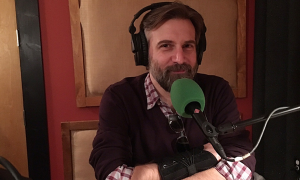
Home » Jazz Articles » Interview » Jarmo Saari: Portrait Of A Guitarist As A Young Man
Jarmo Saari: Portrait Of A Guitarist As A Young Man

I love the moment in music when something is changing and you don
 Born in 1970, Saari had the good fortune to grow up in the vicinity of the Finnish capital’s most productive kindergarten of musical prodigies, the Tapiola Music School. Encouraged by his family, he applied himself to formal studies in trombone and cello, progressing through the hierarchy of graded exams and participating in regular revues and concert appearances. But meanwhile, little known to his classical mentors, he was also getting his musical rocks off with friends in garage and cover bands, where he was turning his hand more and more to the guitar. Little wonder then, that come graduation, and the need to choose a suitable institute of further education, Saari launched himself into studies in the then-fledgling branch of Helsinki’s prestigious Sibelius Music Academy – the Pop and Jazz Department.
So we have a collection of ambitious young musicians, attracted and selected from esteemed musical conservatoires the length and breadth of Finland, concentrated in some refurbished outbuildings on the edge of town, keen to put their classical training aside and strike out into new creative territory. For Saari this meant the discovery of kindred Sibelius Academy spirits, and the establishment of an enduring creative partnership with his most favoured accomplice, vibraphonist and percussionist Arttu Takalo.
Although the pair first met in the second greatest single catalyst for modern Finnish rock and jazz performers – the Military Music Academy, where they were serving their compulsory military service – it was at Siba (the Sibelius Academy) that Saari and Takalo put their compositional heads together with fellow Siba students bassist Tuure Koski and drummer Tommi Salesvuo to put up the band XL. Their first release, Xlent, came out in 1995, and from the outset the band bore the hallmarks of a style that is still exclusively their own: a combination of ambitious compositional skills, excellence in individual musical skills, and a vision of music as unashamed glorification - of the grandiose, of the infinite, or of the infinitesimal. Melodies and rhythms swell and subside, punctuated by bursts of often barely intelligible language, frequently held together by the interplay between Takalo’s vibraphone and a guitar that is plucked, strummed, or caressed, and then amplified, distorted or restrained, as Saari sees fit. ( Section 2 )
Despite an early association with Michel Breckner in 1998 – on the band’s second album, Jukola – XL’s music falls into that amorphous area between jazz, rock and even classical, to the extent that the credits of their last two albums ( Surreal 2002 and Visua l2003, both on Pohjola Records and reviewed in All About Jazz) have included a host of classical musicians, including violinist Pekka Kuusisto and harpist Laura Hyyninen. While Saari’s writing credits dominate the first album, as the years have progressed Arttu Takalo’s influence in this area has blossomed to the extent that on the latest album he wins the standoff by six credits to three. As well as continuing to show classical inclinations, the band has officially extended its commitment to sampled effects and sound sources by absorbing Finnish DJ Bunuel, thus relieving Saari somewhat of his role in this area in live appearances.
Another reason for the spreading of compositional credits in XL has been the width of Saari’s involvement outside the band. Throughout his student years he was regularly playing with the renowned Umo Jazz Orchestra, and with the Espoo Big Band recording with them Live in Australia in 1998. In addition to various engagements in the 1990s with prominent Finnish recording artists (such as singer/flautist Vesa-Matti Loiri, and actress/singer Susanna Haavisto), his opus was further extended in 1999 to include recordings and performances with mainstream Finnish rockers Don Huonot, playing as guest guitarist and arranger. Saari acknowledges this experience as valuable to his previously more cerebral, calculated approach to music-making.
Still another important union, which has continued for Saari since the ‘90s, is with the band Zetaboo. Sharing writing credits with other members, Saari continued the investigations he had begun playing duos with bassist Pekka Lehti into combinations of modern electric and traditional acoustic sounds, combining them nowadays with ethno and jazz rhythms and vocalisations in a similar vein to Chicago band Tortoise. Along with his Siba colleague, singer and accordianist/pianist Anne-Marie Kähärä, Saari joined Lehti and drummer Marko Timonen from the ethno-folk group Värttinä to produce two well-received albums: Zetaboo in 1996, and Medazine in 2000 (the latter on Lehti’s label, Aito Records). The band also worked with a number of classical trombone and brass players, as well as percussion guru Mongo Aaltonen, to produce their own blend of supra-national ethno-jazz. The music is typically full-bodied and melodic, but with a lightness and humour injected through an obvious folk influence, whether Scandinavian or South American. The result is a sound which Saari describes ‘as world music without any nationality’ ( Section 2 ).
More revealing of the classical inheritance that Saari himself acknowledges are two products nurtured during his years at Siba: Neandertal Grooves and Filmtet – A Tribute to Finnish Cinema, released on EMI in 2000 and 2001, respectively. As its title indicates, the latter is a collection of music from classic Finnish films of the twentieth century, arranged by Saari, and played also by Pepa Päivinen (saxophones and clarinets), Seppo Kantonen (keyboards and accordion), Hannu Rantanen (acoustic bass), Marko Timonen (percussion), Petri Keskitalo (Trombone) and Olli Haavisto (pedal steel). Saari’s approach to this project is discussed in Section 5 .
Neandertal Grooves is the grandiose title chosen by Saari for his own composition submitted as the final assessed piece for his studies at Siba. Here we find him in the company of the Espoo Big Band, performing this time a modest range of instruments including chromaharp, vocoder and guitar. In addition to the range of guitar styles, from classical be-bop accompaniment to proto-Frippian electronica, we hear now the scope of vision that Saari includes in his work, as indicated by the titles: Krapina, Hymn, Dance by the Bonfire, Funeral, Runabout/Walkabout, Lake Disappointment, and Hunt. This is pure Saari, working with a ‘13-piece wind section and conductor, combining purely ethic percussive sound sources and patterns, with the addition of his guest tabla maestro Trilok Gurtu.
The sleeve notes of this album give credit to two names for whom Saari has used the term ‘guru’ – namely Joe Zawinul, and guitarist Raoul Bjorkenheim. In addition to these mentors, and acknowledged influences ranging from Stravinsky to Brian Selzer of Stray Cats, Saari himself recently added at the head of his list of contemporary influences the Finnish composer and bassist Pekka Pohjola. While familiar to listeners to Scando-jazz, or to the oft-maligned ‘Canterbury style’ of progressive rock, Pohjola is little known beyond his work with Mike Oldfield, and with the early ‘70s Finnish ‘megaband’ Wigwam. After leaving the band when his ‘compositions became too complicated for the band to play live’, he continued to work under his own name, producing a series of albums through the ‘80s and into the ‘90s. After recording their second album on Pohjola’s own label, XL have invited Pohjola to join them on stage, cementing a relationship that has bound their styles and their careers together over the last decade.

Final mention must also be made of other public projects Saari refers to in the interview. In 2003 under the semi-pseudonym Johnny Island (saari is Finnish for island) playing with the 3-piece Reuna (Edge) he released the album Smelly with fellow Helsinki musicians drummer/DJ Teppo Mäkinen and samplist/bassist Teemu Korpipää. ( Section 6 ) Representing the height of his involvement since 1997 in sampling and electronica, the album is a humorous mix of sometimes extended, multi-language vocalising and post-industrial sounds. Even more exciting though is the currently unrecorded phenomenon of a Saari solo concert, referred to in the interview as Solu (Cell) – a one-man ‘happening’. ( Section 4 ) Far from the grandiosity of J-M Jarre’s solo show, Saari appears alone on stage playing a copious assortment of instruments assembled in groups at three ‘work stations’, aided behind their controls by soundman Heikki Iso-Ahola and light artist Ari Valtonen. Featured in concert in 2003 in Helsinki, this work represents elements of all his past influences, apart from the cello, an instrument which he doesn’t happen to own at the moment. Starting the concert with his face physically and conceptually blindfolded, Saari works his way through the sound sources (ranging from his Salvationist grandfather’s old glass harp, through trombone and Finnish kantele, to his own textured and multilayered guitar), building up patterns and images with the aid of loops, samples and multiple effects. As he himself admits this is the most stressful of performing environments where, with the assistance of his two colleagues off-stage, he proceeds to reveal multiple layers of his musical personality, culminating in his final appearance with an unmodified guitar singing a dedication to his wife and young family.
Saari personifies a young musician whose commitment to his metier is absolute, though at the same time revealing an attitude that is open-minded and at times questioning. The conversation reveals a professional with ambitions to tread a path of unfettered creativity, exploring the bounds of his own technical and compositional skills, and at the same time using the insights he has been privileged to absorb in the intensely Finnish musical environment in which he has so far matured. As a guitarist, his approach is as broad as the influences he admits to. His sounds range from Montgomery’s semi-acoustic chunky be-bop to Jeff Beck-like shrieks and coruscations, and his target seems to be to present them both to the listener on the same plate, for appreciation and evaluation as equals. The listener must also consider his use of non-standard sound sources, the toy robots, the theramin, the trumbone as vocal distortion unit! Behind it all lies a musician eager to thoughtfully follow the newest trends, while showing deep and knowledgeable respect for the extraordinary breadth of popular idioms that twenty-first century music is building itself upon.
For further revelations of Jarmo Saari’s motives, hopes, ambitions and frustrations, read on:
AAJ: What’s the most important part of music-making for you?
JS: I love the moment in music when something is changing and you don’t know what’s coming – but it’s already there - like a little idea, or a solo, or something. It’s something that creates an intensity or tension for the listener: something is happening, but I don’t want to present it immediately. I like to disguise the moment of change. At the moment I use the idea of surprise – not to change everything at once. But I am mainly from that camp where change is slower, where the listener doesn’t know it has changed! It’s something I have learned from symphony and chamber music – something people don’t do so well in rock music. But in films and soundtracks you hear this very clearly.
It’s the most exciting moment in music. But I don’t know how to describe it – it’s so many things! It’s not just the moment of, say, the verse changing into chorus, and it’s definitely not trying to give lots of details, making it very intellectual. It can be a very short moment, or it can be a 10-minute thing. And I think it’s easier to use it in repetitive or hypnotic surroundings, which is where my present music is. It’s so nice to slip in something that no one notices, but that will become very important later on. It’s like composing - you can concentrate on the process in a very ambitious way, looking at moments and stretching it out. Really composing is slowing the improvising process down.
AAJ: I was at a concert in the summer with your old colleague Pekka Lehti and his new band Outo Voima, and it struck me that you are both of a very similar aesthetic, and approach to music – combining a lightness, pureness of sound with melodic humour. I wondered if your two visions are actually too similar, compared with Arto Takalo and XL
JS: There is a certain aesthetic that we share, even if I am more ‘opposite’ to Arto, but on the level of life experiences and of skills we have a lot of differences. I have studied electronics, while Pekka has a lot of experience just where I am lacking. His composition is very intuitive compared to mine, even though I try not to be so intellectual! But I wouldn’t be being honest if I said I wasn’t disturbed about how Pekka took Markko and Anne-Marie to work on his own projects, because we need some independence and separation. But it still seems to be very inspiring, and we are not sick of each other at all. We are planning to work together in the near future.
Zetaboo has been such a reason for so many things. Even if it doesn’t have a life of its own at the moment, you can see its value when you look at the things that have developed from it - and this is a reason for us to come back together again maybe. We would be all so much richer from being apart. It may not be for 15 years or so - but I don’t see any hurry, because people have to feel this need.
I think what Zetaboo was able to create was a kind of world music that didn’t have a homeland. It’s not so clear on the records – they are interpreted in one way, and mixed in another certain way. But knowing the tunes myself, and how they changed when played live, or over time - it felt very nice to have a nationality of nowhere. We had these African rhythms, Scandinavian lightness, some Slavic chord changes, some Gamelan hypnotic chord changes and motifs. It was the same thing I was trying to achieve on Neanderthal Grooves – music from some place that doesn’t exist, but it certainly is a place!
AAJ: At the last XL concert I saw you playing you didn’t have Bunuel with you. But he’s very much part of the band nowadays isn’t he?
JS: Yeah; he is some kind of focus for the band. He’s definitely a storyteller. For some people who would like just instrumental music they don’t like it. But I think it’s a good idea to have someone who is in contact with words and the audience. He’s good at it – very spontaneous. But even playing without Bunuel lately the audience have received us very well.
AAJ: Your concert in Tapiola last month (Solu) was really something different...
JS: Well it really is very abstract in a way, and it’s something personal – putting together everything that has happened in my life regarding music. The only instrument that I didn’t include with me then was the cello – it would have been wonderful, but I just don’t have one just now! You know some of those instruments were built by my grandfather, and he died when I was seven, so I never had any real discussion with him. But I feel he has a very strong influence on me: what he was aiming for. He devoted his life to the Salvation Army – he was never an artist, appearing before an audience. In the Salvation Army he was even considered as some kind of freak. But when I ask my father and his sisters about him, they really can’t say much. They never questioned him or anything – he was just their Dad. So I don’t know where he got his ideas from, for example for building this glass harp. I don’t know whether I look like him, or sound like him. But it’s lovely to see the instruments not gathering dust in some attic.
I decided to have these three different ‘work-stations’ on the stage: in the centre my main ‘kiosk’ has the things I am most familiar with: the electric guitar and the world around it, as well as the trumbone and my voice. Then there was the acoustic desk at one side with the glass harp, and the air-kantele, which can be played while waving it around in the air. Also an omnichord or chromaharp, which I use for chords. Then there was the third table with the toys. There could have been something else there. Also there was the tube radio to give some sort of pulse, or tube effect. I wanted to use this noise which some people would consider annoying, but which treated in a rich and tender way can be the most beautiful sound – like the sea. I was trying to create something organic with these different things – some are very old and fragile. It’s important to have this ‘x-factor’ too – sometimes I couldn’t get the same sounds – you know, because of the weather!
For every piece I tried to have a different approach or angle: the acoustic, fragile beginning, for example, and then the organic noise. That was something I hadn’t done before. Usually I work with melodic or time structures making a composition. But here I’m working with pieces or fragments. I had done something earlier with a theatre group. Although I was just a part of the production, to me I was still music. Not everyone sees music in traffic noise – but I see music in any place where the sound can be organised. It doesn’t matter whether it’s a barking dog, or like in the show the toys, or an electric razor, and typewriter. I know it’s been done before, but why not?
AAJ: Is there any similarity in the way you approach this solo work and your group projects?
JS: It was the same thing with Filmtet and choosing certain instruments – choosing a certain sound. It’s a question of having the approach or sound – whether it was a war movie or whatever, I must have that kind of connection with the subject. And if I don’t find that kind of connection, or aim or idea I am struggling. In fact it was lost for a time this year, when my daughter was born in the beginning of July. I knew that the solo performance was coming up, and the light and sound guys were getting worried: “what’s this thing we’re doing with you, what’s the theme?” My sub-conscious must have been working very hard while I was doing these other things, taking care of the baby, sleeping too little. I still don’t know exactly what the title of it is, but I think I found something with these three work-stations, and presenting myself through my history
It wasn’t a social performance – although I do like to make contact with people when I perform. But it was more like inviting people to visit me at home and see me working with my music. Somehow lately it’s been very important for me lately to try and combine all these elements of my life. That’s why I spontaneously did that song at the end. Somehow there seems to be something happening nowadays that makes the distance between music and art larger and larger. I like the idea of closing that gap. Earlier music had a role for ordinary people, people who don’t usually spend any time listening to music, a role which was very emotional – for example at weddings or funerals. Nowadays music is some sort of a discount product. So I try to make my music not difficult to access and understand, but practical and at the same time of a certain value – sincere, somehow knowing its own value and being proud of it. It’s not about being serious or complicated, but being upright or maybe pure.
AAJ: What about your role in Reuna?
JS: It was kind of ‘buckish’, almost chauvinistic, in contrast to new jazz, which is sort of cool and glamorous or refined; and we try to be the opposite, but still there could be some beauty, though there was still a lot of fuss and saturation about the sound. We tried to touch some other level – but it’s such a funny mission!
But I don’t do that with XL: In fact if I combine everything I do with my own groups my personality can be so much wider - with music I can be so much more than my own self. The details of my own self are something that I can only show on a greater scale to those dearest to me. But with music I can hopefully reach strangers, and give so much more, with some sort of approach – like an actor, just for a moment. It can be very real.
Sometimes I have had this theory of music as characters, so that sometimes when I’m playing I’m thinking how would an 81-year-old Caribbean grandfather play this? It helps me get into the feeling. And when I come up with an approach, I never tell anyone – the place where I go whenever I play a certain song. Or it can be an idea ......of seagulls. It’s my own secret that I’m thinking of seagulls when I perform a certain song. Or it might be my mother! I wrote a piece for my mother. It’s such a nice way of saying certain things to my mother that I would never find the words for. I don’t know exactly what I’m saying, but I’m saying a whole lot. It’s more like the place that I’m presenting to her. Music can be that kind of experience for me.
Section 7.
AAJ: And your future projects...?
JS: To be honest I don’t know if Reuna or Zetaboo actually exist – though I know we haven’t decided not to exist. They’re on standby. It’s not something I am worried about. No one seems to find a way to get gigs – I don’t see how we could tour, with each member of the band doing other things. We don’t have the energy within us to dream up the album, to get the gigs, to get the funding. It’s bad luck and bad timing.
Actually I will be working again with Pekka and Markku. You know in Zetaboo we had a dream that we would go to Brazil and record an album. But it was too difficult finding money or support and everything. But now I have been in contact with a Brazilian writer living in Finland – helping him make his dream come true, helping with producing and arrangements and everything. I have known him for 10 years and I love his music. His name is Sergio Machado and he’s from Rio, although he was born in Bahia, and he’s an authentic interpreter of the style. It’s not like the music of the Carnival or anything – it’s more the real music of Brazil.
And I know I could have picked anybody to help on this, but I felt Pekka and Markku were just the right people, people with the right sensibility, the right concentration and the right sensuality, more than just the right skills – the way I would pick people for any project. It will be released next year (2004) in Portugal and western Europe. I know it will be a marginal record, but I’m very excited by it.
And then there are lot’s of nice things happening around XL: it seems that we will be making our first proper appearances in the USA in the not-too-distant future, if our colleagues in Rockadillo Records come up with the goods! And it could involve a tour in Japan too.

Many thanks to Jarmo Saari for sharing two meals with these discussions, and for taking time out of a busy autumn schedule to provide copious background information. Follow his work with XL and find further links at www.xlfinland.com .
About Jarmo Saari
Tags
PREVIOUS / NEXT

Become a Sustaining Member

Since 1995, All About Jazz has championed jazz as an art form and supported the musicians who create it. Over three decades, it has grown into one of the world's leading jazz resources, serving hundreds of thousands of readers, musicians, presenters and industry professionals each month.
Help Build the Future of All About Jazz
Your support helps us continue building All About Jazz for the next generation—expanding our editorial coverage, preserving jazz history, developing new community features and creating better ways to discover the music and the people behind it.
Become a sustaining member for as little as $20 per year and you'll immediately enjoy an ad-free experience along with access to subscriber features and future articles for a full year.
Together, we're not simply sustaining All About Jazz—we're building its future. Thank you for being part of the journey.