Home » Jazz Articles » Profile » Eric Lewis: Future Music
Eric Lewis: Future Music

I always try to be conscious of the audience. I
—Eric Lewis
 Eric Lewis possesses a gifted mind that never lets go. In fact, it can appear almost compulsive, the way Lewis attacks material, as if his mind refuses to release an idea until it has been absolutely dissected, examined, reassembled, and then reordered all over again. And if he falls upon a particularly pleasing, or perhaps confounding, idea, be careful because you are in for an intense, intricate, joyful ride that will transport you places you didn’t know were possible. Moreover, Eric Lewis speaks just as he plays. Elliptically, both abstractly and concretely, his sentences containing disarmingly open emotion followed by concrete details, slang, a joke. And he repeats himself. Or it appears so if you aren’t listening carefully, because he never actually states the same thing twice the same way. A minor (or major) substitution always exists, and what may seem a tangent eventually reveals itself to be fully appropriate. Sometimes, it’s just a slightly different phrasing, the rhythms rich with varied inflection and emphasis, the slightest shifts altering the meaning of his words.
 After graduating from high school, Lewis departed for New York in pursuit of jazz. According to saxophonist/composer Antonio Parker, who knew him at that time, Lewis left relatively unprepared for the ever intense New York scene. At least it appeared so. Speaking together between sets, Parker (who would later take the stage with Lewis) seemed slightly confounded, and immensely pleased by Lewis’s development. Shaking his head, he exclaimed, “I knew that boy when he couldn’t even play!” before going on to extol Lewis’s work, and to remind me that Lewis had taken first place in the 1999 Thelonious Monk International Jazz Competition.
Since that time, Lewis has done nothing but grow in stature. He has recorded with several significant artists, including Cassandra Wilson and Roy Hargrove. More recently, Lewis has been touring with the Lincoln Center Jazz Orchestra and will appear on Wynton Marsalis’s next Blue Note release. So Lewis is by no means an unknown. Percussionist Lenny Robinson, who has often played with Lewis in N.Y. over the past 7 or 8 years, bares able witness to his development, observing,
Eric is a very smart guy, very intelligent, and his mind works very fast and inventively, both on or off the piano...It’s always a pleasure to play with him because his dynamic range on the piano is wider than most people’s. I mean, the only person who even comes close, in terms of being able to get that expansiveness of sound out of it, is somebody like Randy Weston.
Robinson continued on to describe Lewis’s playing
"...It’s all about textures and layers, and whenever he plays, there’s always the feeling of the solo going somewhere. It never stops or takes a break."
Despite such accolades and experiences, however, Lewis has yet to release a recording under his own name, although he composes tunes often and well. Rumors of imminent recording dates continuously come and go, and though clearly more than ready, there is presently only one way to hear Lewis play his own tunes his own, unadulterated way: to catch him live.
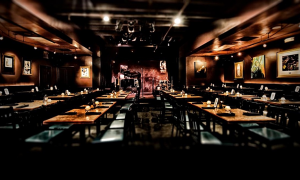
On this particular date, July 5th, Lewis arrived late at HR-57, Washington, D.C.’s Center for the Preservation of Jazz and Blues. This non-profit organization, with its jam session, anything-goes atmosphere, harks back to the semi-mythical Minton’s in its bare bones decor and stubborn broadmindedness, all of which makes it just about the perfect venue for Lewis to display his diverse talents.
Thoroughly exhausted from two previous engagements, Lewis barely had time to adjust HR-57’s Steinway (a ritual he performs no matter how recent the last tuning) before taking the stage with cohort Paul Beaudry and local master percussionist Lenny Robinson. Once behind the piano, all signs of fatigue evaporated and Lewis proceeded to gift the Independence Day weekend crowd with not only one, but three arrestingly energetic sets.
The trio opened with Lewis’s boldly personal reinvention of John Coltrane’s “Mr. Day,” the original’s mid-tempo indigos and melancholic azure laments thickened with midnight black into indignation’s cobalt force. The rhythmic drive and textural layers of Lewis, Beaudry, and Robinson’s equally extended solos combined strata upon strata of rhythmic variance, volatile percussive displays, desperately resonant and lyrically subtle statements. Throughout, Lewis demonstrated a seemingly limitless capacity for pounding harmonic and melodic improvisations.
Following this overpowering display of virtuoso runs, pounding, stride style grooves, rhythmic textures, and almost abusively concussive blows to the keyboard, Lewis presented the tonally nearly diametrically opposed “Wave,” by Jobim. As if to fend off criticisms of bravura, Lewis took the piece at a tenderly slow tempo. Robinson’s muted mallet-on-snare, with tom embellishments, provided a soft rhythmic bed for the slightly blues-tinged, deeply emotive rendition of Jobim’s oft-played classic. Using a soft attack, Lewis built his mood with slow deliberation, offering sporadic upper octave figures and careful phrasing. Giving Beaudry space to develop a long, mournful solo, perhaps his best of the evening, Lewis followed with his own lyrical improvisation.
These songs represent just two examples taken from a night of increasingly intense music that eventually left the audience shouting for more. Catching Lewis between the first two sets, he talked about his frequent trips to Washington, D.C.
AAJ: The last time I saw you here was with the standing trio you use at Cleopatra’s Needle in New York, correct?
Eric Lewis: Well, I’ve been using this bassist for quite a while now, but the drummers switch up a lot.
AAJ: It seems like you and Paul share a strong rapport.
EL: Yes.
(This is an example of how difficult it is to evoke Lewis’s speaking style. With this one word, he was able to imply an intense unadorned surety, and obvious trust of Beaudry.)
AAJ: Are you working towards an Oscar Peterson/ Bill Evans group improvisation style?
EL: Well, I’m a jazz fan, you see. So if I can draw from someone, I will. So in that way, I guess, it’s a jump-off.
AAJ: You seem interested in allowing everyone their own voice.
EL: It’s more a matter of being as professional as possible based upon the cues of the environment....It depends on what everyone’s mood is. Sometimes they want to let me be band-leader, sometimes I want to, you know, let them be the band-leader.
And he laughed, slumping back a little, implying somehow that the latter only happens when he’s feeling self-indulgently indolent.
AAJ: You’ve been coming down to HR-57 fairly regularly.
EL: Yeah, yeah, about every two, three weeks or so.
AAJ: Are you from the area?
EL: No, no, I’m from Camden, New Jersey. I had a gig over at the Cosmos Club and was looking for something to do...and I came over here [to HR-57]. Me and Tony hooked up. The rest’s history.
AAJ: I heard you may record for the HR-57 label in the future, is that possible?
EL: It’s possible, it’s possible.
AAJ: Because people are anxious for you...
EL: ...to get some stuff out there, I know.
AAJ: Exactly. You definitely have a very distinct style. I’d like to take a minute to discuss that specifically.
EL: Sure.
AAJ: I noticed you seem to leave an unusual amount of space for yourself and the other members of the trio to improvise.
EL: Yes, that’s right... You see, there are many different scenarios that can happen, so it is important to have as much flexibility as possible, so as to quickly blend into the environment. A lot of decisions have to be made in a split second—so it’s the same reason an airplane gets really high off the ground... (He paused, fixing me with a mischievous look.) You know, in case something...funny...happens. You need room to maneuver.
At this point we were interrupted by a fan Lewis recognized. Lewis sprang up, shook the man’s hand, and spoke with him for a few minutes, his voice rumbling with good-natured laughter. After excusing himself, he again sat down and waited for me to continue.
AAJ: I also wanted to ask about your compositions. Could you describe your process? Do you compose on paper?
EL: I rarely use paper, unless I’m using it to communicate music to somebody else. Generally, I’ll write a composition when I become impressed by something, or someone. A lot of my tunes, I’ve written about certain people. If I were an artist, I’d probably be very much into portraiture. A lot of my tunes are portraits of friends, or landscapes, a particular place in my heart, lore of New York City...a landscape of a place in my heart.
AAJ: Your compositions leave a lot of material for improvisation.
EL: Because that’s what I like to do. A lot of individuals seem to like tunes that make it tough for the improvisers to get through. But I like my tunes to be simple enough so that the audience can follow along, also the improviser. Easy to remember, so the challenge becomes how much personal involvement you can commit.
AAJ: That approach seems similar to Monk’s seemingly simple melodies, those catchy tunes that provide such fertile territory.
EL: Yes, right. Sing-ability is something special for me. I want my tunes to have easy access for the average listener.
AAJ: You seem to emphasize repeated rhythmic figures. Is that a conscious choice, to explore rhythm?
EL: Well, timing is a dynamic of improvisation that one must be very comfortable with. An element that must be really custom fitted. Everything we do is timed, is a timed event. Whether or not we intend it to be, it is tied to one’s sense of timing and so it’s important to become familiar with the stringencies, and the liberties... So that when you initiate something, you are comfortable with what you’ve begun, how it represents our inner workings... That’s why I focus on timing, placement. Leaving space for judgment.
After speaking for a few moments more, Lewis received a nod indicating it was time to begin the next set. Turning back to me, he finished what he had been saying.
EL: I always try to be conscious of the audience. I’m very audience oriented. I’m part of the audience, too.
With that, he shook my hand, and headed back to the stage.
Free from all other thoughts, I returned to my seat to absorb the next set. Lewis began with two solo pieces, a blazing “Cherokee” and a long, dazzling piece, named “Thanksgiving”. Listening as he then called the rest of the trio to the stage to join him, along with longtime friend Antonio Parker, I became amazed all over again at Lewis’s facility. He danced through Wayne Shorter’s “Pinocchio”, and then handed Parker the lead for a beautiful rendition of “Bye-Bye-Blackbird”. He finished with a powerful, intricate version of “A Day in the Life of a Fool”, laughingly dedicated to Tony Montana. (It’s genuinely one of Tony’s favorite songs.) This last piece exemplified Lewis’s playing—strong, assured, full of imaginative flights and humor (for example, a sudden quote from the “Saberdance”), and an insatiable desire to push, and be pushed, into new territory.
It is clear that Eric Lewis has absorbed much of piano jazz’s history. He plays with a James P. Johnson strength and an Earl Hines inventiveness, but is by no means a revivalist. There is nothing analytically cold or forebodingly authoritarian in Lewis’s music; he presents neither vivisection nor practiced artistry. Lewis’s playing seeks its next instant of brilliance by presenting a confluence of styles within each moment, simultaneously leading back to early jazz foundations, and pushing forward into the realm of experiment. In this way, Lewis’s music builds the future of jazz piano with every performance. But the real key to Lewis’s music is that each performance bestows a revelation. This revelation is not proffered on a silver platter of prefabricated excellence; it is induced through the ecstatic revelry Lewis experiences himself. In the end, Lewis becomes a medium through which the music speaks, and like all ecstatic guides, he is equal measure showman and participant, guide and seeker, savant and trickster.
< Previous
Heartcore
Comments
Tags
For the Love of Jazz
 All About Jazz has been a pillar of jazz since 1995, championing it as an art form and, more importantly, supporting the musicians who create it. Our enduring commitment has made "AAJ" one of the most culturally important websites of its kind, read by hundreds of thousands of fans, musicians and industry figures every month.
You Can Help
To expand our coverage even further and develop new means to foster jazz discovery and connectivity we need your help. You can become a sustaining member for a modest $20 and in return, we'll immediately hide those pesky ads plus provide access to future articles for a full year. This winning combination will vastly improve your AAJ experience and allow us to vigorously build on the pioneering work we first started in 1995. So enjoy an ad-free AAJ experience and help us remain a positive beacon for jazz by making a donation today.

Giveaway

Eligible winners: 15
Days remaining: 6
Days remaining: 6