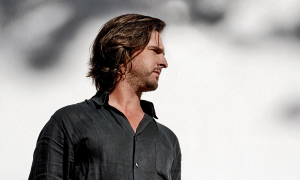
Home » Jazz Articles » Interview » Conversation with Charnett Moffett
Conversation with Charnett Moffett

...the only thing I can really tell you is that I
 Charnett Moffett is an extraordinary bassist. Some might say this is no surprise. After all, not only is he the son of percussionist Charles Moffett, but he also received musical training from an entire family of musicians, all of whom played together in the Moffett family band since Charnett was barely able to walk. He had already studied the drums and the trumpet before turning to the bass. He must have made this transition sometime before reaching the age of eight, because by then he had already begun performing with the Moffett Band on a half-sized instrument. With that kind of training and the incredible environment of jazz that surrounded Moffett, not to mention his later access to such musical greats as Wynton Marsalis, Ornette Coleman, and many others, some might argue that Moffett couldn’t help but become what he has.
 All of that might be true, if all we were talking about was a good bassist, or even a great bassist, but Moffett is definitely more than that. He is an extraordinary musician who has not only mastered his instrument and proven himself a tremendous composer, but has shown himself to be an innovator of technique. And there is one last thing that Moffett projects which no amount of training can produce: honesty. This is the kind of honesty that leads to the spiritual center of music, distinguishing the extraordinary artist from extraordinary musicians. This quality must be located within, cultivated through dedication, maintained by exhaustive practice, and continually rekindled through a process of inward searching and expansion that very few are ready or willing to undertake.
Moffett is also a highly personable individual possessed of a laughter-filled voice and a compelling openness. He holds himself with dignity, but never remove, and when he shakes your hand and smiles, you immediately know that you are welcome and that you are about to engage in a genuine, often humor-filled interaction.
On this occasion, Moffett and I spoke via phone just prior to his performance with McCoy Tyner and Al Foster at the University of Maryland’s 25th William Kapell International Piano Competition and Festival.
Franz Matzner: My first question is pretty simple. Why the bass? You came from a very musical family, so there’s no question of how you were introduced to jazz, but why bass?
Charnett Moffett: (Laughing.) That’s a very simple question for me to answer. The family band needed a bassist. That’s basically what happened. I actually started out on drums. Then I was playing trumpet. But by the time I was eight years old I was playing a half-sized bass for the Moffett family band. [It was] a little bit bigger than the cello, but it was tuned in fourths.
FM: Once you started on the bass, did you pretty much stick with it?
CM: Well, I started on the upright, but about two years later I started playing electric, that being the theme of my generation. I pretty much stayed with the bass from then on. Both of those basses, actually.
FM: You also picked up the piccolo, right?
CM: Yeah, later on. I must have bought some of Stanley Clarke’s records there—and I thought I’d give that a try as well.
FM: What are the differences playing on piccolo?
CM: Well, there’s a big difference between playing on an upright and just the electric bass itself. They have a lot in common, but are almost two totally different instruments. One’s a huge violin, and the other’s a guitar, basically. The only difference between the electric bass and the piccolo bass is that the piccolo is tuned an octave higher. I guess you could tune it any way you like, but the norm is one would be tuned an octave higher, which is basically tenor guitar. It’s really the bottom four strings of the guitar without the top two.
FM: So it’s only the electric piccolo you’re playing?
CM: That’s right. Now, Ron Carter plays an upright piccolo bass that’s tuned I guess an octave higher, but that comes more out of the concept of how Oscar Pettiford was playing the cello when he had Mingus accompanying him on those particular recordings. But I’ve chosen to play the electric piccolo from time to time. I’m not really doing a lot of that right now. I’m trying to concentrate on the upright bass and, of course, the fretless electric bass right now.
FM: You’ve definitely developed just an enormous technique on all those instruments... I was wondering if you could sketch some of your educational background.
CM: Well, honestly, I’m still learning.
(Laughing.)
FM: That’s going to go on forever, though, right?
CM: Yeah, you know, you’re only as good as your last show. So you’re only as good as how much time you’ve put in recently on the instrument. Personally, if I’m playing everyday, I get into...like...an artistic zone, in terms of my thought process and my energy. It’s like being an athlete. You have to take care of yourself, train properly, and prepare. I studied at Julliard for awhile. I spent a couple of years there before I basically left to go on the road with [Wynton] Marsalis. Let’s see, that’s going back almost nineteen years. I went to the LaGuardia High School of the Arts...but I was basically on the road with Wynton Marsalis since I was sixteen years old! I did that for two years.
FM: He brings a lot of musicians through his group.
CM: He’s really a wonderful person. He’s certainly done a lot for the music...and after my time with Marsalis I ended up playing with Tony Williams. That was quite an experience, to be able to work with one of the great innovators of the music... That was certainly quite an experience. Then I sort of moved on to some other different styles and genres, working with people like Stanley Jordon and David Sanborn and so forth. I guess for the past nine years I worked with Ornette Coleman, which is a whole other experience. And now I am very fortunate to be working with another great innovator of our times—he’s done so much for the legacy of the music—Mr. McCoy Tyner. I’ve been with him on and off now for the past two years.
FM: How did you start playing with Tyner?
CM: Oh, it’s been an incredible experience... I was recommended through a friend, Jason Elaine, who was actually the artistic director at that time out at Yoshi’s. McCoy has been doing several two week engagements there for several years now, from what I understand.
FM: It’s become almost a tradition.
CM: I was asked to be a part of that one year. I was very grateful to be asked, actually. (Chuckles.) So we got to playing, and I started learning from him. He would tell me things about music—what he was interested in—and I would try to adapt to his concept. Eventually, I guess I started getting it! I was very fortunate to maintain some kind of musical dialogue with one of the greatest piano players ever. It’s really been a truly great experience.
FM: What was it like that first time you played with him?
CM: Well, I was nervous of course.
FM: Really?
CM: How could you not be? You’re going into a different situation. You want to do your best and you have to have enough confidence to be up there playing in the first place, but by the same token you have to keep it all within balance of the environment... and understand ‘let me try to learn and grow from this experience’ so I can become a better musician. So as long as I’m keeping those things focused, I can continue to evolve as an artist and hopefully influence other artists that will play with me in the future.
FM: It seems to me that you use the bow quite frequently, and with a great degree of precision.
CM: Oh, really? (surprised) There’s always room for improvement.
FM: The bow still isn’t being used that often in jazz bass, is it?
CM: You know, I just think it’s a matter of personal expression. That’s what the music is really about... [Y]ou have to have a certain discipline within the freedom—or freedom within the discipline. You need the disciple to execute an idea technically, but you need to create the freedom in order to...have the ideas come to you spontaneously... I’ve kind of heard the bow as another version—or an extension—of my pizzicato voice. And it’s nice to be able to accompany the band and then utilize another voice as a soloist. It’s kind of an extension of the instrument. To add another color. Paul Chambers was doing this back in the sixties, so it’s not really anything new.
FM: No, but it doesn’t seem to have become a fully integrated or standard method yet either.
CM: I think one has to hear it before one develops the technique to do it. In other words, if you hear it, you’ll do what is necessary to utilize it as a voice.
 FM: I noticed that a lot on Planet Home.
 CM: You’ve heard that?!
FM: Actually, I love this album.
CM: That’s amazing. A lot of people don’t have that record over here in the States.
FM: I wanted to ask about some of your other recordings as well. You’ve done a series of them, and seem to have really tried on a lot of different styles.
CM: Well, you know, I’ve done a few. Here and there.
FM: Planet Home seems to have been a big break.
CM: Yeah, it really was kind of a breakthrough album for me. I don’t know, I guess...I was just at a different point in my life where I wanted to do some different music. So I went for it. You know, I always play the music that is in my heart, whatever style it is. I think it’s important to be sincere to yourself. Because when you’re playing the music, you want to connect with the people. Not in a contrived way, but in an honest way.
FM: And the people can hear it when it’s not.
CM: Exactly.
FM: I really thought this was an exceptional album. The solo pieces, and your work with Geoff Keezer...
CM: Oh yeah, he played wonderfully on the album.
FM: Now, tell me if I’m over-interpreting, but there seemed to be a political element to it[ Planet Home. Considering the song titles, and then doing “Star Spangled Banner” as a closing number.
CM: As an artist, you can’t help but be influenced by your environment. That’s part of the point of doing what we do. I guess if you would like to use the word political, that’s cool. I guess that’s fine. But it wasn’t intended to be. Or if it is, it’s meant in a positive way. Bringing people together as far as a unity. That’s part of my reason for doing “Star Spangled Banner”. I was actually on tour and saw a video of Jimi Hendrix... I just thought it was completely amazing. It didn’t matter that he was playing guitar and it wasn’t exactly jazz. I had to appreciate the gift and the music that hit me. I was like, ‘wow!’ It certainly made me feel something. So I was just as much informed by that as I was influenced by listening to a John Coltrane record, A Love Supreme , something like that. So I thought, maybe I should try that on bass, out of excitement and enthusiasm... And of course, America being the great country that it is, you really are able to appreciate it the more you travel to other places. When you’re here in your own country, you might take things for granted, but when you tour and go across to other places—although most places that I’ve visited have been wonderful—it’s nothin’ like being on tour here where I can catch a ballgame during the day. Or read the signs and know where I’m going. (Laughing.) Have some freedom and independence.
FM: There is something about that, traveling away and then coming back.
CM: For example, I recently returned from a three week tour of Japan. I love Japan. It’s a wonderful place.
FM: I lived there for a little while, actually.
CM: Really?
FM: I had a similar experience. You’re there and you love it, but when you come back it forces you to focus on different aspects of your own culture that you had never thought about.
CM: Basically, you end up just enjoying the strong points of each culture. So that you can grow from each situation and learn from each environment.
FM: It’s very interesting the way you describe coming across the Jimi Hendrix. You can really hear him in your version. At the same time, you’re almost inverting what he did, since at the time it was such a deliberate and controversial political statement.
CM: Well, yeah. (pause) I also thought there was a way I could do it...better. (Chuckles.)
FM: I want to switch topics a bit here and ask about something I’ve been doing a lot of reading about. I’m very interested in the development of bass styles. There’s been so much change over the years, and I’m curious: Where do you think it’s going? Is it still evolving?
CM: I certainly hope so! You’ve got a lot of wonderful players out there, which I think is so healthy. I know there’s always the thing of wanting to have a style or something that separates you from everyone else, but it’s not meant...to disrespect any of the other players. I think it’s about realizing that we’re all musicians and we’re all trying to speak our voice through our art, and enjoy our lives, and hopefully we should be trying to give people joy through our music no matter who we are... So the only thing I can really tell you is that I’m trying to be honest with the things I hear and the way I hear the music, the way I’ve been taught and raised into this music. I was always taught to be yourself. You have to know your history, but you have to go forward also. That’s one of the great things about working with McCoy. He has such a great lineage throughout the music from his beginning to where he is now. I remember talking to him about themes of this subject matter, and he said, ‘Sometimes you gotta go like the palm tree. You have to be able to flow with things. In a storm, you have to bend to this side, and sway back to the other side.’ [That’s] very evident in his playing. Now it’s bringing out another element of my playing. To be able to be grounded and centered, but also to be able to go with whatever happens with respect to wherever we are in the composition. Because what happens a lot of times is, we’ll be playing a standard or even a blues and we’ll be playing the tune and we’ll improvise off of the form of the changes of the song. Then out of nowhere, McCoy will go on this extended creative run that will have everything to do with the tune in terms of the melodic and harmonic structure, yet free of the form. It keeps me on my toes because I have to accompany him in a way that’s appropriate without being selfish because it’s always about putting the music first so you can make the best choices and the best sound that’s harmonious with the environment. So that’s the wonderful thing about playing music...it really brings people together. It’s a very exciting thing for me to be a part of because it’s creatively inspiring and musically interesting.
FM: I’m curious if you practice any other art forms?
CM: Music is already hard enough!
(Laughter.)
FM: Good answer.
CM: Basically, the more comfortable you are with yourself, the more comfortable you are with others. And sometimes understanding yourself can be the most difficult thing in the world. Because you are constantly changing. Not because you don’t have a focus point, but because you are seeking new ideas and information all the time. So if you’re interested—so if you have that way of wanting to live—then you know that you’re constantly in a search. That was one of the great things about playing that composition—“The Search”—on the Land of Giants. That’s basically why I’m having a great time with McCoy right now. The things I’m interested in developing in my life, not only musically, but personally—they all coincide with each other—basically, he’s already gotten to a point where he understands these things and I’m trying to take the opportunity to learn and grow from him... We talk about all sorts of things. Sports. Whatever is going on, the current events of the day. It’s all a part of what influences you musically. In terms of other art forms that I’m studying presently, I’d have to say no, but I’ve got my hands full trying to understand the art form of music in it’s complete form.
FM: Outside of music, what do you do when you’re bored?
CM: Play. Play some more music. (Laughing.) Because if you’re bored, that means there’s something you should play that you haven’t played yet. You know what I mean? Everybody wants to sound good when they play, but actually the best time to sound bad is when you’re practicing because then you can work on something that you haven’t done yet. Then you can add that to your vocabulary. So...you have more information to express and share with others.
FM: If you could play with any musician, any genre, who would it be?
CM: I’m kind of playing with them now. I’ve been very, very fortunate. Really, I have. I’ve played with some of the greatest musicians ever to play jazz, so there’s a big responsibility. I’ve got to get there. I have to get more understanding. I have to keep pushing ahead...if I favor one group or one style, it seems like I’m closing the door on something else. Anyone who really plays well is really my answer at this point. Of course, I have respect for people like Ravi Shankar. I’d like to check that out. Play in an environment like that. Or maybe something else in a more rock element. Someone out there who’s open-minded toward artistic freedom. There are many people out there I’d like to play with, but more importantly, I’m interested in developing a style of music with my own identity—sometime in the future—that will incorporate all of the different elements I’ve been influenced by to date.
FM: Do you have anything you’re particularly into playing?
CM: I think what happens sometimes when I’m doing too many—well, not too many, ‘cause artists, we never have enough work—but I think sometimes when we’re in one environment for too long you miss things. Like if I’m swinging all the time, I may miss funkin’ out because I do enjoy that. Or I may miss playing rock. Or if I’m playing rock, I may say, ‘I haven’t been swingin’ in a while’. I just like to get technically better so that I can maybe go into some other arenas eventually. For example, I love classical music. But there’s a serious commitment that you have to be prepared to make in order to play that music to its highest level. There are all sorts of things. That’s why I think it’s more important for me to think on the compositional level right now. As opposed to as just a bassist or a soloist. So that I can write these ideas that may be improvised and incorporate them into a concept that may develop into something new. I don’t think you try to do something new, I think you just be yourself and express the music as you hear it, and if there’s something unique to it, or that people can relate to, then great. If not, at least you know you expressed yourself the way you wanted.
FM: Have you been working on composition lately?
CM: Well, unfortunately it’s like anything else. I haven’t had time to work on that lately. I don’t think I’ve ever even toured with my own group yet. After playing for twenty years in this business, in a lot of ways, I’m just starting. Which is a good thing! New things to look forward to in life.
FM: It would be terrible if it was the other way around. Twenty years into it and you’re done.
CM: Exactly. You just have to make the best of each situation, and keep moving on forward.
< Previous
A World of Trombone: Slide Hampton & ...
Next >
HighNote/Savant Records
Comments

Tags
For the Love of Jazz
 All About Jazz has been a pillar of jazz since 1995, championing it as an art form and, more importantly, supporting the musicians who create it. Our enduring commitment has made "AAJ" one of the most culturally important websites of its kind, read by hundreds of thousands of fans, musicians and industry figures every month.
You Can Help
To expand our coverage even further and develop new means to foster jazz discovery and connectivity we need your help. You can become a sustaining member for a modest $20 and in return, we'll immediately hide those pesky ads plus provide access to future articles for a full year. This winning combination will vastly improve your AAJ experience and allow us to vigorously build on the pioneering work we first started in 1995. So enjoy an ad-free AAJ experience and help us remain a positive beacon for jazz by making a donation today.

Giveaway

Eligible winners: 15
Days remaining: 4
Days remaining: 4