Interviews

Boston's Randy Roos-A Local Legend Sustains Infinitely

By
PHIL DIPIETRO,
Phil DiPietro

Phil DiPietro

since 1999

Phil wishes he was a musician (well, he is one, but he wishes he were a good one) but he's not frustrated by it. He's frustrated with a lot of other aspects of the so-called biz. Therefore, he's excited by independently released jazz.

Recent articles (133 total)

Published: October 21, 2003

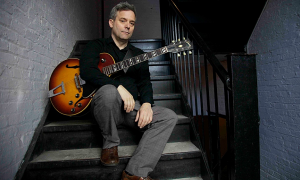
I had the good fortune of attending Boston University during the particularly fertile music period of 1976-1980. I lived near Kenmore Square, and on any given night, friends would head out, especially to the now-legendary "Rat" (Kenmore's "Rathskellar"), a mid-size rock bar, to hear future theater-packers such as the Talking Heads, U2, The Police, The Clash, The New York Dolls and many more. I actually missed all of those shows. See, I was a jazz head, particularly enamored at that time of jazz guitarists. My haunts? The now defunct Michael's and Pooh's Pubs, where a two dollar cover would get you in to see Mick Goodrick, Bill Frisell, Dean Brown, Mike Stern, Van Manakas, Kevin Eubanks, Jack Wilkins, or Wayne Krantz. A kid named Metheny was also gigging around town, but even then, it was a bit of a hassle to get in. So, more than 20 years later, it's an honor for me to bring you an interview with the one guy that always blew the doors off all those others, for me and many of my fellow guitar-freak friends- Randy Roos.

At one of those gigs, I purchased his 1978 masterpiece, Mistral, released on white vinyl by the Boston-based Spoonfed Records, featuring the first even-close-to-major-label recorded performances of guitarist Mike Stern and bassist Neil Stubenhaus, along with drummer Luis DeAndrade and Weather Report percussionist Alyrio Lima. Upon giving this record its first spin, I was convinced it was the greatest single recording I had ever heard up until that moment. Today, it certainly remains a personal favorite, but unfortunately, an unheralded gem for such a watershed achievement in the fusion genre. It featured Randy on his double-neck guitar, one of which was a fretless, with a stainless steel neck, on a body equipped with an infinitely sustaining pickup device. The other was a conventional fretted six, on which Randy comped absolutely miraculous chord voicings, unfathomable to the average guitar hobbyist-unrecognizable even from the telephone-book-width guitar chord "bibles" of the day. I remember a friend who studied with Randy, who is now a successful producer in Nashville, fittingly dubbing them "Roosian" chords. Suffice to say Randy was every bit the chordal master then (and now) as guys like Frisell and Goodrick, who, as it turns out, are friends and former co-duettists.

Not only is Randy under-recognized nationally, he's also a rarely acclaimed local hero, an unacknowledged touchstone on the local scene. Prior to his "jazz" career, he enjoyed great notoriety as a member of Orchestra Luna, an eclectic pop/performance art band with a rabid local following. After Luna, he became easily guilty of jazzer greatness by association, with many, now more recognized, players either playing with him or becoming members of his band at some point. I've personally seen his duet dates with Goodrick and Frisell. Stern and Frisell were co-guitarists in his band. Stubenhaus, Jeff Berlin, Victor Bailey, Kai Eckhardt, Jimmy Earle and Baron Browne filled the bass chair. Tommy Campbell and Jun Saito played drums, and future Allan Holdsworth band member Steve Hunt held down the keyboard chair for many years in Randy's band. Speaking of Mr. Holdsworth, when Bill Bruford decided, after finishing up his Feels Good to Me and One of a Kind records with Berlin, Holdsworth, and Dave Stewart, that he wanted to come to the states to pursue a bit more of a jazz direction, guess who filled the guitar chair for an incredible series of 1980 Boston dates?

A well-respected teacher, Randy's been doing it since he was a teen. A number of world-class players have benefited from his mentoring, both privately and formally, during a teaching stint at the New England Conservatory, including Frisell, Stern, Dave Fiuczynski, David Gilmore and Brian Ales.

Randy is probably most well-known to the music consumer as George Jinda's partner in the early 90's outfit, World News, and as a recording artist for Narada records. His Liquid Smoke and Primalvision received superb reviews and sold respectable, yet ultimately, not business-plan proof numbers. Primalvision, in particular, skillfully melded world beat elements with guitar mastery while avoiding "smooth-age" rhetoric, and remains an exemplary genre-specific recording, in large part, because it avoids so many genre-specific drawbacks.

You can find Randy most often now at his home studio, recording the soundtracks to the PBS show, Scientific American -that's every sound folks. A gig working for a former student, Sheldon Mirowitz, on the PBS special, Columbus & the Age of Discovery, led to both the Narada contract and the Scientific gig.

comments powered by Disqus

View 1 archived comment(s)

Giveaways

Marc Ribot

Marc Ribot

About | Enter

Jeffrey Gimble

Jeffrey Gimble

About | Enter

Tommy Flanagan

Tommy Flanagan

About | Enter

Dan Lehner

Dan Lehner

About | Enter