Home » Jazz Articles » Interview » Terell Stafford: Pushing Music and Community
Terell Stafford: Pushing Music and Community
I love to practice. Dedicate myself to it, so I just want to keep doing that. Get better and better and better.
 Terell Stafford plays the trumpet with remarkable technique, a great sense of melody and swing, and a lot of heart — a combination that makes him stand out on today's scene and a reason it's easy to find him performing with people like Cedar Walton, the Clayton Brothers, Kenny Barron, Matt Wilson, the Carnegie Hall Jazz Band, the Lincoln Center Jazz Orchestra, the Mingus Big Band and the Village Vanguard Jazz Orchestra when he's not fronting his own band on gigs. But it doesn't tell the whole story.
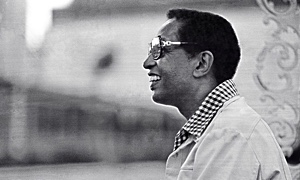
 Stafford, who came to jazz relatively late in his young life after studying classical music in college, is much more than that. Soft spoken and unassuming, he speaks with a quiet calm, his mannerisms at ease even though he was below the weather, health-wise, when he sat down for a chat. His smile is warm and easy. He had played a concert at Skidmore College in Saratoga Springs, NY, two nights before and tended to business like nuthin', blowing clean, funky, melodic and hot in a session with other musicians/educators, even though he had a stool to rely on when he wasn't soloing.
Sitting down a couple days later, it's the same thing. Though he's obviously in some discomfort, and had been teaching students all day, he's warm and at ease. He speaks clear and concise, as if everything's cool. Cause he makes everything cool. Quick with a grin and not quick to sing his own praises. Humility.
Stafford, at the age of 36, has his stuff goin' on. His latest outstanding CD, New Beginnings , is out, and he's not going to panic if it doesn't go through the roof. He's getting gigs, but won't get flustered if there suddenly comes a dry spell. He's more concerned with keeping the ship moving ahead, the sails picking up whatever wind is blowing, and if it isn't gusting now, it will be later.
What's more impressive is his concern for the jazz musicians around him.
In an era where newspaper columnists write about the loss of neighborhoods and the sense of community across the United States — neighbors don't know each other anymore and people don't watch out for each other — Terell Stafford doesn't see it that way.
"I like to try as much as I can, and I want to do a better job of it, in supporting my peers," he said. "Clark Terry is a huge mentor of mine and I talk to him. Talking to him, you hear how those guys used to go out and support one another. Pops would come and hear him, and he'd go out and hear somebody. And I really want to do that more. If I'm home and I see Jon Faddis playing or if I see Jeremy Pelt's playing, if I see Randy Brecker playing, or Lew Soloff or anybody, I want to get out and support them. I want to say, 'Hey, man. It's a community. It's a family. We got to bring it back to the way it used to be.' Because you hear all these stories and you don't hear the reality of it now. That's all they are: stories. It kind of bothers me. 'Remember when? Remember when?' I don't want it to be like that. Let's go. Let's do it."
"The other day I called Faddis. He and I are great friends. I said, 'What are you doing?' He said he and his wife were about to go to Clark Terry's house just to hang out. I was so touched. I wish I would have been around to go do that. I was like, 'Oh man, I wanna go hang out with C.T.!' I thought that was so great. I just played a Jazzmobile in New York and Jimmy Heath came to the concert. We were talking and he was like, 'We used to hang out and do this.' Man! It's like, why can't we say, 'When I hung out' instead of 'used to'"
That's pretty cool from a guy who, though he started playing trumpet at the age of 13 in Chicago, where his family had moved from his native Miami, had not given much credence to jazz. He dabbled in it through high school and his college education at the University of Maryland, but nothing more than that. "I never studied it. My undergrad degree is in classical trumpet and my graduate degree is in classical trumpet," he said. Rather than digging Miles or Lee Morgan or Kenny Dorham, he was into Maurice Andre from the classical realm.
"When I was in graduate school was when I really started taking things seriously. I had played jazz before, but I played in a jazz band in high school, but I don't think we ever played one Basie chart. So I don't know if you can call it jazz band. Then I played in the jazz band when I was in college as well. But it wasn't anything steady."
Then it was on to Rutgers for his master's degree, and things started to click. "It wasn't really until graduate school that I got into it. Kenny Barron was teaching at Rutgers so I went to Kenny and I said 'I want to learn how to play jazz.' He said 'Get a Dizzy record, get a Miles record and get a Clifford record and listen to them.' And I did. And Miles was the first music for me to start to learn. I learned the solos. The technique was there. The fundamentals. But there's much, much, much more than that. It's still a life-long quest for me."
 Part of that quest has led him to New Beginnings, a sharp CD with pianist Mulgrew Miller, drummer Dana Hall, and bassist Derrick Hodge at the core, with help from alto saxophonists Steve Wilson, Dick Oatts and Jesse Davis, and tenor man Harry Allen. The recording is sweet, staring with a couple standards, segueing into a three-song "New Beginnings Suite," which kicks, and then into a few more familiar tunes.
"Originally, I wanted to do an all-alto project, so I was going to have Dick and Steve and Jesse Davis and Bobby Watson. Bobby couldn't get out of his teaching schedule. All these guys have played in my quintet from time to time. When people play, you hear certain people on songs and you say, 'I like the way they just played this song.' I mean, they play every song well. It was my opportunity to have the people that I hear on certain songs play those certain songs. And it was really cool."
The suite segment came from a work he was previously commissioned to do for a New York City-based organization, but it became personal as he wrote it. And it's the highlight of the recording, moving, intense at times, with adventuresome playing for all involved.
"Because of things I was going through with my life, the movements of the suite make up the new beginnings. The first movement, which is when I thought back and reflected on where I've come from. And the second movement is about my good friend Faddis introducing me to my soulmate now, getting me back on track. And the last movement is dedicated to my soulmate. That's how that suite came about and it's pretty much the theme of the record."
Not bad for a guy who hadn't been on the scene as long as his peers. It was right out of Rutgers that he got his first big break, joining Bobby Watson's Horizons band. His debut as a leader came in 1995 with Time to Let Go, followed in 1997 by Centripedal Force and then Fields of Gold.
"After my first year in jazz I met Bobby Watson. And I was in his band Horizon for seven years. I never thought that after one year in jazz I'd be playing at the Village Vanguard. That's how I got huge opportunities. That was my first big break. Because of that, I met so many people. Bobby exposed me to so many people. When the band disbanded, I thought that was it. My career was over. But I met a lot of different people and played with them. McCoy Tyner. Cedar Walton called. A lot of people started calling."
Stafford also had to play catch-up in his development, moving from the classical realm into jazz. He started listening to everything he could. "Early on, I would say Freddie, Miles, Lee Morgan. I learned a lot from studying them. But there were still things that were missing. I needed to go back and study the legacy. Louis Armstrong, Bubber Miley, Cootie Williams, Rex Stewart. All the masters. So I did that. And then I had a whole new understanding about the trumpet and where the history had come from. I appreciated Miles more. I appreciated Dizzy more. I appreciated Clifford more. Freddie Hubbard. Woody Shaw. Because I didn't pay much attention. Since I came in so late, I listened to what everybody else was listening to, so I could catch up to them. Then when I went back and did the homework, I saw that there is so much happening, it's refreshing. A lot of people don't see it. They say that stuff is old. It's been done. But there's so much conception behind it."
Through it all, he has little desire to dig back into classical music performance.
The trumpeter still practices classical music, and teaches some of it, but he doesn't miss performing it. A classical performance last fall made him "a nervous wreck," and made him appreciate the land of jazz.
"It's a different type of preparation. With jazz, the way I prepare myself for a concert is I make sure all my tools are there so I can use different vehicles to get out of things, out of changes. But in classical music, it's not about tools. It's just about the music, cut and dried. Do you have this passage down? Is this passage down? Is this passage down? And it has to be the same way. People that come to hear the music are listening for that. Is this passage down? Is this passage down? Whereas people that come to hear jazz are listening to see, 'Man, let me hear what I can feel.' Not to say there's no feeling in classical music. I'm not saying that. But I was a nervous wreck getting up on that stage in front of that orchestra. The day after that concert, I went on the road in jazz. I went up on the stage and it was a packed room and I never felt so comfortable in all my life. It was like being in a bathtub with bubbles, you know what I mean?"
Another big part of Stafford, his life and career, is teaching. It's important to him, he said, and he tries to impart the history of the trumpet and the music on those he tutors. Terell had an undergraduate degree in education, but hadn't really applied it until he got some advice from one of his bosses — Bill Cosby — when he was on the musical staff, under the direction of Shirley Scott, for the TV show "You Bet Your Life." Cosby suggested teaching at his alma mater, Temple University in Philadelphia. "He's the guy that signed my paychecks every two weeks, so I said, 'good suggestion,'" Stafford chuckled, "and I did it."
"I teach a good amount," he said. "I teach at Temple University now. I'm there three days a week. My schedule's fairly flexible there. They're very supportive of what I do. And then in the summer, since I have my summers off, I do a couple camps. This week I'm doing this [Skidmore]. Next week I do a camp with Christian McBride in Aspen. I'm off for a week. Then I go off on the road to Spain for a week. I'm doing a record, a CD and a concert with a local band. Then I'm going on the QE2 with Slide Hampton, a Dizzy Gillespie alumni group. So I try to get all my heavy touring done in the summer, and dedicate the fall and spring to teaching, but I still do tours then.
 "But I really enjoy it. There are times that I don't. When I'm not reaching the students, or I feel like the students don't want to be reached. It goes both ways. Those times I don't and I appreciate my playing part. I can leave that and go do a concert with some great musicians and feel totally inspired, and go out on the road for a week and come home and say, 'OK. Let me try this concept again. Let me try this approach. Let me work on this.' And it's a great balance because it I think it's expanding me as a person. To teach and to share. Plus I learn a lot from the students. It challenges me. If they can't do something, how do I show them how to do it? How do I know how to do it? Have I ever tried it? All these questions go through my head and it challenges me. When you go home tonight, you better try to work on this in case this question comes up in the future. Which helps me, because I go play with someone else and whatever we were working on with this particular student may come out on the road with Kenny Barron. It may come up in some music."
That's a healthy outlook for a musician. Especially one of Stafford's caliber, and one who has an affect on young musicians coming up. (It might be worthy to note that bassist Hodge on the new CD is a young former student of Stafford, getting his chance to shine a bit.) Stafford also doesn't rest on his laurels as a player. He's a guy with great technique, but don't tell him that. He's got more work to do.
"I want to make more opportunities for practicing. I love to practice. The trumpet does not come easy for me. First of all, it's not an easy instrument. It's not something I just put to my lips. I love to practice. Dedicate myself to it, so I just want to keep doing that. Get better and better and better."
His outlook helps him deal with the jazz industry as a whole, which is not very friendly of late for most of the working folk. There are a lot of complaints. And a lot of people not working. But Stafford is staying away from the negative.
"Things have been OK for me, but it's not always about me. I wish the whole community were a lot happier. I think that everything is a cycle. Time is a cycle, music is a cycle, swing is a cycle. Right now, we're just going through a cycle. I think if we can hang in there, we can make it through this. But right now it is hard. Opportunities aren't there like they have been. It's funny because musicians have months that are called our dark months. Not much work comes in. Right now those dark months have just been extended. But you always know, like Bobby Watson always told me, you always know when a dark month comes there's gonna be a good one coming up, so just try to hang in there.
"That's what I feel like. This summer isn't what other summers have been, but it's going to come around. This month may have been better then last month. I always try to be as optimistic as I can. Because right now everybody's bashing it, and the more you bash it the more you discourage the people who are trying to support it. That's how I look at it. If I can lift it, encourage it, and keep supporting it, we can make it a positive thing. I just see all the bashing from all the musicians and everyone so down on it. It's not this and it's not that. The listeners are going to say, 'If it's not that anymore, then I might as well just go.' And the scene goes down the hill.
"I think things will come around. I don't feel totally discouraged, like I'm going to give up. We just have to make it through these hard times. Hang in there. Look out for one another. If a gig comes up and somebody's not working that much, hook em up. Try to make some opportunities for everyone.
"I talk to a lot of friends who say, 'I wish I were moving more product.' I never worry about that. I take it day to day. Here, I sold a box of CDs. I'm happy about that. I would have brought two boxes of CDs. If I sold a box and a half, it's more than I sold last week. More people hearing the music and passing the word along. I feel good.
"I have no complaints, and when I do start to complain — there've been worse months. There've been worse times. I feel blessed, I feel good."
About Terell Stafford

Tags
PREVIOUS / NEXT


Become a Sustaining Member

Since 1995, All About Jazz has championed jazz as an art form and supported the musicians who create it. Over three decades, it has grown into one of the world's leading jazz resources, serving hundreds of thousands of readers, musicians, presenters and industry professionals each month.
Help Build the Future of All About Jazz
Your support helps us continue building All About Jazz for the next generation—expanding our editorial coverage, preserving jazz history, developing new community features and creating better ways to discover the music and the people behind it.
Become a sustaining member for as little as $20 per year and you'll immediately enjoy an ad-free experience along with access to subscriber features and future articles for a full year.
Together, we're not simply sustaining All About Jazz—we're building its future. Thank you for being part of the journey.