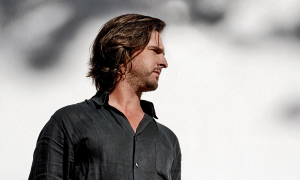
Home » Jazz Articles » Interview » Dave Ellis: Talented Tenor on the March
Dave Ellis: Talented Tenor on the March

This is about as straight-ahead a record as I could ever do because I have so many other influences, but I do consider myself a jazz guy.
 Why Not?
 So many jazz musicians have been heralded as the next “big thing” since the 80s it’s hard to keep track. It can cause one, after a while, to cast a sideways glance at the next pronouncement. But when a saxophonist creeps up on you with a lively, burnished tone and a swagger begat from the likes of Dexter... maybe it’s time not to ask why, but to say why not.
Dave Ellis isn’t a “young lion” at 35, but he’s not a name that’s out there in the jazz world. He’s enough of a tenor saxophonist that Orrin Keepnews took on the task of producing his first major-label CD, State of Mind released April 22 on Fantasy’s Milestones label. Listen to it and ask why he shouldn’t be put in the category with some of the other fine players on the scene. His voice on the instrument is still developing, he admits, but he speaks the right language; the lingo of Sonny Rollins and Joe Henderson and others he has been influenced by.
He’s enough of a player to be a major voice for the Charlie Hunter Trio when first formed and has a wide enough palette to have spent time with Grateful Dead offshoots Ratdog and The Other Ones. He’s also provided a valuable presence for some of Bruce Hornsby’s musical projects.
He likely won’t be saddled with that “next big thing” label, but Ellis is the goods, worth hearing, and worthy of having doors opened for him – even in a period that is getting difficult in the clubs for so many players, and tough in the arid world of recording. This Bay Area west coast cat is fun to hear. Educated at the famous Berkley High music program in California and later the famous Berklee School of Music on the east coast, he comes equipped. He’s erudite and unassuming. He’s talented, yet speaks of his desire to continue to grow and learn.
The new CD is a jazz record, but mainstream isn’t his only turf and it’s not his only goal.
“This is about as straight-ahead a record as I could ever do because I have so many other influences, but I do consider myself a jazz guy,” said the saxophonist. “Since about the age of 9, that’s what my focus was. Of course, you’re assuming a particular meaning of the word jazz. I spent my formative years learning how to improvise and emulating different players that I like – Sonny Rollins, Joe Henderson, Trane and others.”
Ellis is diverse, all right, but the spirit of improvisation is utmost in his playing. The venerable Mr. Keepnews expresses in the liner notes that he thinks Ellis is an excellent talent who has come through the waters forged by Coleman Hawkins and Prez and Henderson and Rollins. He doesn’t burn through music like Johnny Griffin or create the wild abandon of James Carter; his strut is more like Long Tall Dex and Henderson. A robust sound. He has almost an understated sense of swing on bop tunes and a thoughtful ballad style. He’s a good story teller and he’s weaved a good series of tales, from start to finish, on State of Mind.
“He’s one of a kind, and I’m very fortunate to be working with him,” Ellis said of the 80-year-old Keepnews. “There’s a pretty giant generation gap between he and I, except he maintains the childlike attitude that I think it takes to survive in jazz for 50 years, so for me to be around and partake of all his many stories and at the same time be involved in the production of a record that he’s producing was just super informative.”
“He and I had worked on In the Long Run (the second of Ellis’ two previous recordings under his own name) together and had this album planned as the followup to that on Monarch Records, but Monarch went south and did other things. So this record is just the manifestation of something we’d been working on since late in 1999. But he’s fantastic. I was in New York with him doing it and got to know him quite a bit better. We’d been friendly for quite some time, but I got to see what his real place is. When we went to New York, doors were opened and food was laid out and all the cats were always very happy to see Orrin. Eyes brightened up quite a lot. Just to be around that was very fortunate.”
 The musicians on the CD, jazz stalwarts all, had not performed with Ellis before, though he knew some of them. Pianist Mulgrew Miller is revered among musicians and his playing is one of the glues to the new music. Carl Allen, Lewis Nash, Vincent Herring, Peter Washington and Christian McBride are all strong throughout.
“I’ve known Christian through Josh Redman, we grew up together here in Berkley [CA], so I’d known him on and off from when he was with Josh. Vincent Herring I’d spent some time with when we were both very young at Casadero Music and Arts Camp in the late 70s. He remembered me from then, so we had a great relationship harkening back to long ago. But I had not played with any of these guys.”
“There were so many things going on with me at the time. It was inspiring, first. I wouldn’t say paralyzing, and I wouldn’t say intimidating either, because any intimidation feeling would have come from my own mind – they were not giving me that in person at all. In fact they were so helpful and so musical, it was such a high level for me that I tell them that I’m spoiled now. Where do you go from there?”
Ellis, who stayed full term when he was at Berklee and graduated with a degree in production, knows the value of Keepnews and not just from a technical aspect. He knows the producer of Monk, Hawk, Newk, Henderson, Trane and so many more brings a sense of history to the table, brings a sense of respect.
“Orrin really stuck his neck out for me on this one. He’s fond of saying that if the guys are still smiling and saying good things about you after they’ve been paid, then you can consider it a success, which was the case with this. These guys live in New York year round, which means they’re on the road most of the time, live near each other, have paid a lot of dues together, so for me to come in as a California guy and play with these guys, and have it be my session, could have gone the other way than it did. It wound up being a very positive and good thing. And I think in a very large part because of Orrin’s relationship with these guys, the fact that he’s done similar things for them, and they trust his ear and his sensibility. Synergy-wise, I would have loved to spend about another four or five years playing with these guys in some live settings and it would have been a different record, but all things considered, I’m proud of it.
“One of the things I learned was Orrin’s process of putting together an entity, not just a set of songs, but a CD as one entity that plays from start to finish. A piece of work. So because we had this album on the table in late 1999 and then started talking about it again in the middle of 2000 – this album was recorded in 2001 – so we did have multiple meetings about what we wanted to do. Orrin is never one to tell a musician what or how to play, but in this case since we were crafting it together, he had a lot of ideas. So you see lots different time periods represented.
“He wanted to do an Ellington-era ballad, a less well-known one, so “Something to Live for” was that. “Grand Central” was a little more up to date, which had Cannonball and Coltrane on it originally. Orrin has done a lot of work with Vincent Herring – he pays homage to Cannonball lots in his playing, and Orrin recognizes that, so that made some sense for Vince and I to do that under an Orrin umbrella. He let me get away with having my two tunes on there and having mine on there first [“Not That You Asked” and “Isabella Blue”]. There were never any points of contention. Probably the biggest thing we argued about was whether I could get away with doing this version of “Summertime” on the record. It’s dark. It was called “Winterlude” at one point. But he capitulated on that. The Clint Houston tune “Sunshowers” is sort of obscure, but it comes from an even more recent period with sort of a West Coast representation.
“The common thread is that I’m playing on every tune and Mulgrew is playing on every tune. Otherwise the band changes from session to session and track to track. Then there’s the duo with Mulgrew. [Horace Silver’s “Peace.”] We considered all the things, the tunes, era that they represent, the key that they’re in, tempo considerations, time considerations, arrangements, all of those things were factored in. In a way, Orrin makes it seem easy and intuitive, but that’s only because he has 40 years of practice under his belt. You take for granted that somebody can make this flow as smoothly as he made this happen. This album benefits tremendously from Orrin’s production chops.”
Things may take a different direction on Ellis’ next CD, but that would be reflective of his diverse background.
A home, there was a lot of music being played, but not jazz. But in the community in which he lived, different sounds would meld. And in the well-known Berkley High School, which boats the likes of Benny Green, Craig handy and Redman, jazz had a strong pull.
There were other factors. “Lots of Latin stuff. Salsa, the large Escovedo family is from that area and also Bill Sommers and those folks were in that area when I was growing up. R&B. There were two things working: what was going on in the house, which was everything — Beatles and Stevie Wonder all the way down to Calls of the Humpback Whale. But in the community, all of my influences were with my peers and the people ahead of me. There was me as a fifth grader and Benny Green as a 12th grader and a professional-level player. So that’s what you aspire to. You don’t know that that’s out of the norm. A lot of the people who inspired me were teachers and players in the system at that time. So jazz was a real part of my schooling growing up and I was introduced to it really early and had lots of resources, so that made it a little easier.
“It was records like Saxophone Colossus and the Clifford Brown memorial album that were inspiring me at age 9 and 10. You’re not conscious of what’s getting to you, you just know it’s getting to you. I would consider myself a jazz guy in that way,” he said. “I sometimes think I was born 40 years too late. My interests and saxophone style comes from a much older school.”
Ellis was paying drums as a youngster and by 9 was playing sax after a mandatory semester of clarinet at Berkley. In high school, he gigged in dance bands, including The Uptones, a ska and that at times opened for the likes of Billy Idol and the Go Gos. And after high school, he waited a few years before going east to Berklee, sound decision, he said, because “then I was really ready.”
“The most important thing about that place is the community of people that coalesce there. You can bring a lot of knowledge, but you have to go in there and work on it on your own. The folks there are great. I was very lucky. When I went to Berklee, Roy Hargrove was there, Antonio Hart was there and Josh Redman was at Harvard, so he was coming down and visiting. Chris Cheek and Chris Speed and Mark Turner were there, so as far as the land of tenor players, it was very fertile.
“I had my degrees in production and engineering because, number one, I wanted to stay and graduate, which is rare for an instrumentalist. I also didn’t see where a performance degree would go any further with getting me a gig. I can’t imagine showing up to the rehearsal with a diploma and saying, “Look, I really can play.” I’ve always had an interest in the engineering and production side of it, which I still do.”
After Berklee, it was back to the Bay and playing with guitarist Charlie Hunter and drummer named Jay Lane. The playing got good, and the three got serious. Recording for the Charlie Hunter Trio started to come. And steady work, even though Ellis had his production degree at the ready.
“Every time I put my sax down, it seems to have a way of picking itself up and putting itself back in my mouth again,” he quipped.
There were three records with Hunter , Charlie Hunter Trio and Bing, Bing Bing and Ready, Set, Shango. Lane left after the second and ended up with Bob Weir and the Grateful Dead spin-off, Ratdog. It was the link with Lane that got him the gig with the jam band folks.
Playing in front of the illustrious Deadheads was “a very different experience...a positive one,” said Ellis. He said the audiences were patient, and were used to the spirit of improvisation and exploring that is so akin to jazz, even if the music was not as sophisticated. In fact, Ellis said he feels good about being intertwined with two distinct parts of Americana – the Dead and jazz – distinctly American-made and an imbedded part of the nation’s culture.
A tenure with Bruce Hornsby came a short time later and was a good learning experience, said Ellis. He thought Hornsby a “very talented and down to earth” guy who plays music with no thought toward the commercial. The music was straight out of Hornsby himself, who is a what-you-see-is-what-you-get, no-nonsense nice guy, and an outstanding musician.
In each scenario, Ellis fits his sound so that it becomes part of the plan, molding itself where and how it’s needed.
“From a marketing standpoint, that may be a difficult angle to play, but I am not interested in being labeled one thing or the other. If it had to be anything, it would be jazz saxophone. But I take a little bit away from each thing. I tend to believe more harmonically advanced or sophisticated stuff is my interest. I can get enough of two-chord jams where everyone wanks away for hours. That does get boring to me, but not everybody studies Trane and spends their formative in music the way I did and a lot of my peers did. A lot of people don’t want to hear sophisticated harmony. They want to hear one chord and a drum beat...and I can relate to that too, but at the core, I like to progress and grow.”
Ellis said the new music “a very important milestone, as it were. Next for me is showing a little bit more of the electric, funky side. This record, even though it’s being released now, was done about a year and a half ago. Things have changed for me quite a bit. I have a new daughter, two and a half years old. And in those couple years things change. So that’s what I’m looking to do next.”
Ellis said he has no time line in place for the next recording, but he plans on doing more of his own compositions “with an electrically oriented thing. And when I say electric I don’t mean Smooth Jazz, but something that is more of a studio record, more crafted by me, compositionally and arrangement-wise, and not just a saxophone showcase. So that’s where I’m headed now.”
Getting a working and out on the roads is also important in his immediate future. “There’s some very good guys around here, so we’ve been getting together and playing and I’m looking forward to getting together with these guys and seeing what comes of that. I’d like to get in a record with them, if possible,” he said.
All this is happening at a time when the music business isn’t all that gracious, particularly, Ellis said, in his native Bay area.
“The current environment is not one that fosters more gigs. Even the great players who are out here are making decisions to either go down south to LA, or go to New York or something like that. It’s pretty miserable right now. These things go in peaks and valleys, but this has been a very long, low valley right now as far as maintaining an existence as a professional player on the west coast.”
But the east coast isn’t beckoning, even if it has advantages.
“I don’t want to live in New York. I understand what New York is and how the jazz world works. I am of the belief that you have to go and spend time on the east coast and in New York and play to understand New York’s version, which is probably the highest level of a particular kind of jazz. But I’m at the point now where I’m a lot clearer on what I want. And it’s a smaller globe. There’s a lot of things in Europe that happen and you don’t necessarily have to live in New York. It makes life a lot more convenient as a professional player. The guys I played with on this record, like I said, they’re rarely home. They’re out in Europe; a five-hour flight from London and stuff, instead of a 10 or 11-hour flight back to San Francisco. There are some practical reasons for living on the east coast. There’s a lot more gigs and less driving.
“But I like the sky and air. I’m a California boy and I’m not ashamed at all about that. I’m not trying to pretend and put up a New York front. But there’s always a nagging problem that all the cats I want to play with live there. The level of musicianship is so much higher there on a per capita basis that I fight myself in many ways by remaining here.”
Ellis is a laudable artist who should be growing in the sunlight that he likes so much in California, and basking in a spotlight that this new CD shows he deserves.
Website: www.davellis.com
Photo Credit
Henry Benson
< Previous
Trust Me
Comments

About Dave Ellis
Instrument: Saxophone, tenor
Related Articles | Concerts | Albums | Photos | Similar ToTags
Concerts

For the Love of Jazz
 All About Jazz has been a pillar of jazz since 1995, championing it as an art form and, more importantly, supporting the musicians who create it. Our enduring commitment has made "AAJ" one of the most culturally important websites of its kind, read by hundreds of thousands of fans, musicians and industry figures every month.
You Can Help
To expand our coverage even further and develop new means to foster jazz discovery and connectivity we need your help. You can become a sustaining member for a modest $20 and in return, we'll immediately hide those pesky ads plus provide access to future articles for a full year. This winning combination will vastly improve your AAJ experience and allow us to vigorously build on the pioneering work we first started in 1995. So enjoy an ad-free AAJ experience and help us remain a positive beacon for jazz by making a donation today.

Giveaway

Days remaining: 5