Home » Jazz Articles » Interview » Charles Davis: Sweet Storyteller
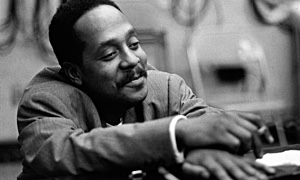
Charles Davis: Sweet Storyteller
Some people say you just play, but you don
 There’s a difference between the elder statesmen in jazz and the newer firebrands, no matter how talented. One is the former’s ability to take their time to tell a story. They’ve been around life and they’re not in a rush. Like Dexter was. And Prez.
Out of that mold is 70-year-old Charles Davis, displaying his rich tenor sax sound and strong baritone sax work on his new CD Blue Gardenia, titled as much for his admiration for Dinah Washington as for his association with Billie Holiday. He played with both, but longer with Washington. He’s not a household name in jazz, but his resume is impressive – as is his new music.
Davis has played with Sun Ra, Coltrane, Johnny Griffin, Archie Shepp, Kenny Dorham, Illinois Jacquet, Amah Jamal and more. He’s a bopper with a sense of adventure. He’s a smooth storyteller with a sonorous sound influenced by his upbringing in Chicago, a musical hot bed (though he was born in Mississippi). On Blue Gardenia, he’s joined by Cedar Walton on piano, bassist Peter Washington and drummer Joe Farnsworth. It’s a straight ahead set and a smooth ride.
“It’s songs I felt and songs I like. There’s more I wanted to do, but we didn’t have so much time. But those are some of the ones I liked,” says Davis. It’s got a taste of blues, bossa and bop, and show Davis great style with melodic improvisation. There are pieces of the great players in his playing, but they’ve been amalgamated into a personal sound and the world should hear more of Charles Davis.
“The main influence was Lester Young, Charlie Parker, Ben Webster, Coleman Hawkins. Don Byas,” he says of his formative days learning the instrument. “Getting out later on, I became friends with John Gilmore, Clifford Jordan. In my neighborhood was John Jenkins and Johnny Griffin. So there was music all around.”
He also learned from the singers he worked with. “Billie got phrases from Lester Young. Dinah was very clear on her diction. That was always something to listen to,” says the soft-spoken sax man.
“A Beautiful Friendship” gets things started and the mood is set for good. It’s a mid-tempo bop tune that Davis and company negotiate in a relaxed fashion, sliding into a blues and then “Bossa Joe” before getting on it with more of a burner, “Stranded,” that shows the quartet’s fire. With the baritone in his hands, the band works though a pair of ballads, including the title tune, and a bounding blues. It’s easy to see, listing to those tracks, why Davis became known as a baritone player, even though he contends he has switched back and froth between the two with regularity throughout his career. He keeps the same rich sound, and has good agility and creativity on the larger horn. He gracefully burns, for example, through “Blues for Yahoo” and softly addresses “Blue Gardenia” with sophisticated melancholy.
“I started out on alto. I have played baritone and tenor all along. I was playing baritone with Coltrane. I played tenor with John Gilmore, Clifford Jordan, Johnny Griffin, back in Chicago in the 50s. I’ve always played the tenor,” he says.
About the CD, Davis says he’s very self-critical. “I hear things and I say, ‘I could have done this better.’ But it’s like telling a lie, once you do it, it sticks forever. But I enjoyed it, but when you first record something, you think you’re the worst sounding individual on the record. Because you’re trying to get out all of yourself, and that’s an impossibility.”
While the recording industry seems to be taking its lumps from musicians in the new millennium, Davis takes things in stride. He says it’s not a lot different than it ever has been. Musicians aren’t getting rich, and many aren’t getting notoriety. But that’s not new.
“For the most part, the people I’ve been involved with seem to be able to come to an amicable agreement about what should be done [on a recoding]. There’s also an area where an artist should take a suggestion. Some things may be personal, as far as what you want to do, but may not be appropriate at the time. I remember a friend of mine, Eddie Harris, when he put out “Exodus,” that was one they didn’t want. But he got it on there, and that was a hit. Shows you how much they know. That’s happened in a lot of cases, the ones they don’t want turn out to be the ones that become most popular.”
Davis began playing in grammar school, “then I went to a famous high school in Chicago. DuSable, named after the person that discovered Chicago. John Baptiste Pointe DuSable. We had a tedious bandmaster. A lot of famous musicians came through there. He tutored people like Dinah Washington, Nat Cole, Gene Ammons, Johnny Griffin, Von Freeman. It’s a long list.
“The better you got, the more gigs you would come by. I started in high school, playing a few little gigs. People give you $2 or $3. But that was big time then, because you had a gig. The money wasn’t the prerequisite then. You play for dances and social events that people have, parties or whatever,” he says.
Davis’ first big break, he says, was getting the call to join Sun Ra, the self-proclaimed being from another planet who combined swinging arrangements with far-out charts from his unique musical mind. “It was great. We sort of had a bebop mystical band. With Pat Patrick, John Gilmore, Julian Priester Arthur Hall, myself, and at one time Richard Evans, a bassist. I still play with the band from time to time.”

So big name or not, Davis has played with the greats and blessed their work with his professional approach and sweet style. His tenure with Lady Day came about when she toured through the city, as so many jazz acts did. “That was through a band mate in Chicago called Al Smith. I periodically played with him from time to time. He got the gig and she came into a place called Budland, at the time. The guy opened it up as Birdland, but Birdland in New York made him change it. She was there for three or four months. It was great. Along with her, was Ben Webster. I was playing in a band that was backing her and Ben was doing feature solos She was great to work with. She had a heck of a command and stage presence when she came on. She was very professional.
“After Billie Holliday, I went on the road with Clarence Henry. He was a protégé of Fats Domino. He had the record out, ‘I Could Sing Like a Frog.’ It was like rock and roll or whatever you want to call it. I stayed with him a few months. Then I came back and I started working with Dinah Washington. Along with Eddie Chamblee, Julian Priester, Melvin Moore and myself, and later on Jack Wilson and Richard Evans. This was in 1958 or 1959. After the band broke up, I worked for her on a few more occasions.
“After Dinah, I made a trip to California. After six months I had to get out of there. I came back, went from Chicago to New York, then started working with Kenny Dorham. That lasted a few years. Been in New York ever since. I worked with John Coltrane, Illinois Jacquet, Clark Terry, Thad Jones-Mel Lewis. I was in the band when Thad quit. We did about three months in Europe. I worked with Erskine Hawkins.”
Davis has a September 19-20 gig at Smoke in NYC with the band to promote the CD. Other than that, there isn’t a lot revolving around Blue Gardenia, but Davis continues to work steadily in these tough times for musicians. “I’m still gigging around New York. I’ll be in Birdland with Barry Harris. I’m going to Japan for a few days and do a concert in Italy after that. I’m hanging in there.”
“It’s up and down,” says Davis with no hint of bitterness or undue concern. “That’s the reality of life. I’d like to have gigs in abundance, but I don’t have them. You still have to maintain. Keep going. There’s always going to be a complaint. If you have 1,000, you want 10,000, and if you have that, you want 50,000. It’s always something.”
The propensity for record labels to look for the new young lions, often overlooking some of jazz’s major contributors in the process,, who are still going and still goring, also doesn’t phase Davis. “That’s nothing new. That always happened. You still have to maintain what you’re doing. You can’t let that bother you. At one point, you have to get a name, and when you get a name, it’s not big enough. That happens to all of us. That’s just part of the realities of being a jazz and bebop musician.’ And for those who don’t like it, “You can go to the other side (pop) and work all the time.”
 While his friend and influence saxophonist George Coleman talks of retiring (“He’s retiring every year. God Bless him if he can do it. There are only two musicians that I knew of that retired. Sid Catlett and Jonah Jones”), Davis says that it’s not in the cards for him. He’ll continue to tote his horn and tell his stories and please audiences wherever he can.
“Like Duke Ellington said: ‘Retire to what?’ I don’t have an eye for retiring right now,” he says, adding with a sparkle, “But I could come into a lot of money and live the good life, though.”
As for the future of jazz from his spot as a veteran musician, Davis isn’t dissuaded. The music has been through tough times and will continue to persevere.
“It was supposed to have been squashed years ago, with the onset of bebop. But as long as you have records of Charlie Parker and Miles Davis and Coltrane and Sonny Rollins, the young kids make new discoveries. The younger kids are into it, so I think it will be around for a long time.”
His advice to those who are coming up that will keep the flame?
“It’s a language, a dialect, a dialog. You have to learn that. Once you learn the scales, that’s one thing. But it’s the way the scales are put together in the form of a solo, for improvisation. It’s a dialect you have to learn. Some people say you just play, but you don’t just play. You have to learn what to say. Lester Young would put it: You have to learn how to tell a story.”
About Charles Davis

Tags
PREVIOUS / NEXT

Become a Sustaining Member

Since 1995, All About Jazz has championed jazz as an art form and supported the musicians who create it. Over three decades, it has grown into one of the world's leading jazz resources, serving hundreds of thousands of readers, musicians, presenters and industry professionals each month.
Help Build the Future of All About Jazz
Your support helps us continue building All About Jazz for the next generation—expanding our editorial coverage, preserving jazz history, developing new community features and creating better ways to discover the music and the people behind it.
Become a sustaining member for as little as $20 per year and you'll immediately enjoy an ad-free experience along with access to subscriber features and future articles for a full year.
Together, we're not simply sustaining All About Jazz—we're building its future. Thank you for being part of the journey.