Home » Jazz Articles » Interview » Kenny Barron: Pianist Who Opens Eyes and Ears
Kenny Barron: Pianist Who Opens Eyes and Ears
It's group-oriented music. So you're surrounded by like minds, so to speak. Then just being able to pluck notes out of the air and have it make sense. To be able to express yourself by doing that. It's really fascinating.
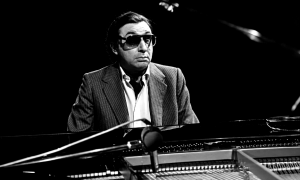
The Philadelphia native has played with remarkable consistency throughout his career and he doesn't just stick to one thing. This summer, he's doing some concerts with the group Canta Brasil, where he gets to dabble with one of his great loves: the music of Brazil. He also has his own working trio and the group Sphere, formed many years ago to play the music of Thelonious Sphere Monk, but long ago establishing itself as its own entity, still surfaces from time to time.
Barron can be found on any number of recordings with numerous giants of jazz. Check out his work with Yusef Lateef in the 1970s, ( Ten Years Hence is a desert island recording), his stellar work with Ron Carter's piccolo bass group, his sweet duets with Stan Getz on People Time or any of his own recordings, which have garnered five Grammy nominations. Barron can always be found at or near the top of fan and critics' polls. He's been on the top of his game for years, and is still learning, teaching and performing in excellent fashion.
His interest in jazz started in his childhood, growing up in a home where older brother Bill played tenor sax and had a good record collection that allowed Kenny to hear the jazz greats. "There was always music around the house. Bill had old 78 recordings with Charlie Parker and Dizzy and things like that. So I would listen to his records. And Philadelphia also had a great jazz radio station. So I heard it on the radio there as well," he says. "When I was old enough to go out and hang out, there were a lot of clubs there for local young musicians to go and play and work on their craft. So at about age 12, I actually really started listening to the music."
Tommy Flanagan, Hank Jones and Wynton Kelly were among his early influences, and he moved on to listen to more contemporary players like McCoy Tyner and Thelonious Monk. He also loved the work of John Coltrane and Clifford Brown, "and guitar players. Because they had a way of playing harmony and chords that really fascinated me."
Barron was studying classical piano from the age of six through high school, so his technique was developing. But so was his ear for jazz by listening to records and getting out to clubs. While he was still in high school, his reputation was such that he began getting calls to play with top musicians coming through town.
"The first gig of significance—well, they're all significant—but the first gig with anybody with a name was in high school. I worked with Philly Joe Jones when he came into town. Also, when I was still in high school, I played with Jimmy Heath."
Barron also played his share of non-jazz gigs as he honed his craft in Philly, a musical hotbed. "Growing up I played rhythm and blues. I played dances and stuff. We all did that. Rhythm and blues when I was growing up was a lot different than what you call rhythm and blues now. Rhythm and blues then was really music based on the blues and it had rhythmic changes. Sometimes it had a backbeat, but basically it was accessible music you could dance to. And music that was still harmonically challenging. And you had to improvise. You had to really play."
But for Barron, the route to jazz was clear, and he took it. Like most artists, it is the spirit of improvisation that called to the pianist. "That's really what it is. First of all, it's group-oriented music. So you're surrounded by like minds, so to speak. Then just being able to pluck notes out of the air and have it make sense. To be able to express yourself by doing that. It's really fascinating. Mostly I think melody. For me, that's the major thing, trying to play as lyrical as possible."
With experience and confidence, Barron knew he had to get to New York. He didn't hesitate at the age of 18 and made the move. "It wasn't such a big decision. It really wasn't that far. I just decided that was the place that I needed to be. I had gone there on a visit before. We went to Birdland and the Five Spot and heard some Latin music. I knew that was the place. I and to come to New York, so I moved the following year. My first gig was with James Moody. I sat in with him at the old Five Spot and he offered me the gig. During that time I also worked with Roy Haynes, Lou Donaldson. All this was 1961."
The association with Lateef—a very influential person in Barron's life—came not long after, even though their paths had crossed in Philly when Barron was still a teenager.
"My first encounter with him was in high school. He came through Philadelphia. You used to play a Monday afternoon matinee in Philly, 4 p.m. to 7 p.m. That was your first hit. His pianist missed a flight from Detroit, so he called Jimmy Heath about a pianist and Jimmy gave him my name. So I went and played the matinee. I was still in high school, so fortunately, I was home from school and got the call.
"Shortly after that I graduated and he asked me to come and play a gig in Detroit at a place called the Minor Key. Right after that, he asked me to write some music for him, which I did. I was very young. The record that came out was called The Centaur and the Phoenix and I had some original compositions and arrangements on there. Joe Zawinul was the pianist on the record. He was still with Dinah Washington at the time. It was a great experience. Then some years later, I started working with (Lateef) on a more full-time basis. It was during the late '60s and early '70s. He encouraged me to go back to school, so I went back to college. At one time, everybody in the bad was in college. So he was very influential in that way. He played a lot of my music, a lot of my original compositions, and recorded quite a few."
The list of jobs included work with Buddy Rich, Getz, Sonny Stitt, Sweet Edison, Sonny Fortune, Milt Jackson, Freddie Hubbard, Stanley Turrentine and more. In the 1980s, Barron took the piano chair in a band formed with saxophonist Charlie Rouse, drummer Ben Riley and bassist Buster Williams in a group called Sphere. Their first recording included several Monk pieces, and with Rouse and riley being two key Monk sidemen, the appearance was that of a Monk tribute group. But they soon moved into their own bag. And after a hiatus (and the passing of Rouse), the band reunited and still exists.
"It was a cooperative effort. It started out as a trio. Myself and Ben Riley and Buster Williams. We had been the rhythm section for Ron Carter. When that band dissolved, the trio stayed together. We functioned as a rhythm section for a lot of people that came to town. Sweets [Harry Edison] and Lockjaw [Eddie Davis], Sonny Stitt. So we decided we should just get a horn player. It was Ben's idea to call Charlie Rouse. We got a couple gigs to see how it would work and it came out great. That was kind of the beginning.
"A few years later, people had been asking if the band was ever going to get back together. We would each get that question from our various travels. So we talked about it and said: Let's try it. We wanted to get someone from our generation. We decided on Gary Bartz. He was one of our peers, but he also played a different instrument, which would add another color. He played alto, and soprano. His playing had more of an edge than Charlie's playing. So that changed the sound of the group a little bit. But it was still Sphere."
Another outlet for Barron's creativity is Brazilian music, which he encountered while playing with Dizzy Gillespie in the 1950s. "We played some Brazilian pieces. But I really got interested when I heard a group called Brazil 55, Sergio Mendes. I heard it on the radio in San Francisco and I immediately went out and bought the record. I've been in love with Brazilian music ever since."
He has been touring this summer with Canta Brasil, playing pieces that are Latin mixed with jazz. Barron says he is more influenced by Brazilian composers than any particular instrumentalist.
Regardless of the setting Barron is capable of fitting in, with his mammoth technique and great tone. He said, for example, that the People Time duet with Getz was a gas, fitting with his lyrical style. But with other musicians, he would call upon other elements, so hat everything fits.
"You're influenced by your musical environment. (Getz) was a very lyrical player, so I was influenced by that. If I was playing with somebody like Albert Ayler, just to draw a name out of the hat, my playing would be a lot different. Because I am influenced by the musical environment. Trying to play with who I'm with, so to speak."
And the list of people Barron plays with continues to grow. He's not at a loss for work, but he admits the jazz scene isn't what it used to be.
"It has changed, but people are still able to make a living. If you're a young person, it's definitely changed, if you're trying to break into it. It's not like it used to be in terms of gigs and venues and things like that. But everything does change. But in New York, I think it's very healthy. Every night you can go to seven or eight jazz clubs, major jazz clubs. You can't do that anywhere else in the states. Or anywhere else in the world, actually.
"The thing that's changed is touring possibilities in the states have really dwindled. We used to be able to go out on the road in the states for months. You can't do that now. If you can book a tour, for a jazz artist, for three weeks, you're doing great. When I was with Dizzy, we'd be out for four months at a time. That's unheard of now. In that respect, it's changed. You could go to a club and be there for one month or three weeks. Now it's three days, maybe."
The recording scene is also hurting, he said. Record companies are no longer owned by people concerned with the music. Record executives of old, like Norman Grantz, "loved the music. But now it's big business. You have people in control who aren't necessarily big fans of the music."
"A lot of the companies now, major jazz labels if you want to call them that, are now basically recording vocalists. It seems to sell for them," he says. "They are businesses and it is about money. That is the bottom line. How many records will you sell? Unfortunately. I don't like it, but that's the way it is. If somebody like Norah Jones sells 14 million records, then obviously that is a great formula. Let's try that again. Whereas, most major jazz artists, if they sell 20,000 or 30,000 copies of a CD, that's a lot."
Barron has been involved in teaching for some time at Rutgers University. It helps him spread the word of jazz and helps him keep busy. "I don't know if I'm influencing anybody with my music. But as far as teaching, I think I have had an influence on people I've come in contact with. That is satisfying. Some I've been able to help."
Modestly said. Barron's playing is one of the exquisite pleasures of jazz and young piano players facing the challenges of the music would do well to listen to this master at work.
About Kenny Barron

Tags
PREVIOUS / NEXT


Become a Sustaining Member

Since 1995, All About Jazz has championed jazz as an art form and supported the musicians who create it. Over three decades, it has grown into one of the world's leading jazz resources, serving hundreds of thousands of readers, musicians, presenters and industry professionals each month.
Help Build the Future of All About Jazz
Your support helps us continue building All About Jazz for the next generation—expanding our editorial coverage, preserving jazz history, developing new community features and creating better ways to discover the music and the people behind it.
Become a sustaining member for as little as $20 per year and you'll immediately enjoy an ad-free experience along with access to subscriber features and future articles for a full year.
Together, we're not simply sustaining All About Jazz—we're building its future. Thank you for being part of the journey.