Home » Jazz Articles » Album Review » Jimmy Scott: The Savoy Years And More...
Jimmy Scott: The Savoy Years And More...

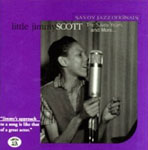
But the wounds?. After a childhood involving a hereditary condition called Kallman's Syndrome, the early death of his beloved mother when her arm was ripped off saving his sister from an automobile accident, a rarely present father, a year in a foster home, lack of acknowledgement in his early Lionel Hampton recordings (listed on the albums only as "the singer"), serious contract disputes with Savoy head Herman Lubinsky that stalled Scott's career, and working at the Cleveland Sheraton in mid-life to care for his invalid father, only Scott's solid determination led him to continue his career in singing.
As The Savoy Years and More?, a 3-CD set, verify, Scott's determination is the listening public's reward. With a unique singing style that stresses elongation of tones to an unusual length and a diction that lends significance to each phrase, Scott has developed an uncanny ability to wrap up the lessons of his life into a voice that pierces the soul of the listener in a way that few other vocalists can achieve.
After his early uncredited success with Hampton on Everybody's Somebody's Fool, which he generously brought to Hampton's attention after learning of it at the Apollo Theater, Scott moved on eventually to Savoy, where some of his earliest and best-known recordings were made. Having become attuned to Hampton's vibes early in his career, Scott continued to add vibists as available like Terry Gibbs, Phil Kraus and Milt Jackson, perhaps because of the resemblance of vibes to the human voice.
Starting in 1952, and promoted tirelessly by his advocate Fred Mendelsohn, Jimmy Scott released a series of recordings, most of them under three minutes in length, that brought him to wider attention. The Savoy Years and More? includes 62 of those tracks, presented in a progression from the first side to his latest recording in 1960. Following the bitter disputes about releasing his albums on other labels, which made them instant collectibles commanding up to $300 an album, Scott returned to Savoy in 1975 for one last recording with strings on that label. His recordings became lusher as strings were added in the later albums, and the sparseness of his earlier recordings actually promote Scott more effectively. The function of the back-up is to accentuate his thought and then to stay out of his way.
Incorporating his story-telling prowess to address themes of love and pain and perseverance, the impression from listening to Scott's Savoy recordings over 23 years is his consistency. Honest in his approach and feeling, Scott never lost his ability to break through a listener's defenses or varied his style. What you hear is what you get, from 1949 to 1999. Despite the back-up of talents like Terry Gibbs, Jerome Richardson, Charles Mingus, Skeeter Best or Kenny Clarke, Scott is never overshadowed, not even when the instrumentalists solo. Each track, and each song, belongs to one of the generation's most influential and most overlooked singers. In fact, Mingus walked out of a recording session with Scott because Mingus couldn't understand at that time why Scott staggered the beat.
Songs like After You've Gone take on a new multi-dimensional meaning when Scott sings it, veering as far away from the upbeat Dixieland version we usually hear as possible. There's absolutely no denying that Jimmy Scott will be blue, or in fact devastated, after he's left alone. When Did You Leave Heaven? reportedly inspired Nancy Wilson to the extent that she used to keep taking her father's records of that song and eventually led her to record her own tribute version. And When You Wish Upon A Star is sung, not wistfully as other singers would address it, but inspiringly as if there will be no doubt that dreams can come true. The conviction and clarity of Scott's voice ironically have a power that belies the smallness of his frame and the openness of his face.
Thanks to Orrin Keepnews for continuing to produce reissues of valuable early artists whose influential early works would have been neglected otherwise. While Scott's recordings in the 1990's document where he's been, The Savoy Years and More? document his early wisdom and his freshness that merely became more seasoned over the ensuing decades.Collective
Personnel

Jimmy Scott
vocalsCollective Jimmy Scott, vocals; Budd Johnson, George Berg, Warren Luckey, Buddy Lucas, tenor sax; Dave McRae, alto and baritone sax; Leslie Johnakins, baritone sax; Jerome Richardson, flute and tenor sax; Terry Gibbs, Phil Kraus, vibes; Howard, Biggs, Lincoln Chase, Robert Banks, Carl "Ace" Carter, Kelly Owens, piano; Hy White, Mundell Lowe, George Barnes, Sal Salvator, Everett Barksdale, Mickey Baker, Lord Westbrook, Charles May, Skeeter Best, Bucky Pizzarelli, guitar; Charles Mingus, Al Hall, Al Lucas, Jack Lesberg, Wendell Marshall, Lloyd Trotman, George Duvivier, Leonard Gaskin, Abe Baker, bass; Rudy Nichols, Louis Bellson, Arthur Edgehill, Dave Bailey, Cliff Leeman, Paul Gusman, Bobby Donaldson, Sol Hall, Kenny Clarke, Bunny Shawker, drums
Album information
Title: The Savoy Years And More... | Year Released: 1999 | Record Label: Savoy Jazz
About Jimmy Scott
Tags
PREVIOUS / NEXT

Become a Sustaining Member

Since 1995, All About Jazz has championed jazz as an art form and supported the musicians who create it. Over three decades, it has grown into one of the world's leading jazz resources, serving hundreds of thousands of readers, musicians, presenters and industry professionals each month.
Help Build the Future of All About Jazz
Your support helps us continue building All About Jazz for the next generation—expanding our editorial coverage, preserving jazz history, developing new community features and creating better ways to discover the music and the people behind it.
Become a sustaining member for as little as $20 per year and you'll immediately enjoy an ad-free experience along with access to subscriber features and future articles for a full year.
Together, we're not simply sustaining All About Jazz—we're building its future. Thank you for being part of the journey.