Home » Jazz Articles » Extended Analysis » Chris Potter: Chris Potter: The Sirens
Chris Potter: Chris Potter: The Sirens

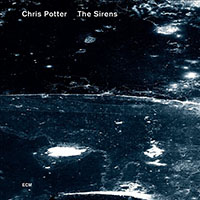
ECM has always had its eye on the US—again, a look at its history reveals that, while it has certainly focused deserved attention to other parts of the world, the label has never ignored the country where jazz began. With ECM's Manfred Eicher turning an even more open eye to the United States in general and New York in particular during the past couple of years, it's clear that there's change in the air. Sure, New York has always been a jazz Mecca, with plenty of serious action, but a number of artists have been catching his attention of late, artists like pianists Jason Moran and Craig Taborn; bassists Larry Grenadier and Michael Formanek; drummers Gerald Cleaver and Eric Harland; and saxophonists Tim Berne...and now Chris Potter. That Potter has enlisted three of these players for The Sirens—plus one very important wildcard—means he's got a group capable of just about anything.
The Sirens retains the distinctive muscle and firepower that's made Potter so vastly influential but, unsurprisingly, posits some new perspectives as well. It represents a return, after the saxophonist's last few years with Underground—which also (likely not at all coincidentally) included Taborn—to an all-acoustic environs, but if the idea of Potter in a more traditional setting with piano, bass and drums suggests something predictable, the wildcard here—beyond a stellar assemblage which is anything but predictable—is the presence of two pianists. Taborn—heard here solely on grand piano—is another rapid riser of Potter's vintage; a keyboardist as comfortable in the more outré context of saxophonist Tim Berne (another recent label recruit with last year's stellar Snakeoil) as he is Dave Holland's more centrist, forthcoming and very electric Prism group, his own ECM leader debut, Avenging Angel (2011), was an encyclopedic tour de force that ranks among the label's best solo piano recordings.
Bassist Larry Grenadier and drummer Eric Harland, beyond their extracurricular activities with popular groups like pianist Brad Mehldau's Trio and James Farm, will be no strangers to fans of the label, the bassist heard most recently with the collective Fly Trio's Year of the Snake (2012), while the drummer continues his tenure with saxophonist Charles Lloyd, last documented on the ambitious Athens Concert (2011).
But it's David Virelles, a relative newcomer—not just to ECM but to the scene in general—who adds the difference that turns what would, no doubt, have been a great session into a positively stellar one. A Cuban expat who first appeared in more conventional Afro-Cuban surroundings with Canadian soprano saxophonist Jane Bunnett, Virelles (turning thirty later this year), began moving away from his musical roots—though they remain, of course, an unavoidable undercurrent—with his fine Pi Recordings debut, 2012's Continuum. Here, contributing prepared piano, harmonium, and the chime-like celeste, Virelles also appears to be on a rapid upward trajectory, his interactions with Taborn particularly notable, the two engaging at a deep level during "Nausikaa" and in the ethereal album closer, "The Shades"—the only track not attributed compositionally to Potter and, in fact, a free improv duet for Taborn and Virelles that's clearly as much about listening as it is playing, with each pianist responding to the other with patient, Morton Feldman-minimalism.
But if these two examples imply that Potter has in any way toned down his approach, the fiery opener, "Wine Dark Sea," lays any such suggestions to waste. A rubato intro, with Potter's unmistakable tenor leading the way, turns to a strong 4/4 pulse driven by Grenadier and Harland, Taborn's arpeggiated support also meeting in unison with Potter's singable theme before opening up to a powerful and extended solo section. Potter's combination of sinewy strength and firm focus is matched by Taborn, whose solo quickly moves from chordal devices to rapid-fire, motivic lines uncannily linked with Harland's cadential snare.
The following "Wayfinder" is more suggestive, however, of The Sirens' directional shift. While Harland's bass drum-heavy rhythm provides a foundation and Potter delivers a clear theme, Grenadier does anything but lay down an anchor, interacting with Taborn and Virelles, whose prepared piano acts as a buzzing contrast to Taborn in an open-ended section that also relies on Harland's ability to, at once, maintain groove and push and pull his band mates. For two increasingly energetic minutes, Taborn's effortless virtuosity is countered by Virelles, who moves seamlessly between prepared piano and celeste to help create shifting moods within a seemingly unfettered section whose allegiance to form is revealed when, magically, the group again coalesces around Potter's now-knotty theme before the saxophonist turns in an incendiary solo over Grenadier and Harland's driving pulse. Things remain unsettled, however, with Taborn and Virelles maintaining some of the cacophony of the middle section before reuniting for a final thematic reiteration and conclusive ending.
What's perhaps most definitive and different about The Sirens is its broad reach. "Dawn (With Her Rosy Fingers)" is a warm ballad, while the nine-minute title track is a rubato tone poem that features Potter on bass clarinet and Grenadier con arco, its darker disposition still leading to a more powerful conclusion when Potter switches to tenor. "Penelope" is a swinging waltz with Potter on soprano, while "Kalypso" is a "changes, no time" piece of collaborative free play that still, at times, manages to resolve into time. Throughout, Potter and his group deliver a combination of effortless control and thoroughly unshackled liberation.
Through it all, there's no mistaking this for anything but a Chris Potter record, but with The Sirens he's delivered one unlike any he's done before. An eclectic album that couldn't have happened without what's come before, it's nevertheless a signpost of significant change, as the saxophonist opens himself up compositionally—and, from a performance perspective, one that, if he can keep this remarkable group together, promises even better things to come.
Track Listing
Wine Dark Sea; Wayfinder; Dawn (With Her Rosy Fingers); The Sirens; Penelope; Kalypso; Nausikaa; Stranger at the Gate; The Shades.
Personnel

Chris Potter
saxophone, tenorChris Potter: soprano and tenor saxophones, bass clarinet; Craig Taborn: piano; David Virelles: prepared piano, celeste, harmonium; Larry Grenadier: double bass; Eric Harland: drums.
Album information
Title: The Sirens | Year Released: 2013 | Record Label: ECM Records
Tags
Chris Potter
Extended Analysis
John Kelman
ECM Records
United States
New York
New York City
Red Rodney
Dave Holland
Steve Swallow
Paul Motian
jason moran
steely dan
Michael Brecker
Manfred Eicher
Craig Taborn
Larry Grenadier
Michael Formanek
Gerald Cleaver
Eric Harland
Tim Berne
brad mehldau
James Farm
David Virelles
Jane Bunnett
Morton Feldman
Chris Potter: The Sirens
PREVIOUS / NEXT

Support All About Jazz
 All About Jazz has been a pillar of jazz since 1995, championing it as an art form and, more importantly, supporting the musicians who make it. Our enduring commitment has made "AAJ" one of the most culturally important websites of its kind, read by hundreds of thousands of fans, musicians and industry figures every month.