Home » Jazz Articles » We Travel the Spaceways » Before We Say Goodbye To 2012
Before We Say Goodbye To 2012

Before we turn our attention fully to 2013, here are some 2012 releases that deserve a listen.
 Sam Newsome
 The Art of the Soprano, Vol. 1
Self Produced
2012
When something is as graceful as an athletic touchdown catch or as beautiful as a landscape, it is quite easy to keep returning to it. Even the untrained can appreciate pure beauty. Such is the case when musician Sam Newsome plies his art, the solo saxophone.
In his case, the soprano saxophone, perhaps the most difficult to master. One can probably count the significant living soprano players on one hand. That maybe why each solo release by Newsome is such a treat. The Art of the Soprano, Vol. 1 follows two other self-released albums, Monk Abstractions (2007) and Blue Soliloquy (2009). Here he guides us through recognized territory, John Coltrane's A Love Supreme from 1965 and a medley of Duke Ellington tunes, plus his own "Soprano de Africana" suite.
Playing solo, this one man band uses occasional overdubbing to simulate the percussive parts of his Africana suite. He pairs his cluck and slap tongue approach with flowing notes to multiply his sound, otherwise he maintains the narrative himself. Newsome's take on Coltrane's masterpiece is both reverent and ultimately fresh. Playing notes into the strings of an open piano, he is able to achieve overtones and echoes that elevate the harmonics without studio effects. With an arsenal of sound, this recording never seems to lag.
In many sci-fi B-movie plots there always seems to be a some type of science experiment that goes horribly wrong. This, of course creates a monster that has to be dealt with. In music, leviathans are not built in a laboratory, but in music practice rooms. They still require that we 'deal' with them. Consider tenor saxophonist Ivo Perelman. The Brazilian-born painter and musician with a Godzilla of a sound, he can be heard on five (count them) stellar releases in 2012. Each disc begins with his quartet of pianist Matthew Shipp, guitar/bassist Joe Morris, and drummer Gerald Cleaver, first heard on the disc The Hour Of The Star (Leo Records, 2011). Perelman then slices and reconfigures the quartets molecules to come up with new strange and beautiful creatures.
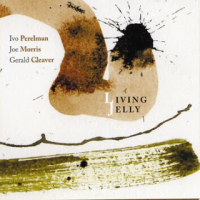 Ivo Perelman/ Joe Morris/ Gerald Cleaver
 Living Jelly
Leo Records
2012
Living Jelly excuses Shipp and plays in trio formation with Joe Morris wielding his electric guitar over bass. Like each new disc, every track is spontaneously composed. Without a bassist, this session opens up, free of a strict timekeeper's watch. Nimble is the tone on "Playing With Mercury," Perelman squeezing out upper register blurts against the nimble fireworks of Morris and Cleaver's stick work. Where a lesser band might get repetitive with such freedom, this trio seems to prefer a coherent message. The bluesy slur of "The Sloth" compliment the almost-bebop of "In Pursuit Of Pleasure."
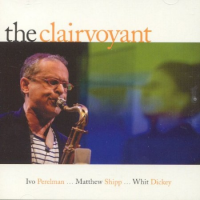 Ivo Perelman/ Matthew Shipp/ Whit Dickey
The Clairvoyant
Leo Records
2012
The saxophonist reunites with Shipp and adds drummer Whit Dickey, (both having worked with the late saxophonist David S. Ware) on The Clairvoyant. Again, sans bass, the role is often filled by Dickey's drum kit. What weaves throughout this disc is a sense of exploration. The trio is constantly marking each other's notions, reacting and anticipating some move or direction. They come off with a fumbling blues touch on "Ritual" with Perelman opening up with his jelly smeared Albert Ayler-sound. Shipp, dances around blues here and then stakes his claim by returning fire on "Torture And Glory." Besides holding down the beat, Dickey is a fine colorist. Where Shipp and Perelman are instigators, the drummer is content to support.
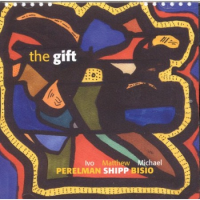 Ivo Perelman/ Matthew Shipp/ Michael Bisio
 The Gift
Leo Records
2012
The Gift swaps Shipp's trio partner Dickey for bassist Michael Bisio.
Without a drummer the trio delivers eight shortish improvisations and two lengthier tracks with the longest, (clocking in at 13:06) "A Flower Bewitched And Too Bright By Far," and the most introspective. The three complete each task with a reasoned articulation that might be the hallmark of Perelman's sound. The title track begins with a very Carl Stallings cartoon-like walk from Shipp. He seems to be goading the saxophonist towards a bit of mayhem. The saxophonist works the upper registers dancing over the runs. Elsewhere the trio makes some lounge-like jazz sounds on "What Is this Anguish?," playing within the form and the formalities of the perceived jazz tradition.
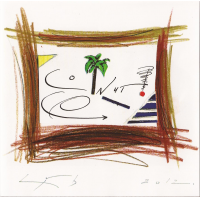 Eric Boeren Quartet
 Coconut
de Platenbakkerij
2012
It is, perhaps unfair to continue to draw comparisons of Eric Boeren's Quartet to that of Ornette Coleman's circa. 1960. Sure the piano-less quartet, founded in 1979, covered primarily Coleman's music and indeed, Boeren plays a cornet, the same type fancied by Don Cherry. In the years since, their evolution has yielded a distinct musical personality.
Coined by journalist Kevin Whitehead, the term "New Dutch Swing" is a befitting descriptor. The release of Coconut follows Song For Tracy The Turtle (Clean Feed, 2010) another live date with drummer Paul Lovens. Where the latter was recorded in 2004, Coconut was made in the Netherlands in June 2012. And, probably more significant, the heart-and-soul of the band, drummer Han Bennink is back in the drum chair. Rounding out the original line up is American expatriate Michael Moore (saxophones) and bassist Wilbert de Joode. This exceptionally well-recorded live date finds Bennink playing a single snare drum. Which, of course, is more than enough for him to command his brand of mayhem. Boeren penned eight of the eleven tracks, the band covering two Ornette Coleman tunes, "Little Symphony" and "Joy Of A Toy," plus Booker Little's "BeeTee's Minor Plea." Never mind the heady intellectual nature of jazz today, this quartet favors a relaxed swing fueled by Bennink and the ongoing conversation between players. Moore tends to finish Boeren's thoughts and de Joode is spurred by Bennink to change direction and tempo throughout. Their playing calls to mind rapid fire comedians who barely pause to allow their audience to catch the last joke.
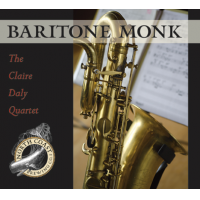 The Claire Daly Quartet
 Baritone Monk
North Coast Brewing Co
2012
Baritone saxophonist Claire Daly's salute to jazz legend Thelonious Monk is an unrepentant delight. Certainly, there have been hundreds of Monk tribute recordings, but Daly's undertaking is quite special. Recorded for North Coast Brewing, makers of the aptly named Brother Thelonious ale, this disc and the previous Brother Thelonious Quintet (North Coast, 2009) with Ambrose Akinmusire donate all proceeds of discs sales to The Thelonious Monk Institute Of Jazz.
Daly's take on Monk pairs the familiar, Monk's "Teo," "Ruby, My Dear," and "Pannonica" with the obscure, "Green Chimneys," "Two Timer," and "Brake's Sake." But even the familiar is renewed by way of Daly's baritone. Although Monk did work with baritone players (Pepper Adams and Gerry Mulligan come to mind), Daly's presence is emphatic. She brings a comfortable swing to the tunes like a blanket of snow that quiets a busy city. With pianist Steve Hudson, bassist Mary Ann McSweeney, and drummer Peter Grant, the eleven selections are delivered almost effortlessly by the band. Highlights include a poignant "Light Blue" with Daly in conversation with McSweeny's bowed bass, "Bright Missisppi" that skips and plops some energized bebop, and the tangled "Let's Cool One." Hudson, although at the piano chair, eschews any direct Monk references, instead sticking to contextual playing, a little slow stride on "Green Chimneys" and deft maneuvering of theme on "52nd Street Theme." Daly swaps saxophone for flute for "Pannonica" and a bit of vocals with the closer, "Holiday Medley—A Merrier Christmas/Stuffy Turkey."
 DKV Trio
 Past Present
Not Two
2012
One of saxophonist Ken Vandermark's earliest Chicago collaborations was in DKV Trio with drummer Hamid Drake and bassist Kent Kessler. While the trio has not released a recording in ten years, the last being Trigonometry (Okka Disc, 2002), this limited edition box set certainly makes up for lost time. The seven disc, nearly 6.5 hours of music documents the band from a (sort of reunion) show recorded 2008 in Sardinia, through an appearance in Chicago 2011. Naysayers and traditionalists might suggest an editor or producer might have pared these seven discs down to a more manageable two-disc set. One which would have been more marketable, and thus consumed by a larger audience. If you follow the theory out, maybe 30 years from now, this lengthy 'complete session' could be released as an archival 'find.'
But then that is not how Vandermark operates. Past Present fits nicely on the shelf with such behemoths as his 12-cd Vandermark 5 Alchemia (Not Two, 2005) and the 10-CD Resonance (Not Two, 2009).
This full immersion style of consumption is not just for Grateful Dead or Fugazi fans any more. Vandermark, and his musical guardian angel Marek Winiarski of Poland's Not Two Records (like Bruno Johnson of Okkadisc before him) believe more is better. Agree, or disagree this box set is a juggernaut of improvised sound making.
The seventh disc, titled Bonus Disc brings DKV full circle from their origins. Recorded in Sant'Anna Arresi, Sardinia, the band covers the music of Don Cherry as they have on Live in Wels & Chicago, 1998 (Okkadisc, 1999) and Trigonometry (Okkadisc, 2002). Like their European comrades, The Thing (Mats Gustafsson, Paal Nilssen-Love, and Ingebrigt Håker Flaten, Cherry's music is a touchstone to their original material. His music is also the codex to understanding DKV's methods.
Like Don Cherry, the trio never hesitates to bring all types of musical language to their instant composing. Vandermark, the ever organizing force, catalogs and coordinates throughout. His knack to bring order from improvisatory chaos is the glue here. Together, the three bring rocked-out sensibility together with ethereal free improvising, some funk, both minimalist and shouting improvisation, moments of gripping music making, and lengthy soloing. If you've got the time, this journey is quite rewarding.
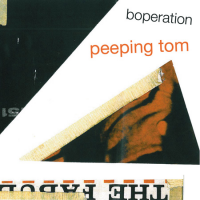 Peeping Tom
 Boperation
Umlaut
2012
What if we could go back in time? Back to an era when bebop was as controversial as hip-hop is now, and jazz musicians were either glorified as trailblazers or denounced as traitors. Surely, we don't want to return to a time when Miles Davis is beaten by the police or Lee Morgan shot, but we do hunger for jazz music to be part of the musical discussion, and maybe just a little argument would be okay.
Enter the French-Swedish-German quartet Peeping Tom whose revival of bebop reignites the music as a cause célèbre. What trumpeter Axel Dorner, saxophonist Pierre-Antoine Badaroux, bassist Joel Grip and drummer Antonin Gerbal accomplish, is the mixing of modernist, sometimes minimalist free improvisation with pure bebop. Their Boperation follows File Under: Bebop (Umlaut, 2009) with the quartet re-imagining classic bop, this time covering tunes by Elmo Hope, Herbie Nichols, Fats Navarro, and George Wallington. Like John Zorn's News For Lulu or Dörner's work with Alexander von Schlippenbach and Die Enttäuschung, the band displays a disdain for the note-for-note recreations of the today's neoconservatives. While they stay true to each song's changes, they inject enough mayhem to make things debatable. Bud Powell's "Fantasy in Blue" is slowed and drawn-out into a lament, but "Mo Is On" by Elmo Hope is played with all speed. That is before it is dissected and reassembled from composed to free jazz, back to composed.
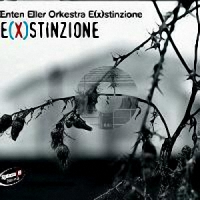 Enten Eller Orkestra
 E(x)STINZIONE
Splasc(H) Records
2012
Expansive and sprawling, this orchestrated multimedia show (sadly, only the soundtrack here) is perhaps the Italian jazz equivalent to Pink Floyd's The Wall (Columbia, 1979). Constructed by the Northern Italian quartet of Alberto Mandarini (trumpet), Maurizio Brunod (guitar), Giovanni Maier (bass) and Massimo Barbiero (drums), known as Enten Eller, this event features the quartet, and augmented version dubbed Orkestra E(x)STINZIONE. Swelling to eight players, plus a string section of another fifteen, the Orkestra tells the story of Italy's declining industrial base and the impoverishment of the blue collar worker.
Part jazz, classical, and part rock opera, this chronicle unfurls with a spoken and sung narrative by Laura Conti that is both poetic and elegiac. She sets up the various parts that can rock out, with bits of funk heard in "Porte Basse" or modern jazz swing "Genetic Deficit," with Marcella Carboni's harp and Brunod's electric guitar. Mandarini's arrangements deftly switch between styles, yet keep the whole intact, weaving the string orchestra into the storytelling.
Guest trombonist Giancarlo Schiaffini and Carlo Actis Dato (saxophone and clarinets) mingle with the score. "Praxis," a heavyweight section, doses electric guitar versus full orchestration and voice. The free section of "Torquemada" allows Dato to go toe-to-toe with the Orkestra, bouncing cries off Maier's bass notes before the piece coalesces into a managed march. This is one ambitious and entertaining effort.
 Jeb Bishop/ Jorrit Dijkstra
 1000 Words
Driff Records
2012
The intersection of certain jazz players is rarely by happenstance. In the case of alto saxophonist Jorrit Dijkstra and trombonist Jeb Bishop, their like-minded approach to music certainly attracted each other to collaborate. Both can be found in Dijkstra's sextet The Flatland Collective, his octet Pillow Circles, and in his Steve Lacy tribute band The Whammies. Both are accomplished solo players.
This duo, recorded with stellar acoustics, features 12 composed pieces, some soloing, and a fine display of extended technique. Each player contributes writing. Where, for instance they are credited as co-authors, the pieces are unmistakably improvised. Such is their interplay, these pieces give the impression that their great minds think alike. The improvisation "Standpipe" begins with simple tones, plus burping and breathy horns that simmer a minimalist approach. The title track works Dijkstra's melody line and commingled horns into a post-bebop tune. The pair often trade long smooth lines as a support for the other's soloing. They can sooth as with "Ice" or bring the honk-fest "Klopgeest." Their varied, yet harmonious approach is a fine musical indulgence.
Alessandro Bosetti finds the sound of music. Correction: Alessandro Bosetti finds the music of sounds. Like John Cage or Bern Porter before him, repetition of sound, be it noise, musical notes, or voice often become his compositions. Does he consider himself to be a collector of field recordings or a composer? Maybe both. His early recordings were minimalist free improvisations efforts, usually playing a soprano saxophone with the likes of Michel Doneda, Annette Kreb, and Bhob Rainey. He then moved into the exploration of speech loops and found sound, cutting himself from the randomness of improvisation by finding a distinct order from seemingly arbitrary sounds. What distinguishes his recent music is a strong performance aspect.
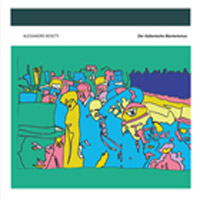 Alessandro Bosetti
 Der Italienische Manierismus
Con-V
2012
Der Italienische Manierismus opens with "Rosso," and the seemingly randomness of minimalist improvisation where he draws from the breath blown (without notes) in a horn (is it Bosetti's soprano?). He then layers loops of voices into an ever increasing volume of 'noise.' Stops all with a dramatic pause, then returns with voice only. Bosetti guides listeners to consider the musicality of the noise through the vehicle of repetition. Such is the case with "Our Positions (for Corrado Costa)" where he repeatedly reads several sentences. The meanings of the words (the same words) morph with the redundancies. They express the same thought, yet intimate something else altogether. Then again, the same can be said for musical notes he chooses. "Dolce Stilnox" mixes a conversation by Valentina Picello over electronic beats and piano, generated not so much as accompaniment but interference. Often, he will merge two dissimilar events, a sampled baby, some dissonant piano, and low-end bass chords heard on "Proust." These collages or aggregations become something more than the sum of their parts, something new altogether. The disc ends with "It Is An Island (for Guiseppe Archiboldi)" Bosetti's now signature sound generation, where repeated text is accompanied by a matching harmonious notes. Instead of notes played on piano, he utilizes an assemblage of tuned crashing noise. Notes that eventually take over the text, as ocean surf pounding the shore.
 Alessandro Bosetti/ Trophies A Color Photo Of A Horse DS al Coda 2012
 Alessandro Bosetti is a master of sound assemblage, mixing samples and notes to create (or perhaps discover) a musical language. Sound collage, a discipline performed in one's own studio is one thing, taking those creations live, playing them with other musicians is quite another. With his trio Trophies, Bosetti realizes his creations with guitarist Kenta Nagai and drummers Tony Buck, and heard on A Color Of The Horse Ches Smith.
Perhaps the most accessible of his recent work, these six tracks follow up on Royals (Monotype, 2010). The trio covers Bosetti's now signature composition "Gloriously Repeating." With Bosetti speaking the lines, his electronics and Nagai's guitar imitate the words' pitch, rhyme, and meter. As with his knack for making music room conversation, adding a backing band validates his sound experiments. The title track reiterates the spoken words, but with Nagai and Smith there is an underlying commentary, as opposed to Bosetti's solo work, where the backing might be found sounds. Smith is a persistent and indefatigable presence supplying continuous motion and sound energy. Mostly eschewing groove, he does supply a constant beat in "Errepikatzen" (Basque for 'repeated') with Nagai freed to blend bits of rock and funk to Bosetti's spoken word and pin-ball machine electronics. The adrenalized "Istruzioni" (instructions), which could find itself one day covered by Tyondai Braxton or the Zs, finds Trophies in hyper-drive burning through Bosetti's muscular Italian tutelage, like John Cage punk rocker.
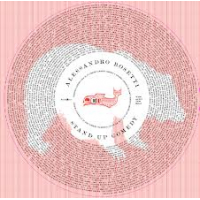 Alessandro Bosetti
Stand up Comedy
Weird Ear
2012
Released as a two-sided LP pictured disc (limited to an edition of 300) or available as a download, Stand Up Comedy (Weird Ear, 2012) comprises two lengthy pieces. Side A, recorded during Bosetti's US and European tour, finds the artist interviewing audience members, telephone callers and radio hosts (some knowing, others not) using his mask/mirror machine that blurps out "yes" or "no," some isolated phrases, noises, and intrusions. Seen as an extension of Futurist experiments from the early 19th century, Bosetti's confabulations are part performance/part musical, with varying sine waves as background. Side B is comprised of a lecture given by an unknown person(s) reread by Bosetti in performance. His recreation is chopped and repeated to recontextualize the words along with electronics, violin, and bass clarinet. The violin and bass clarinet chirp out insect or bird calls as repeated machined sounds. With any work by Bosetti, it is difficult to determine if the score came before the texts, or if the texts were sampled in response to the score.
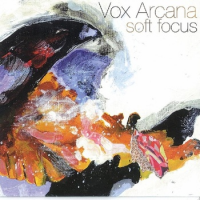 Vox Arcana
 Soft Focus
Relay Records
2012
Of the 15 or so bands that drummer Tim Daisy participates, Vox Arcana might be his most personal, and maybe the most immediate. This trio of Daisy, cellist Fred Lonberg-Holm and clarinetist James Falzone incorporates modern composition, chamber jazz, and plenty of free improvisation into a stripped-down ensemble. Daisy plays a minimal kit, plus marimba, and Lonberg-Holm doubles on tenor guitar here.
Soft Focus is the trio's third release, and even though it clocks in at a mere 37-minutes, each economical piece is priceless. The disc opens with "De Grote Olifant," and the dynamic bowing of Lonberg-Holm, that edges first toward free jazz before opting for a chamber jazz dynamic. Daisy with mallets in hand and Falzone's merciful notes soften the edge. Not that the piece isn't a churning ball of energy. The band doses the clement with the roil. The pacific title track summons the emotional via marimba, pluck cello, and graceful horn. Vox Arcana can draw listeners in for a respite, they can also set one on edge with stop/start compositions, like "The Raft," minimalist improvisation "Minature 2," and drill sergeant maneuvers, "Other Lights."
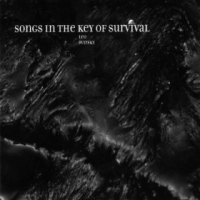 Leo Svirsky
 Songs In The Key Of Survival
Ehse Records
2012
It is debatable whether pianist Leo Svirsky is a Buddhist. It is conceivable his is, at least the music heard on Songs In the Key Of Survival was conceived in Zen. This solo effort (released as a CD/LP/download) by the Hague-base musician puts music to text found on protest placards from recent demonstrations. Each fragment of words can be taken as a koan, "sell yourself until you can afford to buy yourself back," or "the splinter in your eye is the best magnifying glass," or just as happenstance.
Sure, the hipster might take this music for irony's sake. But delivered with an earnest and unaffected tone the music comes off as sincere. Svirsky, a classically trained pianist, is equally at home with the music of John Cage and Cecil Taylor. He dances on the keys, making a gamboling run of notes that mimic a juggler's routine on "A Storm Blows From Paradise..." and "Engführung (Straitening)." He can extend the dynamics of the keyboard with "Ricercare," working the hammers as pistons firing an internal combustion of energy. He also uses silence mid-track to induce contemplation. His music is both meditative and enlightening.
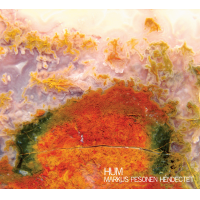 Markus Pesonen Hendectet Hum Unit Records 2012
 Guitarist Markus Pesonen's 11-piece Hendectet opens Hum playing a combination of Rage Against The Machine-meets-Henry Threadgill's Very Very Circus bad. Maybe it's the tuba/trombone/electric guitar combination that fuels this passionate entrance, but Pesonen means to make a statement. This Finnish guitarist/composer based in Copenhagen assembled this Danish and german ensemble to realize these six original tunes, plus two familiar standards, one from jazz the other from pop music). His music is more than noise though. "Hullin Paperit" grows organically from a dreamy sequence of sine wave electronics into a spacey exploration of sound. The appeal here is the flexibility of this large ensemble. The shortish "Sugar Rush" favors an urgent swing and the title track brings to mind Peter Brötzmann's Sonore unit with the intermingling of horns. Pesonen is a fine arranger, this is evident on his adaptation of Charles Mingus' "Goodbye Pork Pie Hat" and The Beatles "A Day In The Life." Both played with loving care, Mingus almost played straight through and the Lennon/McCartney given over to vocalist Elena Setién. The Hendectet maintains the song's eccentric nature, especially the implosion of noise from the final orchestral crescendo. Pesenen certainly loves to turn you on.
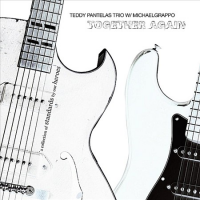 Teddy Pantelas
 Together Again
Tatsou Records
2012
Jazz listeners, especially those who have come to the music in the last 30 years, might not be aware of the provincial nature of jazz players and their music. While we all know of the prodigious talents of Joe Lovano, few are aware of his father Tony 'Big T" Lovano who was a Cleveland institution of a saxophonist. Locals knew Big T and any New York player traveling through town was sure to hook up with him. Same for guitarist Teddy Pantelas, a self-taught Northeastern Ohio legend.
Any night the past 30 or so years you could have heard him entertaining the locals or schooling a Dana School of Music student on a bandstand in Youngstown, Ohio. So, when he is convinced to record another record, that experience is readily apparent. Heard in duo with fellow guitarist Michael Grappo and backed by Jeff Grubbs (bass) and Nathan Douds (drums), Pantelas delivers six covers and his own composition "Split Second." His signature sound is equal parts Pat Metheny and Wes Montgomery. That is to say he's adept at picking and swinging. The opener, John Coltrane's "The Promise" is taken at a quicker pace than the original, to refresh the sound. On the other hand, the standard "Softly As A Morning Sunrise" is given a leisurely rendition, tapping its essence. Split between left and right channels, Pantelas and Grappo's guitars compliment each other as if they were twins separated at birth.
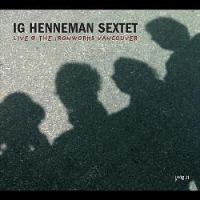 Ig Henneman Sextet
Live @ the Ironworks Vancouver
Wig Records
2012
Sometimes it is difficult to recognize where the compositions end and improvisation begins with Ig Henneman's Sextet. The second release from this ensemble follows Cut a Caper (Wig, 2011) and features her oft partner Ab Baars playing tenor saxophone, clarinet, and maybe the highlight here heard on "Kindred Spirits," an inspired shakuhachi. While these two often play duos, this sextet includes the amazing improvisers Axel Dorner (trumpet) and Wilbert De Joode (bass), plus Henneman's partners in from the Queen Mab Trio, Lori Freedman (clarinets) and Marilyn Lerner (piano).
The violist's compositions indeed leave abundant room for improvisation, a rare commodity in live music performance today, silence. With all the firepower her Tentet, String Quartet, and this Sextet possess, she seems partial to the silence between the notes, the thought unspoken, and even crowd noise. "Light Verse" toys with the gentle interplay between the players, offering the melody as a preamble to Dörner's growling extended technique, Baars' stabbing clarinet, and Henneman's whispered solo. The Sextet's chamber works, such as these composed tracks, paired with the restrained and disciplined improvising of virtuoso performers makes for a great experience.
 Craig Green + Dave King
 Moontower
Long Song Records
2012
The second duo from guitarist Craig Green and The Bad Plus drummer Dave King, Moontower follows the same format as the eponymously titled Craig Green + Dave King (Long Sound Records, 2008). The duo laid down a series of improvised pieces, here arranged as a suite, over two days in Minneapolis. Without the benefit of overdubs or edits the six pieces, and bonus track is pithy and succinct. The sounds are delivered as if a soundtrack to a futuristic Western. Open plains permeate with the echoey guitars and minimalist beat. It isn't until the penultimate track, "Dave King," and bonus "1980's ECM Records," that King has a proper go at his drum kit. These tracks are more about atmosphere and mood.
King's minimalist approach to percussion, his use of odd toys, and here, organ, reveals an introverted personality, or perhaps a perfect accompaniment for Green's desolate sound. The guitarist provides plenty of echoey textures to paint an exposed bleak landscape. Sometimes the visual is not required, nonetheless this music summons a mighty thirst.
Tracks and Personnel
The Art Of The Soprano Vol. 1Tracks: The Ellington Medley: In a Mellow Tone; Soprano de Aficana: Burkino Faso; A Love Supreme: Acknowledgement; Soprano de Africana: Sub Saharan Dialogue; The Ellington Medley: In a Sentimental Mood; Soprano de Afriacana: Zulu Witch Doctor; A Love Supreme: Resolution; The Ellington Medley: Caravan; Soprano de Africana: Fela!; A Love Supreme: Pursuance; A Love Supreme: Psalm.
Personnel: Sam Newsome: soprano saxophone.
Living Jelly
Tracks: In Pursuit of Pleasure; Playing with Mercury; The Sloth; Enigma; Living Jelly.
Personnel: Ivo Perelman: tenor saxophone; Joe Morris: guitar; Gerald Cleaver: drums.
The Gift
Tracks: Too Good To Be True; The Gift; The Gratuitous Act; Refugee; What Is Anguish? Submission To The Process; A Ride On A Camel; A Flower Bewitched And Too Bright By Far; Without Any Warning; Enlistment .
Personnel: Ivo Perelman: tenor saxophone; Matthew Shipp: piano; Michael Bisio: bass.
The Clairvoyant
Tracks: The Clairvoyant; Ritual; Torture And Glory; A Mere Speck Of Dust; State Of Grace; Silken Threads; The Expedients Of A Primitive Being; Fear Of Eternity.
Personnel: Ivo Perelman: tenor saxophone; Matthew Shipp: piano; Whit Dickey: drums.
Coconut
Tracks: Coconut; What Happened At Conway Hall, 1938?; Shake Your Wattle; The Fish In The Pond; Little Symphony; Crunchy Croci; Padàm; Joy Of A Toy; Journal; BeeTee's Minor Plea.
Personnel: Eric Boeren: cornet; Michael Moore: reeds; Wilbert De Joode: bass; Han Bennink: snare drum.
Baritone Monk
Tracks: Teo; Light Blue; Two Timer; Pannonica; Bright Mississippi; Ruby, My Dear; Let's Cool One; Brake's Sake; Green Chimneys; 52nd Street Theme; Holiday Medley—A Merrier Christmas/Stuffy Turkey.
Personnel: Claire Daly: baritone saxophone, flute; Steve Hudson: piano; Mary Ann McSweeney: bass; Peter Grant: drums.
Past Present
Tracks: CD1: Chicago, July 15, 2009. CD2: Chicago, January 6, 2010. CD3: Chicago, December 29, 2010. CD4: Milwaukee, December 30, 2010. CD5: Milwaukee, December 27, 2011. Cd6: Chicago, December 28, 2011, CD7: DKV plays the music of Don Cherry— Sant'Anna Arresi, Sardinia, August 31, 2008: Encore: Remembrance pt. 2; Brown Rice; Orfeu Negro; Dios E Diablo; Introduction (by the DKV Trio); Orfeu Negro; The Thing; Remembrance; Elephantasy; Music Now.
Personnel: Hamid Drake: drums; Kent Kessler: bass; Ken Vandermark: reeds.
Boperation
Tracks: Boperation; Cromagnon Nights; Escalating; Fantasy In Blue; The Gig; House Party Starting; Mo Is On; Pile Driver/Dodo's Dance; Snakes; Up Jumped The devil.
Personnel: Axel Dörner: trumpet; Pierre-Antoine Badaroux: alto saxophone; Joel Grip: double bass; Antonin Gerbal: drums.
E(X)STINZIONE
Tracks: CD1: Intro—Le lucciole; Yluc Song; La scena, gli artisti...; Praxis; Prolungate istantanee; Mostar; Torquemada; Post; Per Emanuela. CD2: Porte Basse; Genetic Deficit; Un Rosario Profano; Isengard; Muri di Pillole; Denique Caelum.
Personnel: Alberto Mandarini: trumpet, flugelhorn, arrangements, direction; Maurizio Brunod: electric guitar; Giovanni Maier: double bass; Massimo Barbiero: drums, percussion; Laura Conti; voice; Marcella Carboni: harp; Giancarlo Schiaffini: trombone; Carlo Actis Dato: tenor saxophone, baritone clarinet, bass clarinet; String Orchestra: Gianluca Allocco: first violin; Raffaella Azzario: first violin; Costanzo Squadrotti: first violin; Nino Russo: first violin; Fabrizio Dutto: first violin; Gabriele Marchisio: second violin; Isabella Slamig: second violin; Giulietta Testa: second violin; Cecilia Concas: second violin; Mattia Sismonda: viola; Guido Neri: viola; David Mosca: viola; Paola Mosca: cello; Alberto Fabi: cello; Bernardino Gallo: double bass..
1000 Words
Tracks: 1000 Words; Bone Narrow; Ice; Klopgeest; Standpipe; Duo Stukje; Drainpipe; March; Dons; Strobe; Stovepipe; El Norte.
Personnel: Jeb Bishop: trombone, mutes; Jorrit Dijkstra: alto saxophone, mutes.
Der Italienische Manierismus
Tracks: Rosso; Fantozzi Vs. Dalla; Our Position (for Corrado Costa); Sigmund Holmes And Sherlock Freud; Dolce Stilnox; Proust; It Is An Island (for Guiseppe Archiboldi).
Personnel: Alessandro Bosetti: voice, instruments, electronics.
A Color Photo Of A Horse
Tracks: A Color Photo Of A Horse; Beset By Anxiety (for Louise Bourgeois); Dead Bird; Errepikatzen (Gloriously Repeating); Istruzioni.
Personnel: Alessandro Bosetti: voice, electronics; Kenta Nagai: fretless guitar; Ches Smith: drums.
Stand Up Comedy
Tracks: Stand Up Comedy; Life Expectations.
Personnel: Alessandro Bosetti: voice, electronics, mask mirror; Johnny Chang: violin; Chris Heenan: contrabass clarinet.
Soft Focus
Tracks: De Grote Olifant; Soft Focus; The Raft; Miniature 1; White Numbers; Other Lights; Miniature 2; The Siren.
Personnel: Tim Daisy: drums, percussion, marimba; Fred Lonberg-Holm: cello, tenor guitar; James Falzone: clarinet.
Songs In The Key Of Survival
Tracks: ...In Qua Tantum Cacatur; A Storm Blows In From Paradise...; Internal Devaluation (A User's Guide); Ricercare; Everything Is True. Nothing Is Permitted; Engführung (Straitening); Profound Boredom And Rage; Katabasis: ...Si Le Geste Est Beau; Sheikinah; Lines Of Flight, Lines Of Capture; Tikkun.
Personnel: Leo Svirsky: piano, vocals.
Hum
Tracks: CO2; Hullun Paperit; Sugar Rush; Hum; Reliever; Goodbye Pork Pie Hat; Space Race; A Day In The Life.
Personnel: Elena Setién: voice, violin; Adam Pultz Melbye: bass; Camilla Barrat-Due: accordion; Marc Lohr: drums, electronics; Otis Sandsjö: saxophones, clarinet; Martin Stender: saxophones,flute; Lars Greve: saxophones, bass clarinet; Tobias Wiklund: trumpet, flugelhorn; Petter Hängsel: trombone; Jonatan Ahlbom: tuba; Markus Pesonen: guitar, lap steel, compositions.
Together Again
Tracks: The Promise; Falling Grace;Split Second; Always And Forever; How My Heart Sings; Softly As A Morning Sunrise; Have You met Miss Jones.
Personnel: Teddy Pantelas: guitar; Michael Grappo: guitar; Jeff Grubbs: bass; Nathan Douds: drums.
Live @ The Ironworks Vancouver
Tracks: Prelude for the Lady with the Hammer; Kindred Spirits; Bold Swagger; Light Verse; A 'n B.
Personnel: Ig Henneman; viola, compositions; Ab Baars: tenor saxophone, clarinet, shakuhachi; Axel Dörner: trumpet; Lori Freedman: bass clarinet, clarinet; Wilbert de Joode: bass; Marilyn Lerner: piano.
Moontower
Tracks: The Moontower Suite: Weather Balloon; The Best Western; Blackwell Star Galactica; Moontower; Craig Green; Dave King; 1980's ECM Recods.
Personnel: Craig Green: electric guitars, electronics; Dave King: drums, percussion, organ.
< Previous
Listen Here
Comments
Tags
We Travel the Spaceways
Mark Corroto
United States
Sam Newsome
John Coltrane
duke ellington
Ivo Perelman
Matthew Shipp
Joe Morris
Gerald Cleaver
Whit Dickey
David S. Ware
Albert Ayler
Michael Bisio
Ornette Coleman
Don Cherry
Paul Lovens
Han Bennink
Booker Little
Claire Daly
Thelonious Monk
ambrose akinmusire
Pepper Adams
Gerry Mulligan
Ken Vandermark
Hamid Drake
Kent Kessler
Mats Gustafsson
Ingebrigt Haker Flaten
Miles Davis
lee morgan
Axel Dorner
Elmo Hope
Herbie Nichols
Fats Navarro
john zorn
Alexander von Schlippenbach
Bud Powell
Jorrit Dijkstra
Jeb Bishop
Steve Lacy
Alessandro Bosetti
Ches Smith
Tim Daisy
Fred Lonberg- Holm
James Falzone
Cecil Taylor
Henry Threadgill
Peter Brotzmann
Charles Mingus
joe lovano
Teddy Pantelas
pat metheny
Wes Montgomery
dave king
For the Love of Jazz
 All About Jazz has been a pillar of jazz since 1995, championing it as an art form and, more importantly, supporting the musicians who create it. Our enduring commitment has made "AAJ" one of the most culturally important websites of its kind, read by hundreds of thousands of fans, musicians and industry figures every month.
You Can Help
To expand our coverage even further and develop new means to foster jazz discovery and connectivity we need your help. You can become a sustaining member for a modest $20 and in return, we'll immediately hide those pesky ads plus provide access to future articles for a full year. This winning combination will vastly improve your AAJ experience and allow us to vigorously build on the pioneering work we first started in 1995. So enjoy an ad-free AAJ experience and help us remain a positive beacon for jazz by making a donation today.

Giveaway

Eligible winners: 15
Days remaining: 6
Days remaining: 6