Home » Jazz Articles » Album Review » Joe Morris: Graffiti In Two Parts
Joe Morris: Graffiti In Two Parts

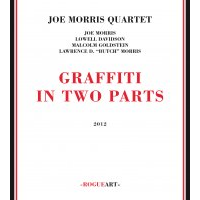
Guitarist Joe Morris, who befriended Davidson in Boston where the pair began working together in 1981, organized this performance, for which he also recruited violinist Malcolm Goldstein and cornetist Lawrence "Butch" Morris. Davidson performs on drums (a loose collection of instruments rather than a conventional kit) for the first half of the concert, and on aluminum acoustic bass for the second. His approach to both is unconventional, mirrored by the other members of Morris' impromptu quartet, which delivers an American equivalent of European free improvisation, eschewing overt idiomatic references. So while Morris' styling on guitar and banjouke has its origins in West African string instrument music, the end result is very different: an asymmetric melodic percussiveness which matches Davidson's lurching knocks and rattles on drums.
Remarkable for its individuals' selflessness, the program is a low-key, undemonstrative affair. "Graffiti—Part 1" comprises a litany of indeterminate scratches, taps and clatters, moving in sudden layered bursts offering no hint of rhythm or melody. Relationships between the four remain oblique, resolutely avoiding any form of resolution. "Part 2" is more animated, with the cornetist and violinist asserting themselves through sustained brass tones and string glissandi. On bass, Davidson creates darkly bowed undercurrents, which entwine with Goldstein's abrasive violin. Passages of drifting lyrical abstraction, punctuated by off-kilter percussive noises, provide depth to proceedings, but otherwise it's an enigmatic encounter in which Davidson remains elusive.
Track Listing
Graffiti - Part 1; Graffiti - Part 2; Tag.
Personnel

Joe Morris
bass, acousticJoe Morris: guitar, banjouke; Lowell Davidson: drums, aluminum acoustic bass; Malcolm Goldstein: violin; Lawrence D. "Butch" Morris: cornet.
Album information
Title: Graffiti In Two Parts | Year Released: 2013 | Record Label: Rogue Art
Tags
Joe Morris
CD/LP/Track Review
John Sharpe
Rogue Art
United States
Lowell Davidson
Ornette Coleman
Gary Peacock
Milford Graves
Malcolm Goldstein
Butch Morris
Graffiti In Two Parts
PREVIOUS / NEXT
Joe Morris Concerts

Support All About Jazz
 All About Jazz has been a pillar of jazz since 1995, championing it as an art form and, more importantly, supporting the musicians who make it. Our enduring commitment has made "AAJ" one of the most culturally important websites of its kind, read by hundreds of thousands of fans, musicians and industry figures every month.