Home » Jazz Articles » Interview » Davey Payne: Ready To Play
Davey Payne: Ready To Play
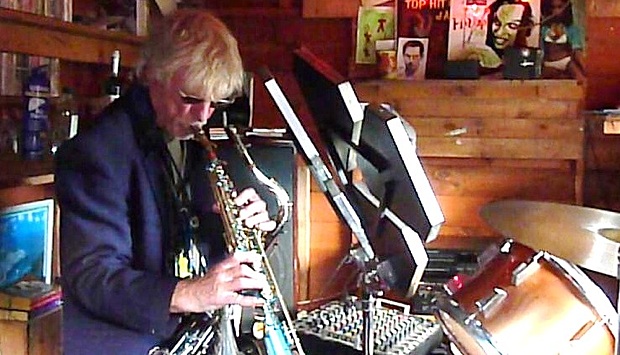

Before he joined forces with Dury, who fronted The Blockheads from 1978 until his death in 2000, Payne was already working round Europe in free playing ensembles with musicians like reed player Terry Day and violinist Charlie Hart.
Payne has recorded and toured with a wide range of musicians. His musical experience and tastes reflect a diverse spectrum of genres and composers. From a child, his influences included films, classical music, jazz and spiritual journeys.
Background and Influences
Payne plays a range of instruments, although more often than not it is a saxophone. The saxophone, however, was not his first love. His early musical fascinations came from films like 1959's The Five Pennies , with Danny Kaye playing cornetist Red Nichols, which also featured trumpeter Louis Armstrong, The Glenn Miller Story (1954) and The Benny Goodman Story (1956), The Fabulous Dorseys (1947), based on the lives of the Dorsey Brothers, and Paris Blues (1961), about fictitious American jazz musicians living in Paris. Payne explains, "It was the trumpet that inspired me to play; a gold, shiny trumpet. I could say it was Satchmo [Louis Armstrong], but really it was whenever a trumpet turned up. I loved trumpet players like Cat Anderson, and Maynard Ferguson's high notes. The trumpet was a lead instrument. However, when I tried to play a trumpet I couldn't get a note out of it. Then I heard clarinetist Acker Bilk on the radio and was hooked on the way the clarinet weaved in and out and complimented the brass. So for a while I listened to English trad. jazz clarinetists, quickly moving on to Barney Bigard with the Armstrong Band."
Payne started life in North London but moved to Clacton as a boy. At 16, Payne moved back to London. He remembers: "We moved to Clacton because we had a holiday bungalow there. Instead of going to art school as advised by my school, it was taken for granted that I would work for my dad. He soon realised that working on machines while singing Louis Armstrong solos wasn't for me."
Payne left home just before his younger brother Barry was born. Back in London, Payne found a job in Nathaniel Berry's music shop in Holloway Road, four doors up from Joe Meek's studio. Apparently Mike Berry and members of the Outlaws used to come into the shop.
The job provided the opportunity for Payne to immerse himself in the London jazz scene. He would go to Ronnie Scott's and the Flamingo all-nighter. At Scott's, Payne saw many American musicians. He saw Art Blakey at the Finsbury Park Astoria. Through the '60s he worked with people including structural artist Bruce Lacey on projects like the Fun Palace in St Katherine's Dock, London. At one event, unbeknown to Payne at the time, a young student and his teacher were in the audience—that young student was Ian Dury.
Payne took clarinet lessons in Clacton but it was while being taught at a music salon that he had an encounter which would change his life and, unknown to him at the time, shape his musical future. "While squeaking on a clarinet with a reed that was too hard at the Alice St Johns' music salon in Clacton-on-Sea," he explains, "a guy walked in and opened a tenor sax case. When I saw the sax in its plush red velvet case I knew I wanted to play one. Soon I was listening to sax players Charlie Ventura,Earl Bostic,and then—the biggest influence of all—I heard a record of the Jazz Concert West Coast (Savoy, 1947) [with the songs] "Rock 'n' Shoals" and "Disorder At The Border," featuring Dexter Gordon and Wardell Gray on tenor saxophones, with Sonny Criss on alto. Also on the record was the great guitar playing of Barney Kessel. That turned me on to jazz guitar. I still listen to a lot of Tal Farlow and Jim Hall. So, at first it was the instruments that inspired me to play and then later I would say my influences ranged from Bilk to Gray,then John Coltrane, Jimmy Giuffre's Train and the River (Atlantic, 1958) and on to soul players and free jazz."
It was not jazz which had the first or perhaps the greatest influence on Payne. He listened to a lot of classical music as he grew up and also rock. He had, even then, an eclectic taste and his broad listening choices as a youngster, provided the origins for some of the different tones and styles he uses in his music. Payne says, "When I was 18 I listened to Jim Dvorak's 'Cello Concerto' and Bartok's 'Sonatas for Solo Violin' with Yehudi Menuhin. I was into spiritualism at the time and tried to levitate to this music. I'm sure I was just a little away from floating on the ceiling. Other music was Ravel's 'Introduction and Allegro,' and Albert Roussel's 'Serenade for Flute,Violin and Viola.' This last piece really got inside my soul. Also,Debussy's 'Prelude a l'apres-midi d'un faune,' which is still a favorite."
Later and Now
"Nowadays," says Payne, "I listen to composers Toru Takemitsu, Oliver Messiaen ,Astor Piazzolla, Howard Goodall and Pierre Boulez. I also appreciate French flute music, bassist Orlando Lopez, trumpet player Toshinori Kondo, violinist Nigel Kennedy's 'Kafka' and I like the voice of Salli Terri with Laurindo Almeida's guitar, featuring flautist Martin Ruderman. Huw Williams' 'Concerto for Oboe and Strings' with oboist Leon Goossens, most classical guitar music and music electronic are also favorites and I enjoy Arvo Part, John Adams, Philip Glass, Uakti and Vivaldi flute concertos, to name just a few."
Of course, many jazz-oriented musicians feature in Payne's listening. He mentions many and has a few favorites. "Pianist/organist Alice Coltrane, [bassist] Charles Mingus and saxophone players Roland Kirk, Andre Vida, Pharoah Sanders, Gato Barbieri, John Coltrane and the wonderful Junior Walker & the All Stars."
So, Payne's musical journey began with wanting to play a small shiny brass instrument and brought him, before he was 16, to a large shiny woodwind instrument. Payne may have come a bit of a roundabout way to find the saxophone but he knew when he had found his instrument. He also plays flute, clarinet, harmonica—anything that can be blown, really. Teachers included the late Don Rendell, with whom Payne forged a lasting friendship. Most musicians get through quite a few instruments and have their personal favorites and Payne is no exception. "My first sax," he says, "was a new Dearman tenor with a plastic mouthpiece. After six months I had bitten a ridge in the top and six months later my teeth had gone through the mouthpiece. Then someone told me about metal mouthpieces so I moved on to a Berg Larson metal.
"Over the years I've had a Buescher tenor and, while playing in a band with a millionaire singer, I was bought a new King Super 20 tenor. Unfortunately I had to swap it for a Selmer Mk 6 and 500 Guilders in Amsterdam in 1968. We were stuck in Holland and I heard a guy playing. He asked to buy my Selmer Mk 6 and I swapped it for his sax and 500 guilders to get us home. The guy who I did the deal with knew Don Byas and advised me that I didn't need to use number 4 or 5 hard reeds but would get a louder, brighter sound using a 2½-3, as Byas did. I've had 3 Mk 6s since then. I also bought a silver Selmer Super 80 alto. In New York I bought a King Silver Sonic alto and in Toronto, Canada, a Selmer Mk 6 baritone and tenor. I've had 3 Graftons-these are rare plastic saxophones, as used by Charlie Parker and Ornette Coleman. A few years back Parker's was sold at Christies for £84,000.00. I part-exchanged my King alto for a turquoise Buffet Prestige baritone that had been used with the Shakin' Stevens band. I sold all my Graftons to player Dennis Lewington for next to nothing and later found out that they had moved to Germany, then Australia and finally ended up in America." Lucky for him he has now acquired another Super 20.
Payne's instrumental collection received a massive boost when he visited his first wife's uncle in Hawaii. "This man," explains Payne, "was an interesting character called Spafford, who had studied to be a doctor in England, experimented giving himself electric shock therapy, travelled the world as a navigator in the American Merchant Navy, worked at Manny's Music Shop in New York and lived and was friends with guitarist Les Paul and his wife in San Francisco before retiring to Hawaii. Spafford was so pleased to have a musician in the family he gave me his collection of instruments including a Leblanc clarinet, Pete Fountain model, signed by Bob Helm from the Turk Murphy Band, and a Yamaha low A baritone, a Conn silver C melody and a rare sarrusophone [like a metal bassoon with a double reed, built to project more sound for marching bands]. Viv Stanshall told me that he would have given me the whole of his instrument collection for it.
Now my saxophones are a Dave Guardala tenor sax, a Keilwerth silver SX90R alto and an LA soprano. I have a Sankyo Silver Sonic flute and a Leblanc clarinet. This writer can vouch for the quality of his Leblanc. I use a Dave Guardala Super King tenor mouthpiece, a gold Bari alto mouthpiece and a Bobby Dukoff copy by Arbiter soprano mouthpiece." He has recently acquired another Mk 6 too.
Where's He's At?
When he played with The Blockheads Payne managed to intersperse free passages over the tightness of the band. He played well with them and left in 1998, since when they have probably played more gigs without him than they played with him. He has also played with other musicians such as Howard Jones where the chances of playing free are more limited. Most of the music he plays now is improvised. On where he feels happiest playing, he comments, "Ideally music should be free, with no preconceived ideas, just floating on spontaneous improvisation. This music has a freshness about it and this kind of honesty is felt by the listener if they are ready to open up to it. At least, most people recognize the energy that it can produce. I like the bluesiness of Mingus and the way he collaborated and used musicians. I like some soul jazz and funkadelic, and bizarre arrangements as well as bandleader/writer George Clinton and William Earl Bootsy's bass. It would have been great to have heard Albert Ayler's screaming sax over some of those great grooves. I am intrigued by some of [pianist] Sun Ra's music, but maybe it's too theatrical; too much is thrown in and it becomes a circus. It's a bit like Shostakovich; a bit of this, a bit of that, a marching bit, a pretty section, too theatrical. Having said that, I sometimes listen to the [composer and bandoneon player] Astor Piazzolla, some Cuban music and Indian sitar which, to me, is the nearest to free improvisation, with its microtones and free-flowing lines."
Free playing seems to be where Payne's heart is. Although he has been influenced by and is open to many other genres, it would seem to suit this spiritual and explorative player. Other genres offer just as much diversity, of course, but for Payne, free form offers the liberty he relishes. Starting with his debut solo of "I'm forever Blowing Bubbles" at the Shangri La holiday camp in Clacton-on-Sea in 1960, by 1964 Payne was playing with his own trio in The Crypt and the Latimer Hotel in Notting Hill. "We played totally free," he says.
The late '60s proved a pivotal point for Payne and in 1968 he met musicians—many of whom have remained contacts and friends—with whom he would play, off and on, for the rest of his career. They were clarinetist Albert Kovitz, saxophonist Paul Jolly, the late pianist Mel Davis, bassist Charlie Hart and free drummer Terry Day. These formed the core of the People Band. They evolved from the jazz venue called 'The Starting Gate' in North London, instigated largely by members like Mel Davis. Payne had already met another future key player of the band, trumpeter Mike Figgis (later to become a film director). Payne explains. "In 1968 Mike Figgis and I returned from Biarritz where we had been playing in Loco Weed, a soul band. I travelled with the People Band and we spent three years playing in Holland with occasional gigs in Belgium, Paris and Germany. Other musicians joined from time to time including Figgis and even [saxophonist/clarinetist] John Surman sat in with us once. Over the next few years, Day, Hart and I worked in Holland as Ommu The Smooch. In England we continued to do gigs with the bigger band. We often played at the Wood Green Arts Centre and the Robert Streets Art Laboratory near Warren Street. Hart and myself, as part of an Arts Council grant, played at the Traverse Theatre in Edinburgh."
During this period, for a time, Payne was living with other musicians in an old steamer in Amsterdam but playing music which was part of the fringe scene as, for a lot of free players at the time, this was never going to make the band rich and famous. Rather, they enjoyed making enough to get by and playing music from the heart. Free form was experiencing a re-genesis in Europe, and Payne and other players found themselves at the centre of the change. Players from the People Band would join other bands on stage at times and when they were in London, they sometimes played with Dury's band The High Roads. For a while, both Payne and Hart joined the band and the group became known as Kilburn and The High Roads. It is surprising, given the number of gigs the People Band performed, that they are not really remembered in Europe, though they have experienced a few mini-revivals since. Those days, according to Terry Day, " you could turn up for a couple of gigs in Holland and by the end of the night have many more planned.'
Since then, Payne has played with a wide range of musicians. He recalls, "In 1972 I played with Dury in Kilburn and the High Roads, did some gigs with Ronnie Lane's Slim Chance, The Fabulous Poodles and a few with musician Chris Jagger [Mick's younger brother]. In 1977, I played and made records with Wreckless Eric [along with, for some of a tour, Payne's younger brother on bass] before joining The Blockheads. Over the next few years I recorded with Nico, The Clash, Desmond Dekker, Howard Jones, Jona Lewie, Pearl Harbour, Ellen Foley, The M Band and Kyoshi, from Japan. In 1984, I recorded and toured Britain, Europe and Australia with Feargal Sharkey.
"By 1986, the People Band had reunited and we called ourselves Mummy. We recorded and played at the Luton Arts Centre before being featured in Figgis' film Stormy Monday (1988), where we appeared as the Krakow Jazz Ensemble, a free form Polish group. Through the '90s I recorded and gigged with the Blockheads, making the album Mr Love Pants (Ronnie Harris, 1998). Now I play the occasional Blockhead gig [last played with them in 2011], some interesting People Band gigs that Figgis arranges, such as one in 2011 at The Royal Opera House, some at Kings Place, London and the People Band played for the 25th Anniversary of the Vortex Club in Dalston, East London."
Payne takes life and music seriously and his conclusions so far about free music are eloquently expressed in a letter he wrote in response to a piece The Wire ran on the People Band in June 2002. In the piece, the musicianship was described as, "concentrated and intense" and recordings as, "straining against the limitations of the medium." It was implied that the band had been largely forgotten in historical accounts of improvised music. The author wrote enthusiastically about the players but perhaps left the reader confused as to what they were really about. Payne felt motivated to clarify and wrote in a letter to the editor:
"Re: The People Band article (The Wire 220). Even though at times the People Band let others 'sit in,' and sometimes it was fun and a laugh, and there would be serendipity, we knew how to work with chance and build on it. I don't believe that we were there to be a catalyst for everybody to blast away, giving them a false sense of freedom or happiness. As far as I'm concerned we weren't out to entertain and the audience were often confused, pained and drained. (...) I believe that at our best we were creating music on the highest level, knocking on the tenth door, and that may not necessarily be a good thing, or maybe it is. After all, who are we to play the divine conch and bagpipes? Of course, there was always the one guy who, after we had emptied the club in Groningen or somewhere, would approach us in his mackintosh and glasses, enthusiastically asking if we had made an album."This kind of quote is fairly typical of Payne who, even when telling you facts, often makes it difficult to understand his meaning.
The Spirit
Payne intersperses thoughts and ideas with references to philosophical ideas and experiences. When asked to clarify his beliefs, he responded, "Hey, if the universe as we know it started with a speck smaller than an atom and was created within a second and there are eleven dimensions or possibly multiple dimensions, I believe anything is possible."
Payne's own spiritual journey started when he was 18 and visited a friend's grandmother who was a spiritual medium. She was, he remembers, in her 70s, "with a straight back, healthy complexion and wore purple and green." Payne joined the Spiritualist Association of Great Britain in Belgrave Square, London and became a vegetarian, but was advised not to "dabble," and live with his feet on the ground. Payne says, "In 1970, when I was introduced to Sat Sang (an Indian philosophical idea), the English representative was surprised that I had found my way to them as I had been a spiritualist. I was advised not to dabble with healing, séances, and trying to prove a world beyond and was told this is the way of Radha Swami. Also, live in the world, stick to the diet and meditate—no showing off with rituals, bells and incense, etc. I now follow a form of third eye meditation taken from the philosophy of Guru Nanak. It's called Radha Swami Sat-Sang. Basically you try and stay at the third eye, in the head, between the eyes, using a five word mantra to help focus, and hope to see the moon, stars and hear the celestial sounds. I'm meant to follow a strict vegetarian diet and not take anything that would give me an altered state of consciousness apart from meditation."
Payne summed up his take on the opposing arguments on this area in a poem he wrote. "The cosmic bagpipes or the primal screams of the devil? Are they the cries of help from our deepest neuroses or celestial sounds from our inner soul? Is it the divine music of the astral plane or cacophony from the ego? Is Stan Getz or Kenny G the road to hell? And Sanders, the divine transcendent music? Is one man's hell another man's heaven? Ayler's screaming for freedom, beauty from chaos may be whipping people into a false sense of spiritual attainment. So will we gain wisdom through the music of Sanders or be dumbed down by Kenny G's 'Songbird'?"
When explaining how he feels about music and its relationship with the inner spirit, Payne's response is profound: "I believe there is a divine music. It goes on; it's automatic, without anger, greed, lust or attachment and egoism. I think I experienced this once with a free music blow at the Paridiso in Amsterdam, and I hadn't been taking drugs, just mu tea and brown rice." He does enjoy the showing off side though and has quite a decent sized ego.
On music and philosophy Payne comments, "I enjoy writing and it helps me to take stock of where I am and what I believe. I've always tried to share my information whether it's about music, diet, macrobiotic cooking, or relationships. Most people are cool anyway; they know where it's at, don't they?" Payne did develop a reputation for being something of a loose cannon and he recalls one incident at a gig, "It was in the early Kilburn and the High Roads. After smashing my saxophone, the flute went, and half of the PA that went in to the audience. It was a gig at Hornsey Art College, and Kilburn and the High Roads were supporting George Melly. A very young Madness were in the audience. I was pissed off with the sound and flipped. I think Lee Thompson, Suggs and co were quite impressed with the stage show, which led them to be the masters of naughtiness on stage." This is just one of several tales of misadventure Payne had, losing his rag and often leaving people slightly bemused at his behaviour but it was part of his nature, apparently.
Payne on His Own
After the Blockheads' initial success, Payne recorded a single, "Saxophone Man," in 1979. He also recorded an album, provisionally called Blowtorch in the United States but it never came to be released, largely because the ideas of the producer differed from what Payne wanted to put across. He said, at the time, that he did not want people from the record company [Stiff] dictating what he should put on his album. Initially they agreed and Payne recorded most of the album, including some self-penned tracks, "'Home James," "Wet Streets" and "Razor Blades," as well as cover versions of standards like "Say a Little Prayer" and "Ain't No Mountain High Enough," but the album was never released. The disparity between the producers wanting to capitalize on Payne's popularity—produce an album with funky/disco grooves perhaps—and what Payne wanted to do was perhaps too great. He had decided to use Day as his drummer and Day, being totally free, might play drums at a session, squeak balloons or read poetry depending on the mood and occasion. Payne says, "The last thing they [the record company] wanted was a mad saxophonist and bonkers drummer [Day] on an album." He tells a story of ending up in a jazz club in New York with Day and The Sex Pistols' and PiL singer John Lydon.
Given the time he put into the project, has he ever hankered after a solo career or hoped to convey his way of playing more commercially? His response: "We all have something to say, and spiritually I shouldn't be political but, 'live by the laws of the land.' However, I did feel I could reach more people with a spiritual message if it meant using backing singers and playing an off-the-wall Kenny G solo [on 'Saxophone Man'], but it wasn't to be. Thank God my ego's big enough already and really most popular music is just simple folk songs embellished. Tchaikovsky embellished them well but, at the end of the day, the verse, head, theme, chorus, middle eight, solo, whatever you call it; it's just a formula."
Now and the Future
Payne lives in a small town in Cornwall, which is about as far west as you can go in England. His house used to be a butcher's shop, then an art gallery. One outstanding feature in his house is Payne's artwork, which is displayed and much of it is rather beautiful. He does play locally on occasion. The Blockheads and he have parted ways. He last played with them in 2011 with them at a memorable 3 day residence at London's Water Rats.
On playing with others and the feelings he gets, Payne comments, "When I play with others, I'm totally aware of them. That's what it's all about; dialogue, communication, to create a oneness, to lose the ego, so if you need to play a thousand notes you do that but if only one note is required you do that also—this is when free music is at its best. It is said that you have to be intelligent and in control of the music. Well, I like to be out of control; it's a different intelligence and control. OK, sometimes tell the music what to do but try letting it speak to you also. If you are a spiritual player some of this will come across whatever you play but it will be watered down. A bit like Malcolm McLaren mixing Madam Butterfly, with rock rhythms to get opera to the masses, but it misses the point somewhat. However, if you need to make a living and don't want to chop wood, you can't be blamed for that. Monet wouldn't chop wood, stuck to his art and become rich and famous. I was lucky and able to more or less play my own thing and be fairly free over the tightness of the Blockheads. And I like chopping wood."
Payne has been influenced by many genres, eras and musicians, absorbing what is going on around him and developing, along the way, his own views. Yet, he is pretty conventional. As a musician he can turn his hand to most genres.
Payne's is very serious about most things and, throughout his career, he has presented several images to the world—from the experimental, free playing player in the '60s and apparently volatile, often furious sax man of the '70s.gs.
Payne can surprise. At a recent production of the play Reasons to Be Cheerful, the Graeae Theatre Company production of the Paul Sirrett play, word got to the cast that Payne and his family were coming to the Truro Hall performance. John Schwerbel & Patrick Kelly, the main vocalist in the show and Dan McGowan—who plays a version of Payne's double sax solo in "Rhythm Stick" in the show—were understandably nervous. Payne visited the cast just after the final sound check and gave them encouragement. He gave Dan a tie he had worn for a gig and Kelly one of Dury's jackets. Of that evening, Kelly says,
"We'd just finished sound check for that night's show at The Hall, Truro. and in comes that smiling, friendly face of Payne (anyone that has ever met him will know what I mean), with a plastic shopping bag in hand. After saying, hello to all the gang, he came to me and said, 'I've got something here.' He paused and then said, 'You might not want it but...,' and then pulled out one of Ian Dury's jackets; it fit like a glove. We had a hug but I had to pop off for a teary blub side-stage. I couldn't believe the love and generosity Payne showed and the casual way the jacket was in a shopping bag and that he thought I might not want it. The jacket only comes out now for special shows, including that night of course. Payne smiled when he saw me in it and gave a little thumbs up from the front row. He sent me a lovely message after we did 'Spasticus Autisticus,' at the opening ceremony for the Paralympics too. That meant the world to me."
Asked if he is working on any projects at present, Payne says, "The People Band are keen to play more" he says. They have played a few gigs at Café Oto in London and Eclectic. He has also talked of doing something at Café Oto ' an Alice Coltrane inspired gig maybe or an album, or recordings, local gigs in art galleries.
He has been writing a biography for many many years now, and it's ongoing. Payne says, "A lot of it is about growing up in North London. Also there is lighthearted political and sexual exploration—but there are lots of good pictures and it's real." Writing with Payne proved interesting and we have written a few articles together, including one published in Record Collector. He is a born story teller and the some stories vary with each telling but he also proved generous with his time. I played a little with him and he has lost none of his enthusiasm.
Selected Discography
Howard Jones, Pearl in The Shell (Dtox, 2010)
Terry Day, Interruptions (Emanem, 2006)
Ian Dury and The Blockheads, Mr Love Pants (CNR, 1997)
Nico, Drama of Exile (Aura, 1981)
Ian Dury and The Blockheads, Laughter (Stiff, 1980)
< Previous
Into the Air
Comments

Tags
Davey Payne
Interview
Sammy Stein
United Kingdom
London
Terry Day
Red Nichols
Louis Armstrong
Glenn Miller
Benny Goodman
Dorsey Brothers
Cat Anderson
Maynard Ferguson
Acker Bilk
Barney Bigard
Art Blakey
Ian Dury
Charlie Ventura
Earl Bostic
Dexter Gordon
Wardell Gray
Sonny Criss
Barney Kessel
Tal Farlow
Jim Hall
John Coltrane
Jimmy Giuffre
Dvorak
Yehudi Menuhin
Toru Takemitsu
Astor Piazzolla
Toshinori Kondo
Nigel Kennedy
Laurindo Almeida
Vaughan Williams
Arvo Part
John Adams
Philip Glass
Uakti
Alice Coltrane
Charles Mingus
Roland Kirk
Pharoah Sanders
Gato Barbieri
Junior Walker
Don Byas
Charlie Parker
Ornette Coleman
Les Paul
Bob Helm
Turk Murphy
George Clinton
Albert Ayler
Sun Ra
Mel Davis
John Surman
Stan Getz
Kenny G
John Kelly
For the Love of Jazz
 All About Jazz has been a pillar of jazz since 1995, championing it as an art form and, more importantly, supporting the musicians who create it. Our enduring commitment has made "AAJ" one of the most culturally important websites of its kind, read by hundreds of thousands of fans, musicians and industry figures every month.
You Can Help
To expand our coverage even further and develop new means to foster jazz discovery and connectivity we need your help. You can become a sustaining member for a modest $20 and in return, we'll immediately hide those pesky ads plus provide access to future articles for a full year. This winning combination will vastly improve your AAJ experience and allow us to vigorously build on the pioneering work we first started in 1995. So enjoy an ad-free AAJ experience and help us remain a positive beacon for jazz by making a donation today.Near


Giveaway

Eligible winners: 15
Days remaining: 6
Days remaining: 6






